 100 Years of Australian Air Mails
From the booklet printed December 2014
A narrative of the 100 years anniversary celebrations of the visit of Maurice Guillaux to Australia in 1914, concentrating on the reenactment flight of July 12-14 2014. The title pays homage to the book 50 Years of Australian Airmails by Nelson Eustis: we received permission from the family to reprint the original booklet, which was greatly appreciated.
Contents of 100 Years of Australian Air Mails
In a nutshell: 94, 964, 989 and 2014
Melbourne to Seymour (Mangalore)
Seymour — Benalla - Wangaratta
2014: Mangalore to Benalla, Benalla to Wangaratta
In a nutshell: 1914, 1964, 1989 and 2014
In 1914.
July 16-18 1914: Visiting French airman Maurice Guillaux flew from Melbourne to Sydney carrying Australia's first airmail (1875 specially prepared postcards) and first air freight (tea samples and fruit juice). His Bleriot Xl aircraft is preserved in the Powerhouse Museum, Sydney,
In 1964:

Vic Walton, chief test pilot
for Victa aircraft, led up to four VictaAirtourers in a re-enactment flight,
16-18 July. He carried a variety of specially prepared mail items. As the
Victas taxied in at Mascot a Qantas Boeing 707-138B VI-I-EBC arrived overhead, setting
a new record time of 38 minutes 25 seconds from Melbourne Tower to Sydney
Tower.
In 1989
The 75th anniversary was commemorated by the issue of a stamped envelope, some of which were carried by Australian Airlines from Melbourne to Sydney on 18 July 1989.
In 2014
The centenary of the airmail flight was commemorated by a major reenactment activity, supported by owners and operators of light, recreational and historic aircraft, aero clubs and other community groups, aircraft museums and the French community in Australia. This booklet is a brief summary of this event.
Initial Planning
At its July 2013 meeting the Aviation Historical Society of Australia (NSW) decided to investigate the running of a centenary re-enactment of
Australia's first air mail and air freight flight and planning began in August. Almost immediately the French community of Australia indicated enthusiasm for the venture, and it was decided to conduct the flight from Saturday 12 July 2014 to Monday 14 July, to take advantage of the weekend and to have the conclusion of the flight as a highlight of the Bastille Day commemorations.
At the August meeting, it was decided to use an Australian-made Jabiru light aircraft, and Jabiru Australia, based in Bundaberg, indicated its keen support. There was a clear majority over the second choice which was for a more 'historic' aircraft.
An early donation from Dick Smith enabled the establishment of our website and shop, and this was vital assistance.
Aero clubs and local communities along the route were invited to participate by holding special events in conjunction with the visit of the mail flight and the responses were enthusiastic. However, this flight would take place at the worst time of the year as regards weather, so it was decided to have an all-weather escort aircraft as backup. If the Jabiru was held up, the mail could be carried on ahead by the second aircraft so that the local events could go ahead.
The Jabiru and the Bleriot
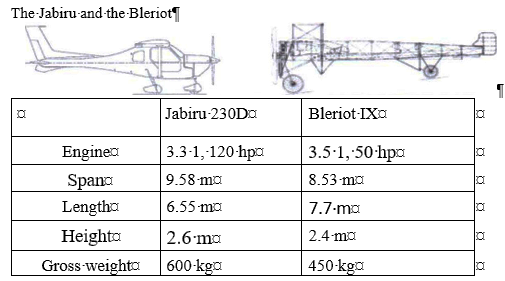
Drawings to approximate style.
The Preliminaries
Centenary of Guillaux’s first dieplay
The first public display given by Guillaux was at Newcastle, on April 25 1914 (not yet Anzac Day!). His aircraft was also the first to fly in Newcastle. This event was marked on 25 April 2014 by a flypast over Sydney and Newcastle by three Tiger Moth aircraft from Luskintyre Aviation Museum. The aircraft are depicted flying low over the Newcastle Showground, where the exhibition took place.
At the event there was considerable discussion of the mail re-enactment and it was decided to see if a relay of older aircraft could be formed to carry a commemorative cargo of philatelic material produced by Australia Post and emails were sent out asking for expressions of interest.
There was a great response. About 40 aircraft participated at various stages, and the relay mail was carried by a very interesting group of aircraft.
Flying boat centenary
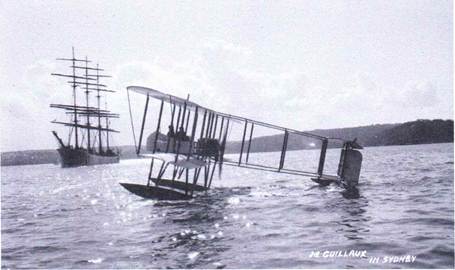
Guillaux was the first person to fly a seaplane in Australia when on 11 May 1914 he flew Lebbeus Hordern's Farman seaplane from Double Bay.
This was commemorated by the Seaplane Pilots Association of Australia on 8 May 2014 when 18 seaplanes flew over Sydney Harbour. They were led by SPAA president Phil Dulhunty in his Cessna, and several of the aircraft landed at Rose Bay for a brief commemoration at the Rose Bay Club. These two events were a good lead-up to the actual re-enactment, which occurred on July 12-14, 2014.
Cargo
In 1914, Guillaux carried 1785 specially made numbered postcards. In 2014, the Jabiru, the main re-enactment aircraft also carried 1785 cards, whose design was based on the originals. The Jabiru also carried messages from the vice-consul for France in Melbourne, the governor of Victoria, and the Lord Mayor of Melbourne to their counterparts in New South Wales. Noted Australian philatelist Mike Hill gave advice and generous assistance from the outset of the project.
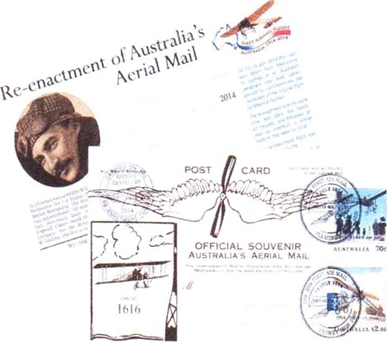
The Aviation Historical Society
of Australia (NSW) produced commemorative envelopes. These were also used for
postage from en-route stops.
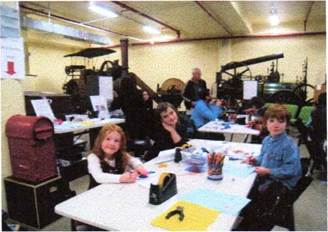
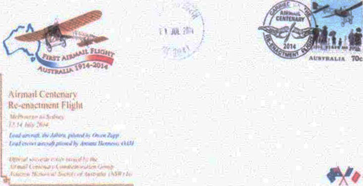
Australia Post philatelic services provided commemorative items: reproduction postcards, sample stamp folders and commemorative envelopes and by their 'in kind' assistance were a major sponsor of the project..
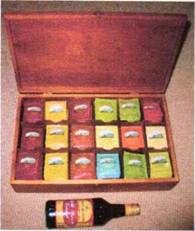 In 1914 Australia's first airfreight
was also carried: tea samples and OT fruit juice. Similar loads were carried in
1964.
In 1914 Australia's first airfreight
was also carried: tea samples and OT fruit juice. Similar loads were carried in
1964.
In 2014 the tea was provided by Madura Tea and the fruit juice is chili cordial, made by Murray Breweries of Beechworth, using the original OT juice process.
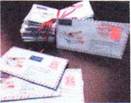
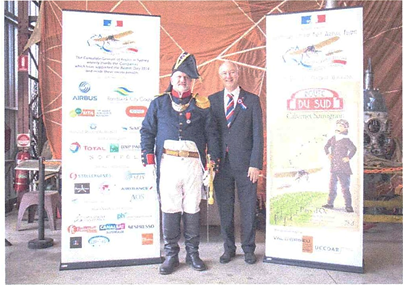
Below: Airbus envelope carried on re-enactment flight. Following the successful flight across the English Channel the Bleriot Xl was produced in large numbers. The Bleriot organisation became part of SNCASE (the aircraft factories in south-east France) in the late 1930s when the French aircraft industry was nationalised. In 1957 SNCASE proud ty sponsored by: merged with the south-western AIRBUS aircraft construction group SNCASO to form Sud Aviation, which produced the highly successful Caravelle jet aircraft and made design studies for the Caravelle 12, the precursor of the Concorde. Sud Aviation became a major part of Aerospatiale, which in turn became part of Airbus Industrie. Thus, in supporting the re-enactment, Airbus was continuing a long association with Bleriot.
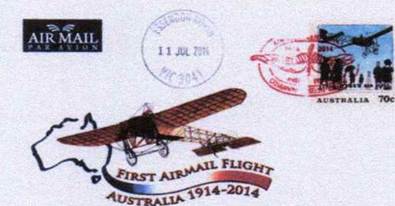
TOTAL Australia was a major
sponsor. Total was active in the Australian market as a supplier of petroleum products
in the 1960s and 1970s, and still retains a strong presence. TOTAL Oil
Australia supplies specialised lubricants TOTAL and is involved in renewable
energy through its subsidiary Suncorp, which is also active in Australia
Total's contribution funded most of the costs for our all-weather escort aircraft, itself essential to the safe and efficient running of the event.

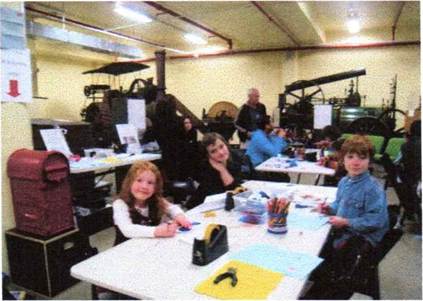 This aircraft also carried a very
special philatelic cargo: the Powerhouse Discovery Centre ran a wonderful
special aviation weekend on 14-15 June 2014, emphasising the centenary
re-enactment and other aspects of early Australian aviation history. As part of
this event, children were encouraged to write aerogrammes, specially produced
by the PDC. These were taken to Melbourne, where they were presented to the
Melbourne Lord Mayor, who placed a special seal on them before they were flown to
Sydney and mailed to the originators. Elsie, Lang and Nice were among the aerogramme
writers at Castle Hill PDC and Joseph, Marcus, Brianna and Sophia handed the
letters to Lord Mayor Robert Doyle.
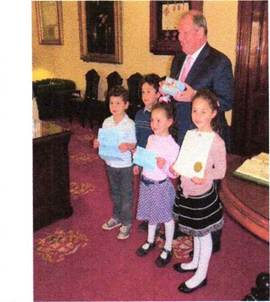
This aircraft also carried a very
special philatelic cargo: the Powerhouse Discovery Centre ran a wonderful
special aviation weekend on 14-15 June 2014, emphasising the centenary
re-enactment and other aspects of early Australian aviation history. As part of
this event, children were encouraged to write aerogrammes, specially produced
by the PDC. These were taken to Melbourne, where they were presented to the
Melbourne Lord Mayor, who placed a special seal on them before they were flown to
Sydney and mailed to the originators. Elsie, Lang and Nice were among the aerogramme
writers at Castle Hill PDC and Joseph, Marcus, Brianna and Sophia handed the
letters to Lord Mayor Robert Doyle.
 |
French vice-consul Mr Jean-Paul Esnault handed Owen Zupp a message for M Berti, the Consul-General in Sydney.

The 2014 re-enactment
Aircraft flying the whole journey: Jabiru and Cessnas:
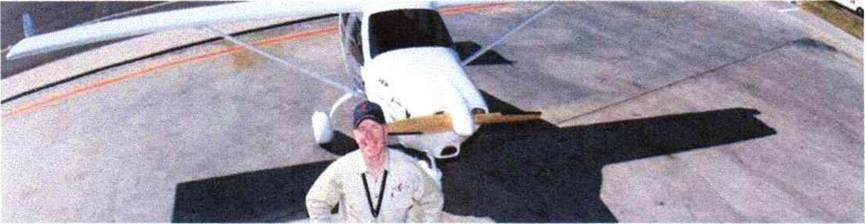
Owen Zupp flew Jabiru 230D
24-8503 with the load of the Bleriot: 1785 postcards, tea samples and fruit juice,
and official messages from the Melbourne French consul, Mayor and the Victorian
Governor to their counterparts in Sydney. This aircraft was supplied and fully
funded by Jabiru Aircraft of Bundaberg and flown to Melbourne by their pilot
Nasser Abdul. The weather was very marginal; Nasser stopped at Narromine
overnight and was able to fly on to Melbourne on Friday 11 July. When the
aircraft reached Sydney, Nasser flew it back to Bundaberg, arriving on Tuesday
15 July, a round trip of almost 5000 kilometres. The Jabiru is cutting-edge
technology, designed and built in Australia. Unladen, it weighs only 336
kilograms, but it cruises at about 120 knots and carry loads of up to 700 kg.
It is a world leader in its class, and the contribution of Jabiru aircraft was
essential to the project.
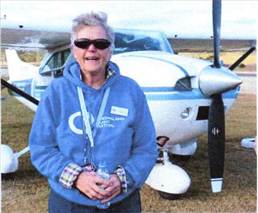
Aminta Henessy OAM is one of Australia’s
most skilled and respected Australian light aircraft pilots. She has flown from
USA to Australia on over 30 occasions and has been responsible for many public
education programs to reduce fear of flying. She flew to Melbourne on Thursday
10 July, in very bad weather conditions, landing at Wagga en route. It was
planned that if bad weather delayed the Jabiru Anita could carry the mail.
Jacki Milroy and Amy Crevola flew Jacki’s Cessna 172 XH-XOL for the whole journey. Jacki is the Chief Flying Instructor of Osprey Aviation Services at Teralgon, Victoria, and their journey was self-funded,
A fourth aircraft, Cessna 177B VH-WNM, belonging to Paul McGuire and flown by Matt Segafredo was unable to reach Melbourne because of the weather conditions and had to withdraw from the flight.
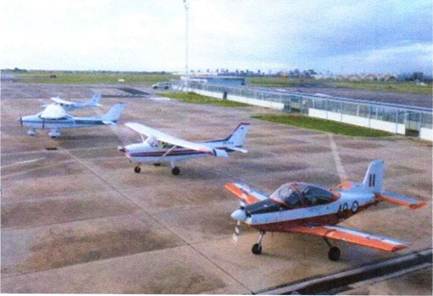
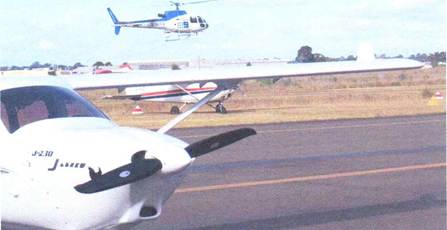
The aircraft leaving Essendon:
CT-4 of Michele Schiffer, carrying the Australia Post mail, Jackie Milroy's
Cessna, Aminta Hennessy's Cessna leading the way to check weather conditions
and carrying the PDC children's aerogrammes, Owen Zupp in the Jabiru carrying
the replica postcards, the symbolic cargo, and the official messages, at the
rear.
The aircraft relay.
A series of historic and general light aircraft carried the Australia Post commemorative mail, envelopes for the French sponsors and for AHSA These aircraft collected outward mail from all stops en route, and delivered inward mail for Harden as described later.
Melbourne to Seymour (Mangalore)
(1914: Flemington Showgrounds, Melbourne, to Jordan's Paddock, Seymour; 1964: Essendon airport Melbourne, to Mangalore airport, Mangalore, 2014: Essendon to Mangalore).
Owen Zupp Grave described his concern about the weather. ‘Mark Carr from Benalla emailed on the day before the flight: The weather for tomorrow (Saturday) is not looking great. Scattered showers, strong winds and possible hail. The other problem is the grass runways at Benalla are probably too wet so it's the east-west runway only. Owen Zupp in his online blog also describes his fears but during the night of the 11th things seemed to improve.
I stirred in the darkness and the green glowing numbers on the clock confirmed that it was 1 am. I rolled back and stared at the invisible ceiling as the drops continued to patter, but not pelt, upon the roof. I drew out my iPad and checked the weather yet again, but the prediction remained the same. Although the jagged blue line of cloud and rain was speeding across the map of the region and offered more hope than the endless lines of meteorological text. Maybe, just maybe....’
In the event we were delayed only about half an hour. At each stop on the first day we had concerns but the weather seemed to clear in front of us. Our departure was covered by ABC TV, Channel 9 and Channel 39. Members of AHSA (Victoria) and the French vice-consul were on hand to give support.
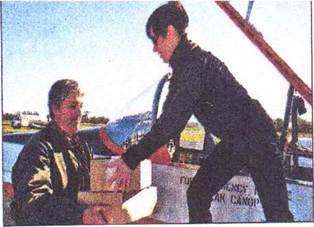
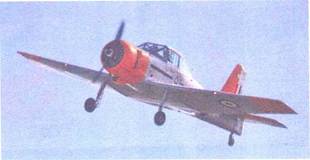
Unloading: Winjeel pilot Mark
Carr receives the Australia Post cargo from Michele Schiffer who piloted the
plane pictured, an ex-RAAF training aircraft, the CT-4.
The first leg in the relay was flown by Michele Schiffer in her ex-RAAF Pacific Aerospace CT-4, formerly A19-049, now VHPTM. Michele is a research fellow in genetics at Melbourne University with a passion for flying. She and her mother Irene joined the re-enactment until Wagga. They then returned to the aircraft's base at Lilydale.
Guillaux landed in a paddock near the centre of Seymour, and our first leg ended at nearby Mangalore airport. This was intended to be a quick handover to the next aircraft, but Lyn Bradbury of nearby Avenel heard about the visit and took matters in hand. Her fellow church ladies laid on a fabulous country morning tea, very welcome after our early start. We also met the Mayor of Seymour and local media: the Telegraph provided the pictures for this section.
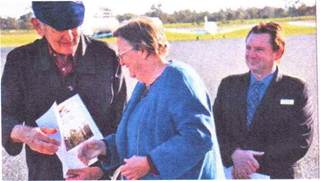
The relay mail was handed over
to Mark Carr, in his CAC Winjeel VH-CZE for the flight flew it to
Benalla.
Seymour — Benalla - Wangaratta
(1914: Jordan's paddock Seymour to Sisley's paddock, Wangaratta; in both centres the Bleriot was the first aircraft to visit, and created a sensation; on to Albury race track where Guillaux had performed on 23 May 1914. 1964: Mangalore to Wangaratta, with heavy rain and muddy conditions at Wangaratta, then on to Albury.)
2014: Mangalore to Benalla, Benalla to Wangaratta
Benalla was not visited in 1914 or in 1964, but is now a major centre for light aviation with a thriving aviation museum at the airport, very close to the town centre. President Terry Kay and the members of the museum were all prepared for our arrival and the aircraft were soon lined up outside the museum where a crowd of a few hundred people was gathered.

Mark Carr's Moth Minor was also
on display, so we had three generations of RAAF training aircraft on hand.
An interesting exhibit was the 1930s French-designed pou de Ciel, 'Flying Flea’., a1930’s attempt to make a popular light aircraft. Terry and museum volunteers had lifted it down from its display point in the hangar ceiling
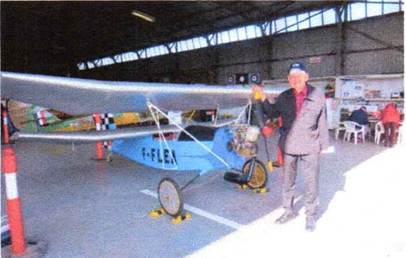
.
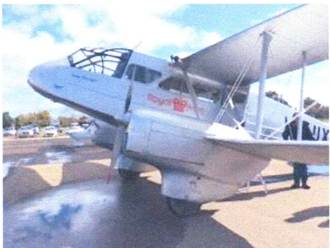
We were also joined by VH-UKZ,
a de Havilland Dragon Rapide of 1930s design. Lovingly restored to as new
condition by Maurice Rolfe, and flown by John Williamson, this eight-passenger
biplane airliner was a glamour aircraftof the re-enactment, right down to the
‘Royal Mail” logo on the fuselage.
Benalla to Wangaratta
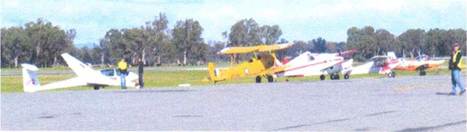
The relay mail was handed over to Mark Siacca, to fly a Schleicher ASK-21 sailplane to Wangaratta. Benalla was host to the 2016 World Championship in gliding.
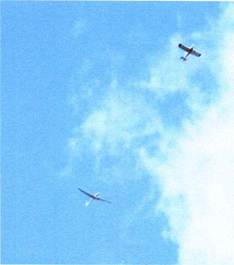
Weather was still a concern,
and when we took off for Wangaratta it seemed that the Rapide would not be able
to land at Wangaratta because of high cross winds. The escort aircraft, the
glider and the Jabiru landed, and again, despite the cold conditions, a big
crowd was there to welcome us. The Rapide made a couple of low passes, and
pilot John Williams decided that landing would be safe and landed, to the
cheers of the crowd. After a warm welcome and a great barbecue lunch we moved
on.
Wangaratta to Albury
(1914: Guillaux did not need to land at Albury, only 45 miles from Wangaratta, but wanted to meet again his compatriot Alderman Frere. There was a huge crowd to greet him, and after a quick lunch he left Albury for Wagga at 1 35pm on the first day of his flight. 1964: The Wangaratta mud was washed off the three Victas now present; and the group stayed in Albury overnight).

The relay mail was loaded on
the Rapide and after a very welcome barbecue, we flew on to Albury for an
overnight stop.
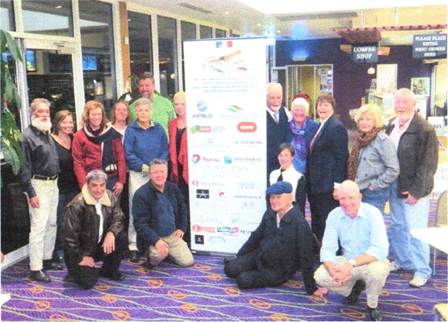
Members of the Albury Aero Club
were there to meet us and aircraft were fuelled and tied down for the night. We
had evening meal with Albury historians and aviators.
Weather was still threatening to disrupt the timetable. We stayed overnight at the Thurgoona Country Club and enjoyed dinner with Albury historians and aviators.
Albury to Wagga Wagga
(1914: Guillaux flew over Culcairn and Henty, following the railway; a hoaxer had phoned and told the authorities that he would land there, and preparations were made accordingly, but he flew on. At Wagga Wagga, seeing a large crowd at a racecourse, he landed, only to find that it was the wrong racecourse, and he had landed during a race meeting. Quickly moving to the correct racecourse, he refuelled and flew on. 1968: A far more orthodox flight, greeted at Wagga by a large crowd; Vic Walton signed many autographs).
Our early departure from Albury next morning was delayed by fog. The relay mail remained on the Rapide, and we flew to Wagga Wagga. Both the Jabiru and the Rapide made orbits over Henty and Culcairn.
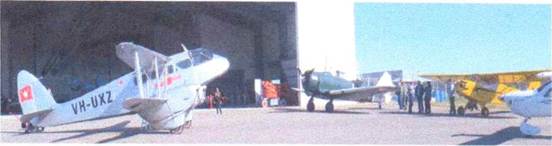
The Dragon Rapide, Wirraway and
Piper Cub at Wagga Wagga; Jabiru on the right.
In Wagga Wagga, Tony Middleton had organised our welcome, and again a big crowd was present.
As well as people interested in aviation, media people and historians, the local Alliance Francaise was there in strength. As the Rapide drew in to the Douglas Hangar, which Tony had taken over for the occasion, the Alliance Choir serenaded us with the Marseillaise.
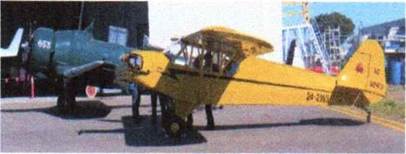
We then had a morning tea of French pastries while everyone looked over the aircraft display. David Middleton's Airco of 1950s vintage was joined by aircraft from Temora Aviation Museum — Wirraway VH-BFF, formerly of 5Squadron RAAF, a veteran of World War Il, and the museum's Piper Cub. The Cub design last year celebrated its 75th anniversary.
Wagga Wagga — Temora - Harden
(1914: Guillaux left Wagga Wagga for Harden at 3 30 pm, hoping to fly on to Goulburn that same day. Landing at Harden at 4 06 pm, he endeavoured to fly on to Goulburn but was forced back by bad weather. He had to remain at Harden, a small farming / railway town, for all the next day. He gave an aerial display and took three people for flights. 1964: A fourth Victa, carrying a Lipton Tea executive, joined the reenactment and again the aircraft flew direct from Wagga Wagga to Harden. Stan Brady, who had been one of Guillaux' three passengers in 1914, was taken for a flight in Vic Walton's Victa. The Victa flight then flew on to Goulburn.)
2014: At Wagga, Michele Schiffer and her CT-4 left us to return to Lilydale, its base near Melbourne, and the Rapide left to return to its base at Tocumwal.
The remaining five aircraft flew on to Temora, where a small but enthusiastic crowd met us and a welcome lunch was served.
Temora was included in this re-enactment because of its wonderful Aviation Museum and the enthusiasm of its director, Kenny Love.
Wagga to Temora

The relay mail was stowed in the
Wirraway. It was necessary to tie it carefully to the floor of the fuselage, as
the exposed control cables could be easily jammed by moving packages.
Temora to Harden
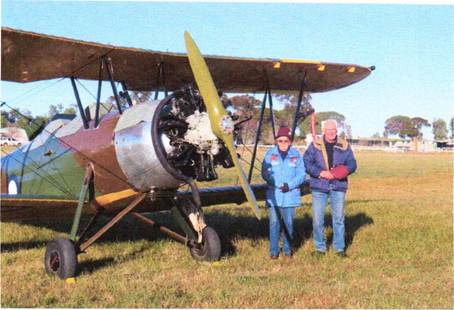
Clin Ashton-Martin and his wife
Barbara Pearce were at Temora to meet us with their wonderful Avro Cadet
biplane trainer of 1930's vintage. The RAAF had acquired 34 of these early in World
War Il, but it is thought that only two remain. This rare survivor had been
preserved by Sid Marshall of Bankstown, responsible for the preservation of
many exciting aircraft. Clin and Barbara have completely reassembled it and
restored its RAAF livery. The relay mail was loaded in the Cadet for the next
leg to Harden. This included a unique package: letters to Harden. This had been
organised by Harden postmaster Ross Pollock. 26 AHSA envelopes were carried from
Essendon to Harden, and they were all signed by the three main pilots.
Kenny Love, director of the Temora Aviation Museum, also joined in this leg, flying the museum' Piper Cub.
Ojars Balodis, a plastics manufacturer and former racing car driver who lives at Mount Eliza, Victoria, joined the flight in Benalla and flew with the reenactment to Harden in his Piper PA-24.
Harden overnight stop
Guillaux had stayed in Harden for two nights in 1914 because of bad weather. He had reached Harden on the first day but was unable to continue to Goulburn the following day. He stayed at the Carrington Hotel, which was also our resting place for the night.
The population of Harden Shire is about 5000 and certainly over 1000 were there to greet the 2014 mail flight.
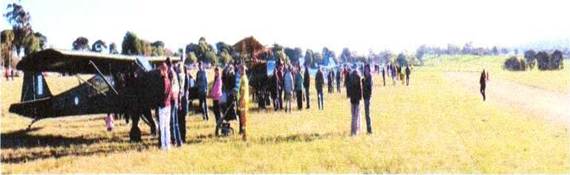
Thirteen aircraft landed at the
airstrip, which doubles as polo field and showground. Car clubs, model aircraft
clubs and many other local groups had gathered. The local SES and Bush Fire
Brigade were in charge of security, and nothing seemed to have been overlooked.
Shire workers controlled the runway where it crossed an access road and Colin
Southwell took it on himself to stay overnight at the airfield.
The crowd came on to the airfield area to meet the aviators and to look at the aircraft. These included the Poulettes, three aircraft of the formation flying group of the Canberra Aero Club with their camera aircraft, who were to take the relay mail on to Goulburn.
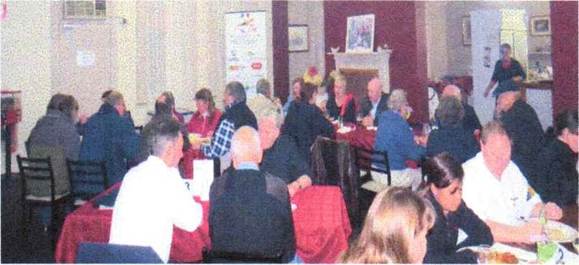
A general invitation had
been issued for any interested people to join the aviators at dinner at the
Carrington, and the dining room was full with members of the strong local
history society and people interested in aviation. During the evening French
Consul-General Eric Berti rang from Sydney to pass on his good wishes and in
return the dinner group, led by the Canberra aviators, sang the Marseillaise to
him, with great enthusiasm if not with complete accuracy in terms of melody and
words.
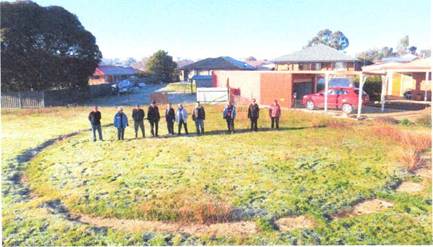
Lorraine Brown and other
historians took us to see a concrete circle in the grounds of the local High
School that marked the landing ground in 1914. This is not widely known outside
Harden.
We then headed to the airfield, only to find that the aircraft were covered with a couple of centimetres of ice as a result of the heavy frost.
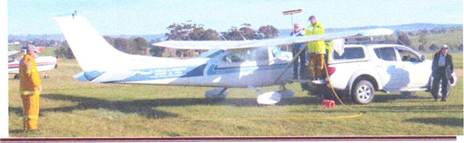
The aviators set to work to
clear the ice and almost by magic the local bush fire brigade materialised to
assist, and with the aid of their hoses, the aircraft were soon clear of ice
and we were on our way.
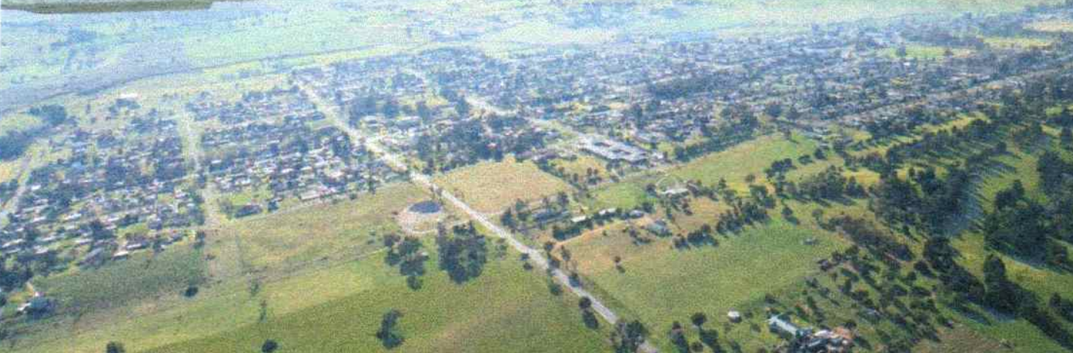
Above: the twin towns of
Harden-Murrumburrah.
Harden to Goulburn
(1914: Guillaux had tried to fly to Goulburn on the afternoon of 17 July, but again was driven back by bad weather. The following morning he left Harden at 715 am and reached Goulburn two hours later. The morning was cold, with a strong headwind, and he rushed to the beacon fire at Goulburn racecourse to warm himself. 1964: the re-enactment personnel stayed overnight at Goulburn, enjoying the company of the members of the local aero club.)
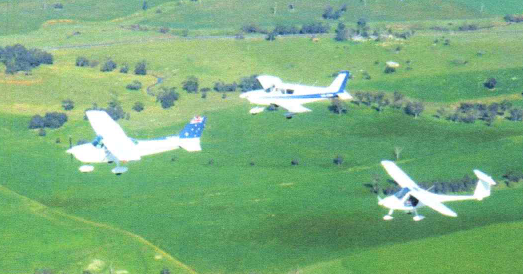
The relay mail was carried by
the Poulettes, the formation group of Canberra Aero Club. Les Sullivan, Phil
Allen and Brian Olson flew in the formation with Rob Terzi flying the camera
escort for this leg. Conditions were ideal, and the formation flew over towns
enroute before landing at Goulburn.
The Goulburn airport was taken over by John Ferrara in 2011, and is presently under considerable development.
The Celebrate Goulburn Group (inc) is a volunteer group of history enthusiasts who organised a group of pre-World War I cars to meet the reenactment, along with many people in 1914 clothing, led by Lorraine and Gil Whitehouse.
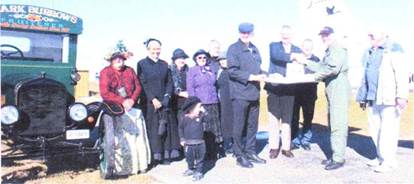
In this picture can be seen
Jean 'Queen of the South' Tebay, Jean Townsend, Loraine Whitehouse, Pat
Spilspury, Airport owner John Ferrara, Cr Carroll James, Airmail Centenary Commemoration
Group's Tom Lockley, Cr Geoff Kettle, Alan Caldow of Goulburn Public School,
pilot Owen Zupp, and Bob Flanagan. Front: Oscar Townsend. Photo: Chris Clarke,
from Fairfax newspapers, forwarded by Roger Macdonald of Summit Sun.
Goulburn racecourse, where Guillaux landed in 1914. The picture below is held at the Rocky Hill Museum, Goulburn and shows the scene in 1914. The three people in the centre of the picture are (left to right) David Baxter of Baxter's shoe factory, the Mayor of Goulburn (Alderman Betts) and Guillaux himself.
Goulburn — Mittagong - Sydney
(1914: Guillaux left Goulburn at 11 05 am and planned to land at Moss Vale. However he could not find the airstrip andflew on. He landed at Liverpool, had a leisurely lunch, andflew on to land at Moore Park at 2 55 pm, half time in the football, where he was met by a huge crowd including the NSW Governor and other dignitaries. 1964: The Victas flew to the now defunct airstrip at Hoxton Park, then on to Kingsford-Smith airport to arrive at 2 55 pm along with a QANTAS Boeing 707 aircraft that made a record-breaking flight from Melbourne)
In 2014 it was decided to reinstate a landing near Moss Vale, at the Berrima Aero Club grounds near Mittagong, then to fly on to Bankstown airport.
Goulburn to Mittagong
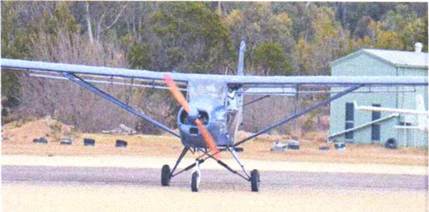
The relay aircraft for the flight
to Mittagong. was a Skyfox Gazelle, another Australian-designed and
Australian-built light aircraft. The pilot was Nathan Wilson. The leg was
undertaken in perfect conditions and the Berrima Aero Club members were fully
prepared for the mail handover. The aero club has taken over the wartime
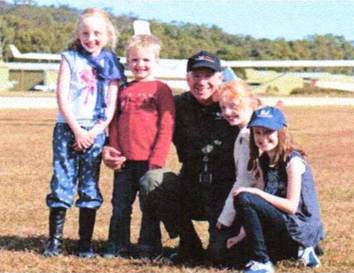
airfield at Mittagong and is home to some very interesting aircraft. Owen Zupp,
pilot of the Jabiru, lives locally and arranged the events of this stop. He presented
a memento of the occasion to Aero Club president Mark Willard and was greeted
by his children,
Mittagong to Bankstown
The relay mail was carried to Bankstown in two very significant aircraft.
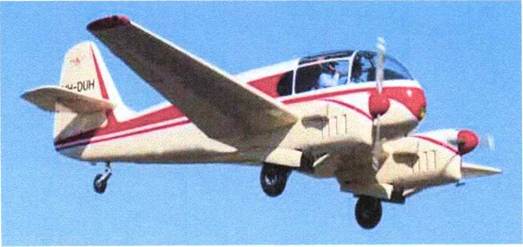
Aero 145, VH-DUH was a Czechoslovakian
aircraft imported in the early years after World War Il when we were not able
to buy American aircraft. It is an elegant four-passenger aircraft of
streamlined construction. This example has been fully restored and is based at
Mittagong. The pilot was Chris Byrne.
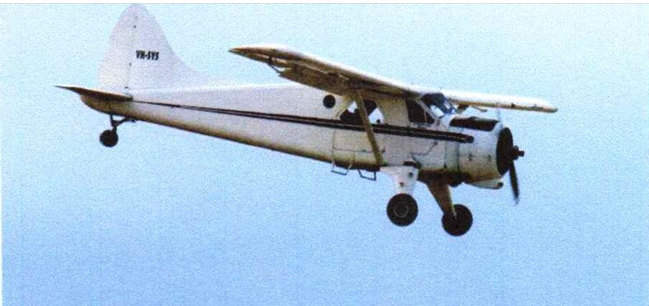
Sy Alsepp flew VH-SYS, his Canadian-built
DHC-2 Beaver, an aircraft of similar vintage, but made for far more rugged
service. These aircraft were used in the Snowy Mountains Scheme and also in
various Antarctic expeditions. The aircraft arrived at Bankstown about 2 30 pm
and assembled at the hangar of Clamback and Hennessy. The arrival at Bankstown
was covered for TV by ABC and by Channel 9.
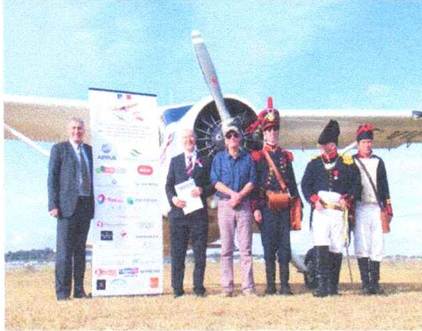
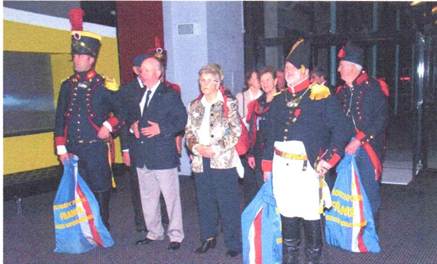
The aircraft were met by French
Consul M Eric Berty, representatives of the French sponsors and the Sydney
branch of the Republican Guard, resplendent in their traditional uniforms.
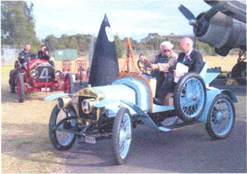
Geoff Simmons of Georges Hall
used his 1904 Delage car to the nearby Australian Aviation Museum.
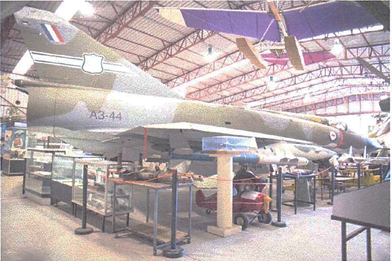
Australian Aviation Museum, Bankstown
Bankstown Museum's Dassault Mirage fighter, French designed and built in Australia in the 1960s.
M Berti, French Consul-General and bodyguard...
The museum at Bankstown
provided a welcome for the aviators and an excellent lunch, organised by AHSA
committee members Paul and Christine Ewoldt. Many members of the
French-Australian community attended, as well as people from the aviation
community and historians. One of many honoured guests was Phil Dulhunty, whose career
in aviation — and in electrical engineering — has lasted for seventy years. He
has been involved in many areas of aviation, especially in the field of
seaplanes, he was responsible for the importation of the Aero 145 and other
Czech aircraft.
The Bankstown museum has been under threat of closure for some years, as its valuable site is being taken over to provide for Sydney yet another shopping centre. But this event was clear evidence that the museum is rising above all the difficulties it faces.
To the Powerhouse Museum
A fleet of French cars from the Citroen, Peugeot, Simca and Renault car clubs (organised by Paul Playoust) delivered the mail packages, and the aviators, to the Powerhouse Museum at 6 30 pm, where the traditional Bastille Day reception was being held.
The usual
diplomatic guests were joined by aviators and aviation historians, and the mail
and the aviators were escorted to the stage by the Republican Guard. The
official messages were handed over to the recipients (the 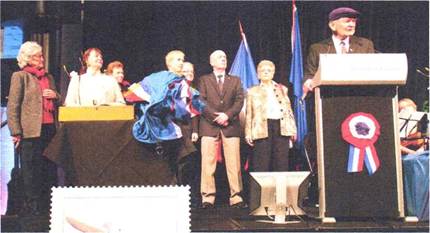
French Consul-General and
representatives of the New South Wales Government and the Lord Mayor of Sydney)
and the French sponsors were introduced and thanked.
The original Bleriot Xl which was
used by Guillaux is on display on the area which was used for the reception.
It is certainly one of the
world's aviation treasures: there are certainly fewer than thirty aircraft of
pre-World War I vintage preserved throughout the world, and few of these have
performed such an amazing feat.
Disposal of the mail
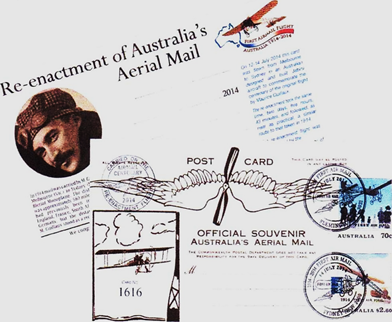
All the commemorative mail was sent out on 18 July, the exact hundredth anniversary of the original flight. This comprised the postcards that had been sold in advance, and several hundred letters that had been picked up en route.
The postcards were enclosed in special commemorative folders. These, and most of the other material used for publicity, were produced by Juanita Franzi, Australian aviation artist of world repute, and a member of the commemorative flight planning committee.
Also on that day Mme Fleur Pellerin, the French Trade Minister, M Berti and the French sponsors were thanked at a reception held in Mme Pellerin's honour.
The distinguished French guests who represented the sponsoring organisations received postcards numbered from 5 to 10 to mark the outstanding contribution of the French community.
A brief summary
The 1964 re-enactment was very successful, and involved four Victa Airtourers.
The 1989 re-enactment was undertaken by a commercial airliner as part of their normal schedule.
But we believe that the 2014 flight was the largest event of its type that has been undertaken in Australia.
Another striking feature of this re-enactment was the comparatively small cost. The spectacular result was made possible by a combination of several vital factors. Dick Smith gave a very early donation which enabled our website shop to be set up; philatelic enthusiasts purchased postcards in advance, enabling our communications and publications to proceed; M Berti, the French Consul-General in Sydney, mobilised the French business community to provide the basic expenses of the re-enactment and was a constant source of assistance.
But by far the most significant input was that of the aviation community and the local groups that hosted various aspects of the event. Jabiru aircraft of Bundaberg provided the main re-enactment aircraft, and the relay aircraft were almost completely funded by the aircraft owners.
To all these people go the thanks and appreciation of the organising committee, the Airmail Centenary Commemoration Group of the Aviation Historical Society of Australia (NSW) Inc. The principal members of the committee were (in alphabetical order) Anthony Coleiro, technical consultant, Christine Ewoldt (philatelic manager) Paul Ewoldt who handled media liaison, Juanita Franzi of Aero Illustrations, Tom Lockley (secretary), Judy Rainsford who organised many aviation aspects of the event, including the wide participation of AWPA members, and John Scott (history consultant).
An interesting sidelight has been a renewed interest in France in the activities of Maurice Guillaux. We made contact with his grandson Michel Guillaux, and have been assisted by a number of French historians. As a result of this increased interest, a new street in his home town of Montoire is to be named after him.
What next?
AHSA's aim in conducting this exercise was to increase awareness of Guillaux' activities in Australia, of Australia's remarkable aviation history, and indeed of the vibrant state of Australia's light and recreational aviation sectors. To an extent, this has been achieved, but more needs to be done. The photo on page 19 shows a marker of exactly where Guillaux' aircraft stopped at Harden and was previously undocumented outside Harden. This picture also emerged during the reenactment process, thanks to Martin Lang, and is believed to be taken at the same spot.
Over the next few months the story of the re-enactment itself will be collected in full detail and will be recorded on the website and in a 'coffee table' book. The small history booklet that was prepared for the flight will be upgraded to include the additional information that has been collected.
We still have a few hundred postcards and some commemorative envelopes. These may be purchased from the website www.australiasfirstairmail.com. Soon, cards numbered 1 to 4 will be sold, and also card no 1785. Other items will also become available. We hope to make a profit which will enable the placement of commemorative plaques inside many buildings associated with the exploits of Maurice Guillaux in Australia.
For more information, comments, criticisms and questions please email Tom Lockley at guillauxcentenarv@gmail.com.
Afterword
This is booklet is a basic report of the flight made by light aircraft from Melbourne to Sydney on July 12-14 2014 to commemorate the first airmail flight in Australia, made in July 1914 by visiting French airman Maurice Guillaux.
The title of this booklet pays homage to Fifty Years of Australian Air Mails, (1964) a booklet by the noted philatelist and historian Nelson Eustis, which has been freely plundered for material regarding the 1914 flight, and the 1964 flight was best covered by James Warrington's article in the August 1964 edition of Australian Flying.
Photographs used come from many sources, principally from Anthony Coleiro, Alan Campbell, Antony Grage, the French Consulate, Benalla and Wangaratta Aero clubs, Mottvs Aviation Photography (Luskintyre) and from newspapers including Seymour Telegraph, Gou/burn Evening Post, Chris Clarke, from Fairfax newspapers Mittagong, (forwarded by Roger Macdonald of Summit Sun), and The Harden-Murrumburrah Express and the Twin Town Times.
To all these people and others who have been inadvertently omitted, our thanks and appreciation.
ISBN 978-0-9803693-5-9
List of publications related to the flight:
Booklets:
· 50 Years of Australian Air Mails, HN Eustis, 1964: 400 'not for sale' copies printed by courtesy of his family. A few are still available.
· Maurice Guillaux — Pioneer French Aviator in Australia, a preliminary collection of the history of Maurice Guillaux, June 2014
· Australia's First Seaplane, May 2014, concentrating on the story of LebbeusHordern's seaplane as flown by Maurice Guillaux Participant Handbook for the re-enactment flight, written by Tony Coleiro, July 2014
· 100 Years of Australian Air Mails, (this booklet)
All these books have been hand-printed and are in limited supply. Some were carried on the flight and have been stamped with the official stamp.
Journal Articles
· Major articles in July 2014 Aviation Heritage (Journal of the Aviation Historical Society of Australia)
· The French Australian Review, no 56 Winter 2014. Reprints are available in limited quantities at no charge.
· Articles also appeared in many other aviation-related journals including the publications of AAAA, SPAA, AWPA, AOPA, MAAS and AAMB as well as daily newspapers.
· Owen Zupp wrote an excellent article printed in Australian Aviation, September 2014
Tom Lockley, tomlockley@gmail.com