Maurice
Guillaux…
Who
was he and why is he important?
 The
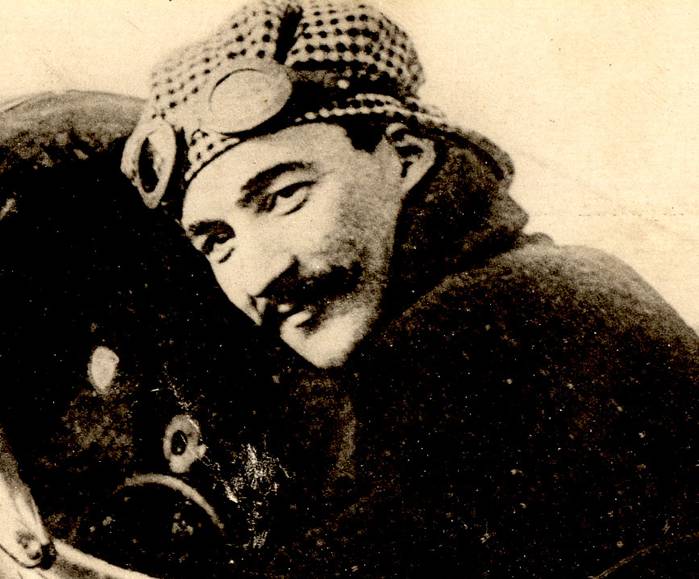
dashing, elegant aviator Maurice Guillaux was born in Montoire
in Central France in 1883. We know little of his early career, but by 1912 he
was famous as the chief pilot of the Caudron factory, giving many aerial
displays. He was successful in the Pommery Cup competition for long-distance
flying, but by 1913 the aircraft were doing up to 1000 km a day, and
measurement was difficult. The competition became less popular with the public.
The
dashing, elegant aviator Maurice Guillaux was born in Montoire
in Central France in 1883. We know little of his early career, but by 1912 he
was famous as the chief pilot of the Caudron factory, giving many aerial
displays. He was successful in the Pommery Cup competition for long-distance
flying, but by 1913 the aircraft were doing up to 1000 km a day, and
measurement was difficult. The competition became less popular with the public.
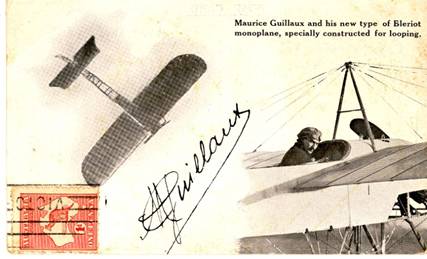
He then acquired a new Bleriot monoplane,
specially designed for ‘looping the loop’, a new and exciting feat. After a few
demonstration flights in France he and four associates left on a world trip,
aiming to make lots of money by giving flying displays.
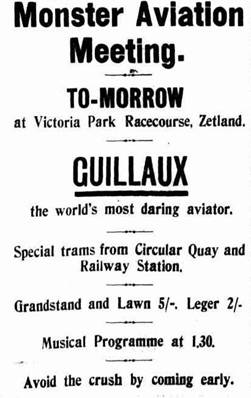 After a brief stop in Egypt, the team came
to Australia, landing in Sydney on April 4, 1914. He gave displays in Sydney
and Newcastle. In May and June he also performed in Melbourne, and regional
centres such as Wagga Wagga, Albury, Bendigo and
Ballarat. These displays were hugely successful: hundreds of thousands of
people paid to see him fly. Other pilots, including the American Arthur B
“Wizard’ Stone and the Australian Harry Hawker were clearly outclassed by
Guillaux.
After a brief stop in Egypt, the team came
to Australia, landing in Sydney on April 4, 1914. He gave displays in Sydney
and Newcastle. In May and June he also performed in Melbourne, and regional
centres such as Wagga Wagga, Albury, Bendigo and
Ballarat. These displays were hugely successful: hundreds of thousands of
people paid to see him fly. Other pilots, including the American Arthur B
“Wizard’ Stone and the Australian Harry Hawker were clearly outclassed by
Guillaux.
On May 13 ‘Wizard’ Stone announced plans to fly
mail from Melbourne to Sydney, with a flight date proposed ‘on or about’ 23
May. This was delayed until June 6, but on June 1 Stone crashed in Rockhampton,
Queensland, while racing against an automobile. He was injured and his aircraft
was badly damaged.
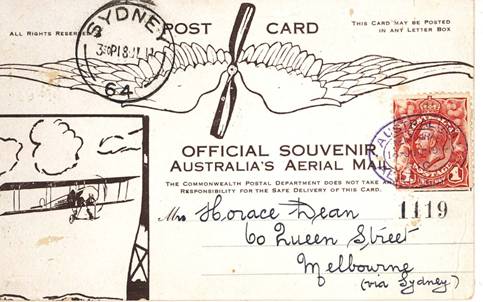 Guillaux too over the air
mail project. He took off on his journey from Flemington showgrounds,
Melbourne at 9 12 am on 16 July, 1914, and landed in fields at Seymour and
Wangaratta before entering New South Wales, reaching Albury racecourse at 12 50
pm. Here he had lunch with compatriot Alderman Frere
before flying on to Wagga Wagga and then to Harden at
4 06 pm. Trying to fly on, he was forced back by bad weather, In one day he had
flown about 1000 kilometres, giving aerobatic displays over each town to
entertain the huge crowds that greeted him at every stop.
Guillaux too over the air
mail project. He took off on his journey from Flemington showgrounds,
Melbourne at 9 12 am on 16 July, 1914, and landed in fields at Seymour and
Wangaratta before entering New South Wales, reaching Albury racecourse at 12 50
pm. Here he had lunch with compatriot Alderman Frere
before flying on to Wagga Wagga and then to Harden at
4 06 pm. Trying to fly on, he was forced back by bad weather, In one day he had
flown about 1000 kilometres, giving aerobatic displays over each town to
entertain the huge crowds that greeted him at every stop.
On 17 July he was again forced to return to Harden because of
weather, but on 18 July he was able to move on to Goulburn. This was a freezing
winter morning, for which Goulburn is infamous, and when he landed he rushed to
the beacon fire to thaw out. He flew on, missing a planned landing at Moss
Vale, but landing just behind the main street of Liverpool. After lunch with
the locals, he took off in time to arrive at Moore Park, in central Sydney, by
2 50 pm.
Here he was received by a huge crowd, including the
Governor-General. A band played the Marseillaise and he handed over his cargo.
There were 1785 postcards and special messages such as those from the Governor
and the French Consul in Victoria to their counterparts in New South Wales. A
packet of Liptons Tea and some OT lemon cordial were also carried; this was Australia’s
first air freight.
He was seated on the top of his aircraft, which was
controlled by bending the wings. This was, at the time, claimed to be the
longest air mail flight anywhere in the world and certainly this epic of
endurance, courage and skill ensured that he was the pre-eminent aviator of the
time in Australia.
Guillaux was not only active as a showman, but took an important
part in other aviation matters. Lebbeus Hordern, a member of the wealthy Hordern
family had purchased a Farman seaplane, and Guillaux
made many record-breaking flights in it, sometimes with rather attractive lady
passengers. He was involved in the development of the Ham Common airfield,
which is now Richmond RAAF base and gave advice to the fledgling Australian
Flying Corps. His 197 days in Australia had an enormous effect on Australian
aviation history.
By August, the news was dominated by the outbreak of war. On
2 August, Guillaux had a major crash, damaging his aircraft and injuring
himself. The aircraft was repaired, and Guillaux recovered in a few weeks, but
the time for flying displays was over. Guillaux returned to France on 22
October, as an aviator attached to the First Australian Division. He eventually
returned to France and was killed in an aircraft crash, while test-flying a new
aircraft, on 21 May 1917.
A re-enactment flight will take place in 2014, between
Melbourne and Sydney, using a Jabiru, a modern Australian lightweight sports
aircraft of similar weight and engine capacity to Guillaux’ Bleriot. The Jabiru
will be accompanied by a number of other historical aircraft and will follow
the route pioneered by Guillaux, with major celebrations at each stop. The
flight’s conclusion will be the centrepiece of Sydney’s Bastille Day
Celebrations.
To find out more, go to www.australiasfirstairmail.com .
Send your email address to guiillauxcentenary@gmail.com to receive the latest news on this event- and also early
advice of how you can purchase unique philatelic material.
If you have any suggestions, or you would like to help in any
way, please email guillauxcentenary@gmail.com