 Maurice Guillaux’ displays
in Sydney, 1914
Maurice Guillaux’ displays
in Sydney, 1914
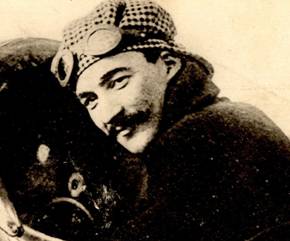
This is a
brief treatment of the aeronautical activities in Sydney (and Bathurst) of
Maurice Guillaux, French aviator who was in Australia from April to October
1914. His main feat was the carriage of Australia’s first official air mail
from Melbourne to Sydney, 16-18 July 1914. His contributions to Australian
aviation history are great, but because World War 1 broke out days after his
main flight, much of the story has been lost.
In this centenary year, a re-enactment of the air mail flight is occurring, and we are also taking advantage of the interest being shown to collect as much information as we can. If you can add to the story, please email guillauxcentenary@gmail.com.
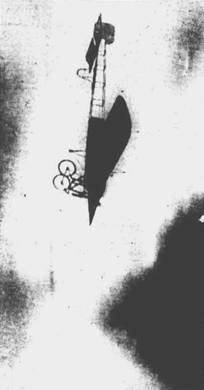
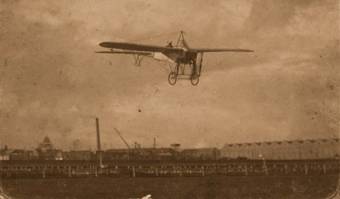 Picture: from the collection of the PowerHouse Museum, Sydney: Guillaux
flying over Victoria Park, his main Sydney venue. The museum also holds the original aircraft
used by Guillaux, one of the world’s great aeronautical treasures.
Picture: from the collection of the PowerHouse Museum, Sydney: Guillaux
flying over Victoria Park, his main Sydney venue. The museum also holds the original aircraft
used by Guillaux, one of the world’s great aeronautical treasures.
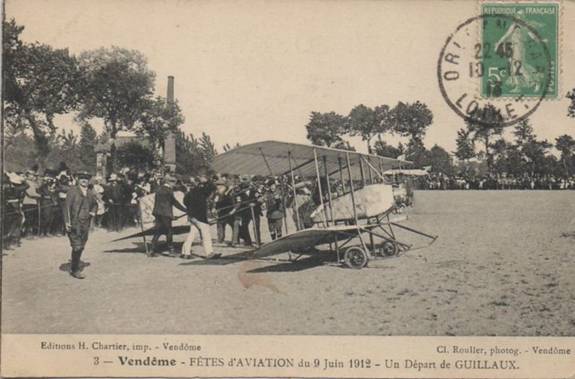 Certainly
Guillaux was a fine pilot. He had appeared on the French aeronautical scene
when awarded licence no 749 in France on 19 February 1912, at the age of 29. By
June 1912 he was a noted pilot for the Caudron factory,
as seen in the postcard. He moved on to become chief pilot of Clement-Bayard,
winning the Pommery Cup for long-distance flying and becoming one of the top
French pilots. This elite band was idolised by the public. However late in 1913
he was suspended from the long-distance flying completion because of a
discrepancy of his records. He purchased a new Bleriot XI, specially modified
for aerobatics, and set off on a world tour with the aim of making money.
Certainly
Guillaux was a fine pilot. He had appeared on the French aeronautical scene
when awarded licence no 749 in France on 19 February 1912, at the age of 29. By
June 1912 he was a noted pilot for the Caudron factory,
as seen in the postcard. He moved on to become chief pilot of Clement-Bayard,
winning the Pommery Cup for long-distance flying and becoming one of the top
French pilots. This elite band was idolised by the public. However late in 1913
he was suspended from the long-distance flying completion because of a
discrepancy of his records. He purchased a new Bleriot XI, specially modified
for aerobatics, and set off on a world tour with the aim of making money.
He
and his associates, Messrs Rupeausseu, Maistre, Cominos, and du Coque, arrived
in Sydney on the Orontes on 8 April 1914.
We
know relatively little about his associates. Lucien Maistre was the son of a
former French vice-consul in Australia, and this may explain Guillaux’ team’s
choice of Australia as the first major stop on the proposed world tour. He is
listed in early newspaper reports as a representative of the Gnome engine
company. Rupeausseu is sometimes listed as ‘manager’. Even less is known of the
other two.
An
Australian entrepreneur seems always to have arranged events for visiting
celebrity airmen. One such was Arthur Rickard, a land developer responsible for
subdivisions from Woy Woy to Penshurst. He organised
events for the American Arthur Burr ‘Wizard’ Stone. Albert Sculthorpe, a
councillor of St Kilda, Melbourne, was ‘manager’ of Guillaux’ performances in
many places, the first record of this being The
Sydney Morning Herald of April 22.
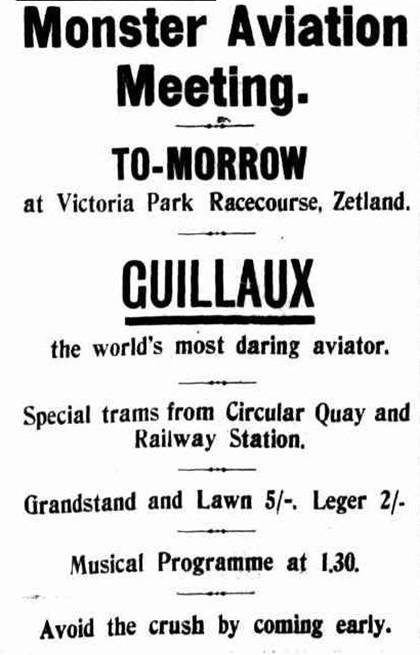
 The
assembly of the aircraft was a complex operation. We know that Guillaux was
very knowledgeable about the aircraft and had a ‘hands-on’ mechanic role. Obviously the
task was finished by Monday 21 April, when he gave an exhibition at Victoria
Park racecourse, which seems to have been his main base in Sydney at the time.
This was given to a small crowd, and was probably mainly a test flight.
However, ‘he looped the loop three times in succession, with the utmost ease,
and as coolly as though he were lighting a cigarette’, as described by the Herald
reporter. In his next flight he went for a tour of Sydney Harbour, flying
through the heads. Among those who congratulated him after the flights was W S
Hart, a pioneer Australia aviator,
The
assembly of the aircraft was a complex operation. We know that Guillaux was
very knowledgeable about the aircraft and had a ‘hands-on’ mechanic role. Obviously the
task was finished by Monday 21 April, when he gave an exhibition at Victoria
Park racecourse, which seems to have been his main base in Sydney at the time.
This was given to a small crowd, and was probably mainly a test flight.
However, ‘he looped the loop three times in succession, with the utmost ease,
and as coolly as though he were lighting a cigarette’, as described by the Herald
reporter. In his next flight he went for a tour of Sydney Harbour, flying
through the heads. Among those who congratulated him after the flights was W S
Hart, a pioneer Australia aviator,
The following Saturday, 25 April, he gave a
performance at Newcastle, then returned to Sydney. He
flew over Sydney on Friday 1 May, attracting huge interest, and held a
well-advertised public performance on Saturday 2 May.
The
Sydney Sunday Times described the event:
‘Guillaux was fully 800feet above the
earth, and dipping the nose of the monoplane, he MADE A SENSATIONAL DESCENT
straight at the Vice-President of the Executive Council (Mr Flowers), the Lord
Mayor (Alderman Richards), and a group of pressmen. Mr Flowers looked up, and
seeing the monoplane coming towards him at a terrific rate, caught hold of a
little boy who accompanied him, and together with the Lord Mayor beat a hasty
retreat. Guillaux, however, swerved upward when within 30 or40 feet of the
ground, and relieved Mr Flowers' feelings. Climbing steadily, Guillaux circled
the course several times. Once, when he was at the southern end, he tilted the
machine and rushed downward in a bee-line for the hundreds of people who had
congregated on the sandhill there. Most of them thought the airman welcoming to
grief there and then, also a number of themselves, for THEY FLED PRECIPITATELY.
Guillaux, however, righted the machine within what appeared to be a few feet of
the side of the sandhill, and flew away. Setting the nose of the machine upward
again, the Frenchman rose until there were fully 1500feet between him and
mother earth. He dipped the nose of the machine downward, and descended at a
terrific rate of speed, giving one the impression that he was falling. He was
too— for several hundred feet — but righted himself again gracefully, and
soared aloft.
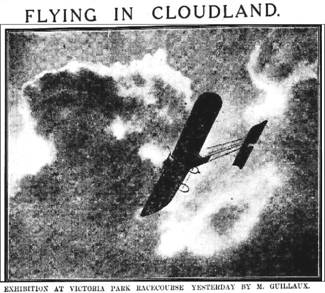 The Frenchman's next feat was what the crowd
had been anxiously waiting for — the loop-the-loop, and he executed the
dangerous manoeuvre at a height of about 2000 feet, where he was in full view
of the spectators. Heading in the direction of the grandstand the little yellow
machine suddenly turned a complete somersault. The roar of applause that broke
from the crowd was deafening. A second or two later it broke out again as
Guillaux looped the loop for the second time.. There
were spiral descents, volplanes, banking and fish-like movements until he
reached the straight, along which he flew at a RATE OF 71 MILES AN HOUR
receiving the plaudits of the spectators. He was smiling when he started on the
first aerial journey, and he was smiling when he landed, 25minutes later.
The Frenchman's next feat was what the crowd
had been anxiously waiting for — the loop-the-loop, and he executed the
dangerous manoeuvre at a height of about 2000 feet, where he was in full view
of the spectators. Heading in the direction of the grandstand the little yellow
machine suddenly turned a complete somersault. The roar of applause that broke
from the crowd was deafening. A second or two later it broke out again as
Guillaux looped the loop for the second time.. There
were spiral descents, volplanes, banking and fish-like movements until he
reached the straight, along which he flew at a RATE OF 71 MILES AN HOUR
receiving the plaudits of the spectators. He was smiling when he started on the
first aerial journey, and he was smiling when he landed, 25minutes later.
‘........
The second exhibition occupied 30 minutes.......... even more daring than the
first, for, besides looping the loop so often that one lost count of the number
of times he executed this movement, the Frenchman turned his machine over and
flew for a considerable distance upside down — a feat that requires the
greatest courage and technical skill.
 ‘At the conclusion of the last
flight Guillaux flew along the straight. The machine was below the level
of the fence, and as it sped along prior to coming to a halt there was a mighty
and unanimous shout of 'Hooray, Guillaux,' which completely drowned 'See
the Conquering Hero Comes,' which the band was discoursing. Between his
flights Guillaux was presented to the Governor, Sir Gerald
Strickland. A leading French lady of Sydney also presented him withal
magnificent floral tribute’.
‘At the conclusion of the last
flight Guillaux flew along the straight. The machine was below the level
of the fence, and as it sped along prior to coming to a halt there was a mighty
and unanimous shout of 'Hooray, Guillaux,' which completely drowned 'See
the Conquering Hero Comes,' which the band was discoursing. Between his
flights Guillaux was presented to the Governor, Sir Gerald
Strickland. A leading French lady of Sydney also presented him withal
magnificent floral tribute’.
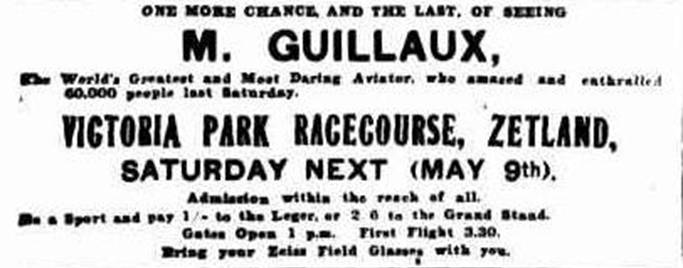
Guillaux
and his team were occupied the following week in assembling and flying Lebbeus
Hordern’s Farman seaplane, but he returned to Victora
Park for another display on May 9. This was advertised as ‘one more chance, and
the last of seeing M Guillaux, the world’s most famous and daring aviator, who
entertained 60 000 people last week’. The crowd figure might be exaggerated,
but an independent estimate of the 9 May attendance was 30 000, and the
aerobatics were as spectacular as previously. There was a rather frightening
incident: ‘for a
time he flow close to the earth. This was the most dangerous, though less
spectacular, of all his movements, and was nearly the cause of an abrupt
termination to the exhibition. He passed outside the grounds flying so low that
the chauffeurs in the waiting motor cars ducked their heads. A sharp turn to
the left, and he passed between the grand stand and
the leger. ... almost
instantly he crashed into the telephone wires drawn tight between the
buildings. One wire snapped at the point of impact and fell clear of the
machine, but the other broke some distance away and coiled over the right wing
as the machine headed for the flat. The wing did not free itself from the wire
until the second fence was reached’.
The
following week he moved south, giving displays at Wagga Wagga,
Albury, Melbourne, Bendigo, Ballarat, Adelaide and Geelong before preparing for
the Melbourne-Sydney mail flight early in July.
Moore
Park was chosen as the Sydney landing-place for this flight, and the timing –
3pm on Saturday 19 July – was made to suit the convenience of the football
crowd and the Governor and other dignitaries, who welcomed him. This was a huge
event: an enormous advertising campaign was launched for Liptons Tea and OT
juice, whose products were carried on the first flight as Australia’s first air
freight.
Another
performance was given on 25 July at Newcastle. On his return to Sydney it was
advertised that he was going to drop money over the city on behalf of Black and
White Whisky, but the authorities banned this activity.
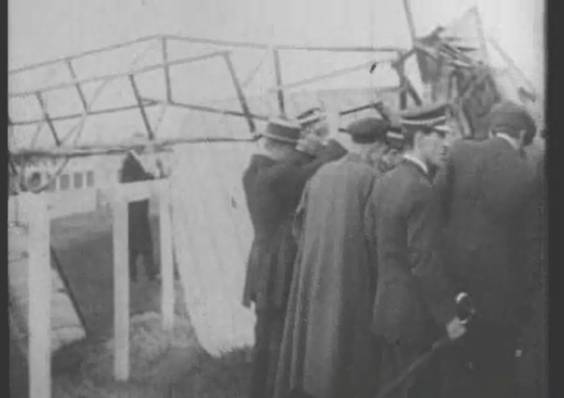 The next performance was
held at Ascot racecourse on Saturday 2 August. While flying at an altitude of
about 200 feet, the aircraft dropped on one side and crashed to the ground.
Guillaux was able to walk away from the badly damaged aircraft, but had bad
cuts to the face and head.
The next performance was
held at Ascot racecourse on Saturday 2 August. While flying at an altitude of
about 200 feet, the aircraft dropped on one side and crashed to the ground.
Guillaux was able to walk away from the badly damaged aircraft, but had bad
cuts to the face and head.
Scene from (very rare) film
footage of the crash at Ascot.
Thus the Evening News: ‘It was when he was immediately over the
grandstand that the accident happened. The centre of all eyes, the Frenchman
was noticed to bend forward and touch a lever, and on the Instant the large
machine, which was going at a fast rate, turned almost in its own length. .....
and as the
aeroplane canted over on its side many shouted out a warning to the intrepid
aviator. Evidently he realised the gravity of the occasion, and he bent forward
with his hand on one of the levers. It was too late, however, and still
travelling fast the machine dipped more and more on its side. The Frenchman was
noticed making frantic efforts to right his craft, but turning completely over It swooped like an arrow to the ground.
'
There were cries of horror from the crowd, but as the machine neared the
earth there was an ominous silence. Women turned away their heads and refused
to look, while a large number of the men seemed as if transfixed. Then' It
happened. With a crash and a hard thud, the machine struck the ground. That
broke the spell. Men rushed to the spot, and thronged round the fallen
aeroplane. Guillaux was lying In the midst of the wreckage, still strapped to
his seat, but he was bleeding profusely from a deep wound in the head, and
blood was streaming down his head and his clothing.......... He was evidently
unconscious to what was going on around him, and moaned and chattered in
French. Then the work of rescue was begun, but it was not as easy as would
appear. The unfortunate man lay entangled in a mass of broken wires and
splintered woodwork, but they were gradually cut away. At last, the rescuers
were able to reach him and he was carried tenderly out. By this time the whole
crowd had thronged round the spot, and as the Frenchman was lifted out they
cheered madly. The noise seemed to bring him back to his senses and he
struggled weakly on to his feet. This was the signal for the crowd, and cheer
after cheering out. Guillaux smiled, but be was scarcely able to stand. He
exhibited great self-possession, however, and conversed in a low tone with
those around him’.
Fortunately there were doctors present,
and Sir Alexander McCormack and Dr O'Gorman Hughes forced their way through.
They immediately bandaged the Frenchman as best they could with the means at
their disposal. He was severely cut about the heat and lower part or the body,
and appeared to be in great pain. He was placed in a waiting motor car and
hurried away to St. Vincent's Hospital, the crowd cheering wildly as the
machine moved down the ground.
Many theories were advanced as to the
cause of the crash, but nothing definite emerged.
Ascot
racecourse has long since been absorbed into Kingsford-Smith airport.
By
September 12 Guillaux and his machine were fit enough repaired to give a
performance at Bathurst. A new Australian managers had appeared, Messrs. MacCallum Bros, and Treacy,
represented in Bathurst by Mr R H Treacy.
Guillaux
spoke of his earnest desire to return to France, and of the importance that
aircraft would have in the war. The
description of the display indicated that both Guillaux and his repaired
aircraft were on top form, but there was no doubting that the enthusiasm for
flying displays was waning, as the war took all people’s attention. Lucien
Maistre had already left for France.
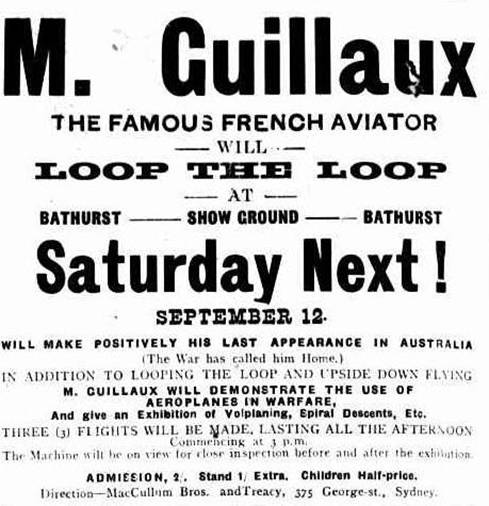 The Bathurst Times reported on a civic
reception given by the Bathurst Council. Guillaux was widely praised and
through a Mr A McLauglan, described as his business
manager, replied to the speeches, saying that Guillaux would shortly leave for
France. However, he wanted to return to Australia soon, obviously expecting a
short and victorious war.
The Bathurst Times reported on a civic
reception given by the Bathurst Council. Guillaux was widely praised and
through a Mr A McLauglan, described as his business
manager, replied to the speeches, saying that Guillaux would shortly leave for
France. However, he wanted to return to Australia soon, obviously expecting a
short and victorious war.
The
time for display flying was over. Guillaux sailed for Europe on 22 October as
an aviator attached to 1 Australian Division. He was killed in 1917 while
test-flying a new aircraft. He is recorded as a French-Australian casualty of
the war on the honour board in the French Consulate in Sydney.
A re-enactment flight will take place in 2014, between Melbourne
and Sydney, using a Jabiru, a modern Australian lightweight sports aircraft of
similar weight and engine capacity to Guillaux’ Bleriot. The Jabiru will be
accompanied by a number of other aircraft and will follow the route pioneered
by Guillaux, with major celebrations at each stop. The flight’s conclusion will
be the centrepiece of Sydney’s Bastille Day Celebrations.
To find out more, go to www.australiasfirstairmail.com .
Send your email address to guiillauxcentenary@gmail.com to receive the latest news on this event- and also advice of
how you can purchase unique philatelic material.
If you have any suggestions, or you would like to help in any
way, please email guillauxcentenary@gmail.com