Maurice
Guillaux…
Pioneer
of seaplane flight in Australia
 8
May 2014 will mark the centenary of the first seaplane flight in Australia.
8
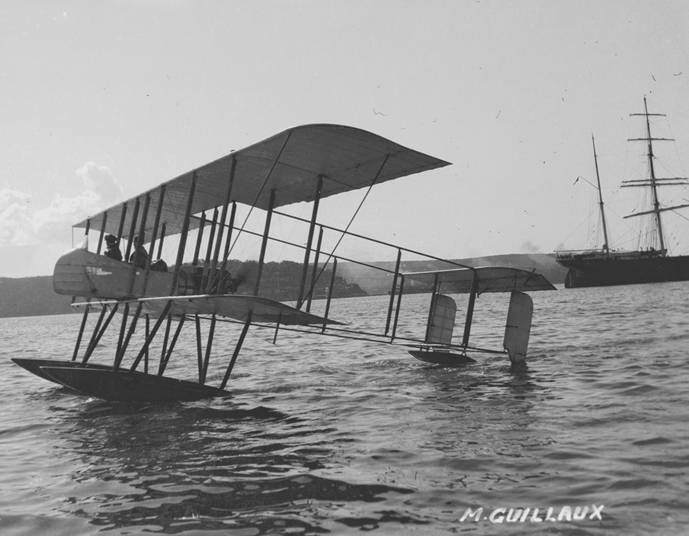
May 2014 will mark the centenary of the first seaplane flight in Australia.
Picture Sam Hood. State Library
of NSW –a128591
To learn
more about the various Centenary commemorations of the flights of Maurice
Guillaux visit www.Australiasfirstairmail.com and send
your email address to guillauxcentenary@gmail.com
The Maurice Farman seaplane entered service in several
countries in1913. A Greek Farman seaplane was the first aircraft to be used in
war when it attacked Turkish warships with grenades during the Balkan War.
Lebbeus Hordern, a member of the wealthy
family which owned the Sydney department store Anthony Horderns, imported a
Farman in 1914. It was the first floatplane in Australia. Its 70 horse-power
Renault engine enabled a maximum speed of 60 miles-per-hour. Wingspan was about
57 feet, 17.3 metres, it was about 35 feet, 10.6 metres long, and weighed about
1680 pounds, 760 kilograms. It could carry ‘two seventeen-stone passengers’ or
three passengers of lesser weight!
Lebbeus Hordern enlisted the services of the visiting French
aviator Maurice Guillaux and his team. They had arrived in Sydney on 4 April
1914, with their Bleriot XI which had been specially prepared for stunt flying,
and gave flying exhibitions in Sydney, Melbourne and provincial centres.
Maurice Guillaux flew the Farman for the first time on May 8
1914, as described by the Sydney Morning Herald
reporter:
Mechanics
moved about in an orderly sort of disorder. Wire stays were tightened, ash
props were tested, nuts were screwed up or slackened as required, levels were
taken, the great polished propeller was tried. It was a general tuning up of
the white-winged flying machine. And over all, Guillaux kept a hawk-like
supervision. No detail was too small for his personal attention. At last all
was ready.
‘Right to a
millimetre’ was Guillaux's comment after he had subjected all to a minute
scrutiny……. nothing could be left to chance. Up into the pilot's seat he
mounted, the hydro-aeroplane having been wheeled down to the water's edge by
many willing hands. Petrol was poured into the tank, and a mechanic, who looked
as if he came well up to the 17 stone standard, climbed into the passenger's
seat behind Guillaux, a dapper figure in a tweed suit, who made no sartorial
preparation for the flight beyond casting aside his Homburg hat.
The
mechanic set the propeller whirring at top speed. So strong was the air-current
which its revolutions set up, that a shower of sand and hats was blown into the
shed behind, small children wore thrown to the ground, and the crowd holding
the ‘tail’ were almost forced to let go their hold.'
Guillaux
sat himself firmly in his seat, gave the order for release, and immediately
afterwards the 'plane was skimming along the waters of Double Bay at breathless
speed. For a few hundred yards it rushed along, spurning the water, in a direct
line for Clarke Island.
‘There she
goes!’ shouted the spectators, as they saw the far-spreading wings lifted
slowly into the air. By degrees it rose, like a great bird stretching its
pinions for height, and up it soared, its white wings showing clearly against
the dark green foliage which clothes the slopes of the opposite shore. Away
over towards Mosman it glided, as easily as if it were a bird, and then, with a
wide sweep towards the right, it sailed in the direction of Manly. It seemed to
soar right over one of the Manly boats, which sounded its siren in salutation.
For a few minutes it was lost to view, and then it re- appeared over Point
Piper. Right over the heads of the watchers at Double Bay it flew citywards,
and after a circular movement, came back to the starting point. Landing on the
water some distance out, it made its way to the point of departure, covering
the intervening distance at the speed of an. express train.
![Portrait of Louise Nellie Lovely (1895-1980), silent film actress [picture].](02%20First%20seaplane%20flight_files/image009.jpg) Guillaux then took Lebbeus Hordern for a flight. He
came back enraptured. ‘Flying is the sport for me after this’ he said. The next
passenger was the French Consul, M. Chayet.
Guillaux then took Lebbeus Hordern for a flight. He
came back enraptured. ‘Flying is the sport for me after this’ he said. The next
passenger was the French Consul, M. Chayet.
The following Monday Guillaux made twelve flights, On one of
these the passenger was Miss Louise Carbasse, then a 19 year-old Australian
actress. After the war, she became a well-known Hollywood actress under the
name of Louise Lovely. Three days later, in a flight above the harbour, he
travelled at over 100 miles an hour, thanks to strong tailwinds.
On 22 May Guillaux and Lebbeus Hordern announced their
intention to fly the seaplane from Sydney to Melbourne, but this flight was
never attempted. Guillaux also announced his intention to remain permanently in
Australia, making his home in Sydney. He had purchased some more aircraft that
would arrive in about three months.
During June Guillaux was largely occupied with giving his
performances, and then on July 16-18 he made an epic flight in his Bleriot from
Melbourne to Sydney, carrying Australia’s first air mail and air freight. This
was claimed to be the longest such flight that had been made in the world at
the time. Liptons tea and O.T. juice, sponsors of the flight, mounted huge
advertising campaigns and the entire population was aware of this great
achievement.
Only a fortnight after the epic mail flight, war broke out.
This completely dominated the media, and largely for this reason Guillaux’ feat
is not widely known. On 5 August the Herald reported Guillaux’ eagerness to
return to France. These plans were delayed by a bad crash in his Bleriot, which
caused serious injury, and eventually he did sail for Europe on HMAT Orvieto on October 22. He accompanied
the Headquarters staff of the First Australian Division, listed as ‘Aviator’,
and travelled with an unnamed attendant. He was killed in France on 21 May
1917, while testing a new aircraft.
At the outbreak of war
Hordern presented his seaplane to the Australian Government and the aircraft
was taken on strength at Point Cook as CFS7, in other words the seventh aircraft,
and the first seaplane, of what eventually became the RAAF. Almost immediately
it was sent, with a BE2 landplane, to New Guinea on HMAS Una to take part in the capture of German possessions in New Guinea
Though it was not used in these operations, this was the first overseas
military deployment of an Australian combat aircraft.
The aircraft was returned to Point Cook
in 1915, but was reconstructed as a landplane. It was still in use in 1917, but
its subsequent fate is unknown.
After the war, Lebbeus Hordern continued his interest in
marine-type aircraft. In 1920-22 he imported a Felixstowe F3 twin-engined
flying-boat, two Curtiss Seagull flying-boats, and a Short Shrimp seaplane,
which Captain Frank Hurley used for his New Guinea film Pearls and Savages. The decision to build the Australian seaplane
carrier HMAS Albatross, announced in 1925, may well have been influenced by the
publicity gained by Hordern’s seaplanes.
The Seaplane Pilots Association of Australia is planning to
commemorate the centenary of Guillaux’ first seaplane flight. Watch for further
developments!