Maurice
Guillaux in Newcastle
April
25 and July 25 1914
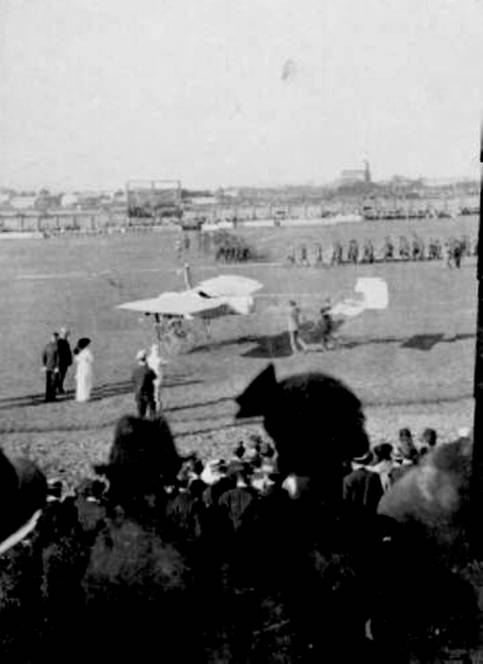 This picture is reproduced by courtesy of the
Newcastle Region Library, and depicts the scene at Newcastle Showground on 25
April, 1914.
This picture is reproduced by courtesy of the
Newcastle Region Library, and depicts the scene at Newcastle Showground on 25
April, 1914.
The
French aviator, Maurice Guillaux had arrived in Sydney on 8 April. He and four
associates had come to Australia to make money by giving aerial displays with their
Bleriot XI aeroplane, and Newcastle was the venue for his second public display
in Australia.
Groups
of army cadets can be seen in the background, and the group near the aircraft
probably includes the Mayor, Mr John Reid, and his wife. The fashionably
dressed people in the foreground have probably paid two shillings to sit in the
grandstand for the display.
The
Australian Aviation Historical Society (NSW) is commemorating the centenary of
his visit in 2014 and seeks any further information on his activities. Can you
help?
In
mid-July 1914, French aviator Maurice Guillaux flew from Melbourne to Sydney
seated on his Bleriot XI aircraft. The journey took 2 days, 5 hours and
43 minutes, and he carried Australia’s first air mail and air freight). However
two weeks later, World War I broke out, and Guillaux’ epic feat was largely
lost to historic memory.
The Aviation Historical Society of Australia, NSW (inc) is co-ordinating a re-enactment flight which will occur
on 12-14 July next year.
Guillaux stayed in Australia for only 200 days, and gave
flying displays in Newcastle twice, the first visit being April 25. The Sydney Morning Herald of Monday 27
April gave a full report.
The display was scheduled to begin at 3 pm on Saturday
25 April, and from two o’clock onwards there was a long queue of cars, sulkies
and buggies entering the gates of the showground. The total crowd was estimated
at 6000 to 7000. Weather was ideal: clear skies and a light wind.
Promptly at 3 pm, Guillaux appeared and as he moved to
his aircraft the band played the Marseillaise.
He took off and circled the showground, gaining height. He switched his
engine off and glided down. According to the report, ‘many people thought that
they would be struck by the machine, and they ran in all directions’, but the
engine was re-started and waved to the crowd and soared upwards again.
The show consisted of many ‘somersaults’ – which must
mean ‘loop-the-loops’, including three consecutive ‘backward somersaults’,
outside loops. Perpendicular dives, pulling out at the last possible moment,
were regarded as being even more exciting than loops. The crowd cheered
enthusiastically.
The first flight lasted 33 minutes.
Guillaux was congratulated by the Mayor, Mr John Reid.
Mrs Reid presented him with a red, white and blue scarf and with a
horseshoe-shaped bouquet of flowers. Guillaux thanked her, and presented her
with a diamond brooch and a rosette. Some minutes after, he took off again.
Groups of cadets were on the ground,
present at Guillaux’ invitation.
He flew low over their heads, but ‘no disorder prevailed’ even though he was
about three feet above their heads. Even more spectacular aerobatics were
interspersed with these low runs across the crowd, and the vertical dives and
‘somersaults’ were repeated. A near-collision with a sparrow created merriment.
He then set out towards Stockton, to the north. He
flew over the harbour; all the steamers tooted and the men working on the
vessels cheered loudly. The French frigate La
Bruyere dipped its flag in salute.
The people on the ground watched the aircraft till it
was out of sight. It returned at a height of 7000 feet. After another
spectacular display of aerobatics, Guillaux landed to the cheers of the crowd and with
the band again playing the Marseillaise.
He was interviewed after the flight, probably using
the services of his friend Lucien Maistre as interpreter, as he did not speak
English. He spoke of the magnificent view of Port Stephens that he had seen.
Despite the warm day, at 7000 feet he was very cold. He spoke highly of the
warmth of his reception in Newcastle and the number of people attending.
The Newcastle papers claimed that this was his first
performance in Australia, but actually on the previous Saturday he had
performed at Victoria Park racecourse in Zetland, Sydney, where a new housing
development is now being built.
There are a many gaps in our information about
Guillaux at Newcastle. The newspaper archives list no advertisements for his
show, and usually he charged a shilling or more for entry to the ground from
which he flew.
There is a record of A W Jones flying at West Maitland
on July 12, 1913. However, when he took off to fly to Newcastle on July 15 he
crashed; we do not know if either he or other aircraft flew at Newcastle before
Guillaux’ flight.
The photo on the front cover of this brochure is only
photo we have found of the event. It will be great if we find out more about
his time at Newcastle as a result of interest in the centenary of his visit.
Guillaux moved on to conduct similar displays in
Sydney, Wagga Wagga, Albury, Melbourne, Bendigo,
Ballarat, Adelaide and Geelong. In Sydney he also became the first person to
fly a seaplane, when on 8 May 1914 he flew a Farman ‘hydro-aeroplane’ that had
been imported by Mr Lebbeus Hordern of the famous retailing family.
His major feat in Australia was the flight from
Melbourne to Sydney on July 16-18 1914, carrying 1785 postcards (Australia’s
first airmail) and some Liptons Tea and some O.T. lemon cordial (Australia’s
first air freight). This was believed to be the longest such flight that had
been undertaken anywhere in the world.
After this, Guillaux made another visit to Newcastle,
giving another display on July 25. This did not get as much publicity as the
previous visit had generated, but a newspaper report recorded an attendance of
about 10 000. At this time the news was being dominated by events in Europe
that would shortly lead to the outbreak of World War I.
Guillaux had a bad crash at Victoria Park on August 1,
seriously damaging himself and his aircraft.
The aircraft was repaired and he gave other displays at Bathurst and
Sydney, but on 22 October he sailed back to Europe on a troopship. His wartime
career is not well documented, but he was killed in the crash of a new fighter
aircraft on 21 May 1917.
Almost uniquely for aircraft of this era, the actual
aircraft used by Guillaux was preserved and may be seen hanging from the
ceiling at the PowerHouse Museum, Sydney
The Royal Newcastle Aero Club website reports an
interesting legacy of his visit. When they began their club in 1928, ‘there was
much controversy before the site [for its operations] was selected. Some years
ago a visiting French pilot gave a public exhibition of flying, including a
death-defying loop the loop from Newcastle Showground. Possibly because of this
and the apparent fragility of the vintage aircraft he was flying, public
reaction was immediate and hostile with many regarding aircraft as out of this
world, strongly opposing the siting of an aerodrome in the city area’.
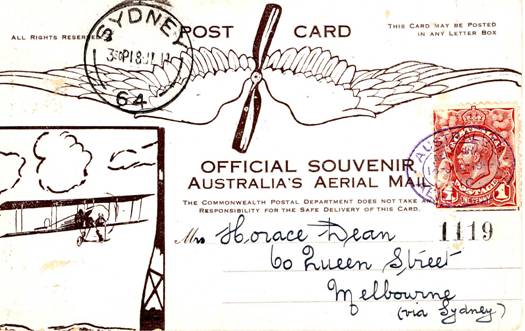
A re-enactment of Guillaux’ mail flight will take place on
July 12-14 2014, between Melbourne and Sydney, using a Jabiru, a modern
Australian lightweight sports aircraft of similar weight and engine capacity to
Guillaux’ Bleriot. It will carry exactly 1785 postcards, the same number as was
carried on the original flight and based on the originals. These unique
philatelic items can be purchased from the website.
The Jabiru will be accompanied by other aircraft and will
follow the route pioneered by Guillaux, with major celebrations at each stop.
The flight’s conclusion will be the centrepiece of Sydney’s Bastille Day
Celebrations.
To find out more, go to www.australiasfirstairmail.com .
If you have any historical information about Guillaux’ activities in Australia, if you would like to take part in the commemorations, or you would like to help in any way, please email guillauxcentenary@gmail.com .
Tom Lockley, PO
Box 301, Pyrmont NSW 2009, co-ordinator