Maurice
Guillaux in Albury and Wagga
May
16 to 24 and July 16-17 1914
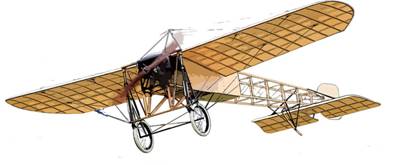 Maurice Guillaux, a famous French
aviator, visited both Wagga Wagga and Albury twice – the first time to give
aerobatic displays and the second time while carrying Australia’s first air
mail and air freight from Melbourne to Sydney – at the time, an epic flight
that was of world-wide interest. However two weeks later, World War I broke
out, and Guillaux’ epic feat was largely lost to historic memory.
Maurice Guillaux, a famous French
aviator, visited both Wagga Wagga and Albury twice – the first time to give
aerobatic displays and the second time while carrying Australia’s first air
mail and air freight from Melbourne to Sydney – at the time, an epic flight
that was of world-wide interest. However two weeks later, World War I broke
out, and Guillaux’ epic feat was largely lost to historic memory.
The Aviation Historical Society of Australia, NSW (inc) is
co-ordinating a re-enactment flight which will occur on 12-14 July next year.
The mail for the flight is being carried in a Jabiru light aircraft flown by
John Fowles of Albury accompanied by other aircraft. The flight will arrive at
Albury airport at about 2 30 pm on Saturday 12 July, and stay overnight. Next
morning, it will fly on to Wagga, arriving about 9am, and will remain on the
ground for about 90 minutes. Commemorative mail will be delivered to each site
and mail will be collected for other addresses; other activities are welcome.
If you would like to be a part of this event, please contact us.
Background
to the visits
Maurice Guillaux left France on a world tour early in 1914 to
make money from aerial aerobatic displays. He and his team reached Australia
early April 1914.
After assembling his Bleriot XI aircraft, specially designed
for aerobatics, he gave performances in Sydney and Newcastle. Guillaux became
the first person in Australia to fly a seaplane when he flew a Farman
‘hydro-aeroplane’ on 8 May.For more information visit our website or contact us for more printed
material.
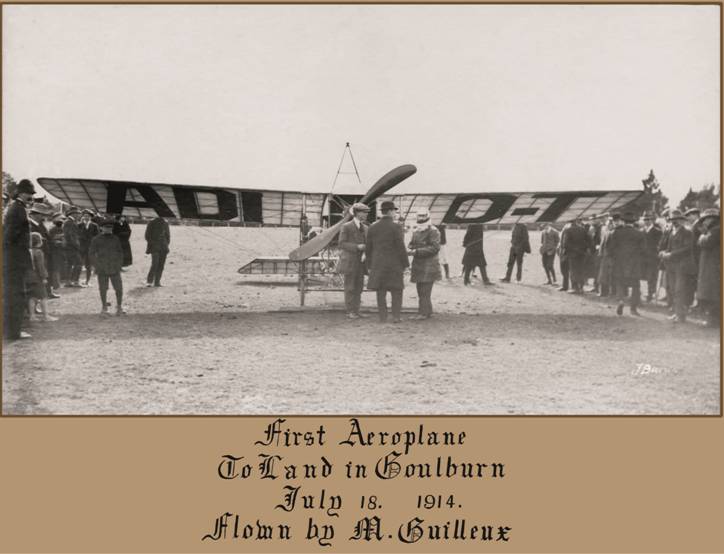
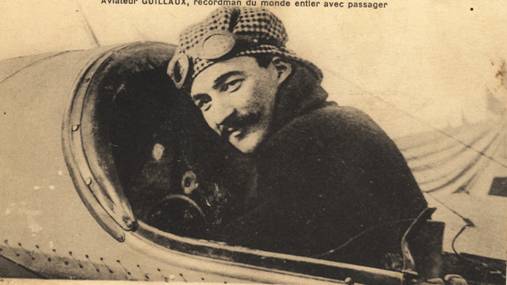
We do not have a good photograph of
Guillaux, members of his team, or his aircraft, either in Albury or Wagga
Wagga. This picture comes from Goulburn. Are there pictures from Wagga and
Albury, and can we find them?
Wagga
Wagga: en route to Melbourne,
May 16 to 18 1914
The Urana Independent and Clear Hills
Standard gave a full
report of Guillaux’ display at Wagga on May 16. Special trains had been run
from Junee and Culcairn, and they were both packed with passengers. The paper
estimated that 8000 people paid for entry to the racecourse and another two to
three thousand people gathered outside. They were thrilled by the daring
aerobatics, one of the most spectacular being a vertical dive that pulled out
only just above the watching crowd.
Guillaux was assisted by various people. Alderman Albert
Sculthorpe of St Kilda was listed as ‘director’ of the organisation. His
daughter, Miss Milly Sculthorpe accompanied him.
A Mr Kyrle was listed as ‘manager’ and took ‘living pictures’
for a firm called ‘Panama Expositions’. M Lucien Maistre (translator and
‘manager’) and M Rupeausseu were French, and had come to Australia with
Guillaux.
According to the Border
Mail of 19 May, on the Saturday evening a ‘picture concert’ was seen in the
Masonic Hall. 8000 feet of ‘living Sydney pictures’ were shown by Mr Kyrle.
The Mayoress of Wagga, Mrs McDonough, presented gifts
(provided by Huthwaites store) to Guillaux and other members of the group.
Mr Kyrle had taken ‘living pictures’ of Wagga, including some
of the aerobatic performance. The film went to Sydney for processing and
returned by express train to be shown on the following Monday night. Unfortunately,
the National Film and Sound Archive does not have a copy of any such film, and
have little knowledge of Mr Kyrle. So far we have found only a few minutes of
movie film depicting Guillaux’ activities in Australia.
The
Albury event: Saturday 23 May
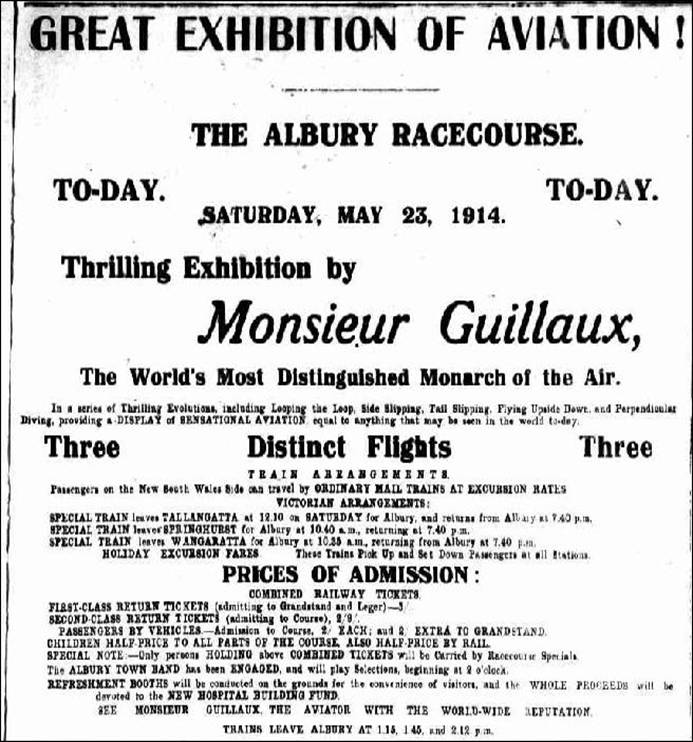 The Border Mail and Riverina Times from
19 May onwards described the preparations and the event. Mr Sculthorpe and Mr
Kyrle arrived at the station on the morning express on 18 May, where they were
met by Mr Lionel C Griffiths, who, with Alderman Frere was credited with
arranging the visit. Alderman Frere was of French origin. For the event the
golf club competition was postponed, but shops stayed open with reduced staff.
Guillaux’ management offered the refreshment rights to the secretary of the New
Hospital Fund; two liquor booth licences were taken out, with ‘arrangements for
afternoon tea, etc’. Special trains both from Victoria and New South Wales were
organised.
The Border Mail and Riverina Times from
19 May onwards described the preparations and the event. Mr Sculthorpe and Mr
Kyrle arrived at the station on the morning express on 18 May, where they were
met by Mr Lionel C Griffiths, who, with Alderman Frere was credited with
arranging the visit. Alderman Frere was of French origin. For the event the
golf club competition was postponed, but shops stayed open with reduced staff.
Guillaux’ management offered the refreshment rights to the secretary of the New
Hospital Fund; two liquor booth licences were taken out, with ‘arrangements for
afternoon tea, etc’. Special trains both from Victoria and New South Wales were
organised.
Mr Sculthorpe talked of Guillaux’ achievements including record-breaking
long-distance flying in France and flying from Paris to London in a
record-breaking 4½ hours, carrying four passengers. His claim to have flown
over Mount Blanc at a height of 32 000 feet is not particularly believable! But
certainly Guillaux had been very popular – over 120 000 people had seen his
Sydney performances and at Wagga 8000 people had paid to see him.
Australian aviator Harry Hawker had visited Wagga the
previous March. This had been a sensation: special trains had been run to his
performances, but Guillaux’ display was more spectacular. ‘No words can
describe what he does and can do. All other aviators pale before him; looping
the loop at an altitude of 14 000 feet is mere child’s play to him. He knows no
fear and seems bereft of nerves. He back-somersaults in the air, does
perpendicular dives, spiral descents, flies upside down (which is more than the
winged bird does)’.
 ‘Guillaux is master of the air, a
conqueror greater than Alexander’. It looked forward to the near future when
‘the Border Mail will reach its big
circle of Upper Murray subscribers on the morning of issue and every morning,
instead of being blocked by trains which run at infrequent intervals.’
‘Guillaux is master of the air, a
conqueror greater than Alexander’. It looked forward to the near future when
‘the Border Mail will reach its big
circle of Upper Murray subscribers on the morning of issue and every morning,
instead of being blocked by trains which run at infrequent intervals.’
Guillaux was rather short, but apart
from that had ‘matinee idol’ looks.....
In
Victoria and South Australia....
Guillaux visited Government house, by aircraft, on 28 May,
where he was received by the Governor-General, the state Governor, and their
wives. He gave a performance in Melbourne on Saturday May 30, then performed at
Bendigo, Ballarat, Adelaide and Geelong before returning to Melbourne early in
July.
The
mail flight
At this time he was contracted to fly the first air mail from
Melbourne to Sydney; the promoter Arthur Rickard and engaged the American
aviator Wizard Stone to do this, but on June 1 he crashed, and after some negotiation,
Guillaux agreed to make the flight.
On July 16 he left
Melbourne Showgrounds on his journey. He landed in Sisely’s paddock, Trawool
Road, Seymour, then at Jordan’s paddock, Wangaratta.
Albury,
16 July 1914
Guillaux’ aircraft had enough range to fly further than
Albury, only about 15 minutes’ flight from Wangaratta. However he wanted to land
there again to see his friend Alderman Frere. He landed alongside the judges’
box at the racecourse, which adjoins the present airport, at 12 50 pm. Senior
Sergeant Blackburn and his mounted police formed a guard of honour.
Among the notable people who were there to welcome him were
the chairman of the racing club Mr E J Belbridge, the secretary of the racing
club Mr J Norman Hayn, Mr and Mrs F C Blacklock, Mr and Mrs H M Hassett, Mrs
Kennedy and the Misses Kennedy, Mr and Mrs Gibson from Bulgandra station, Miss
Thompson, Miss Cox, Miss Kenneally, Mr C J Williamson, Mr and Mrs G S Read, Mr
and Mrs Phil Howard, Mr T H Butcher representing the Shell Oil Company of
Australia, Mr F Read representing the Dunlop Rubber Company, Mr McLennan, Mr G A Gray JP, Mr J J Mangan,
Miss Howe, Miss McLaurin and Ensign Setterfield. The Mayor, Alderman Waugh,
welcomed him and called for three hearty cheers, then Alderman Frere took him
to lunch.
The Melbourne Truth,
a newspaper that was completely devoted to sex and scandal, reported that
Guillaux was having an affair with one Bessie Harrigan, who originally came
from Albury. Guillaux, so the story goes, met her when she was working at the
Paris Cafe, a ‘swell Phillip Street Cafe’ in Sydney. Though the 18 July edition
of Truth says that she accompanied
the group, she is not mentioned in the local newspaper report!
This was the only stop at which there was no mechanic from
Guillaux’ team. Mr Blacklock provided some oil and assisted with the starting
of the engine. Guillaux took off at 1 35pm, heading for Wagga. The weather
looked unfavourable, and he was anxious to be on the move.
He did fly over the town of Culcairn, 32 miles out from
Albury. A hoaxer had phoned the shire office and pretended to be one of
Guillaux’ mechanics. He asked if Guillaux could land there, and frantic
preparations were made for him to land on the Railway Parade. As he flew over,
the local newspaper proprietor waved a piece of red cloth impaled on a
pitchfork to attract his attention, but he flew on, much to the town’s
disappointment. A similar thing happened at Henty, the next town on the route.
A large crowd had gathered at Spencers Hotel, a special mail package had been
prepared, and petrol was on hand.
Wagga,
16 July 1914, and afterwards
Guillaux reached Wagga at 2 45 pm, covering the 79 miles, 125
kilometres, in 70 minutes. He was to land at the MTC racecourse. As he
approached, he saw a crowded racecourse, and landed in the main straight.
However, it was the wrong racecourse, and he had landed, just near the judges’
box, shortly after a race had finished. He quickly flew off to the correct
course, where the Mayor, Alderman McDonough and other councillors were waiting
to greet him, One of Guillaux’ support team refuelled and serviced the aircraft.
The Wagga Express recorded that ‘Sitting
in his airship, wearing a comfortable fur-lined leather coat, hooded with a
red, white and blue scarf, Monsieur Guillaux wore an expression of excited
pleasure and intense satisfaction of his so far successful flight’.
After being delayed a full day at Harden, due to bad weather,
he flew on and finally landed in Moore Park, Sydney, at 2 55pm on 18 July. He
was greeted by a huge crowd – mainly from the nearby football game – and by the
Governor and other dignitaries. The airmail flight was sensational news.
Liptons Tea and O.T. juice all mounted huge advertising campaigns.
Guillaux flew at Ascot racecourse, now part of
Kingsford-Smith airport, on August 1, but had a serious crash. He was badly
injured and the aircraft was considerably damaged. Both were repaired and he
conducted a display at Bathurst on 5 September and a final display in Sydney on
12 September. He then returned to Europe and was killed in France in 1917 while
testing a new aircraft.
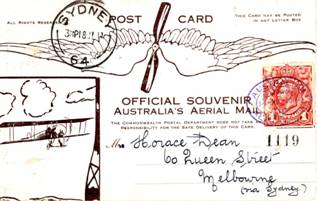 A re-enactment of
Guillaux’ mail flight will take place on July 12-14 2014, between Melbourne and
Sydney, using a Jabiru, a modern Australian lightweight sports aircraft of
similar weight and engine capacity to Guillaux’ Bleriot. It will carry exactly
1785 postcards, the same number as was carried on the original flight and based
on the originals. These unique philatelic items can be purchased from the
website.
A re-enactment of
Guillaux’ mail flight will take place on July 12-14 2014, between Melbourne and
Sydney, using a Jabiru, a modern Australian lightweight sports aircraft of
similar weight and engine capacity to Guillaux’ Bleriot. It will carry exactly
1785 postcards, the same number as was carried on the original flight and based
on the originals. These unique philatelic items can be purchased from the
website.
For more information: www.australiasfirstairmail.com
Email guillauxcentenary@gmail.com to go on the mailing list!