Maurice
Guillaux at Melbourne (and Geelong)
May-July
1914
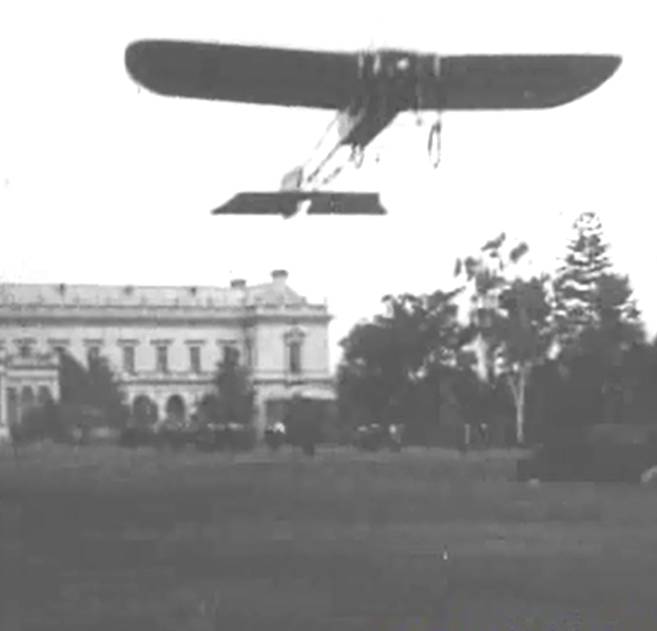
Frame from a 1914 newsreel movie: Guillaux taking off from the grounds of Government House, Melbourne, 28 May 1914
Maurice
Guillaux had had a few mentions in the Australian media before he arrived in
Australia, and his fame was such that he was interviewed in Fremantle en route
to Sydney, and then when he reached Sydney he had celebrity status
He
performed in Sydney and Newcastle in April, and early in May he and his team
were occupied in assembling and flying Lebbeus Hordern’s seaplane, However later
in the month he headed south, with a performance en route at Wagga (May 16) and
Albury (May 23). It was reported that a guarantee of over £1000 was given to
induce him to travel to Melbourne.
Melbourne performance, 30 June 1914
On
28 May he landed in the grounds of the residence of the Governor-General, in
Melbourne; Canberra was still a long way in the future. The Governor-General,
Sir Ronald Munro Ferguson, Lady Helen Munro Ferguson, the Governor of Victoria,
Sir Arthur Stanley, and his wife were also present. Lady Stanley conversed with
Guillaux in French. The machine was carefully inspected – Lady Stanley calling
for a chair upon which she stood to get a better view of the controls.
Guillaux
performed an aerobatic show, and then returned to his base, the Flemington
showground, where he was congratulated by Lieutenant Harrison, of the Aviation
Corps. The following day, obviously at Harrison’s invitation, Guillaux visited
Point Cook, where the first military flying school in Australia had commenced
operations on 1 March 1914. The Argus
reports that Guillaux had no problems in flying to Point Cook, but his
mechanic, travelling by car, became lost en route. Guillaux gave a flying
display and also rode in one of the Point Cook aircraft over the Point Cook
area. He congratulated the government on its establishment of the base and gave
his opinion that Point Cool was an excellent site for the purpose.
 The
Governor-General was among the huge crowd which attended his display on
Saturday 30 May. As a result of a misunderstanding, the Governor-General had to
walk through the crowd to reach the display area, and was delayed; Guillaux
refused to start before he came, and the crowd was a little restless.
The
Governor-General was among the huge crowd which attended his display on
Saturday 30 May. As a result of a misunderstanding, the Governor-General had to
walk through the crowd to reach the display area, and was delayed; Guillaux
refused to start before he came, and the crowd was a little restless.
But when the show began it was rapturously received.
As the Herald reported ‘Melbourne
people... had certainly seen nothing which even approached this in sensationalism.
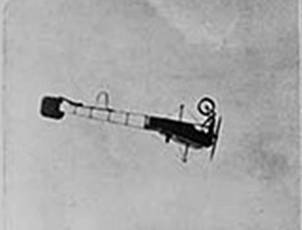
M Guillaux was to Mr Hawker as a Drury Lane melodrama is to a repertory play’. As well as looping the loop, a feature was
what we now call a ‘stall turn’ where the aircraft flew vertically to
standstill. He also then dived towards the earth, pulling out at what seemed to
be the last moment. 25000 to 30 000 people watched the display, so at even a
shilling entrance fee, the £1000 guarantee was easily fulfilled.
He also flew over the Moonee Valley racecourse,
creating a diversion in the proceedings; according to the Adelaide Advertiser, ‘while the Frenchman was soaring through the
air the bookmakers did very little business’. The Weekly Times of 6 June adds detail: ‘Those present (at the races),
thanks to Mr Arthur Hiskins, had a good view of M Guillaux’s aerial feats. On
one occasion when the daring young Frenchman dived suddenly towards the earth
much concern was felt by watchers at the valley. Their feelings were not
relieved by a bookmaker offering to bet 6 to 4 that he had broken his neck. A
few minutes later the aviator soared into the sky like a bird, and headed for
Moonee Valley. He hovered over the course long enough, as it were, to see
Meerut win, and then sped back to the showgrounds’.
The Argus contrasted
this brilliant display with the performance of Mr W Jones at Perth, when he
provided a very unexciting show.
There seems to be no doubt that Guillaux spoke very
little English, but the Herald printed a lengthy interview, which the sensationalist
Truth made the target of considerable
ridicule.
Bendigo, Ballarat and Adelaide
On June 8, Kings Birthday holiday, Guillaux performed
at Bendigo, and then at Ballarat on the following Saturday. He flew between
Bendigo and Ballarat, this feat attracting considerable interest. On 20 June he
performed in Adelaide and by 27 June was back in Melbourne.
The Geelong display, 4 July 1914
Guillaux flew from Melbourne to Geelong on Friday 3
July, and this event itself was enough to make the newspapers. The Lord Mayor
of Melbourne, Mr D V Hennessy, sent a message with Guillaux to the Mayor of
Geelong, Alderman E G Gurr. The 45 miles were covered in 63 minutes, but this
probably includes a small display of aerobatics over the Plumpton racecourse at
Geelong, where he happened to arrive just after the last race, before the
crowds dispersed. He landed and was welcomed by Alderman Gurr and Mr H A
Anderson, president of the racecourse stewards.
Guillaux gave a press interview in which he described
the flight. He had navigated by following the railway line.
His display on 4 July attracted the usual large crowds
who were enthralled by his daring displays of such ‘evolutions’ as looping the
loop, flying upside down and making vertical dives from which he pulled out at
the last moment. He also, for the first recorded occasion, took passengers for
flights, including a young lady Miss Jetta Tivey, daughter of the manager of
the Colonial Bank, who ‘enjoyed every moment’ of her 20 minute flight. Mr R N
Tournoeur, of Ballarat, was told to hold on to the pilot while he looped the
loop.
He flew back to Melbourne the following day, and was
caught in a crosswind that he estimated at 45 mph, which blew him southward.
However when he descended to about 200 feet the wind was not as severe, and he
could reach a ground speed of about 30 mph. The flight took about 70 minutes.
Before the mail flight
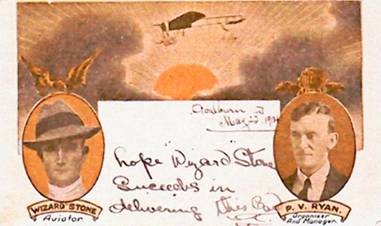 Arthur Rickard was a Sydney-based entrepreneur largely
involved in real estate development. In 1908, for example, he organised a
successful subdivision at Woy Woy, the first of many such deals. A great
self-publicist, he had arranged with the American aviator Arthur ‘Wizard’ Stone
to fly the first Government official airmail from Melbourne to
Sydney, but Stone crashed his aircraft and was injured. The flight was
cancelled and the mail was eventually carried to Sydney by rail.
Arthur Rickard was a Sydney-based entrepreneur largely
involved in real estate development. In 1908, for example, he organised a
successful subdivision at Woy Woy, the first of many such deals. A great
self-publicist, he had arranged with the American aviator Arthur ‘Wizard’ Stone
to fly the first Government official airmail from Melbourne to
Sydney, but Stone crashed his aircraft and was injured. The flight was
cancelled and the mail was eventually carried to Sydney by rail.
Meanwhile, Guillaux was approached to make a similar
flight. A start date of 9 July was proposed, but a story in The Argus, 8 July, stated that
negotiation with Rickard had broken down, and that purchasers of the cards
could have their money back. This was a sudden and unexpected announcement:
crowds had already gathered at the landing ground at Seymour. Guillaux instead
flew to a coursing meeting at Carranballae at the request of Mr Gordon
Chirmside, whom he had met when performing at Ballarat.
Soon it was announced that the mail would be flown
beginning 16 July, but exactly who was backing it is a subject for further
research. There is quite an amount of information on the subject, most of it
contradictory!
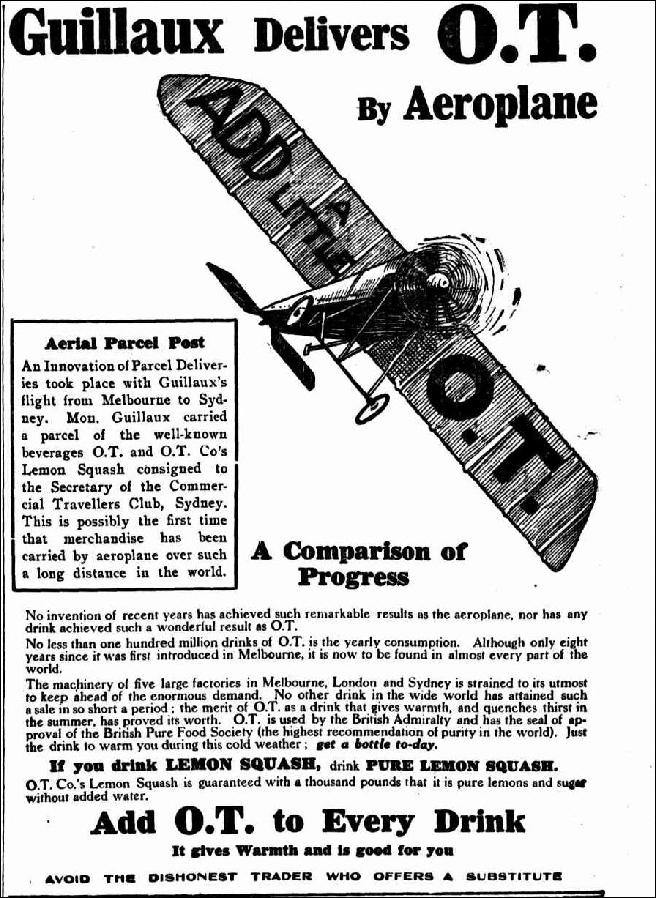
Certainly, Mr Wilson of O.T. Cordials was involved:
the aircraft wings were emblazoned with “ADD a little O.T.’ and within a few
days of completing the flight O.T. had begun a huge advertising campaign as is
seen in this booklet.
 O.T. was a leading beverage manufacturer. As well as
producing orange and lemon cordial, it produced an ‘adult soft drink’ simply
known as O.T. It was the Claytons of its day; the temperance movement was
strong, and O.T. was seen as a good alternative to alcoholic beverages. It was
a mixture of fruit juice and chilli. O.T. later became Kia-Ora, which was in
turn taken over by Coca-Cola. Coca-Cola were invited to participate in the
re-enactment but declined.
O.T. was a leading beverage manufacturer. As well as
producing orange and lemon cordial, it produced an ‘adult soft drink’ simply
known as O.T. It was the Claytons of its day; the temperance movement was
strong, and O.T. was seen as a good alternative to alcoholic beverages. It was
a mixture of fruit juice and chilli. O.T. later became Kia-Ora, which was in
turn taken over by Coca-Cola. Coca-Cola were invited to participate in the
re-enactment but declined.
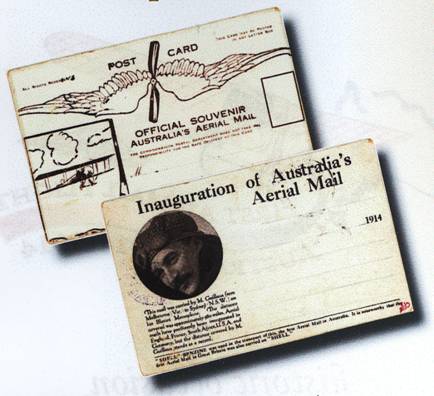
It is interesting to note that no advertising appears
to have been needed to sell the postcards actually carried by Guillaux; there
is evidence that over 2000 numbered cards were printed, and indeed that all
were sold, but also evidence that only 1785 cards were carried on the flight.
The cards may have been quickly designed and printed: the aircraft shown is not
a Bleriot. The postcards designed for Wizard Stone were printed in colour, and
were more elaborate.
The flight would not have been an appealing financial
proposition without outside backing: Guillaux could draw crowds of thousands
who would pay from one to four shillings each for a single display, but the
total proceeds of the long air mail flight would be much less than this. One
itinerary proposed an aerial display at Goulburn en route.
In any case there was no major public performance
between the Geelong event on 4 July and the departure for Sydney on 16 July. He
received a mixed press during this period: On 6 July the Geelong Advertiser calculated his fuel bill for
the flight from Melbourne: eleven shillings and ninepence. On 9 July Punch estimated that Melbourne
performances had been about one-third less profitable than Sydney performances:
Punch blamed the weather and a less
plentiful supply of money. Truth on
11 July mentioned the fact that he had been found guilty in France of cheating
in a long-distance flight, but other papers approvingly mentioned the fact that
he had ordered new aircraft from France with the view to setting up a permanent
flying business in Australia.
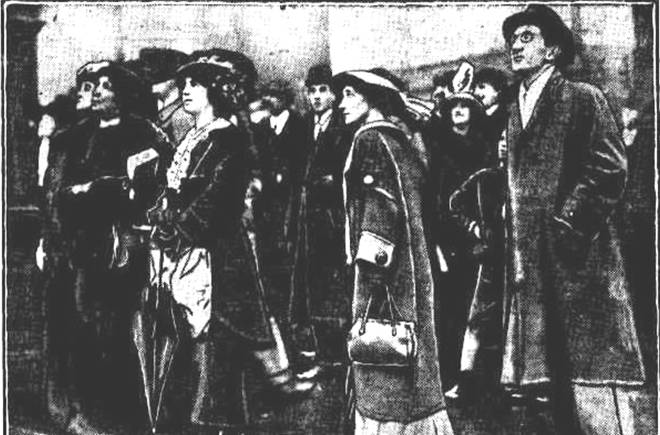
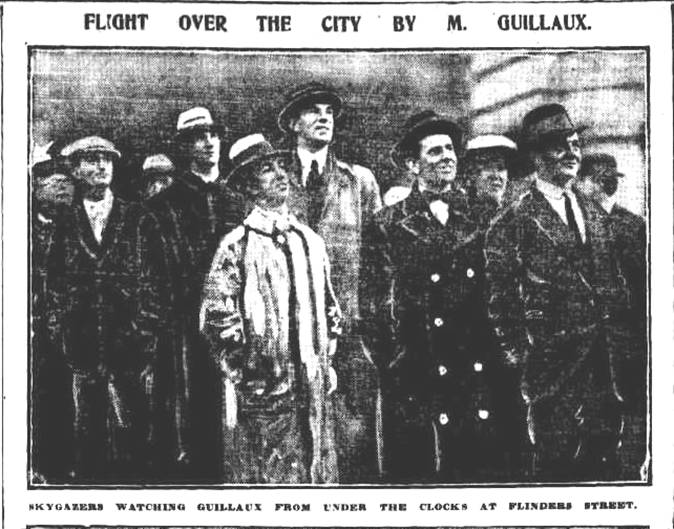
On 14 July he made a flight
over the city. The Argus described
the effect of this – everyone was watching. Traffic came to a standstill.
The mail flight
Guillaux began the morning of July 16 1914
at 6am at the Cafe Denat (80 Bourke Street, Melbourne, Florentino Restaurant).
After his morning cutlet, he went to the Melbourne Showgrounds, his principal
base in Melbourne, and prepared his aircraft. His load was 1785 specially
printed postcards, a letter of greeting from the Governor of Victoria (Sir
Arthur Stanley) to the Governor of New South Wales (Sir Gerald Strickland), a letter from the French
Vice-Consul in Melbourne (M Homery) to the French Consul-General at Sydney (M Chayet),
a quantity of Lipton Tea and some lemon cordial. Fuel was provided by Shell,
and this was noted on the postcards. Shell also supported the 1964
commemoration flight.
All was ready for departure at 9 am, but
the mail had not arrived. At 9 05, the acting deputy postmaster-general, Mr. W
B Crosbie, appeared with the mail bag and at exactly 9.12 a.m., Guillaux took
off for Sydney. A promised letter from the Lord Mayor of Melbourne (Alderman
Hennessy) to the Lord Mayor of Sydney had not arrived.
![Darge, Algernon, 1878-1941. Maurice Guillaux in his Bleriot XI monoplane holding aerial mail bag at the Agricultural Society's show grounds before flying to Sydney on first air mail delivery, Melbourne, 16 July 1914 [picture]](05%20Melbourne%20and%20Geelong_files/image024.jpg)
This
wonderful photograph by Algernon Darge captures the moment of departure for
this epic flight.
Overleaf:
the first O.T. advertisement placement appears to be in The Argus, 20 July
1914. There were at least 240 such placements in newspapers all over the
country.
To learn
more about the Air Mail Centenary commemorations visit www.Australiasfirstairmail.com and send
your email address to guillauxcentenary@gmail.com