Maurice
Guillaux and Adelaide
June
1914
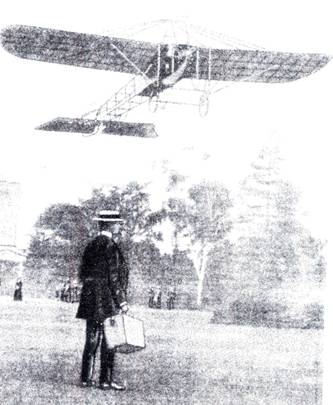 Frame from a 1914 newsreel movie: Maurice Guillaux taking off from the grounds
of Government House, Melbourne, 28 May 1914
Frame from a 1914 newsreel movie: Maurice Guillaux taking off from the grounds
of Government House, Melbourne, 28 May 1914
Never heard of Maurice Guillaux?
The French aviator
Maurice Guillaux spent less than 200 days in Australia, April-October 1914, but
had a great influence on Australian aviation.
His Bleriot
XI aircraft was specially modified for aerobatics, and he gave spectacular
aerobatic performances in Sydney, Newcastle, Wagga Wagga,
Albury, Melbourne, Bendigo, Ballarat, Adelaide, Geelong and Bathurst. He was
the first person in Australia to fly a seaplane in Australia when he flew
Lebbeus Hordern’s Farman ‘hydro-aeroplane’ at Double Bay, Sydney, 8 May, 1914.
He made
several record-breaking flights, but his major feat occurred on 16 to 18 July
when he flew from Melbourne to Sydney. The journey took 2 days, 5 hours and 43
minutes, and he carried Australia’s first air mail and air freight). However
two weeks later, World War I broke out, and Guillaux’ epic feat was largely
lost to historic memory.
The
Aviation Historical Society of Australia, NSW (inc) is
co-ordinating a re-enactment flight which will occur on 12-14 July 2014. Now read on....
Guillaux and Adelaide
On 8 June 1914 the Adelaide
Advertiser reported the imminent visit of Guillaux, but not very
enthusiastically. They had already seen A W Jones fly in that city, though
Guillaux had some interesting new tricks.
Guillaux was interviewed on 16 June at the Grand Central
Hotel, Adelaide – which, incidentally has since been demolished to make way for
a car park. He told of his exploits in France, and of his long and safe career,
including 100 flights in Australia.
On Friday 19 June he flew over Adelaide, creating the usual
high degree of interest, with a few aerobatics to whet the people’s appetite
for the next day’s event at Cheltenham racecourse. On Saturday 20 June,
according to the Advertiser, ‘The
large number of people who patronised the ground and Derby stands, the big
crowd who paid for admittance to the flat, and the still larger concourse of
spectators -who did not pay, but -watched the aviator in the air from points of
vantage outside the course, bore testimony to the curiosity which the
Frenchman’s visit had aroused’. One of the freeloaders was so impressed by the
show that he later sent in a shilling to be given to the aviator. The Herald estimated the crowd at 15 000.
The Railways Brass Band provided musical selections. 'The
Governor, Sir Henry Galway and Lady Galway arrived at the course by motor car
shortly before 3 pm. M. Guillaux was
introduced to them by Mr J W Canaway, the French
Consul. Lady Galway, who can speak French fluently, enjoyed a few minutes'
conversation with the aviator.
Guillaux personally inspected his aircraft carefully, and
donned his leather coat and hat. The engine was started, as two attendants held
down the tail. ‘The biplane (sic) was
guided upward as if ascending a spiral staircase. When a good height had been
attained, M. Guillaux stopped the engine and caused his machine to dip in such
a startling way as to suggest to the uninitiated that he was about to crash to
the ground. He speedily rose again from the drop and circled round
side-slipping and dipping as before. Each time he reached higher altitudes by a
series of graceful circling movements suggesting to the mind the flight of
gulls above the crest of storm-tossed water...... Rising to about 3,000 or 4,000 ft he looped
the loop-a thrilling feat, which must be seen to be fully appreciated, and he
did it with an ease that astonished the spectators..
Having remained in the air about 20 minutes he descended to the ground by a
graceful volplane. As his machine alighted virtually in the same spot from
which it had arisen, the big crowd surged round him and cheered lustily’.
At about 4 pm he made a second -flight. This time he flew
over the city and the southern suburbs. and returned to a great reception from
the crowd.
The spectators at the West Adelaide and Norwood at the
Jubilee Oval were delighted when Guillaux flew over the ground at half-time.
The umpire, Mr Abernethy, was not popular when, ‘with insistent whistle, he,
commanded players to resume while the airship was still in sight. The game was
continued but for a space the crowd were quite unconscious of what was going
on, on terra, firma. They had a-loftier ideal than football just then, and not
being able to watch at once both players and airman, they forgot their
allegiance to the national pastime and ignored the football’ (Advertiser). According to the Adelaide Register the flight had been
pre-arranged with one Mr T Pope of Glen Ormond, who had persuaded Guillaux to
fly over his home ‘Sunnyside’ where he was holding a party with 300 guests. He
also flew over a parade of the 74th Regiment of army cadets at
Unley, and the boys greeted him with a huge cheer.
He returned to Cheltenham, gave another aerobatic display,
and landed to the cheers of the crowd. His aircraft, which attracted a lot of
attention, was guarded by mounted troopers until it was dismantled for the trip
back to Melbourne.
The following Monday evening Guillaux’ party, and their
aircraft, left for Geelong where the next performance was due.
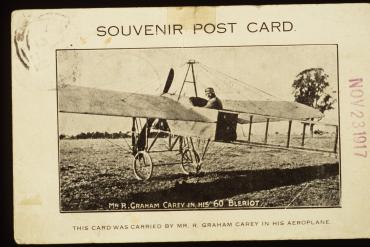 There was an interesting postscript
to this visit. The Bleriot aircraft in which Guillaux flew was purchased in
January 1916 by Graham Carey, a remarkable Australian businessman, Aged 41 at the
time, Carey had made a career in the transport business, and by 1912 was a
prominent motor-car dealer in Ballarat. When he was rejected for active
service, he acquired the Bleriot, which had been left behind by Guillaux. He
learnt to fly the aircraft, and flew at various displays during the last months
of the year 1916. One such display was in Adelaide on 27 October 1916, dropping
Enlistment and War Loan leaflets over the city ad performing for the Army
Nurses day.
There was an interesting postscript
to this visit. The Bleriot aircraft in which Guillaux flew was purchased in
January 1916 by Graham Carey, a remarkable Australian businessman, Aged 41 at the
time, Carey had made a career in the transport business, and by 1912 was a
prominent motor-car dealer in Ballarat. When he was rejected for active
service, he acquired the Bleriot, which had been left behind by Guillaux. He
learnt to fly the aircraft, and flew at various displays during the last months
of the year 1916. One such display was in Adelaide on 27 October 1916, dropping
Enlistment and War Loan leaflets over the city ad performing for the Army
Nurses day.
He flew South Australia’s first airmail from Adelaide to
Gawler on 23 November 1917, again in the Bleriot. After the war he bought a
number of other aircraft. His story is told in A Message from the Clouds, by Des Martin and Bertha Carey.
The Bleriot was seldom used after 1917, probably because of a
shortage of spare parts. Carey eventually sold the Bleriot to K J Chaffey of
Deniliquin. It was seldom, if ever, used and in December 1925 it was sold, for
£25. Later it was acquired by the Sydney Technological Museum. It was restored
mainly by students of the aircraft Engineering School, Sydney, and put on
display for the 1964 airmail flight re-enactment. It remains on display at the
PowerHouse Museum, Sydney,
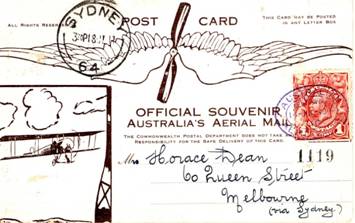
A re-enactment of Guillaux’
mail flight will take place on July 12-14 2014, between Melbourne and Sydney,
using a Jabiru, a modern Australian lightweight sports aircraft of similar
weight and engine capacity to Guillaux’ Bleriot. It will carry exactly 1785
postcards, the same number as was carried on the original flight and based on
the originals. These unique philatelic items can be purchased from the website.
The Jabiru will be accompanied by other aircraft and will
follow the route pioneered by Guillaux, with major celebrations at each stop.
The flight’s conclusion will be the centrepiece of Sydney’s Bastille Day
Celebrations.
To find out more, go to www.australiasfirstairmail.com .
Do you have any historical information
about Guillaux’ activities in Australia? We would like to take advantage of the Centenary to
collect all this material. We have not been able to locate any photographs from
his Adelaide display.
Are you a light aircraft owner who would like to join
the flight?
If you would like to take part in the commemorations, or you would like to help in any way, please email guillauxcentenary@gmail.com .
Tom Lockley, PO Box 301,
Pyrmont NSW 2009, co-ordinator, 0403 615134