Aviation
Historical Society of Australia(NSW)inc
Air Mail Centenary Commemoration Group
Maurice Guillaux in Seymour and Wangaratta
July 16 1914
Never heard of Maurice Guillaux?
![First flight from Melbourne to Sydney showing pilot Maurice Guillaux standing on a Bleriot monoplane with a 50 horsepower Gnome engine, Wangaratta, July 1914 [picture].](08%20Seymour%20Wangaratta_files/image004.jpg) nla.pic-vn3723553; First flight from Melbourne to
Sydney showing pilot Maurice Guillaux standing on a Bleriot monoplane with a 50
horsepower Gnome engine, Wangaratta, July 1914 (E.A Crome
collection)
nla.pic-vn3723553; First flight from Melbourne to
Sydney showing pilot Maurice Guillaux standing on a Bleriot monoplane with a 50
horsepower Gnome engine, Wangaratta, July 1914 (E.A Crome
collection)
The French
aviator Maurice Guillaux spent less than 200 days in Australia, April-October
1914, but had a great influence on Australian aviation.
He made
several record-breaking flights, but his major feat occurred on 16 to 18 July
when he flew from Melbourne to Sydney. The journey took 2 days, 5 hours and 43 minutes,
and he carried Australia’s first air mail and air freight. He passed through
Seymour and Wangaratta (picture above). However two weeks later, World War I
broke out, and Guillaux’ epic feat was largely lost to historic memory.
The Aviation
Historical Society of Australia, NSW (inc) is
co-ordinating a re-enactment flight which will occur on 12-14 July 2014. It
will pass through Mangalore and Wangaratta airports on Saturday morning 12 July
2014. Now read on....
Departure from Melbourne,
16 July 1914
![Darge, Algernon, 1878-1941. Maurice Guillaux in his Bleriot XI monoplane holding aerial mail bag at the Agricultural Society's show grounds before flying to Sydney on first air mail delivery, Melbourne, 16 July 1914 [picture]](08%20Seymour%20Wangaratta_files/image006.jpg)
Guillaux began the morning of July 16 1914
at 6am at the Cafe Denat (80 Bourke Street, Melbourne, Florentino Restaurant).
After his morning cutlet, he went to the Melbourne Showgrounds, his principal
base in Melbourne, and prepared his aircraft. His load was 1785 specially
printed postcards, a letter of greeting from the Governor of Victoria (Sir
Arthur Stanley) to the Governor of New South Wales (Sir Gerald Strickland), a letter from the French
Vice-Consul in Melbourne (M Homery) to the French
Consul-General at Sydney (M Chayet), a quantity of
Lipton Tea and some lemon cordial. Fuel was provided by Shell, and this was
noted on the postcards. Shell also supported the 1964 commemoration flight.
All was ready for departure at 9 am, but
the mail had not arrived. At 9 05, the acting deputy postmaster-general, Mr. W
B Crosbie, appeared with the mail bag and at exactly 9.12 a.m., Guillaux took
off for Sydney. A promised letter from the Lord Mayor of Melbourne (Alderman
Hennessy) to the Lord Mayor of Sydney had not arrived.
Melbourne to Seymour, 9 12am to 9 54 am (61 miles, 43 minutes)
There is a prevailing northerly wind in
July in this area but obviously not on 16 July. The 61 miles (98 km) to Seymour
was covered in 42 minutes, a speed of nearly 100 mph. This indicates a tail
wind, a southerly. He passed over Wardong, 34 miles
from Melbourne at 9 25, to the cheers of the townspeople.
Seymour, 9 54 am to 10 25 pm (31 minutes)
Practically all of Seymour seemed to be at
Jordan’s Paddock on the Trawool road (now the Goulburn Valley Highway).
According to the local paper, the road ‘presented the appearance of Flemington
road on Cup day. There were motors, waggons, carts, horsemen, paters and maters
carrying children, footmen, etc., the whole forming a picturesque group.’
Guillaux’ representative, Monsieur J P
Begin, looked after the aircraft, replenishing oil and eleven gallons of fuel.
He may also have translated the welcome of the President of the Shire,
Councillor George Howe. A bottle of ‘gold-top’ was passed around, the drinkers wishing
good health to the aviator. After taking aboard oil and eleven gallons of
petrol, Guillaux left at 10.25 a.m. and headed for the next stop, Wangaratta.
Seymour to
Wangaratta 10 25 am to 11 40 am (84 miles, 75 minutes)
According to the Euroa Gazette, he was seen from the ground, first ‘by the eagle eye
of Mr D Richards’ at Euroa at 10 45. He was at a considerable height and passed
over the town half a mile north of the railway station, where many people were
gathered. Children had been let out from school to watch the plane as it passed
over on a steady direct course for Wangaratta, passing over Benalla at 11 20 am
at an estimated speed of 70 mph. Glenrowan was passed at 11 35. ‘Guillaux passed between the school and Mount Glenrowan at a height
of 2000 to 3000 feet’ according to the Glenrowan News in the Wangaratta Chronicle.
Wangaratta, 11 40 am to 12 15 pm (35 minutes)
Google Earth shows Sisley Avenue running
into Racecourse Road, and the aircraft landed at ‘Mr J. Sisely's
(sic) paddock on Racecourse Road’, probably the current racecourse. He landed
very close to the beacon fire that had been lit to indicate the landing area
and the wind direction. The crowd was, says Nelson Eustis, ‘larger than
Seymour, but would have been much bigger had Guillaux not been running
three-quarters of an hour early’. A member of Guillaux’ team was present, and
they talked in French. Guillaux warned the onlookers in English, which he
seldom spoke – ‘keep back, no smoking here’. Fuel and oil were supplied by Mr J
Hickey. The mail train, which had left Melbourne three hours before Guillaux,
arrived just as Guillaux was preparing to depart, and ‘had many wondering
whether or not trains were becoming a trifle old-fashioned’. ‘If the landing
was graceful, the soaring upward was superb. No tremor, no flutter of a wing as
with a bird; but just as if some invisible power was lifting the machine it
rose from the earth; then, sweeping around, the latest Australian Mailman came
back over the town and sped off direct for Albury’ (Wangaratta Chronicle)
Wangaratta to Albury 12:15 pm to 12:50 pm: (45 miles, 35 minutes)
There was no need to land at Albury.
Guillaux could have flown on to other centres, possibly even to Wagga. But he
wanted to meet his compatriot, Alderman Frere, again. He had performed in
Albury on May 23, 1914.
After leaving Wangaratta, the airman is
quoted as saying ‘I rose high and the cold was intense. Just as I was
approaching Albury the machine rocked and fell into innumerable air pockets.’
But another report says that he passed over Beechworth at a height of 40 to 50
feet.
He flew over Chiltern, between Wangaratta
and Albury, at 12.30 pm and as usual there was a huge crowd in the streets to
see him pass over. From Albury, he flew on to Wagga Wagga,
then Harden, where he was held up during 17 July by bad weather. He flew on the
next day to Goulburn, Liverpool, and finally Moore Park, where he delivered his
mail at 2 55 pm on 18 July.
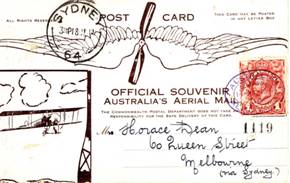 A
re-enactment of Guillaux’ mail flight will take place on July 12-14 2014,
between Melbourne and Sydney. There will be two mail-carrying aircraft: a Jabiru,
a modern Australian lightweight sports aircraft of similar weight and engine
capacity to Guillaux’ Bleriot will carry exactly 1785 postcards, the same
number as was carried on the original flight and based on the originals. These
unique philatelic items can be purchased from the website.
A
re-enactment of Guillaux’ mail flight will take place on July 12-14 2014,
between Melbourne and Sydney. There will be two mail-carrying aircraft: a Jabiru,
a modern Australian lightweight sports aircraft of similar weight and engine
capacity to Guillaux’ Bleriot will carry exactly 1785 postcards, the same
number as was carried on the original flight and based on the originals. These
unique philatelic items can be purchased from the website.
A relay of historic aircraft will carry a load for Austalia Post.
Both aircraft, with anyone else who would like to join in, will
follow the route pioneered by Guillaux, with major celebrations at each stop. The
flight’s conclusion will be the centrepiece of Sydney’s Bastille Day
Celebrations.
To find out more, go to www.australiasfirstairmail.com .
Are you a light aircraft owner who would like to join the flight? If you would like to take part in the commemorations, or you would like to help in any way, please email guillauxcentenary@gmail.com .
Tom
Lockley, PO Box 301, Pyrmont NSW 2009, co-ordinator, 0403 615134. Appreciation to the work of
Nelson Eustis, which provided many facts for this account. We hope that the
re-enactment will bring to light more information about this flight,
particularly as it affected Seymour and Wangaratta.