 Maurice Guillaux in Goulburn
(and related
matters)
Maurice Guillaux in Goulburn
(and related
matters)
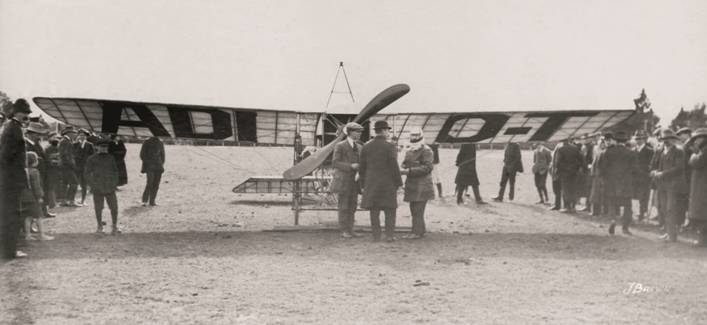
 This
wonderful photograph, from the collection of the Rocky Hill War Memorial and
Museum at Goulburn, shows the aircraft on the ground at Goulburn Racecourse.
The man wearing a cap in the centre group is Clyde Baxter, of the Baxter Shoe
Factory; he later volunteered for overseas service in World War I. Next, back
to camera, is probably the Mayor, Alderman Betts, and Guillaux is on the right.
This
wonderful photograph, from the collection of the Rocky Hill War Memorial and
Museum at Goulburn, shows the aircraft on the ground at Goulburn Racecourse.
The man wearing a cap in the centre group is Clyde Baxter, of the Baxter Shoe
Factory; he later volunteered for overseas service in World War I. Next, back
to camera, is probably the Mayor, Alderman Betts, and Guillaux is on the right.
Maurice Guillaux, a
French pilot specialising in aerobatic displays, spent less than 200 days in
Australia in 1914. His most amazing flight took place on 16-18 July, 1914. He
flew a small mailbag, containing 1785 specially printed postcards and a few
freight items, from Melbourne to Sydney. This established a world record for
this type of flight and was one of the great feats of early aviation. However
its memory has largely been lost because it occurred just before the outbreak
of World War I, which dominated all news reporting.
In the centenary year
of this flight we are making a big effort to collect all available information.
If you have souvenirs, pictures or other memorabilia of Guillaux, please email guillauxcentenary@gmail.com
with details. Read the brochure Maurice
Guillaux – Who was he and why is he important for a general coverage of his
work in Australia.
Tom Lockley
Aviation
Historical Society of Australia(NSW)inc
Air Mail Centenary Commemoration Group
Website: www.australiasfirstairmail.com
The
Goulburn Penny Post, as it then was, had reported on
Guillaux’ activities from the moment his ship, SS Orontes, landed at Freemantle. Like other newspapers, its
coverage was adulatory – for example, from a May 5 report of his Sydney
performance: ‘Harry
Hawker, with the last word in racing biplanes at his disposal, invested flying
with a new meaning for the Australian public early in the year, outstripping
the flights of previous performers handicapped by comparatively crude machines,
so did Guillaux demonstrate the daring possibilities of aerial acrobatics in a
manner that Hawker's feats never suggested. Leisurely climbing to vast aerial
heights; diving like a falling rocket stick hundreds of feet at a time;
throwing back somersaults in quick succession; heeling over at an angle that
only missed the perpendicular by a degree or two; even flying upside down – this was mastery of the air indeed!’
Goulburn played an important part
in the main event of Guillaux’ time in Australia, namely the carriage of air
mail and air freight from Melbourne to Sydney, 16-18 July 1914.
He left Melbourne Showground, Flemington, at 9 12 am on 16 July, and on that
day flew via Seymour, Wangaratta, Albury and Wagga Wagga
to Harden. Here he was detained for a full day because of adverse weather, then
flew on early on the following day to Goulburn, where he arrived at 9 15 am
after a two-hour flight. Though his aircraft normally cruised at about 60 mph
(100 km/hr) he was only able to average 47 mph because of headwinds. Apart from
that it was bitterly cold: a beacon fire had been lit for him at Goulburn
Racecourse, and he rushed to it to warm up as soon as he landed!
The coverage of the mail flight reflected the rather
disorganised nature of the planning. The American, ‘Wizard’ Stone, had been
hired by real estate developer Arthur Rickard to carry out the mail flight, and
elaborate postcards had been prepared and sold. When Stone crashed on June 1,
he was injured and his aircraft badly damaged, and Rickard approached Guillaux
and the visiting Italian airman Bianchi to take over the task. Negotiations
were not smooth, but eventually Guillaux agreed to carry the mail. New
postcards were quickly printed.
The first plan proposed by Guillaux’ team was to fly from
Melbourne to Goulburn on the first day, stay overnight, and take off for Moss
Vale at the following morning at 9 am, and arrive in Sydney about 2pm. A basic
problem was costs. The Mayor, Alderman Betts, had asked that no charge be made
by Guillaux for public entry to the proposed landing site, the northern part of
Victoria Park. Guillaux’ organisation would not have been happy about this:
even if he got all the proceeds from postcard sales at one shilling or two
shillings each, this would not have equalled the amount he could raise by a
single afternoon’s flying display which might have thousands of onlookers
paying similar amounts.
By Saturday 11 July, new plans were announced. M Rupeausseu, of Guillaux’
organisation, had written stating that Guillaux would be in town the following
Saturday. The racecourse would be used for the landing. An excited Post article the following Tuesday noted
‘it is fortunate that the first exponent of the art of aviation
to be seen locally should be one of the calibre of M. Guillaux, who has been
setting Sydney, Melbourne, and other towns agog by his wonderful feats’. He
would arrive in Goulburn between12 noon and 1 pm on Friday, and give an
exhibition of flying on the racecourse – ‘looping the loop, giving displays of
high and low flying and perform other feats’. Entry to the showground would
cost 2 shillings with an extra one shilling for entry to the grandstand.
![First flight from Melbourne to Sydney showing pilot Maurice Guillaux standing on a Bleriot monoplane with a 50 horsepower Gnome engine, Wangaratta, July 1914 [picture].](10%20Goulburn_files/image007.jpg) On Thursday 16 July the Post recorded that Guillaux would leave
the Royal Agricultural Showgrounds, Melbourne, at 9 o'clock that morning,
stopping at Seymour, Wangaratta, Albury, and Wagga on the first day; at Harden
and Goulburn on the second day; and at Moss Vale on Friday, arriving in Sydney
at 3pm Saturday. This plan was obviously designed to arrive in Sydney at the
best possible time, landing at Moore Park at a time convenient to the football
crowds.
On Thursday 16 July the Post recorded that Guillaux would leave
the Royal Agricultural Showgrounds, Melbourne, at 9 o'clock that morning,
stopping at Seymour, Wangaratta, Albury, and Wagga on the first day; at Harden
and Goulburn on the second day; and at Moss Vale on Friday, arriving in Sydney
at 3pm Saturday. This plan was obviously designed to arrive in Sydney at the
best possible time, landing at Moore Park at a time convenient to the football
crowds.
Guillaux
at Wangaratta, NLA pic vn372553v
In the event, Guillaux reached Harden on the first day, but was
prevented from flying on for a whole day by weather conditions. Against the
advice of M Maistre, his manager, who was in Goulburn, he did leave Harden at
2pm on the Friday; the Goulburn people heard of this and rushed to the
racecourse, the children from Bourke Street School being given a half-holiday
for the purpose. However at 4pm it was announced that Guillaux had been forced
to return to Harden because of adverse winds and freezing conditions.
The next day Guillaux left Harden at 7 15 am and exactly two hours later
reached Goulburn. He battled adverse winds and freezing conditions; when he
landed he rushed to get warm at the beacon fire that had been lit on the
racecourse. Relatively
few people were there to welcome him, but he Post description was ecstatic – ‘with the grace of a bird selecting
a resting place M Guillaux issued from the clouds to the west of South Hill
shortly before half-past nine this morning, and soaring gracefully over the
eminence descended with a swoop at the southern end of the racecourse and
alighted almost in the centre of the ground’. He stood by the fire, warming
himself and drinking a cup of tea from the thermos he carried with him.
The Post article is a little disjointed:
probably it was rather rushed so as to be included in that day’s edition. It
does not mention the brief welcoming ceremony that is depicted in the picture
on the cover of this pamphlet. Through an interpreter, Guillaux described the
freezing conditions and the difficulty of navigation; early in the trip he
claimed to have climbed to 13000 feet and navigated by compass; he flew over
snow-covered mountains. Near Goulburn he had descended below the cloud base,
and had to pick his way around tall hills.
Guillaux
himself checked his machine very carefully, and supervised the refuelling,
making sure that smokers kept well away. While it was being refuelled, two
swans flew over; someone in the crowd compared them with the Bleriot, and
Guillaux joined in the laughter.
Guillaux did
not give an aerial display, and there is no mention of admission being charged.
Many people crowded around the plane, examining it carefully. The canvas of the
aircraft had many signatures of Harden residents written in pencil.
He took off
at 10 am, but was forced to return because of a faulty spark plug. Before his
next take-off he ran the engine at high power, with the aircraft’s wheels
chocked and three men holding down the tail. ‘The suction from the propeller
blades was so strong that the men's clothing blew about as if in a gale of wind
and their hats were carried away’...... ‘On his second ascent the airman rose
to a height of 1100 feet. He circled the race course and then flew in the
direction of Murray's Flat, where he altered his course slightly, evidently to
give the people at Kenmore Hospital an opportunity of seeing him’.... ‘It was
amusing to watch the horses stampede across the paddocks and a number of birds
flying for safety. Guillaux makes the birds look trivial when he takes charge
of the air.’
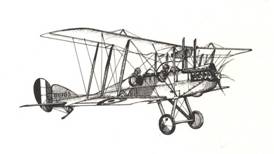 Incidentally, the second aircraft to reach Goulburn did not have as happy
an experience. W J Stutt, Chief Instructor from the
NSW State Aviation Flying School at Richmond flew to Melbourne with Mr A G F
Jones, Minister for Public Instruction as passenger. He arrived in Goulburn,
via Golspie (details of this interesting stop are not known) at 8 30 on the
morning of Thursday 1 November 1917. They were flying in one of the new Curtis
JN ‘fast biplanes’ that had recently been acquired.
Incidentally, the second aircraft to reach Goulburn did not have as happy
an experience. W J Stutt, Chief Instructor from the
NSW State Aviation Flying School at Richmond flew to Melbourne with Mr A G F
Jones, Minister for Public Instruction as passenger. He arrived in Goulburn,
via Golspie (details of this interesting stop are not known) at 8 30 on the
morning of Thursday 1 November 1917. They were flying in one of the new Curtis
JN ‘fast biplanes’ that had recently been acquired.
For the re-enactment flight, the Jabiru re-enactment
aircraft is scheduled to arrive in Goulburn from Harden at 9 55am on
Monday, 14 July 2014. John Ferrara of the airport and Bob
Piper, historian, are organising the reception of the aircraft. We
hope to have a formal handing-over and receiving of mail, involving local
government and postal authorities, and there may be other aviation-related
events. This is to be arranged, and any Goulburn group that would like to
participate is very welcome! Please contact Tom Lockley, email guillauxcentenary@gmail.com with
ideas or suggestions, and to get on the email list for more information as
the project develops!
After being
welcomed by the Mayor, Alderman Wood, the two airmen were taken to breakfast at
the Mayor’s home, ‘Carlton’, hosted by Miss Wood, and returned to the aircraft
at 9am. However, on take-off, the aircraft hit a pole and was damaged.
According to the Post parts were sent
from Richmond and the aircraft was repaired and left Goulburn on the following
day. I once spoke to an eyewitness who said that the pilot was taking off into
the sun and did not see the pole, and that the damage was to wooden parts and
was repaired by local craftsmen, using the Technical College facilities.