The History of the
New South Wales State Aviation School

In March of 1912, the Australian Aviation Pioneer
and Parramatta Dentist William Ewan Hart bought part of Ham Common, near
Clarendon and Richmond in New South Wales. He claimed the area was;"the
finest site in Australia for an aviation ground."
The land Hart bought was originally part of the
original land grant made by the Governer of New South
Wales to William Ezzy. Hart had a serious accident in
September of 1912 flying his self designed and built aircraft, Hart didnt return to flying with any haste and Ham Common saw no
aircraft take off within it's boundaries until in September of 1914 a
Frenchman, Maurice Guillaux started a flying school on the Common. Guillaux was
to carry the first air mail in Australia from Melbourne to Sydney, but Guillaux
left for France in October of 1914 and another Frenchman took his place, M.J.C.
Marduel. Marduel also left
to return to France and enlist with the French Services. Before Marduel departed he took the then NSW Government Minister
for Public Instruction, Mr Carmicheal, up in flight
from Parramatta to Richmond.
The flight Mr Carmicheal
took with Marduel may have had some influence on NSW
government thinking, as one year later the NSW Government took the decision in
Parliament to establish a civil aerial training school in Sydney with the
intention of producing military pilots for the Australian Flying Corps while
Australia was still at war, and after hostilities had ended, training civil
pilots. This was a particurely far sighted Government
decision for it's day but an unusual one, as NSW had no defence powers, these
being the responsibility of the Australian Federal Government, and a military
Central Flying School was already established in Point Cook Victoria. It is
possible New South Wales was vying with Victoria for influence and prestige, or
the previous Militia mentality for it's defence which
had been NSW's responsibility pre-1901 may still have existed in the NSW
Parliament. Either way the patriotism of the NSW Government could not be
doubted in this decision.
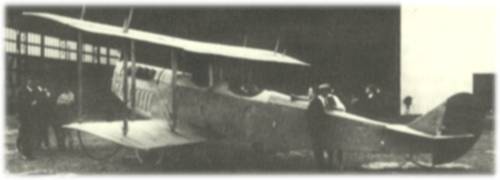
The NSW Government purchased for the flying school
four Curtiss Jenny biplanes, JN3 and JN4 two seaters powered by 90 hp eight
cylinder engines and one Caudron GH two seater with a 35 hp Anzani
engine. A large hangar was built at Ham Common along with a repair shop to
complete with repair machining tools. The hangar cost a total of 12,000 pounds, the two Curtiss aircraft cost 2,840 pounds. Other
purchases the NSW Government made included a motor car, a lorry, plant and
equipment and a spare Curtiss engine.
As instructors for the new school two Australian
pilots, Mr William J Stutt and Mr Andrew Lang arrived
in mid 1916 from England. Both had flown for military work in England. It was
reported Stutt had made 6,000 flights, of which 2,000
of them had been for the Royal Aircraft Factory at Farnborough. Stutt had flown most british
aircraft types, had ferried aircraft across to France and flown many captured
aircraft types as well. Stutt made his first flight
on the 21st of July 1916. He was later to take several local Hawkesbury
dignitaries and NSW Government officials in flights over the Hawkesbury and
Parramatta area's. The school was officially opened by
the State Governer, Sir Gerald Strickland, on the
28th of August 1916 to an audience of 4000 people including the then NSW
Premier, Mr William Holman. The large crowds were afterwards entertained with a
flying display.
The first course at the school began in August 1916
and applicants had to be between the age of 18 and 30, having passed a strict
medical examination, and undertake enlistment in the Australian Imperial Force,
making them eligable for overseas service. By
Australian law any Australian who did not volunteer for military service could
not serve outside of Australia and it's territories.
The new applicants were also required to pay a fee of 60 pounds, which would be
refunded upon enlistment. The course was to last twelve weeks and twenty four
cadets were chosen from a list of two hundred and thirteen applicants. The
Windsor and Richmond Gazette detailed the requirements of applicants;
Applicants must be 18 to 30 years of age. After the
termination of the war applicants, male or female, from 18 to 35 will be
admitted to the school.
During the continuance of the war applicants must
undertake to enlist immediately upon completion of course, for active service
in such branch of the Australian Imperial Expeditionary Forces as the
Commonwealth authorities may determine.
Applications must be accompanied by a medical
certificate, stating that the applicant is physically qualified for aerial
service, and especially that he has a sound heart and good eyesight. A furthur examination will be made before an applicant is
admitted to the school.
Preference will be given to applicants qualified in
one of the follwing ways: - He must hold or have held
a commision in the senior cadets. He must be an
officer or non commisioned officer in the citizen
forces with the rank of sergeant, or higher. He must be a graduate in
engineering, or have completed at least two years course of instruction in
engineering at some university. He must be a mechanic, or in an apprentice of
more than three years standing engaged in one of the following trades, and at
the time of application must present certificates showing that he has has satisfactorily completed a course in engineering, or an
allied subject, at some technical college or trades school : - Boat Builder,
cabinet maker, coachmaker, carpenter, or joiner,
motor mechanic, turner and fitter, machinist, patternmaker, blacksmith, ironfounder, brassfounder,
moulder, boiler maker, shipwright, electrical fitter, or electrician, or be or
have been employed in the engineering workshop. He must also possess a fair
knowledge of internal combustion engines. After the termination of the war such
male or female applicants as may be approved by the committee. All students
entering the school do so at their own risk. No compensation will be payed on
account of death of, or injury to, a student attending the School of Aviation.
The committee reserves to itself the right to remove at any time any student
whose progress and conduct are not considered satisfactory.
Applications were invited and nearly 300 applicants
expressed a desire to enter the school. All those who were eligable
on the score of fitness and suitability were interviewed personally by the
committee of control, who made a selection based upon the latest advice of the
British authorities.The applicants were thinned out to
25, which is at present the limit of successful tuition. These students will
enter upon 12 weeks course of practical training on August 12.
At the termination of the course an examination
will be held by examiners appointed by the Commonwealth military authorities,
and if succesful a certificate will be issued to that
effect. If unsuccessful in passing the examination, the student, provided he
has the necessary mechanical ability, will be given a certificate stating that
he is suitable for employment as an aviation mechanic.
During the continuance of the war students will be
given an allowance of 6s a day for seven days per week while actually in
attendance at the school.
Arrangements are now being made for the official
opening of the school of aviation a few days subsequent to the entry of the
students upon the course.
Of the twenty four students in the course, ten were
selected for commissions in the Australian Flying Corps, eight others left for
England to join the Royal Flying Corps and one, David Williams was chosen to
remain as an assitant instructor. Five others failed
the course. The second course ended in April 1917 and David Willaims
was anxious to fulfill the requirement that he join
the AIF. At his own expense and despite the friction between the Ham Common
School and Point Cook, Williams travelled to Victoria and was accepted into the
AFC with a commision. Williams was later asked to
re-establish the NSW Government Flying School in Sydney in 1920 after the war.
In May of 1919, Billy Stutt
recommended Ham Common was undesirable as an aviation school due to it's distance from Sydney and that courses in aviation and
air mechanics, aircraft building and aircraft engineering be undertaken at the
Sydney Technical College. Stutt's recommendation
included that the Australian Defence Department be allowed to purchase the land
at Ham Common for a fair valuation. In July 1920 Ham Common was offered to the
Commonwealth of Australia for 14,118 pounds for the land and buildings. The
following year the newly formed Royal Australian Air Force secured RAAF Airbase
Richmond as the aerodrome of No.2 Wing Headquarters and the home base of No's 3
and 4 Squadrons RAAF. Today the Richmond Airbase is still active as part of the
Australian Defence Forces.