The spy story
After he left Australia, we have very little news of Guillaux. On 20 February 1914 the Moorabbin News reported that he had flown, in France, at 144 mph from Savigny-sur-Seine to Paris, thanks to a strong tail wind.
Flight Magazine, 19 February 1915, p. 129 gives one of the very few mentions of his war activities:
‘…... Guillaux, who, it may be remembered, came
within an ace of winning the Aerial Derby in 1912 on the little Caudron monoplane, is now testing Moranes’.
The Geelong
Advertiser, Saturday 27 February 1915, reported that local man Mr Tivey had
received a postcard from him saying that he was off to the front to undertake
reconnaissance missions. On 10 May 1915 the
Sydney Morning Herald reported that
he had begun work testing Bleriot
aircraft.
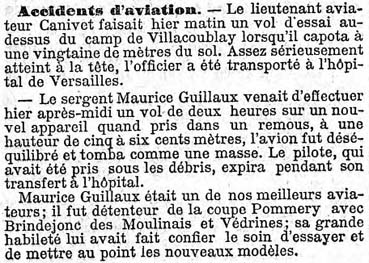
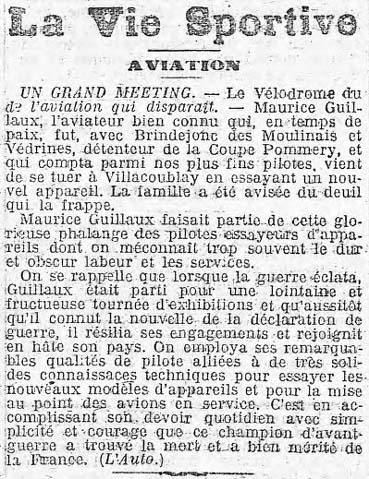
The French newspapers, but not the Australian newspapers, noted his death which occurred on 22 May 1917:
• Le Temps, n° 20.410, Jeudi 24 mai 1917, p. 3, en rubrique « Faits
divers ».
• La Presse,
n° 9.035, Vendredi 25 mai
1917, p. 2.
The start of the spy story
Nothing
more was heard until
21 July 1917 when
Pte.
G. A. Oliver, Motoring Editor of the Mail, wrote a rambling article from London,
in which he said ‘Guillaux
is now rumoured
to be taking an active part inthe war on the German side’. At this stage he had
already been dead for two months.
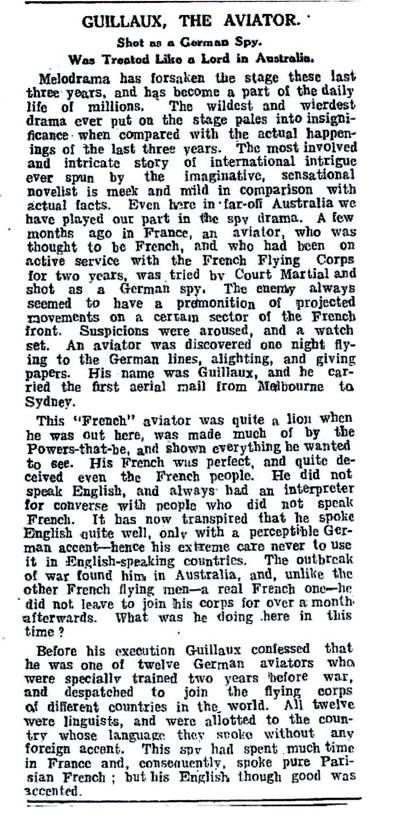
The next
item of news was the detailed description of his activities as a spy and his
consequent execution, printed in the Melbourne
Punch on Thursday, 15 November, 1917,
reproduced on this page..
 It
was taken up by
Euroa Advertiser the next day Friday
16 November 1917, and in the next six weeks it was printed by at least 39 other
newspapers.[i]
It
was taken up by
Euroa Advertiser the next day Friday
16 November 1917, and in the next six weeks it was printed by at least 39 other
newspapers.[i]
On 23 May 1918 Punch retracted its story. On Page 8, without a special heading, in the middle of a column entitled ‘Views and News’, the following may be found:
Some months ago
"Punch'' published a statement that Guillaux, the flying- man who visited
Australia prior to the outbreak of war, and gave a series of exhibition
flights, had been shot in Paris as a spy. M. Raoul Lambert, of Middle Brighton,
states that he had made inquiries from a former Consul General for Prance, who
is now in Paris, and he has been informed that the statements concerning
Guillaux are untrue. On the other hand, Guillaux -was killed, M. Lambert is
informed, while "trying out" aeroplanes for the French Government, and was
awarded a military funeral. We are pleased to give Mr. Lambert's denial as a
contradiction to the statements and rumours that were current not only in
Victoria, but in other States.
51 retractions or corrections were published in various newspapers before the end of the war, but after 23 May the ‘shot as a spy’ story was also repeated 8 more times, its last iteration being in The Argus (Melbourne, Vic. : 1848 - 1957), Saturday 23 November 1940, page 1 (not long after the surrender of France in 1940). It is interesting that this is the only time it was published by papers of the standing of The Argus or The Sydney Morning Herald.
Papers who reprinted the story:
1.
[i]
Euroa Advertiser (Vic. : 1884 - 1920) Friday 16 November 1917 p 3
2.
Violet Town Sentinel (Vic. : 1914 - 1918) Tuesday 20 November 1917 p 3
3.
Castlemaine Mail (Vic. : 1917 - 1918)
Thursday 22 November 1917
p 1
4.
Federal Standard (Chiltern, Vic. : 1914 - 1918)
Friday 23 November 1917
p 2
5.
Murchison Advertiser and Murchison, Toolamba, Mooroopna & Dargalong
Express (Vic. : 1914 - 1918)
Friday 23 November 1917
p 2
6.
Wangaratta Chronicle (Vic. : 1914 - 1918)
Saturday 24 November 1917
Edition: Mornings p 2
7.
The Casterton News and the Merino and Sandford Record (Vic. : 1914 -
1918)
Monday 26 November 1917
Edition: Bi-Weekly p 4
8.
Rutherglen Sun and Chiltern Valley Advertiser (Vic. : 1914 - 1918)
Tuesday 27 November 1917
p 2
9.
The Gundagai Times and Tumut, Adelong and Murrumbidgee District
Advertiser (NSW : 1868 - 1931)
Tuesday 27 November 1917
p 2
10.
Tungamah & Lake Rowan Express and St. James Gazette (Vic. : 1914 - 1918)
Thursday 29 November 1917
p 2
11.
Chiltern and Howlong Times and Ovens Register (Vic. : 1914 - 1918)
Tuesday 27 November 1917
p 2
12.
Upper Murray & Mitta Herald (Vic. : 1914 - 1918)
Thursday 29 November 1917
p 2
13.
Myrtleford Mail and Whorouly Witness (Vic. : 1914 - 1918)
Thursday 29 November 1917
p 5
14.
Queanbeyan Age and Queanbeyan Observer (NSW : 1915 - 1927)
Friday 30 November 1917
p 2
15.
Albury Banner and Wodonga Express (NSW : 1896 - 1938)
Friday 30 November 1917
p 26 ‘said to be a German Spy’
16.
Young Witness (NSW : 1915 - 1923)
Friday 30 November 1917
p 2
17.
Tocumwal Guardian and Riverina Echo (NSW : 1913 - 1918)
Friday 30 November 1917
p 2
18.
Windsor and Richmond Gazette (NSW : 1888 - 1954)
Friday 30 November 1917
p 4
19.
Mortlake Dispatch (Vic. : 1914 - 1918)
Saturday 1 December 1917
p 2
20.
Barrier Miner (Broken Hill, NSW : 1888 - 1954)
Wednesday 5 December 1917
p 4
21.
The Bathurst Times (NSW : 1909 - 1925)
Monday 3 December 1917 p
4
22.
Leader (Orange, NSW : 1912 - 1922)
Wednesday 5 December 1917
p 5
23.
The Richmond River Herald and Northern Districts Advertiser (NSW : 1886
- 1942)Tuesday
4 December 1917
p 2
24.
The Register (Adelaide, SA : 1901 - 1929)
Saturday 8 December 1917
p 4
25.
Kalgoorlie Miner (WA : 1895 - 1950)
Wednesday 12 December 1917
p 4
26.
Dungog Chronicle, Durham and Gloucester Advertiser (NSW : 1894 - 1954)
Friday 14 December 1917
p 2
27.
Examiner (Launceston, Tas. : 1900 - 1954)
Saturday 15 December 1917
Edition: p 2 also
rehashing his disqualification from the Pommery Cup
28.
The Urana Independent and Clear Hills Standard (NSW : 1913 - 1921)
Friday 21 December 1917
p 1
29.
Bunbury Herald (WA : 1892 - 1919)
Saturday 29 December 1917
p 3
30.
Kalgoorlie Miner (WA : 1895 - 1950)
Wednesday 12 December 1917
p 4
31.
The Kiama Independent, and Shoalhaven Advertiser (NSW: 1863 - 1947)
Wednesday 12 December 1917
p 2
32.
Wellington Times (NSW : 1899 - 1954)
Thursday 13 December 1917
p 7
33.
Canowindra Star and Eugowra News (NSW : 1903 - 1907; 1910 - 1922)
Friday 14 December 1917
p 7
34.
The Blue Mountain Echo (NSW : 1909 - 1928)
Friday 14 December 1917
p 3 (‘The news that Guillaux,
the aviator, has been shot as a German spy will come as a great shock’)
35.
Windsor and Richmond Gazette (NSW : 1888 - 1954)
Friday 7 December 1917 p
2 – a witness recalled that he
was slow in taking off his hat when the Marseillaise was played, and
showed no emotion
36.
Goulburn Evening Penny Post (NSW : 1881 - 1940)
Saturday 8 December 1917
p 4 – (‘a report, for the
accuracy of which we can not vouch’)
37.
Forbes Times (NSW : 1912 - 1920)
Friday 7 December 1917 p
8
38.
Southern Star (Bega, NSW : 1900 - 1923)
Saturday 8 December 1917
p 1
It is clear that the stories all come from the same
source; It was very common for other papers simply to
‘lift’ stores from a source. There are a few 'Chinese whisper' variations as the
story spread..
Bill Woerlee has dissected this article as follows:
A few months ago in France, an aviator, who was thought to be French,
and who had been on active service with the French Flying Corps for two years,
was tried by Court Martial and shot as a German spy.
GUILLAUX died on 24 May 1917. However, no news of
his death was carried in any of the Australian or New Zealand newspapers. This
was a piece of particular information that only few people would have been
privy to and confined to friends and a few interested government officials. The
French authorities had no obligation or need to transmit this information
through official channels so the knowledge was unofficial.
That means the circle of those in the know could
not have extended to more than about a hundred people in Australia (and this is
a generous figure based upon friends and family of friends and friends of those
families coupled with a dozen government officials) confined mainly to Sydney
but a small group in Melbourne.
Following the broadcast of the story through the
media, it is obvious that the story originated in Melbourne although it may not
have been written in Melbourne.
(Bill was obvously not familiar with the .
The enemy always seemed to have a premonition of movements on a certain
sector of the French front. Suspicions was aroused, and a watch set.
This was entirely a creation of paranoid fantasy.
The French and British did feel that the Germans were getting advanced notice
of their attacks. Many Belgian and French housewives doing their daily washing
were arrested during this time and accused of spying for Germany. Certain
coloured sheets signified some sort of movement to the Germans. It was obvious
to those on the ground. Many a woman had to plead for their lives on the basis
of these wild allegations.
The fact that using the same methods of attack over
and over again did not seem to register that this was the tip off.
So building on this paranoia, the author cleverly
wove this concept into the story to give it gravitas. It was an addition that
clearly came from someone well read in the problems faced on the Western Front.
Possibly a person who returned.
An aviator was discovered one night flying to the German lines,
alighting and giving papers.
This line sounds so plausible if it is taken at
face value. The clever author wove this line in realising that no one would
question the methodology. After all, none of the readers would have either the
experience or the sophistication associated with such a mission to spot the
obvious problems.
And the obvious problem is the ability for an
aircraft, on a military airfield to take off surreptitiously without anyone
noticing at all. In the silence of a night, the pilot would have to walk to the
aeroplane, fill it up, crank it to start, pull the chocks away without the
aircraft flying off without him, jump on board and take off in the dark without
any guidance and all the time hoping that the base guards don't hear the
engine, let alone see the flames coming from the manifold as the engine takes
off. All this without waking the whole airfield. It
defies belief.
Similarly landing to deliver documents.
To know this, another aircraft would have had to
have been mobilised at the same airfield. A nearby airfield alerted by a
telephone call would not cut it because no one would know the direction the
errant aircraft was flying and so interception would have been impossible. Now
to take off and follow the errant aircraft would have meant a quick scramble.
Assuming the pursuit pilot was able to follow the
errant aircraft, the next question just jumps out. In the dead of night, from a
great height so as not to give the game away - the pursuit aircraft would be
making quite a din which would alert any German guard at the airfield where the
errant pilot landed - so the aircraft would have to fly at a fair height to
disguise the noise. To do this was necessary so the errant pilot would return
feeling as though he was undetected. Under these conditions, how on earth did
the pursuit pilot have the vision to get visual confirmation that the errant
aviator alighted and handed over papers. In the dark
at 100m this would be impossible so at a height of say 1,000m this would have
been risible evidence.
The return flight would have been equally perilous.
No lights, no navigation points and nothing to give guidance to the errant
pilot as to the airfield from which the mission originated
nor to land without any navigation aids.
So the flight described would have been basically
impossible to accomplish unless there was quite a support team assisting the
errant pilot. The article makes it clear that this was a solo endeavour so it
is just an impossibility.
It is a clever invention woven into the story for
the benefit of those credulous readers who did not have the faculty or
experience to discern the veracity of the construction. Hence
why the story made the rounds in rural Australia rather than being picked up by
the major metropolitan dailies or weeklies.
This "French" aviator was quite a lion when he was out here,
was made much of by the Powers that be, and shown everything he wanted to see.
His French was perfect, and quite deceived even the French people.
This is quite an interesting twist. The author is
deliberately suggesting that GUILLAUX was not French. Without stating where he
was actually born and raised, the author is inferring that it was not France.
There is no location given so the author does not have to prove anything. The
statement, at face value, only questions the description of ethnicity.
The comment "His French was perfect, and quite
deceived even the French people." implies an alternative origin rather
than France. of course, if he was born and raised in
France, his French would be perfect and not deceive anyone with the
intonations. If he came from another place, unstated, also left to the
imagination of the reader is where this so called French mole was trained.
And here is the rub. A spy would be trying to
maintain a low profile. Yet GUILLAUX went out of his way to be noticed. And the
author of the piece makes it clear that this was so.
This contradiction does not sound queer if the
reader fills in the blanks with their own prejudices which was
specifically the author's intent. The two sentences are a clever insinuation
without making any factual claim.
He did not speak English, and always had an interpreter for converse
with people who did not speak French. It has now transpired that he spoke
English well, only with a perceptible German accent - hence his extreme care
never to use it in English-speaking countries.
Here again is a clever construction which tells a
truth that GUILLAUX "... always had an interpreter for converse with
people who did not speak French." If GUILLAUX's mother language was French,
then one would expect this. And the author makes this point.
Then he goes onto conjecture.
"It has now transpired that he spoke English
well, only with a perceptible German accent - hence his extreme care never to
use it in English-speaking countries."
The author does not tell the audience where this so
called transpiration took place. No evidence is offered and yet the sentence
has all the appearance of being constructed from a piece of hard evidence.
There is no doubt that GUILLAUX understood and spoke
very poor English. It was a necessity. So any English spoken would have been
accented. We are not told who determined that his English speech occurred with
a German accent. The audience is left to adduce this in line with the
prejudicial comments within the text and the context of the article.
The outbreak of war found him in Australia, and, unlike the other French
flying men real French ones - he did not leave to join
his corps for over a month afterwards. What was he doing here in this
time?
And this is a particularly nasty piece of
insinuation.
There is a mixture of truth and fabrication
together. When the war broke out, he remained in Australia until the end of
August when he joined the convoy going to Egypt. This was his first opportunity
to depart after being laid up in hospital recovering from a crash in his
Bleriot aircraft. That was what he was doing during that time.
See: GUILLAUX's
return to France, 1914.
The author relied up the reader
not knowing this information and so draw a negative message.
This is a vicious slander relying upon the
ignorance of the reader.
Before his execution Guillaux confessed that he was one of twelve German
aviators who were specially trained two years before war, and despatched to
join the flying corps of different countries in the world. All twelve were
linguists, were allotted to the country whose language they spoke without any
foreign accent.
This comment is an amazing allegation which only those privy to the Court Martial Documents and
interrogations would know. The impression is that this is precisely where it
was derived. The aim is to give this story the ring of authenticity to
it.
The reason for these men being despatched two years
before the war was to explain when GUILLAUX received his flying certificate,
which was French Aviators Certificate No. 749, awarded on 19 February 1912. The
author obviously knew the date of GUILLAUX's certification to craft this section.
Now if GUILLAUX confessed to being one of twelve,
given the details elicited, one would expect the names and locations of the
other eleven to have been obtained by the interrogators. After all, they were
able to get the plan. The names should have been easy after GUILLAUX gave up
the key information. And yet the story is silent upon the other eleven to the
point of not even venturing a location for some of them or an indication that a
few had already been caught and executed subsequent to the capture of GUILLAUX.
But this information is not offered. The readers are left to draw their own
conclusions.
This spy had spent much time in France and, consequently, spoke the pure
Parisian French; but his English though good was accented.
Here we have another excellent insinuation.
If GUILLAUX was French from birth, he would have
spent much time in France and because of his location for his adult life in
Paris, spoke pure Parisian French. This all goes without saying.
But if one aims to insinuate something sinister,
the emphasis of natural residency is exchanged for the idea of residency with a
purpose, then a completely different reading of plain facts occur.
Bill’s
conclusions
There is no doubt that the author of this piece was
well versed in the craft of writing. The person was highly literate with the
ability to craft a story that would resonate quickly. It would need to be fact
woven with fiction drawing the reader to the inevitable conclusion that the
author cited the information from an authoritative source.
Other evidence against the claim
We have no German confirmation post Great War of
any German espionage activities.
Certainly he was accepted for military service
early in his career. He spoke about the uses of aviation for military purposes and
was keen to return to France. Some articles mention that it took a few months
from the beginning of the war before he sailed to France, but this was because
he was in hospital to recuperate from serious injuries resulting from a crash
on August 2 1914.
The first denial of the story did not occur until 21 December[i]
and an official denial did not come until the middle of 1918.[ii]
This tardiness on the part of French authorities is cited by supporters of the
spy allegations as evidence that there was truth in the story, but it is more
likely that the ‘different’ French community in Australia was feeling the
effects of Australian prejudices and did not want to attract attention by
denying the rumour.
On 23 May 1918 Punch retracted its story. On Page 8, without a special heading, in the middle of a column entitled ‘Views and News’, the following may be found:
Some months ago
"Punch'' published a statement that Guillaux, the flying- man who visited
Australia prior to the outbreak of war, and gave a series of exhibition flights,
had been shot in Paris as a spy. M. Raoul Lambert, of Middle Brighton, states
that he had made inquiries from a former Consul General for Prance, who is now
in Paris, and he has been informed that the statements concerning Guillaux are
untrue. On the other hand, Guillaux -was killed, M. Lambert is informed, while
"trying out" aeroplanes for the French Government, and was awarded a military
funeral. We are pleased to give Mr. Lambert's denial as a contradiction to the
statements and rumours that were current not only in Victoria, but in other
States.
51 retractions or corrections were published in various newspapers before the end of the war, but after 23 May the ‘shot as a spy’ story was also repeated at least 8 more times. Perhaps the last iteration was on page 1 of The Argus of Saturday 23 November 1940. (not long after the surrender of France in 1940). It is interesting that this is the only time it was published by papers of the standing of The Argus or The Sydney Morning Herald.
[i] The Richmond River Herald and Northern Districts Advertiser (NSW : 1886 - 1942), Friday 21 December 1917
[ii] The Argus (Melbourne, Vic. 1848 - 1957), Tuesday 30 July 1918, page 6
Guillaux was also defended in the Sydney
Morning Herald, Thursday 25 July 1918, page 8
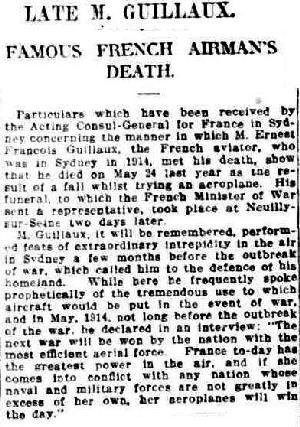
Transcript:
LATE M. GUILLAUX.
FAMOUS FRENCH AIRMAN'S DEATH.
Particulars which have been received by the Acting Consul-General for
France in Sydney concerning the manner to which M. Ernest Francois Guillaux,
the French aviator, who was in Sydney in 1914, met his death show that he died
on May 24 last sear as the result of a fall whilst
trying an aeroplane. His funeral to which the French Minister of War sent a
representative, took place at Neullly-sur-Seine two days later.
M Guillaux it will be remembered performed feats of extraordinary
intrepidity In the air in Sydney a few months before the outbreak of war, which
called him to the defence of his homeland While here he frequently spoke
prophetically of the tremendous use to which aircraft would be put in the event
of war, and in May 1914 not long before the outbreak of the war he declared in
an interview: "The next war will be won by the nation with the most
efficient aerial force. France today has the greatest power in the air and if
she comes into conflict with any nation whose naval and military forces are not
greatly in excess of her own, her aeroplanes will win
the day."
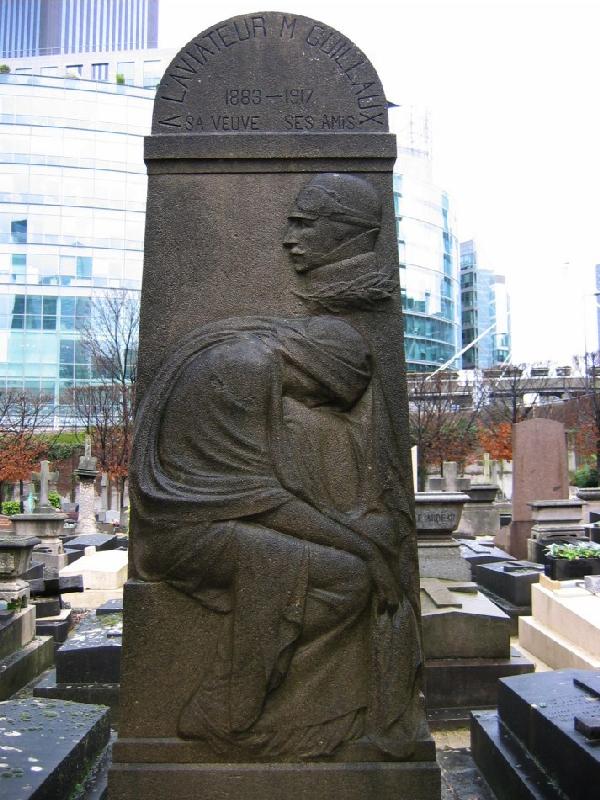
Maurice GUILLAUX's tomb at Neuilly-sur-Seine
If Guillaux had indeed been shot as a spy, his body
would never have been preserved by a monument such as his grave at Neuilly-sur-Seine
Bill Woerlee’s investigation is extremely detailed and thorough.
His conclusion that the story is untrue. He suspects
that it was a product of the times, with anti-German phobias rampant. He
describes the hysteria about spies, giving multiple examples..
‘[this type of thing]
stirred up a great deal of paranoia. People began to see spies
everywhere’. In this climate the Guillaux story would find ready acceptance.