First Flight
http://predecimal.nf/first.htm
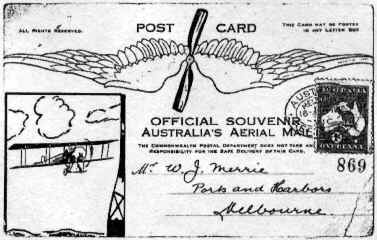
.
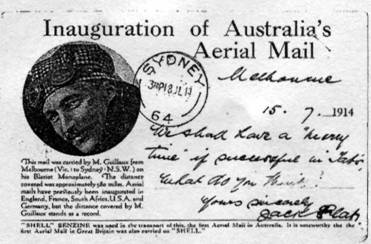
Reverse of above card -back stamped Sydney
Our first official aerial mail carried in Australia
- July 16-18, 1914. It was flown from Melbourne to Sydney by the French aviator
Maurice Guillaux. Souvenir cards were issued, as illustrated, and the post
office provided a special cachet for articles carried by the plane. The cards
sold for 1/- each and postage required was 1d and all mail was cancelled at
Melbourne with the oval violet cachet Australia, Melbourne, 16th July 1914 via
Aerial mail .
The Commonwealth Postal Department did not take any
responsibility for the safe delivery of the mail. Back stamped Sydney 18th July
1914 the total mail weighed 40 lbs, approximately 2,500 items. This flight was
the most important in Australian aviation prior to World War I.
The Australian Airmail Catalogue mentions
that some forgeries of the cards and a few letters exist.
The story of this remarkable flight, organised by a
Sydney entrepreneur Arthur Rickard, was certainly an epoch in Australian
history worth reporting.
Guillaux's Time Table: Melbourne depart 912am. This was 12 minutes
later than he intended hut the mail from the General Post Office was late in
arriving. Guillaux was waiting beside the cab of his machine on the oval at the
Royal Agricultural Showgrounds at Flemington and the mechanical staff had given
the plane a thorough overhaul and it was ready to start. Wandong, 34 miles out,
was passed at 925am. The press of the day reported - The Aviator passed over
Wandong at an altitude of 300 feet causing plenty of wonderment amongst the
people and consternation amongst the farm animals. Dogs barked, fowls cackled,
horses neighed and pranced about and with a final stare, kicked up their heels.
The Aviator could be plainly seen, comfortably
seated. He followed the railway line from Seymour to Wangaratta where he arrived
at 1140am and was greeted by people and left at 1215pm. The Flour Mill blew its
whistle to notify the people at Chiltern he was coming. The streets were lined
with spectators. The airman was travelling about fifty miles an hour and it was
bitterly cold. Approaching the racecourse at Albury, he made a steep descent
from about 2,000 feet and made a perfect landing in front of the grandstand. He
refuelled and oiled the machine and then went to lunch.
Wagga was the next destination, 268 miles from
Melbourne and he left in a strong wind and covered the 84 miles to Harden in
sixty minutes, his best speed from
place to place. The roughest journey he had ever experienced was between
Harden and Goulburn. He was tossed about until he was very airsick and decided
to return to Harden before dark. His wrists were aching from tugging at the
controls. He was beset with perils. The news from Goulburn was not good as
there was no sign of the storm abating.
He left Harden at 715am on the Saturday morning and
into terrible head winds. It was difficult to keep the plane steady and
impractical to follow the railway line so he steered across country over two
big lakes, George and Bathurst. On the whole 94 miles to Goulburn there was not
an inch of clear ground and had the engine failed the flight would have been at
an end. As it was the journey occupied two hours.
A big fire had been lit at Goulburn on the
racecourse and Guillaux was glad to warm his frozen limbs. Leaving Goulburn at
1105am, he found as he was approaching Yass, he had to
climb to 10,000 feet. Soon again, he was in heavy cloud and had to steer by
compass. He rarely saw the railway line hut mountain peaks were always in view.
-
He was not due in Sydney until after 300pm and his
maps did not carry him any nearer to Sydney than fifty miles but he saw a
township in his path and open ground, so Guillaux alighted and found he was at
Liverpool at 23 minutes to 100pm. The wind was still squally and he was carried
at tremendous pace over the Sydney suburbs approaching the football ground.
People were cheering and he waved his acknowledgment and landed in a blinding
storm. He was cold and very happy - he had delivered the mail.
The sense of wonder and admiration his journey
created was captured in the newspapers of the day that published his story.
Much was made of the fact that the flight was made in mid winter, over the most
mountainous part of the continent and he was flying over country unfamiliar to
him with maps designed for surface travellers.
Guillaux
left Australia in August 1914 to join his country's air service. He was
attached for a short time in 1917 to No.5 Squadron, Australian Flying Corps as
an instructor, then stationed in England. He was
killed in a crash on May 22, 1917 at Villacouhlay,
France.