 Aviation
Historical Society of Australia
Aviation
Historical Society of Australia
Air Mail Centenary Commemoration Group
Newsletter 2: November 6, 2013
For newcomers: who we are, what are we doing, and why....
![Darge, Algernon, 1878-1941. Maurice Guillaux in his Bleriot XI monoplane holding aerial mail bag at the Agricultural Society's show grounds before flying to Sydney on first air mail delivery, Melbourne, 16 July 1914 [picture]](newsletter2_files/image004.jpg) In mid-July 1914, French aviator Maurice
Guillaux flew from Melbourne to Sydney, seated on his
flimsy Bleriot XI aircraft. The journey took 2 days, 5 hours and 43 minutes,
and he carried 1785 postcards (Australia’s first air mail) and some Liptons Tea
and some lemon cordial (Australia’s first air freight). At the time this was
the longest such flight in the world: it was front-page news. However, two
weeks later, World War I broke out, and Guillaux’ epic feat was largely lost to
historic memory.
In mid-July 1914, French aviator Maurice
Guillaux flew from Melbourne to Sydney, seated on his
flimsy Bleriot XI aircraft. The journey took 2 days, 5 hours and 43 minutes,
and he carried 1785 postcards (Australia’s first air mail) and some Liptons Tea
and some lemon cordial (Australia’s first air freight). At the time this was
the longest such flight in the world: it was front-page news. However, two
weeks later, World War I broke out, and Guillaux’ epic feat was largely lost to
historic memory.
The Aviation Historical Society of Australia, NSW (inc) is a group of people dedicated to preserving aviation history and heritage, and we are co-ordinating a re-enactment flight which will occur on 12-14 July next year. A wide coalition of business, aviation groups, historians and philatelists are working together to carry out the re-enactment, which aims not just to recognise the work of Maurice Guillaux, but to showcase the wonderful history of Australian aviation over the past century and more. Now read on....
The re-enactment Aircraft
Several proposals were put before the AHSA committee, and it was decided to have an Australian-designed, Australian-made Jabiru as the symbolic mail-carrying aircraft. Of similar size and weight to the Bleriot, it showcases the latest technology in light sports planes. The Sporting Aircraft Association of Australia, Garland Aerospace, Jabiru Aircraft and many other individuals and groups have combined to organise and support the aircraft.
Our pilot has been chosen!
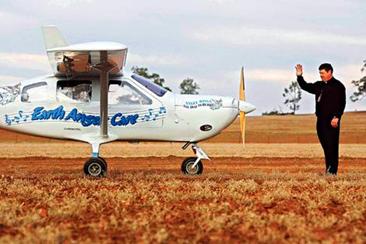 John Fowles of Albury has been nominated
as the pilot of the lead Jabiru. His exploits in his Jabiru are legendary: for
example, in 2007 he flew around Australia, leading a group of eight light
aircraft, keeping to his announced timetable throughout. He is flying his
trusted early-model Jabiru, brought up to date by a full refurbishment
conducted by Garland Aerospace.
John Fowles of Albury has been nominated
as the pilot of the lead Jabiru. His exploits in his Jabiru are legendary: for
example, in 2007 he flew around Australia, leading a group of eight light
aircraft, keeping to his announced timetable throughout. He is flying his
trusted early-model Jabiru, brought up to date by a full refurbishment
conducted by Garland Aerospace.
Jabiru Australia are also making available a second, new model Jabiru.
Planning progress....
We also have a definite route and itinerary for our flight. Guillaux left Flemington racecourse at 9 12 am on 16 July 1914 and flew via Seymour, Wangaratta, Albury, Wagga, Harden, Goulburn and Liverpool to land at Moore Park, Sydney at 2 55 pm on 18 July 1914. He landed in open fields that are now residential areas: his landing at Liverpool was in a paddock just behind the main street! Our route follows the original as closely as is reasonable, using modern airfields. See our itinerary on the next page.
Guillaux landed at Moore Park, near Sydney Cricket Ground, where he was met by the state Governor and by the Governor-General. We are hoping that we can persuade the relevant authorities to let the Jabiru land at the nearby Parade Ground, Centennial Park, where the French community will be celebrating Bastille Day.
Please go to our website, www.australiasfirstairmail.com , and follow the link to our latest plans.
Watch for our next newsletter, early in December.
Our itinerary....
|
Jabiru departs |
time |
destination |
distance (nm) |
ETA |
Time on ground |
|
|
Sunday, 12 July |
Essendon |
09:12 |
Mangalore |
52 |
09:56 |
1 hour 30 minutes |
|
Mangalore |
11:30 |
Wangaratta |
61 |
12:25 |
1 hour 30 minutes |
|
|
Wangaratta |
14:00 |
Albury |
38 |
14:41 |
overnight |
|
|
Sunday, 13 July |
Albury |
08:30 |
Wagga |
60 |
09:22 |
1 hour 30 minutes |
|
Wagga |
11:00 |
Temora |
45 |
11:44 |
1 hour 45 minutes |
|
|
Temora |
13:30 |
Harden |
44 |
14:14 |
overnight |
|
|
Monday, 14 July |
Harden |
09:00 |
Goulburn |
68 |
09:55 |
45 minutes |
|
Goulburn |
10:40 |
Bankstown |
87 |
11:46 |
2 hours 30 minutes |
|
|
Bankstown |
14:20 |
Centennial Park |
38 |
14:55 |
nom 2 hours |
The Jabiru stage times are calculated at a cruising speed of 100 nm/hr and the Jabiru cruises at 115 nm/hr. This should allow for adverse winds. 15 minutes is added to each stage for taxying etc. For full details of the Jabiru course, see http://australiasfirstairmail.com/planningfolder/flightplan/flight_plan%20index.htm.
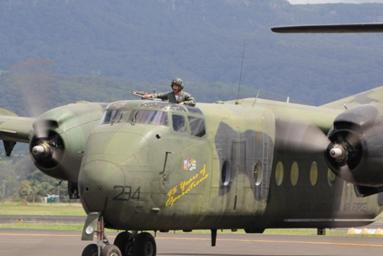 The Jabiru will be accompanied throughout
the journey by two escort aircraft. A de Havilland Caribou, operated by the
Historic Aircraft Restoration Society at Albion Park, will carry any equipment
needed, and will be a wonderful drawcard at each stop en route. People will be
able to get ‘up close and personal’ with this wonderful aircraft. Shell
Australia have expressed interest in supporting the
Caribou, and final details are being worked out.
The Jabiru will be accompanied throughout
the journey by two escort aircraft. A de Havilland Caribou, operated by the
Historic Aircraft Restoration Society at Albion Park, will carry any equipment
needed, and will be a wonderful drawcard at each stop en route. People will be
able to get ‘up close and personal’ with this wonderful aircraft. Shell
Australia have expressed interest in supporting the
Caribou, and final details are being worked out.
It is planned that another all-weather aircraft, funded from sales of philatelic material, will fly ahead of both aircraft to ensure that all goes smoothly at each stop. The Jabirus will also be supported by a mobile workshop that will travel by road, staffed by SAAA volunteers.
Weather may be a big problem, so we are working on several alternative plans. Working from historical meteorological data, it has been calculated that we have at least a 75% chance of adhering to our schedule, and over a 90% chance of having nothing more than variation of an hour or so. In the worst case, mail can be carried on the Caribou or the other escort aircraft for a stage or two. Barring something like ‘once in a century’ storms over the entire area, we will have a great event.
Aero Clubs, local government authorities and civic groups are being invited to celebrate the arrival of the re-enactment by holding fly-ins, historical displays and similar events: even though we have not fully publicised the idea, we have already had a wonderful response from several of these places.
Other aircraft may join in the flight, either for one or two stages or for the whole journey to Bankstown. Technically, there is no reason why these aircraft cannot fly along with the other aircraft, using standard safety rules. However, all participants are determined to emphasise safety, and AHSA has appointed Tony Coleiro as safety consultant. Tony is employed by QANTAS as an A330 ground instructor conducting pilot endorsement training, and is a senior RAAus instructor with Sydney Jabiru Flying School conducting flight training on high performance light sport aircraft at Bankstown NSW. He has a Commercial Pilot Licence with Grade 1 Flight Instructor rating. Including general aviation aircraft, ultralights and gliders, he has flown 47 different types of aircraft.
Tony is working on a pilot handbook for the event, with airfield specifications and safe flying rules, and it is envisaged that he will fly in an escort aircraft and offer briefings and timing suggestions to anyone joining in.
Coming soon: the philatelic event of the decade!
There are several philatelic products in the pipeline, but one stands out as a unique opportunity.
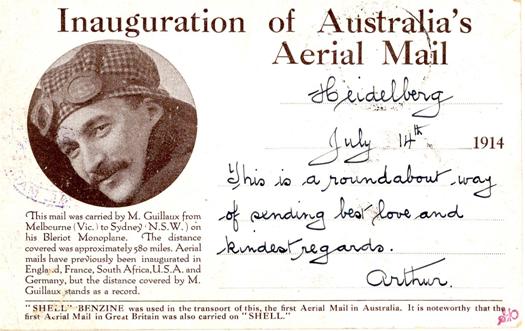
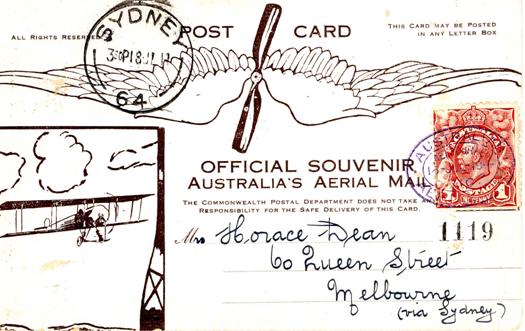 Exactly 1785 numbered postcards will be
carried, in the Jabiru if at all possible. They are modelled on the originals,
with minimal change to the wording, eg Re-enactment of Australia’s Aerial Mail
rather than Inauguration of Australia’s
Aerial Mail.
Exactly 1785 numbered postcards will be
carried, in the Jabiru if at all possible. They are modelled on the originals,
with minimal change to the wording, eg Re-enactment of Australia’s Aerial Mail
rather than Inauguration of Australia’s
Aerial Mail.
The postcards are shown here at their actual size.
 Australia Post is issuing special stamps,
but they will not be available until 1 July 2014. Frankly, we (AHSA) need money
now to ensure that we can carry out our planning properly. Therefore we are beginning to sell the postcards within the
next month; purchasers will receive a statement detailing their card, and it
will be delivered shortly after the centenary date, 18 July 2014. This is a
standard practice in the philatelic world.
Australia Post is issuing special stamps,
but they will not be available until 1 July 2014. Frankly, we (AHSA) need money
now to ensure that we can carry out our planning properly. Therefore we are beginning to sell the postcards within the
next month; purchasers will receive a statement detailing their card, and it
will be delivered shortly after the centenary date, 18 July 2014. This is a
standard practice in the philatelic world.
The cards will be stamped, and addressed according to the purchasers’ instructions, and weare also planning to have imprints of official stamps for the start and the finish of the flight as well as a specially-made commemorative imprint for the flight itself.
The
initial issue of cards will consist of all cards except numbers 1 to 10 and
1776 to 1785. Early purchasers will be able to select the numbers they want. We
want to be sure that the issue will not be taken over by profit-making stamp
dealers, so no-one will be allowed to buy more than two cards.
Michael
Hill, a highly respected philatelist and dealer, is being employed to manage
the issue and full details will be made available at the time that sales begin.
To ensure that you do not miss out on this great opportunity
ensure you have sent your email address to guillauxcentenary@gmail.com .
The first seaplane flight....
Guillaux is best
known for his mail flight, and his spectacular flying exhibitions also are
remembered. But he holds another record, less well-known, as the first person
to fly a seaplane in Australia.
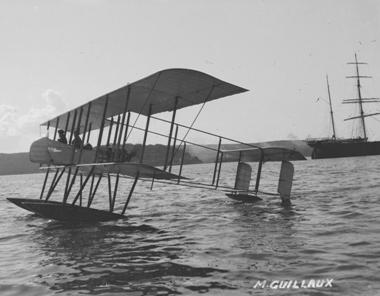 Lebbeus Hordern, of the wealthy family who
owned the huge retail store Anthony Horderns, imported
a Maurice Farman seaplane in 1914 and employed Guillaux and his associates to
assemble and test fly the aircraft. It took to the air on May 8, 1914; within
the next few days Guillaux took up some twenty passengers, including some
rather attractive ladies!
Lebbeus Hordern, of the wealthy family who
owned the huge retail store Anthony Horderns, imported
a Maurice Farman seaplane in 1914 and employed Guillaux and his associates to
assemble and test fly the aircraft. It took to the air on May 8, 1914; within
the next few days Guillaux took up some twenty passengers, including some
rather attractive ladies!
Hordern and
Guillaux had big plans for the expansion of Australia’s aviation activities,
but these were cut short by the outbreak of war in August 1914. Lebbeus’
seaplane was donated to the military, where it actually became the first
aircraft to be sent from Australia for military purposes before becoming a
training aircraft at Point Cook.
The Seaplane Pilots
Association of Australia is planning to mark the centenary of the first
seaplane flight. This will probably take the form of a gathering of seaplanes
in Sydney, possibly on the weekend following the centenary of the first flight.
Picture Sam
Hood. State Library of NSW –a128591
Fly-over of historic aircraft
A FLY-PAST OF
VINTAGE AIRCRAFT is being planned for the business lunch hour between 1300 and
1400 hours on Monday 14 July 2014. It is hoped that this will draw
attention to the historic flight and attract exposure via TV and the media.
Judy Rainsford is
negotiating with Roy Fox, who has expressed support and interest in the
event. With his Dragon Rapide, Eagle, Cobra
Swift and other vintage aircraft and networks, Roy is a familiar figure in
aviation and his experience welcome. If you have ideas, or would like to
participate, please contact Judy Rainsford -judyrainsford@hotmail.com .
The French Connection.....
M Berti,
Consul-General of France, has been untiring in his efforts to assist the
commemorations. He has plans well in hand for the Bastille Day commemorations,
and is lobbying people such as Tom Enders, head of EADS, which among other
things produces the Airbus. Many exciting things are happening: we are sending
out another newsletter early in December, so we will give full details then!
A word from Harden.....
The township of
Harden is centre of the Harden Shire, population about 4000. The smallest of
the towns visited by Maurice Guillaux in his mail flight, it was also the most
important: he was delayed here for a full day because of bad weather. Harden
was also the first of the stopping points to get involved in the re-enactment.
Debbie Astill, of the Carrington Hotel, where
Guillaux stayed, immediately offered overnight accommodation to the flight crew
and is spreading the word so that the overnight stay in Harden, Sunday 13 July,
will be a wonderful occasion. We have also heard from Lorraine
Brown from the Harden Murrumburrah Historical Society whose enthusiasm is
inspiring. During this month we are making more formal contact with airfields,
aero clubs, local government and other organisations en route, and will have
more information for you next month. We hope to send newsletters out every
month from now on.