 Aviation
Historical Society of Australia
Aviation
Historical Society of Australia
Air Mail Centenary Commemoration Group
Newsletter 3: January 30 2014
For
newcomers.......
In mid-July 1914, French aviator Maurice
Guillaux flew from Melbourne to Sydney seated on his Bleriot XI aircraft. The journey
took 2 days, 5 hours and 45 minutes, and he carried Australia’s first air mail
and air freight. However two weeks later, World War I broke out, and Guillaux’
epic feat was largely lost to historic memory.
The Aviation Historical Society of Australia,
NSW (inc) is co-ordinating a re-enactment flight which
will occur on 12-14 July this year. Now read on...
The big development this month: Sale of our postcards
Australia Post is releasing commemorative
stamps on July 1, 2014. Unless postage
charges change they will be in 60c and $2.60 denominations.
 The most collectable philatelic item will
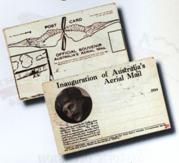
certainly be the postcards produced by us. There are exactly 1785 numbered
postcards, modelled on the originals, and the major focus of the re-enactment.
The most collectable philatelic item will
certainly be the postcards produced by us. There are exactly 1785 numbered
postcards, modelled on the originals, and the major focus of the re-enactment.
Cards cost either for $30 or $35,
including all postage and handling fees. The $30 ‘standard’ postcard will have
only the lower denomination stamp, and the $35 ‘premium’ postcard will have
both stamps.
So please go to www.australiasfirstarimail.com,
enter the shop, and complete your purchase in the normal way using a credit
card or PayPal. You can print off a receipt as part of the purchase process and
you will receive, through ordinary mail, a certificate of purchase, as
described later. Your postcard will be sent to Melbourne for the re-enactment
flight. During the period 12-14 July 2014 it will be carried to Sydney.
Appropriate postmarks and backstamps will be made and
it will be imprinted with a special logo modelled on that used for the 1964
re-enactment. It will be sent by registered mail in a fully protected envelope
to the address you have provided.
If you haven’t got a credit card......
We can accept bank transfers or cheques. It is a little more
difficult to select the number you want on your card. Email guillauxcentenary@gmail.com for
details. 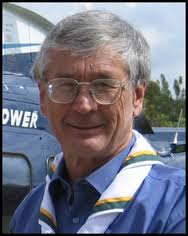 You can also buy from Mike Hill, Bexley
Stamps, (02)
9920 5057
You can also buy from Mike Hill, Bexley
Stamps, (02)
9920 5057
One of our customers.........
Dick
Smith has heard of our efforts and has given us $1000 for our project. At this
stage it is invaluable assistance: our budget remains slender. The money is a personal donation from Dick, and a great
endorsement of our efforts.
Dick has also bought one of our cards. His order
included the comment “Congratulations for organising the
centenary of the flight. I am delighted to buy a postcard and I hope many
others will also – it is a very historic document and will increase in value
over the years, I’m sure”.
So next time you go shopping please support Dick Smith
Foods – as Dick says, the food
company deserves help because it gives all its profits to charity and assists
Aussie farmers.
The early purchase of
postcards is of huge assistance to us in running the best possible re-enactment
flight. Please buy your postcards now,
and encourage your friends to do likewise!
What is the money used for?
We will firstly use all proceeds from the sale to ensure a
safe and efficient re-enactment flight. Our main need is to get an escort
aircraft with ILS capability to take over the mail carriage for a stage or two
if the weather becomes troublesome for the Jabirus and to carry support teams.
We do anticipate that when we sell all the cards and pay for
the re-enactment we will have a surplus, which will be donated to appropriate
organisations to assist in the preservation of Australia’s aviation heritage.
Full details of the organisation of the commemorations,
including the terms and conditions under which your purchase has been made,
will be found on www.australiasfirstairmail.com.
A full financial statement will be published on this website at the conclusion
of the program.
Our new brochures........
Juanita Franzi,
committee member and professional aviation artist has produced two
brochures describing the original flight and the re-enactment. If you would
like multiple copies of the brochures to distribute to your organisation,
please email guillauxcentenary@gmail.com
|
|
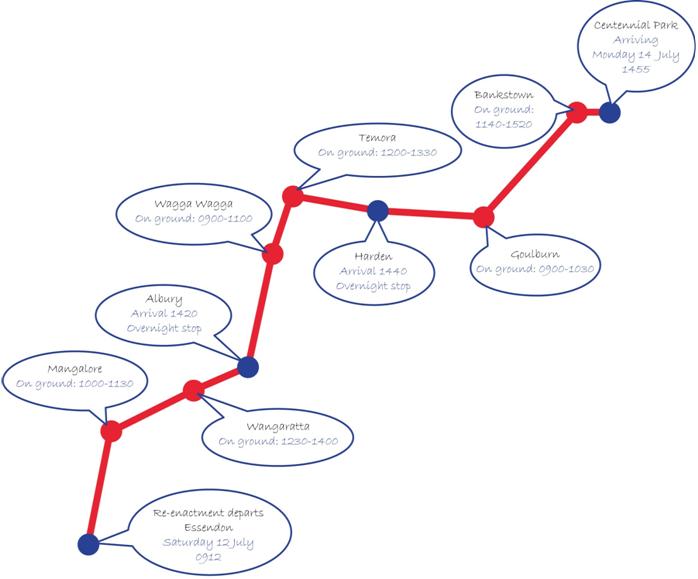
The re-enactment flight timetable
The task for the next two months is to talk to people in
each town and explain what we are doing.
Already, things are happening: just one example is at Wagga, where
Peter Middleton is arranging an escort of historic aircraft to and from
Wagga, and Gerald Gaskin of the aero club is organising a barbecue
breakfast for the morning of Sunday July 13.
By early April we hope to have a complete program of
activities in place!
|
|
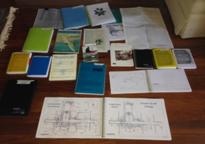
David Kelly’s collection
David Kelly, managing director of Lucrum
Consulting in North Sydney is one of several people who have contacted us. He
has been collecting Bleriot information and plans for over ten years.
The aim of collating all available information is being
achieved!
Safety first, last and always
Technically, AHSA does not have to worry about safety
regarding this operation. A Jabiru, properly registered and prepared, in the
hands of a suitably qualified pilot, is perfectly entitled to fly from Essendon
to Bankstown, as is any aircraft that wishes to fly along with it. Each
aircraft pilot is responsible for the safety of his or her aircraft, and AHSA
has no role at all in this.
The people connected with the Jabiru are negotiating with
CASA re the possibility of landing in Centennial Park; it will be wonderful if
this can happen, but if not there is a plan B and a plan C.
However, AHSA member Tony Coleiro, a highly qualified pilot
and instructor, has given a lot of thought to what could go wrong with our
project. He has produced a handbook for the guidance of participants, and it
will shortly be on our website and made available to anyone who wishes to join
the project. He will travel with the re-enactment and be available to give advice as required.
A time line for our activities
Our progress has
been delayed, largely because of problems with the website shop. We had hoped
to have it ‘up’ for the December meeting at AAMB Bankstown, but it has only in
the last few weeks reached an acceptable standard of speed. It is a fully
secure website, with no possibility of your bankcard details being improperly
used.
So during the next
month, our top priority is to get the postcards sold. If we can sell 300 cards
in February, we have the necessary finances to get a really excellent
re-enactment flight.
During March we
will be firming up arrangements in the en-route stops.
For the 100 year
anniversary of Guillaux’ arrival in Australia, early April, we hope to
inaugurate our program. The period May-June will be a combination of events
marking the centenary of his various efforts and of refining the commemoration
flight arrangements.
Australia Post is releasing
the commemorative stamps on July 1. We are fully prepared for a busy time
making the final arrangements!
AHSA meeting in Melbourne
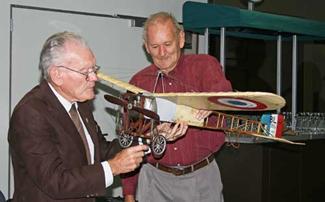
Tom Lockley visited
the Melbourne meeting of AHSA at their invitation to discuss the re-enactment
flight and other activities, and as usual, this was a great opportunity for
gathering information.
Garry Sunderland
brought in his beautifully made Bleriot XI model. He built it some 20 years
ago, and it is a free-flight model, the control surfaces being pre-set before
the flight. In the picture he is explaining the suspension system of the
Bleriot, which is surprisingly sophisticated.
Kevin O’Reilly is a
noted historian and author whose award-winning book about early Australian
aviation is entitled Flyers of Time. He
has sent us a wonderful photo of Guillaux’ aircraft on the ground at Bendigo,
and spoke about the connection with the O.T. juice company and many other
matters.
Melbourne AHSA
members are keen to become involved and are very interested in the re-enactment
and the general emphasis on Australia’s aviation heritage that is part of the
process.
Australia Post
Tom Lockley met
with Australia post philatelic officers while in Melbourne. Teena
Barnes, who handles the philatelic aspects of the release of new stamps was joined by other officers and the whole exercise
was discussed.
They were very
interested in the whole process and were impressed with what the aviation
community had achieved.
There is
considerable support for the re-enactment, and Australia Post will co-operate
in various ways. Christine Ewoldt, our philatelic manager, will have more news
on this shortly.
Guillaux at Goulburn
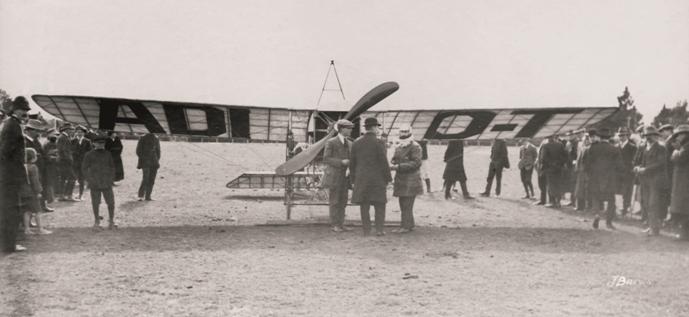 High-quality pictures from 1914 are
relatively rare. This picture comes from Goulburn, and was sent to us by Bob
Saunders of the Rocky Hill War Memorial Museum. We can identify the men with
Guillaux in the centre of the picture: on the left is Clyde Baxter, whose family owned Baxter’s
boot factory, and in the middle is the mayor of Goulburn, Alderman Betts.
High-quality pictures from 1914 are
relatively rare. This picture comes from Goulburn, and was sent to us by Bob
Saunders of the Rocky Hill War Memorial Museum. We can identify the men with
Guillaux in the centre of the picture: on the left is Clyde Baxter, whose family owned Baxter’s
boot factory, and in the middle is the mayor of Goulburn, Alderman Betts.
Guillaux
had been held up at Harden on 17 July by bad weather. Lucien Maistre, Guillaux’
interpreter and associate had telegraphed from Goulburn advising Guillaux to
remain in Harden. However, he set out at 2pm and the news was telegraphed to
Goulburn.
The
Goulburn Penny Post described the
enthusiastic response to this news. The children at Bourke Street School were allowed
to leave and large crowds moved to the racecourse. A few paid an admission fee
to enter the course itself, but the majority did not enter, waiting around to
see what would happen.
Maurice
Guillaux turned back after reaching Galong, twenty miles from Harden, because
of strong headwinds. Guillaux feared that the aircraft might not reach its
destination and would have to crash in heavily wooded, mountainous country. The
news reached Goulburn, and the disappointed crowd headed home.
Guillaux
took off at 7 15 am the following day: sunrise was at
about 7 am. It appears that the headwind persisted – the average speed was only
47 mph when the aircraft cruised at about 60 mph. He described the ground over
which he flew: ‘never had I seen such an inhospitable region as this: the deep
yawning chasms seemed to be calling me down, into the merciless depths, never
to rise again’. Relatively few people were there to welcome him, but he Post description was ecstatic – ‘with
the grace of a bird selecting a resting place M Guillaux issued from the clouds
to the west of South Hill shortly before half-past nine this morning, and
soaring gracefully over the eminence descended with a swoop at the southern end
of the racecourse and alighted almost in the centre of the ground’. This was
the first aircraft seen in Goulburn.
Goulburn
is notorious for its bitterly cold weather, and when he landed he rushed to the
beacon fire that had been lit. He drank from a thermos flask of tea that he had
with him, then personally checked his aircraft very
carefully, making sure that the smokers kept well away.
He took off at 10 am, but was forced to
return because of a faulty spark plug. Before his next take-off he ran the
engine at high power, with the aircraft’s wheels chocked and three men holding
down the tail. ‘The suction from the propeller blades was so strong that the
men's clothing blew about as if in a gale of wind and their hats were carried
away’...... ‘On his second ascent the airman rose to a height of 1100 feet. He
circled the race course and then flew in the direction of Murray's Flat, where
he altered his course slightly, evidently to give the people at Kenmore
Hospital an opportunity of seeing him’.... ‘It was amusing to watch the horses
stampede across the paddocks and a number of birds flying for safety. Guillaux
makes the birds look trivial
when he takes charge of the air.’