 PowerHouse Development Centre Flight Weekend
Aviation Historical Society of Australia (NSW) inc
Airmail Centenary Commemoration Group
PO Box 301, Pyrmont 2009:
gulliauxcentenary@gmail.com Website www.australiasfirstairmail.comThis email is going to many new people, including the members of AAMB Bankstown. We have had some problems with our mailing list, but think all these difficulties have been solved. However, if you do not wish to receive these newsletters please advise by email.
In this issue:
PowerHouse Development Centre Flight Weekend
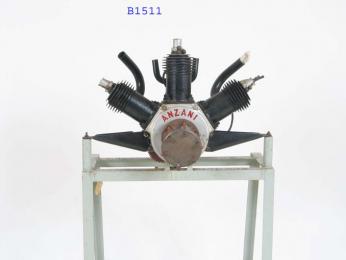
This amazingly simple Anzani engine is the same as that which powered Louis Bleriot’s aircraft when he flew the English Channel on July 25th 1909. The noise from this engine must have been deafening! It produced 24 horsepower and weighed only 66 kilograms. Within a few years, Guillaux’ aircraft had a 50 horsepower engine, weighing 72 kilograms. The modern Jabiru 6-cylinder engine weighs 83.5 kilograms, and develops over 120 horsepower – with a lot more refinement than these old engines! But for their time they were a remarkable achievement and we can even now admire the skill and ingenuity of the engineers.
The
PowerHouse Development Centre is one of the hidden treasures of Sydney’s cultural life. It is the storage facility for the Museum of Applied Arts and Sciences which includes other organisations such as the PowerHouse museum. They are often open for school and other groups and have an open weekend every month.This weekend is devoted to Flight, and this topic has been chosen largely because of the imminent airmail re-enactment. The museum’s keen and knowledgeable volunteers are conducting numerous ‘behind the scenes’ tours of the flight collection and of the remarkable early aircraft engine collection. The opening of this section has been very popular with a wide range of people. There are paper plane model making activities and other air-related activities for children, including one where the children make aerogrammes. These will be carried on the re-enactment flight, and this free activity does a lot to introduce the youngest generation to the idea of letter-writing – and the physical transport of paper messages! Also in attendance is the Lawrence Hargrave Society, bringing this great Australian some of the credit his researches deserve.
This is exactly the sort of synergy that we hoped for when we began this commemorative process nearly a year ago, and we thank Christopher Snelling, his helpful staff and the volunteers for making it all possible. We will try to extend the aerogramme exercise to the airfields at which the re-enactment lands.
Have we got time to get things done?
There is a lot to be done, but just for interest here is a comparison of organisation of our re-enactment with the planning of the original flight.
Arthur Rickard was a mover and shaker of the early 1900s. He subdivided land in many suburbs and towns – from Glebe to Woy Woy and Wentworthville. He had imported Wizard Stone, an American, to give aerial displays, which were very successful. A young Bert Hinkler was employed as mechanic.
With the arrival of Guillaux, the popularity of Stone’s relatively staid flying displays declined, and special stunts had to be invented to keep him in the public eye. In mid-May Rickard announced that Stone would make an airmail flight from Melbourne to Sydney. Elaborate postcards were printed and sold, but on 1 June Stone had a bad crash, damaging both himself and his machine. On 19 June it was announced that Guillaux would make the flight, but agreement was not reached and on 9 July it was announced that Guillaux would not fly for Rickard. On the same day, application was made to the Post Office for Guillaux to make the flight, and one week later he was in the air. In that week, landing fields were found in Seymour, Wangaratta, Harden and Goulburn, mechanics and fuel were sent to each stop, sponsors were found, postcards were printed and sold.
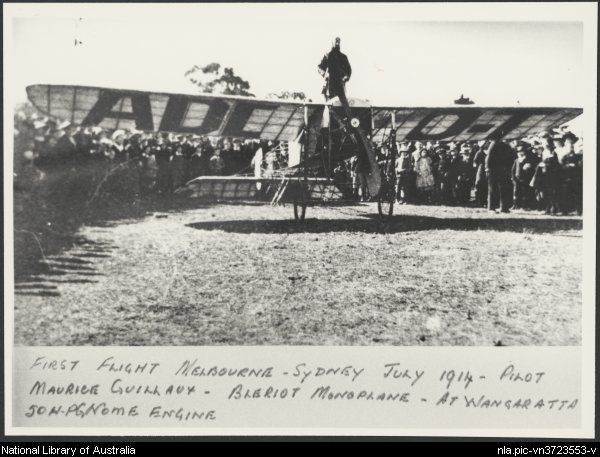
Guillaux’ aircraft being refuelled at Wangaratta, where he had landed at Sisley’s paddock, a few kilometres from the city centre.
We have been preparing for this flight since July 3 last year. In this age of mobile phones, internet, radio and television, we must be able to tie up the remaining loose ends! Fortunately, the essential ingredient, the enthusiasm and the skill of the aviators, is in plentiful supply. Everyone is entering into the spirit of the adventure, and a whole raft of individual efforts is coming together to ensure that we have a great event.
The Guillaux flight was big news in the Harden-Murrumburrah Express this week:
EXCITEMENT in the region is mounting as word of the celebration of the centenary of Australia’s first airmail flight spreads. On July 13 Harden will be visited by a group of aircraft of astounding sophistication when compared to the fragile little construction of wood and fabric held together by wire and glue which made the journey alone in 1914. At the time, this was the longest airmail flight in the world. It had been only 11 years since the first successful powered flight in America.
Even in a world where war was looming, planes were far from being a feature of everyday or military life. In 1914 the French, with 36 aircraft, had more planes in its air corps than all the world’s air forces put together.. America had only two planes in its fleet. Daredevil French pilot Maurice Guillaux flew a Bleriot Xl, a revolutionary plane designed by Louis Bleriot, on the flight. Always fascinated by flying machines, Bleriot financed his aircraft design with money he made by inventing and manufacturing the world’s first practical car headlights. In 1909 Bleriot gained worldwide fame by being the first to cross the English Channel in a heavier than air aircraft. Maurice Guillaux was the first pilot to perform a loop-the-loop in the skies and the first to fly a seaplane in Australia.
This time in our history was rich with adventurous people willing to risk life and limb in pursuit of knowledge and experience. This epic and ground breaking flight was overshadowed by the outbreak of WWI, when many millions of brave people risked their lives to protect freedom.
On July 13 Harden will welcome a Jabiru, and half a dozen accompanying aircraft to the airstrip on Burley Griffin Way. In the Picnic racecourse area there will be stalls to browse and lots of food and music. To read more about the historic flight and the part Harden played, pick up a brochure from organiser Lorraine Brown at the West End Gift Shop, or from WhichCraft and various shops around town.
Avro Cadet joins the re-enactment
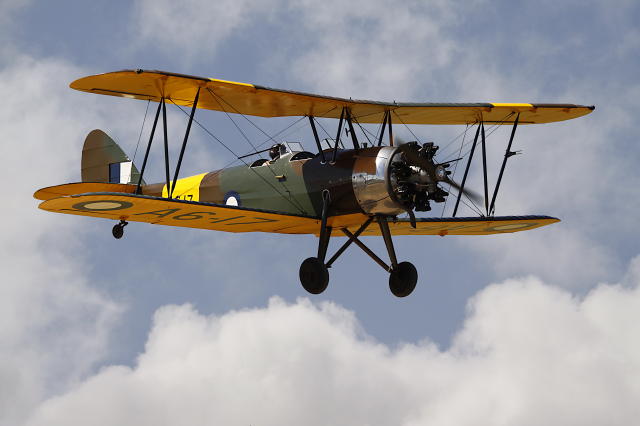
Late news: one of the accompanying aircraft at Harden will probably be this Avro Cadet, a training aircraft of World War II vintage. Much less common than the Tiger Moth, it is a very exciting machine! It belongs to Clin Ashton-Warner, and is kept on his property between Temora and Barmedman. It is amazing how many fascinating things are preserved in country areas!
Some reminders:
Commemorative stamp launch – Bankstown July 2
We will send out invitations shortly, but if you are in Sydney and can come to the Australian Aviation Museum at Bankstown on July 2, 5pm to 7pm the commemorative Australia Post stamp packages will be launched in Sydney. Stamp clubs, aviation enthusiasts, historical societies and other groups will be represented. This will precede the July AHSA meeting which will also be held at AAMB.
Replica Postcards
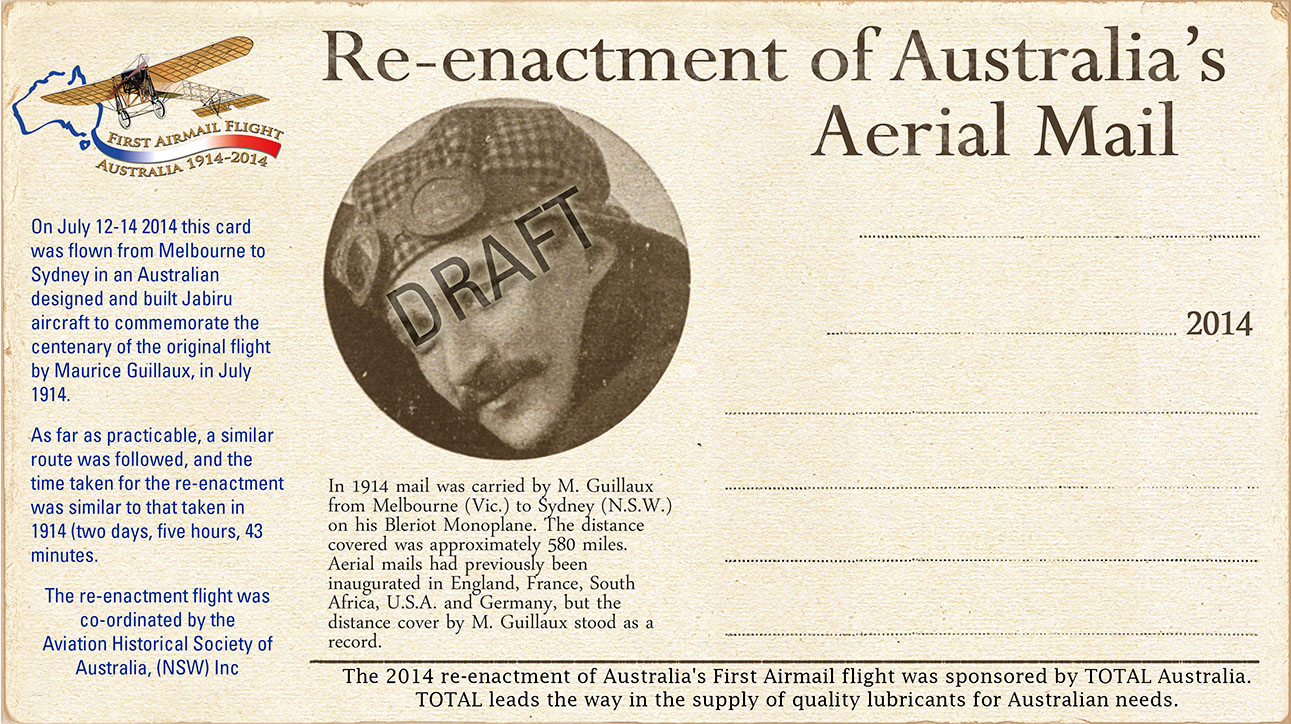
We showed many people at Castle Hill yesterday and the consensus was that we had a good balance between the original postcards carried by Guillaux and an entirely new design. The new postcards have all the features of the original, with additional space for the larger stamps and also for a brief explanation of the event. They come in a specially designed small folder which both protects and enhances the postcards. When the folder is opened out we have an A4 display that looks very good in a picture frame. When we have finalised the design we will print pictures in the daily bulletin.
In the meantime sales are continuing. The website shop is working well, but remember if you have problems email us or buy through Mike Hill at Bexley Stamps at no extra charge: details on the website.
Layout draft of the front of the postcard: minor changes only are to be made.
Tom Lockley, secretary, Airmail Centenary Commemoration Group of the Aviation Historical Society of Australia, (NSW) inc.