Around Australia with Goble and McIntyre:6 April to 19 May 1924
The first aircraft to fly around Australia was a Fairey IIID seaplane of the RAAF, flown by Squadron Leader ‘Jimmy” Goble and Flight Lieutenant Ivor McIntyre of the RAAF.
Sunday 6 April 1924: Point Cook to Sydney via Eden
Monday 7 April 1924 – Sydney to Port Stephens (Myall River)
Wednesday 9 April 1924: Myall River to Southport, Queensland
Thursday 10 April 1924: Southport to Gladstone
Friday, 11 April 1924: Gladstone to Townsville
Monday 14 April 1924: To Cooktown. 9
Wednesday, 16 April 1924: Cooktown to Thursday Island
Wednesday 23 April 1924: Thursday Island to Galliwin’ku (formerly Elcho Island)
1924: A note on relationships with the First Nation
Thursday 24 April 1924: Galliwin’ku to Darwin
Sunday, 27 April 1924: Darwin to Napier Broome Bay
Monday, 28 April 1924 – Mission Bay to Broome
Tuesday 29 April 19 1924 Broome to Port Hedland
Wednesday 30 April 1924: Port Hedland to Carnarvon via Onslow
Sunday 11 May 1924. Carnarvon to Perth via Geraldton with forced landing en route
Monday 12 May 1924: Perth to Albany; false start to Israelite Bay
Thursday, 15 May 1924 Albany to Israelite Bay,
Saturday 16 May 1924 – Israelite Bay to Ceduna (aka Murat Bay, Denial Bay)
Saturday, 17 May 1924 – Ceduna to Port Lincoln
Sunday 18 May 1924: Port Lincoln to Beachport
Monday 19 May 1924: Beach Port to Point Cook, via St Kilda
Philately – and the 1974 celebration
The sole surviving Fairey III:
Other early round-Australia flights
The second flight around Australia, 1924: H C Brinsmead
Australia / Solomon Islands flight, Richard Williams 1926
Setting the scene
World War I was a horrible event. But it did have remarkable effects on the history of aviation. There were enormous technical advances, and there were many highly skilled aviators among the survivors: Australians were found to be particularly adept at adopting this new technology. Aircraft were well suited to meeting transport and communication needs in Australia, and the post-war period was a time of many exciting developments.
Also, on 31 March 1921 the Australian Air Force was formed, being declared the Royal Australian Airforce in June 1921. It was obvious that air power was becoming more and more important for defence. The RAAF fleet was based on the ‘Imperial Gift’ of 100 aircraft from Britain, surplus aircraft from the war. All were landplanes, but, on the initiative of ‘Billy’ Hughes, Prime Minister of Australia 1915-1923, six seaplanes had also been purchased.
Wing Commander Stanley Goble was acting as head of the air force in 1923-24, while Richard Williams, the Chief of Staff, was overseas. Aged 32, he had had a stellar war career and was a strong supporter of seaplanes. With the support of the Government, he planned and executed the first flight around Australia, using one of the Fairey IIID seaplanes.
As will be seen in the ensuing pages, this was a mighty logistic feat involving many service personnel, but its success depended on almost superhuman efforts by two remarkably skilled aviators, and, to be frank, some very good luck. Goble acted as navigator, and Lieutenant Ivor McIntyre was pilot: recently arrived from England, he had quickly demonstrated remarkable skill, notably in handling conditions of bad weather and low visibility.
Goble and McIntyre’s flight around Australia was recognised as being the outstanding pioneering flight of the year 1924: the British Royal Aero Club awarded them the annual Britannia Trophy and they were appointed Commanders of the Order of the British Empire in the King's Birthday Honours.
This webpage deals mainly with the flight itself and related events. The story of the Fairey III aircraft and their part in the development of the RAAF is the subject of another booklet, to be published soon.
Tom Lockley.
The Aircraft
A10-3
was the aircraft chosen by Goble and McIntyre in the round Australia flight. It
had flown only 13 hours 15 minutes since its Eagle engine, No. 6094, had been
installed and tested on 19 April 1922. 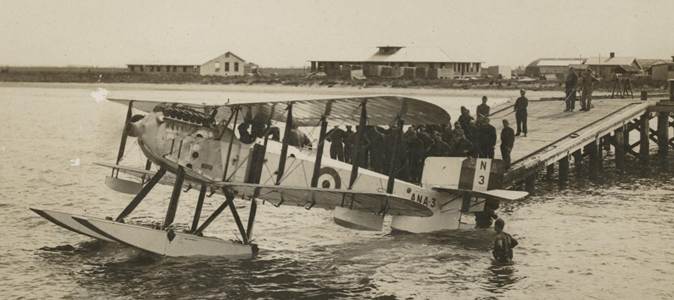
No photo exists of the start of the around-Australia flight; here the aircraft, shown at Point Cook is still labelled ANA-3 (its earlier naval designation)
Technical Data for the Fairey III (RAAF:
DESCRIPTION: Three-seat survey and spotter-reconnaissance
seaplane. Wooden structure, fabric covered.
POWER PLANT: One 375 hp Rolls Royce Eagle VIII.
DIMENSIONS: Span 14.05 minutes (46 ft 1.25 in); Length 11.28
minutes (37 ft); Height 3.44 minutes (11 ft 4 in).
WEIGHTS: Empty 1473 kg (3248lb); loaded 2231 kg (4918lb).
ARMAMENT: One 0.303 Vickers gun forward and one Lewis gun aft.
PERFORMANCE: Max speed 171 km/h (106 mph); Climb 7 mins to 5,000 ft (1524 m);
Range 885 km (550 miles); Service ceiling 17,000 ft (5182 m)
The aircraft was carefully prepared for the flight. From Neville Parnell’s account: An auxiliary petrol tank with a capacity of 40 gallons was fitted on a stretcher in the second cockpit. This necessitated the removal of the radio, but it would have been very unreliable in remote areas and was probably useless. An additional radiator was fitted under the fuselage aft of the engine; this came from an SE5 fighter. The petrol capacity, with the extra tank, was increased to 147 gallons and the water for cooling, from 9 to 12 gallons. The floats were opened. and the interior was coated heavily with Biturine. An extra lining of fabric was fitted, and then the outside of the floats had three coats of marine paint and one coat of marine varnish applied. Finally, the whole aircraft was coated with marine varnish, so that at the outset of the journey the aircraft was resplendent.
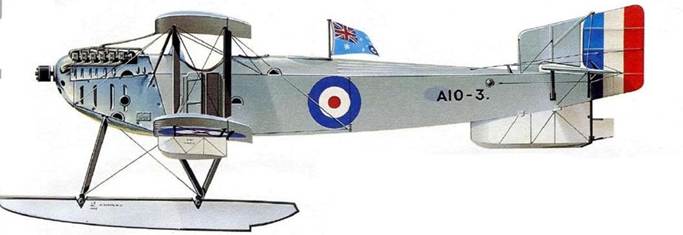
The Faireys were designed for use in cold countries, hence the installation of
the additional radiator. The thinner hot air also meant that performance was
not as good as in colder climates. Also, the Eagle engines needed constant
maintenance in comparison with those of the later de Havilland aircraft.
For weight reasons, it was necessary for the aviators’ ‘personal luggage’ to be kept to a minimum. According to Smiths Weekly, they did not even carry a change of clothing, but a sobering thought for all of us in these modern times is that they carried service rifles and ammunition from fear of being attacked by ‘hostile natives’.
Initial publicity was cautious in expectations. From The Argus, Melbourne, 5 April 1924: When the aviators have reached Thursday Island arrangements may require to be altered. After the Island has been passed the procedure will depend upon the condition of the seaplane, and upon the weather for there will be a stretch of 480 miles across the sea before Elcho Island—the next stopping place— is reached. Refuelling and stopping stations have been planned for the journey which will be 9,000 miles. It is also interesting that newspaper coverage of the beginning of the flight was minimal, but as the flight continued, interest grew, and the completion of the flight was widely publicised.
Route Preparations
The logistics for the flight were complex, because much of the route had never been flown before. ‘Thirty-seven dumps of fuel, oil and distilled water [were] pre-positioned for the flight by the Vacuum Oil Co. In all, 4000 gallons of ‘Plume’ aviation spirit, 150 gallons of ‘Castrol’ oil and 350 gallons of 350 gallons of distilled water were placed in dumps right around the coastline. Trains, ships and even pearling luggers were used for the task. Watchmen protected the dumps 24 hours a day.’ (Smiths Weekly, 3 May 1924). As it transpired, only 24 dumps were used. The Argus, 21 May, listed the support both used and unused available for the flight as (Point Cook), Eden, Sydney, Yamba, Southport, Brisbane, Gladstone, Rockhampton, Bowen, Townsville, Cooktown, Port Stewart, Hicks Island, Cooktown, Elcho Island, Graham Island (unknown to Google Earth), Darwin, Graham Moore Island (Drysdale Mission), Camden South, Derby, Broome, Port Hedland, Onslow, Carnarvon, Geraldton, Fremantle, Leeuwin, Albany, Esperance, Eyre, Eucla, (actual landings at Israelite Bay and Denial Bay or Ceduna) Fowler's Bay, Port Lincoln, Port Elliot, Kingston, Beachpool (Beachport?), Porland (Portland?). The airmen did not land at the underlined places, but there may have been fuel dumps and other preparations in place. Certainly, the preparations were wide-ranging and often were themselves significant feats of logistics.
Diary of the Journey
Sunday 6 April 1924: Point Cook to Sydney via Eden
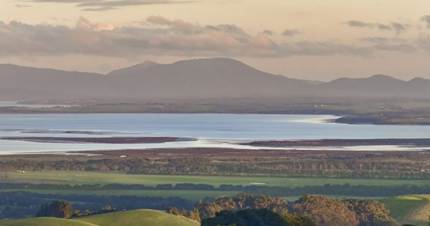 From Parnell: After being delayed a day by
heavy seas off Point Cook, the flight started at 6.00 am on Sunday, 6th April
1924, With W/C Goble, in command, as the navigator and F/O McIntyre as the
pilot. It is obvious that the route was always close to the shoreline:
Parnell says that after only 45 minutes they had to force-land at Corner Inlet,
(left), a nice, secluded bay north of Wilson's Promontory, to repair the
auxiliary fuel tank. Taking off again ten minutes later, they ran into a
30-knot gale and heavy rain. McIntyre had to descend from 2,500 feet to 250
feet and continue at that height all the way to Eden, NSW., which was reached
at 11.40 am. They had originally intended to fly direct to Sydney but the
Fairey had used more fuel than had been anticipated. Eden had often previously
been visited by Fairies, and fuel was available. On landing, one of the floats
was slightly damaged by the waves. They left Eden at 1.26 pm for Sydney.
From Parnell: After being delayed a day by
heavy seas off Point Cook, the flight started at 6.00 am on Sunday, 6th April
1924, With W/C Goble, in command, as the navigator and F/O McIntyre as the
pilot. It is obvious that the route was always close to the shoreline:
Parnell says that after only 45 minutes they had to force-land at Corner Inlet,
(left), a nice, secluded bay north of Wilson's Promontory, to repair the
auxiliary fuel tank. Taking off again ten minutes later, they ran into a
30-knot gale and heavy rain. McIntyre had to descend from 2,500 feet to 250
feet and continue at that height all the way to Eden, NSW., which was reached
at 11.40 am. They had originally intended to fly direct to Sydney but the
Fairey had used more fuel than had been anticipated. Eden had often previously
been visited by Fairies, and fuel was available. On landing, one of the floats
was slightly damaged by the waves. They left Eden at 1.26 pm for Sydney.
During the flight the compass in the rear cockpit ‘exploded’, showering McIntyre with glass and alcohol. The last 90 miles were flown within 100 feet of the sea, through blinding rain, and several times the plane nearly collided with the cliffs near Bulli. However, a safe landing was made at Rose Bay at 4.00 am and the compass was taken to the RAAF Experimental Section at Randwick to be repaired. This was under the control of Squadron Leader L J Wackett, a legend in Australian aviation history. Their main project at the time was the construction of the Wackett Widgeon amphibian which first flew on 3 December 1925. The Widgeon was a potential rival to the Fairey but was not produced in quantity. Though one was used by the RAAF it was never officially adopted and has no A-number.
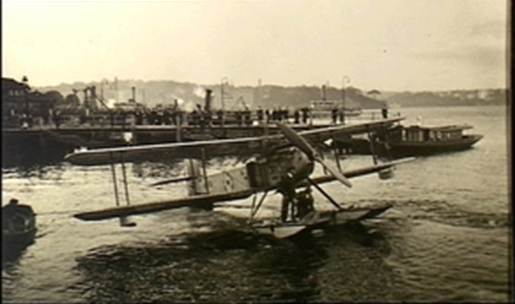
Photograph: in the AWM collection, labelled ‘probably Sydney, c. 1924. Wing
Commander Goble and Flight Lieutenant McIntyre on a survey flight around
Australia’.
Monday 7 April 1924 – Sydney to Port Stephens (Myall River)
12.48 pm to 2.15 pm, 1 hour 27 minutes, approx 200 km, 107 nm.
Rain continued, and takeoff was delayed until 12.48 pm, still in bad
weather. Ten minutes after takeoff the compass burst again. Passing Newcastle,
they flew at 500 feet, in a 50-knot gale from the east. Heavy rain forced them
down to 50 feet where the sea was only just visible, and the flying conditions
were making the Fairey almost uncontrollable. McIntyre endeavoured to make Port
Stephens but being shrouded in mist and rain and with islands in the vicinity,
a landing there was too risky. A short break in the weather gave them a glimpse
of the Myall River, where they immediately put down. The gale blew all night.
It took several lines, anchors and an all-night watch to keep the aircraft on
the river. The float which had been damaged at Eden began to leak slightly.
(Parnell). The weather was poor and they did not fly on 8 April but were able to
patch the leaking float with a patch and red lead.
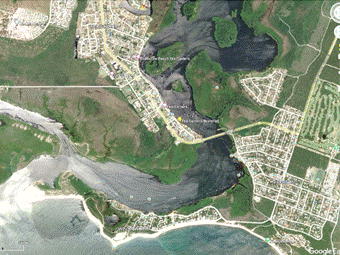
The Myall River runs into the northern shore of Port Stevens about 1km from the heads. The river has many tidal shoals and has few straight reaches, This map shows an area of about 4km x 2 km.
Wednesday 9 April 1924: Myall River to Southport, Queensland
12.33 pm to 5.10 pm, 4 hours 37 minutes. The total distance from Sydney to Southport is 752 km, 406 nm. A fuel dump at Yamba was not used.
Taking off on 9 April at 12.43 pm, McIntyre had to follow a precarious path around the bends in the river and narrowly missed hitting several oyster-bed posts. The flight to Southport was without incident, and they arrived at 5.20 pm. Parnell notes that it rained constantly and they flew at an altitude of between 100 and 500 feet.
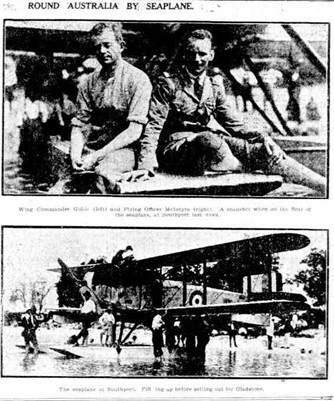
There are relatively few photographs of the journey. These photos were taken
at Southport and published in The Weekly, a Brisbane newspaper, on 17
April 1924
Thursday 10 April 1924: Southport to Gladstone
11.23 am to 3.45 pm, 4 hours 22 minutes, 552 km, 290 nm
After another night of heavy rain, Southport was cleared just before noon and a fairly pleasant flight was made to Gladstone, which was reached at 1545. Coral in the harbour and mud and logs in the river forced McIntyre to land at Facing Island some ten miles away. ‘The petrol was brought over in a launch by Captain Payne, the marine pilot at Gladstone. For four hours (10 am to 2 pm the next day) the crew worked up to their necks in water straining the fuel through chamois leather. Sleep was impossible due to sandflies and mosquitoes, so they floated the Fairey outside the reef and made a bonfire on the beach with some empty cases and half a gallon of the taxpayers’ petrol. (This account by Parnell is contradicted by an article in The Brisbane Courier of 11 April which says that the aircraft landed at the mouth of the Auckland River, close to the settlement, and was refuelled there, but the other accounts describe the refuelling process in considerable detail).
Friday, 11 April 1924: Gladstone to Townsville
6.45 am to 11.50 am, 5 hours 5 minutes, 782 km, 422 nm: delayed 2 days awaiting compass (sent from Melbourne).
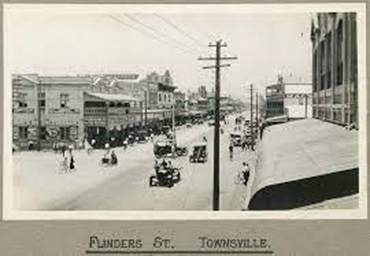 Townsville
in 1924 was a wealthy, modern city, thanks to its sugar industry, timber
extraction, and the fact that it was a reliable harbour serving mining
throughout central Queensland (Queensland State Archives).
Townsville
in 1924 was a wealthy, modern city, thanks to its sugar industry, timber
extraction, and the fact that it was a reliable harbour serving mining
throughout central Queensland (Queensland State Archives).
They departed from Gladstone at 0637 with good visibility and no rain, bound for Townsville. According to the local press, they orbited over Bowen and Mackay, which delayed them but delighted the townspeople. Touchdown at Townsville was at 1150, and as they taxied to the beach they were escorted by a large shark, about fourteen feet long* which circled the aircraft. It was discovered that a compass being sent from Melbourne would not arrive until the 13th, so pending its arrival the Fairey was taxied up the river and hoisted onto the Burns Philp wharf, and the time was spent in patching up the floats and coating the seams with carbon expanding paint. McIntyre was suffering from the unwanted attentions of the mosquitoes and sandflies; his knees and ankles were swollen to twice their normal size and for several days after leaving Gladstone, he could not don his boots. He also had a septic finger which had to be surgically treated before leaving Townsville.
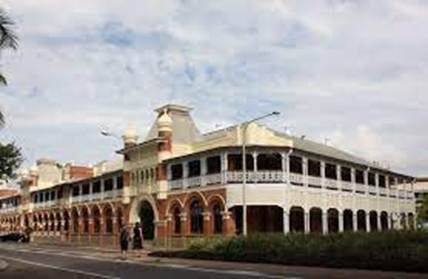
The aviators landed ‘between the breakwaters’ and
taxied to the beach opposite the Queens Hotel, which is still standing.
Monday 14 April 1924: To Cooktown
7.30 am to 10.0 am, 3 hours, 515 km, 278 nm.
The compass arrived, was fitted, and a start was made for Cooktown at 0730 on the 14th. The weather was fair but the air was rather bumpy. While making a circuit of Cairns harbour, the Fairey lost 500 feet in the turbulence, and the antics of a herd of goats that stampeded at the sound of the aircraft were visible from the air. Cooktown was reached at 1030. A strong wind was, blowing over the hills and made the air extremely turbulent, but a safe landing was made on the Endeavour River.
 McIntyre's
finger had to be lanced again – by a woman doctor, to his embarrassment. Heavy
rain fell that night and a gale blew, making it necessary for Goble to stand
watch over the aircraft. McIntyre, who spent the night in bed, said later that
he had ‘a clear recollection of Goble in a pair of shorts and very little else,
sheltering under a woman’s umbrella in three inches of rain.’ Similar
conditions – heavy rain and low clouds – persisted the next day.
McIntyre's
finger had to be lanced again – by a woman doctor, to his embarrassment. Heavy
rain fell that night and a gale blew, making it necessary for Goble to stand
watch over the aircraft. McIntyre, who spent the night in bed, said later that
he had ‘a clear recollection of Goble in a pair of shorts and very little else,
sheltering under a woman’s umbrella in three inches of rain.’ Similar
conditions – heavy rain and low clouds – persisted the next day.
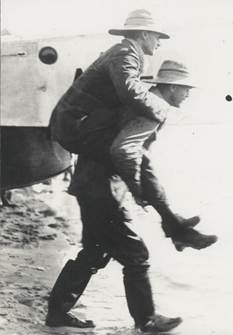
Both airmen had health problems, not surprising when the arduous flight and long hours combined with sunburn, minor injuries and insect bites. McIntyre carrying Goble: RAAF official photo.
Wednesday, 16 April 1924: Cooktown to Thursday Island
8.38 am to 2.30 pm, 5 hours 57 minutes, 901 km, 487 nm.
The rain cleared slightly, and they took off for Thursday Island. In Princess Charlotte Bay they passed the steamship Eastern which greeted the fliers with several blasts on the ship's whistle. From this point, the conditions deteriorated – all the way to Cape Sidmouth they flew through heavy rain. Goble could hardly see McIntyre in the front cockpit, and the Fairey was becoming very difficult to control. Once the wheel was wrenched from McIntyre's hands. They force-landed on the open sea and after discussion decided to try to climb over the clouds, but this proved hopeless as the clouds were a solid mass. They then headed out to sea and flew a compass course up the Coast. Reconnaissance of the coast was negligible as it was sighted only a few times. On arrival at Thursday Island, they found a big squall hanging over the town and had to dive around it to make a landing.
This was planned as a major stopover, and a stock of spare parts had been sent. As mentioned before, it was uncertain whether the flight would continue after Thursday Island was reached. However, despite their trials and tribulations, the aviators were keen to proceed.
 Arrangements
had been made by the RAAF mechanic, Corporal Gurr, with a local pearler, Mr
Hocking, to use his boat slipway for repairs. For the next five days, the rain
fell continuously. The enforced halt gave the crew a chance to have the machine
overhauled and to have it patched up generally. A spare engine had been sent to
Thursday Island, but it was not fitted. The floats were found to be leaking
again and would have to be replaced. This necessitated lifting the 2½ ton
aircraft to slip the new floats underneath. As there were no cranes or derricks
on the island, two special sheerlegs, 50 ft. long and eight inches square, were
erected. It took days to get them into position; then the aircraft was lifted
by block and tackle and the new floats fitted. It was impossible to swing the
new compass in the pilot's cockpit and to correct the deviations as there were
no turntables available and the tides were too strong. As Goble had the master
compass, he tied a pair of siring reins to McIntyre's arms and guided him from
the rear cockpit.
Arrangements
had been made by the RAAF mechanic, Corporal Gurr, with a local pearler, Mr
Hocking, to use his boat slipway for repairs. For the next five days, the rain
fell continuously. The enforced halt gave the crew a chance to have the machine
overhauled and to have it patched up generally. A spare engine had been sent to
Thursday Island, but it was not fitted. The floats were found to be leaking
again and would have to be replaced. This necessitated lifting the 2½ ton
aircraft to slip the new floats underneath. As there were no cranes or derricks
on the island, two special sheerlegs, 50 ft. long and eight inches square, were
erected. It took days to get them into position; then the aircraft was lifted
by block and tackle and the new floats fitted. It was impossible to swing the
new compass in the pilot's cockpit and to correct the deviations as there were
no turntables available and the tides were too strong. As Goble had the master
compass, he tied a pair of siring reins to McIntyre's arms and guided him from
the rear cockpit.
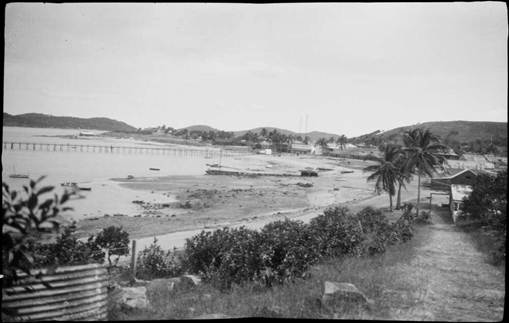
Thursday Island was a small village clustered around the waterfront. Picture from the Michael Terry collection, NLA PIC/8847
Though fuel dumps had been established all around Australia, it had been thought that it might be desirable to call off the round-Australia flight at Thursday Island. Fears were held for the durability of the Fairey, and we have already seen engine failures, chronic float problems, and compass disasters. Nevertheless, quite a major depot had been established, manned by Corporal Gurr. Nothing more is known of him, but he was very capable. Also, this indicates the attention to logistics that is a characteristic of this flight.
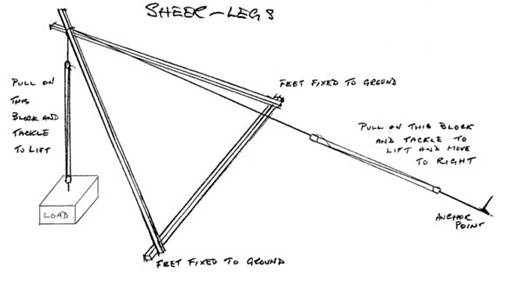 Rain
fell continuously for the next five days. ‘The floats were found to be leaking
again and would have to be replaced. This necessitated lifting the 2½ ton
aircraft to slip the new floats underneath. As there were no cranes or derricks
on the island, two special sheerlegs, 50 feet long and eight inches square,
were erected. It took days to get them into position; then the aircraft was
lifted by block and tackle and the new floats fitted’. It is a pity that there
are no photos of this operation!
Rain
fell continuously for the next five days. ‘The floats were found to be leaking
again and would have to be replaced. This necessitated lifting the 2½ ton
aircraft to slip the new floats underneath. As there were no cranes or derricks
on the island, two special sheerlegs, 50 feet long and eight inches square,
were erected. It took days to get them into position; then the aircraft was
lifted by block and tackle and the new floats fitted’. It is a pity that there
are no photos of this operation!
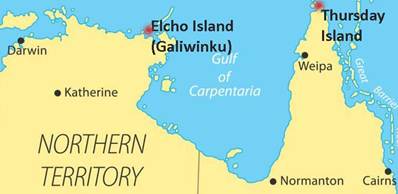
The next stage from Thursday Island was certainly the most difficult of the entire journey. There were no suitable places for refuelling around the coast of the Gulf of Carpentaria. Even today, there is no coastal road and hundreds of kilometres of coastline that is completely deserted. There are massive mangrove swamps: when Burke and Wills reached the Gulf in their 1861 trans-Australia expedition these prevented them from reaching the open sea.
So the only option was a flight across the open ocean to Elcho Island (modern Galiwinku). Among other factors, the matter of range was critical. The distance was nearly 800 km, one of the longest stages, and the prevailing winds were in the opposite direction. When cruising at about 180 km/hr a headwind of even 30 km/hr would make the journey impossible. When added to the fact that there was virtually no shipping in the Gulf, flying over the open water in such an unreliable aircraft was a very perilous undertaking. The historical accounts do not do the situation justice!
Wednesday 23 April 1924: Thursday Island to Galliwin’ku (formerly Elcho Island)
6.40 am to 11.50 pm, 772 km, 417 nm.
According to the newspapers, the aviators had hoped to refuel at Elcho Island and fly on to Darwin that same day. Here is Parnell’s account of the flight. (Because the pilot’s compass was not functioning, Goble indicated necessary direction changes to McIntyre by pulling on string ‘reins’).
 Thursday
Island was put astern at 0640 on the 23rd, 17 days after leaving Melbourne, and
the Fairey was no longer in pristine condition. With the guns, ammunition,
drinking water and extra spares, it was considerably above the manufacturer's
maximum allowable weight. As for the weather, it was noted that while a strong
surface wind was blowing, the clouds higher up were moving in the opposite
direction.
Thursday
Island was put astern at 0640 on the 23rd, 17 days after leaving Melbourne, and
the Fairey was no longer in pristine condition. With the guns, ammunition,
drinking water and extra spares, it was considerably above the manufacturer's
maximum allowable weight. As for the weather, it was noted that while a strong
surface wind was blowing, the clouds higher up were moving in the opposite
direction.
At about 0830 the engine started misfiring; two valves were sticking badly, and considerable vibration was experienced. An hour and a quarter after leaving Thursday Island, the wind changed to the south, reducing speed, and a course change was necessary. At 0920 the wind veered to SSW and then at 1040 to SE. Visibility was hazy and the sea had an eight-foot swell. McIntyre was answering well to the reins and the flight was continued at 500 feet all the way across the Gulf of Carpentaria. When land was sighted it was found that they were only 12 miles off course after a flight over 410 miles of open sea -- surely a rare feat for those days. They headed for Elcho Island where touchdown was made at 1150.
It was impossible to go on to Darwin without adjusting the valves and faulty carburation, and this work was carried on until late at night. Some of the more adventurous aborigines came down and watched them. They ran the engine up in the darkness; it was still coughing and spitting badly, and one native who seemed to know a lot about seaplanes remarked ‘My crikey, mine tinkit dis feller gotten bad bellyache.’ But when Goble climbed up to, the cockpit and fired a red Verey light into the sky, the natives took to the bush with wild screechings and were not seen again.
The beach was soft, sandy and well-sheltered from the SE winds. (Parnell).
The RAAF historian Frank Doak records this comment from Goble:
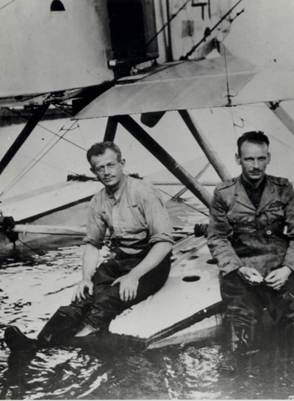 While
working on the machine a few natives came down. We had a gallon of petrol and a
gallon of distilled water left over. We poured the the petrol on the beach and
dropped a match and set the sand on fire. After that, we played a very dirty
trick on them and gave them the distilled water. They threw blazing torches
into it which only spluttered and went out. Finally, to dismiss our audience I
climbed into the machine and fired a red Very light.
While
working on the machine a few natives came down. We had a gallon of petrol and a
gallon of distilled water left over. We poured the the petrol on the beach and
dropped a match and set the sand on fire. After that, we played a very dirty
trick on them and gave them the distilled water. They threw blazing torches
into it which only spluttered and went out. Finally, to dismiss our audience I
climbed into the machine and fired a red Very light.
The modern Elcho Island is famous as the home of the late Aboriginal folk musician Geoffrey Gurrumul Yunupingu and other notable musicians. It was the inspiration for the famous song ‘My Island Home’. Its dance troupe has achieved great recognition, and it is a thriving arts centre. Galiwin’ku (the modern preferred name) is a traditional Aboriginal community with restricted access; permission to visit is required by law and can be made through the Northern Land Council directly or via the Galiwinku Council. There is a population of around 2,200 people, of whom only about 70 are non-Aboriginal. The most commonly spoken language is Djambarrpuyngu but at least twelve other languages still survive. Shepherdson College, the main school, is recognised worldwide for its work in intercultural education.
And, incidentally, establishing a fuel depot here is yet another example of the major planning that went into the McIntyre / Goble flight. There must have been a caretaker for the fuel, but no details are available. More information is needed!
1924: A note on relationships with the First Nation
 The
attitude to the Aboriginal inhabitants was of its time, and it is interesting
to examine in some detail. The airmen did not carry spare clothing, they still
made room for a couple of .303 rifles and ammunition. This attitude was very
common.
The
attitude to the Aboriginal inhabitants was of its time, and it is interesting
to examine in some detail. The airmen did not carry spare clothing, they still
made room for a couple of .303 rifles and ammunition. This attitude was very
common.
For example, when McGuiness and Fysh travelled from Normanton to Darwin surveying for the Smith flight in 1919, they were regaled with tales of early fights with the Aborigines ‘whose love of spearing cattle got them into trouble with the station people’. The Wollogorang Station homestead was ‘spear proof with its heavy wooden doors loopholed’ so that guns could be fired on any attackers.
Therefore, McGuinness and Fish were also equipped with a .303 service rifle and ammunition. A J Cotton, father of famed aviator Sydney Cotton, was manager of Brunette Downs station, and warned ‘the Blacks are bad, too – and Murdering Tommy is out in the Turn-off Lagoon area’.
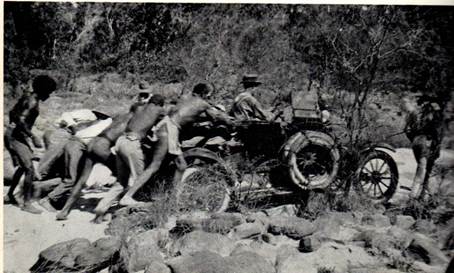
Whether the danger was real or not, It is clear that Fysh and McGinness would certainly not have completed their journey without being helped by groups of Aboriginal people pushing their Model T out of impossible situations, as per the picture.
Goble and McIntyre were ‘weighed down’ with firearms, and their feelings are clear from the account of the journey, notably on Thursday Island, Elcho Island and later at Mission Bay. The help of the First Nations people at Mission Bay almost certainly saved the aircraft from being wrecked by the high tide, the strength of which had not been realised by the aviators.
The attitudes of 1924 are a century old. The aviators were products of their time, just as we are of ours. Future generations will doubtless look back on us, with similar criticisms. But the facts must be recorded and the appropriate lessons learnt.
Thursday 24 April 1924: Galliwin’ku to Darwin
10.27 am to 2.30 pm, 3 hours 57 minutes, 540 km, 292 nm.
According to Parnell, after take-off, they climbed to 4500 feet with a full load, taking ‘under 15 minutes’, but facing a strong headwind they dropped back to 2,000 feet. Many native fires were seen along the way and alligators were observed diving into the rivers as the aircraft passed overhead.
One source lists a fuel dump at Graham Island but there is no such place on this flight leg that is listed in Google Earth. Possibly it was confused with Sir Graham Moore Island, mentioned on the next page.
After reaching Cape Cockburn, the course was altered to pass over Goulburn Island … on landing at Darwin they shook hands with each other, very relieved to have successfully negotiated the last two stages. They had been frightened that the engine might conk out.
Issacs also says that an attempt was made to resume the flight on the following day, but the engine was not producing enough power.
The seaplane was hoisted onto the wharf with a railway crane, (below} and all through the 25th the carburettors and magnetos were overhauled. Throughout 25-26 April the crew worked each day in the blazing sun until midnight, and Goble’s knees were burnt raw and had to be wrapped in bandages.
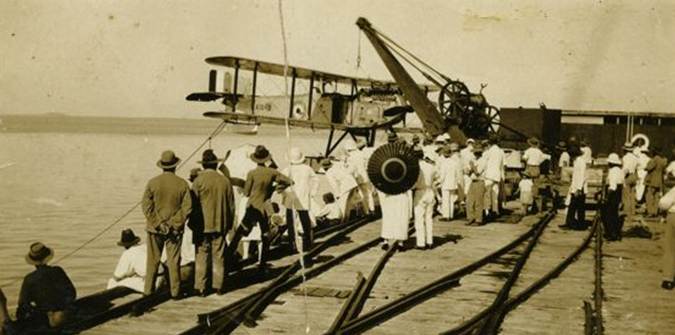
Picture from Library and Archives NT PH0413/0008.
Sunday, 27 April 1924: Darwin to Napier Broome Bay
10.10 am to 2.55 pm, 3 hours 35 minutes, 583 km, 315 nm.
(‘Disambiguation’ is desirable: Napier Broome Bay is not near Broome. The modern settlement of Kalumburu is on the Drysdale River that flows into Napier Broome Bay; it is the most northerly settlement in Western Australia. There is another Drysdale Rover, much smaller, that flows into Exmouth Gulf. Mission Bay, referred to by Isaacs, does not appear on Google Earth, but elsewhere the mission is said to be situated at what is now known as Hollywood Beach. In some newspaper accounts the fuel dump is listed as being at Sir Graham Moore Island, at the head of Napier Broome Bay, but even today there is no sign of habitation on the island).
The seaplane was lowered into the water and at 10.10 am they took off for Napier Broome Bay. Visibility was good. Cape Londonderry was reached at 1.20 pm (328 miles in 3 hours 10 minutes, an average of 103 mph) and Mission Bay at 1.45 pm where a landing was made in a choppy sea. The guns were loaded as they were not sure whether the natives were friendly. However, they were met by the Father Superior of the Spanish Mission, and all was well. He plied them with biscuits and wine, and they were feeling rather heady as they returned to refuel the plane. By 6 pm it was completed and the missionaries provided a kangaroo tail dinner and the natives staged a special corroboree. (Isaacs)
This was Drysdale River Mission, an outpost of the Benedictine monastery at New Norcia, which had been established about 100 km north of Perth in 1846. The mission at Napier Broome Bay had been established in 1908 following exploratory work by Father (later Abbot and Bishop) Fulgentius Torres, the leader of New Norcia since 1901. The mission station was served by a coastal steamship, and this is obviously how the fuel was delivered.
Photo from WA Government Find and Connect website, ‘Natives being taught the sign of the cross’.
![Aboriginal People Being Taught the Sign of the Cross [altered from original title]](44%20Days01_files/image018.jpg) The
Benedictine mission at Drysdale River was, indeed, not always peaceful. Until
the 1920s, the missionaries’ position was precarious, in 1913 the Aborigines
beat up the missionaries on several occasions, and seriously wounded one of
them with a spear. The monks lived in a two-storey monastery with a ladder, the
only form of access to the second storey, withdrawn at night for security.
A missionary recorded a night when we were in the chapel saying our prayers,
with the Rosary in one hand and the revolver in the other. (I minutes
Crawford, The Benedictine Mission at Kalumburu, Studies in Western
Australian History, Issue 3, page 43). (Events such as this need to be recorded
as they illustrate the violence that sometimes pervaded interracial
relationships of the time. It is great that we are all becoming aware of this.
-tl).
The
Benedictine mission at Drysdale River was, indeed, not always peaceful. Until
the 1920s, the missionaries’ position was precarious, in 1913 the Aborigines
beat up the missionaries on several occasions, and seriously wounded one of
them with a spear. The monks lived in a two-storey monastery with a ladder, the
only form of access to the second storey, withdrawn at night for security.
A missionary recorded a night when we were in the chapel saying our prayers,
with the Rosary in one hand and the revolver in the other. (I minutes
Crawford, The Benedictine Mission at Kalumburu, Studies in Western
Australian History, Issue 3, page 43). (Events such as this need to be recorded
as they illustrate the violence that sometimes pervaded interracial
relationships of the time. It is great that we are all becoming aware of this.
-tl).
Under the Western Australian Native Mission Stations Act 1923, an area of one thousand acres of land in the Doongan District was formally granted to the Benedictine Community of New Norcia, Incorporated, ‘for the purposes of the Drysdale River Mission’. In 1926 it was reported that about 60 indigenous people lived in the area, including several children sent there by the Chief Protector of Aborigines, A O Neville. By 1932 three Benedictine Sisters had arrived at the mission from New Norcia, their principal objectives being to run the hospital and provide education to the children of the mission. It was reported in 1934 that there were 10 children in attendance at the mission school.
Because of a shortage of fresh water, in 1937 the main settlement was moved up the river a few kilometres to Kalumburu.
In 1940 the RAAF set up a ‘staging’ base in the area for the route from Fremantle to Darwin. On 27 September 1943, six people were killed during a Japanese air raid, comprising a mother, her four children and the Mission Superior Father Thomas Gil.
They were taking shelter in a trench. The mission’s buildings were damaged severely in the attack. At the nearby airfield, the ammunition hut exploded when it was hit by a bomb, but there were no other casualties, (Kimberly Echo newspaper).
The RAAF established Truscott Airfield in 1944 about 20 km to the north, and it remains in use as a commercial airstrip, largely serving the pearling industry. Kalumburu itself has another aerodrome.
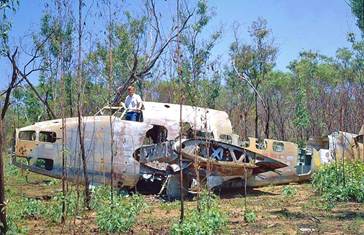 The Mission ceased operations in
1982 and the area is controlled now by the Kalumburu Aboriginal Corporation.
Although it is still very isolated, a tourist industry is developing, based
around the area’s cultural and natural heritage. Remains of wartime aircraft
may still be found- picture from Geoff Goodall’s Aviation History Site, which
has a great section on the aviation history of the region at https://www.goodall.com.au/australian-aviation/kimberley-war-relics/kimberleyrelics.html.
The Mission ceased operations in
1982 and the area is controlled now by the Kalumburu Aboriginal Corporation.
Although it is still very isolated, a tourist industry is developing, based
around the area’s cultural and natural heritage. Remains of wartime aircraft
may still be found- picture from Geoff Goodall’s Aviation History Site, which
has a great section on the aviation history of the region at https://www.goodall.com.au/australian-aviation/kimberley-war-relics/kimberleyrelics.html.
Returning to the flight, all available comments indicate that the Aboriginal people were very helpful to the aviators. This is an area of extreme tides. Goble and McIntyre stayed in the Fairey overnight, anchored 200 yards from the high-water mark. Nevertheless, the low tide was a surprise to the aviators, and the Aboriginal people ‘had to be hurriedly called from their beds to help push the seaplane into deeper water. McIntyre used the engine to assist the natives as they pushed and pulled the aircraft around but in the process, the port float was strained and was leaking badly’ (Parnell). Goble recorded that ‘by way of returning the native hospitality we gave a demonstration of setting the sea on fire with petrol to the vast amazement of the community.’ (Doak).
Monday, 28 April 1924 – Mission Bay to Broome
10 am to 2.45 pm 3 hours 35 m, 797 km, 430 nm.
Despite the best efforts of the Aboriginals and the crew, the aircraft had been damaged on the night of 27 April because of the extreme tides in the area. The port float was strained and leaking badly. Bound for Broome, they took off at 10.00 am in a choppy sea with one float half full of water.
The engine was running very well, and Broome was reached at 2.45 pm. The harbour was very exposed, and with a tide of thirty-six feet was not of much use as a seaplane base. (Parnell).
At Broome, they were met by Leading Aircraftsman Gottschalk, who was a very skilled mechanic, much appreciated by the airmen.
The Broome correspondent of the Melbourne Herald wrote a lengthy article, dealing with the stopover at Napier Broome Bay, emphasizing again the fears they had of the natives, but noting that they were delighted at their good reception from the missionaries and the Aboriginals.
The Herald article also went into considerable detail about the stay in Broome. Last night, although very tired, the airmen were busy overhauling their machine and making engine adjustments. The covering of these great distances is a severe test of the engine, and the airmen know that the success of their venture depends on it.
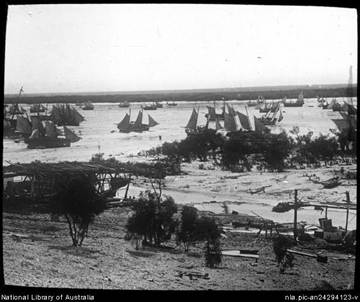 The
improved communications in Broome brought news of the flight to a wider
audience: All their friends in Melbourne will be glad to know that, despite
the arduous days and nights both airmen have their tails ‘right up’. Senator
Pearce, Minister for Homeland Territories, said today ‘As the Minister who
founded the Australian Air Force In 1921, I am proud to think it is able to
carry out such a great undertaking as this flight. The information and
experience obtained by Wing-Commander Goble and his companion must be of
considerable value. I am following the flight with keen interest, as everybody
else is.
The
improved communications in Broome brought news of the flight to a wider
audience: All their friends in Melbourne will be glad to know that, despite
the arduous days and nights both airmen have their tails ‘right up’. Senator
Pearce, Minister for Homeland Territories, said today ‘As the Minister who
founded the Australian Air Force In 1921, I am proud to think it is able to
carry out such a great undertaking as this flight. The information and
experience obtained by Wing-Commander Goble and his companion must be of
considerable value. I am following the flight with keen interest, as everybody
else is.
Broome, at the time, was a great centre for the pearling trade.
Tuesday 29 April 19 1924 Broome to Port Hedland
8.10 am to 11.20 am, 3 hours 10 m, 507 km, 274 nm.
The three aviators left Broome at 8.10 am on the 29th in a very rough sea and arrived at Port Hedland at 11.20 am. With the floats taking in water, they decided to stay there the rest of the day because the next sheltered harbour was Carnarvon, two stages further on. Onslow, the next stop, had an open beach. (Parnell)
Broome was in touch by telegraph and these reports were widely reproduced. Unfortunately, there are no photographs of their stay in Broome.
Wednesday 30 April 1924: Port Hedland to Carnarvon via Onslow
Port Hedland to Onslow, 8.42 am to 11.30 am.2 hours 42 minutes, 404 km, 218 nm, Onslow to Carnarvon 2.25 pm to 5.55 pm, 3 hours 30 minutes, 468 km, 253 nm, total for day 872 km, 471 nm; delayed 10 days awaiting a new engine.
Leaving Port Hedland at 8.42 am the next day, they reached Onslow at 11.30 am and beached the Fairey IIID on the sandy shore for refuelling. There were supposed to be no rocks in the. area, but as the tide went out it was found that the floats were rubbing on jagged rooks. Refuelling was immediately stopped, and the plane was moved half a mile down the beach. With full tanks, they left for Carnarvon at 2.25 pm.
They reached Carnarvon at 5.55 pm; the. On the way, they were met by a launch with members of the local sailing club. The secretary, whose first thought was for refreshment, held up a bottle of whisky in one hand and a bottle of beer in the other and yelled ‘What are you going to have?’ However, as they were stuck on a sandbank at this time and still three miles from the beaching place, the seaplane crew decided to wait until they were safely on the beach.
At daylight on the 30th, they were ready to leave for Fremantle, but the engine had dropped from 1,650 rpm to 1,500 rpm, insufficient to lift the heavy seaplane off the water. An examination disclosed that two valves were burnt out; it was impossible to take them out without stripping the engine and Gottschalk decided to try to grind them in the cylinders. This took two days, but after testing the engine, it still did not develop enough power and required a top overhaul. (Parnell)
Arrangements were made for a spare engine to be bought forward from Perth — some 700 miles (I,125 km) by rail and road, with two mechanics.
They left Perth on Sunday 5 May, when they travelled 450 km by rail from Perth to Mullewa, which is 100 km inland from Geraldton, on the railway to the Mount Magnet goldfields. The remainder of the journey was by motor lorry, and this would have been quite a difficult journey at the time. Western Australia followed the usual pattern of rail development which concentrated on inland communication, leaving coastal transport to the coastal trading ships, and roads were primitive.
They arrived late on Wednesday 8 May. Mr Faulkner of the Northwest Department got a small crane onto a bridge against which the seaplane was moored; work began at daylight on the 9th and by 3 pm the engine was fitted, tested, and ready for the air. Considering the lack of facilities, Gottschalk did an excellent job, He, Goble and McIntyre were ready to go on the 10th, but the night tide did not arrive and the Fairey was left high and dry. Another night had to be spent at Carnarvon. (Parnell).
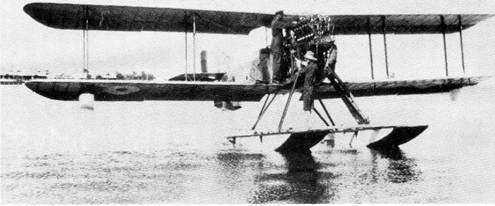 This photograph was taken at Carnarvon. The
propeller has been removed, and the extra radiator was also disconnected at
Carnarvon for the rest of the flight.
This photograph was taken at Carnarvon. The
propeller has been removed, and the extra radiator was also disconnected at
Carnarvon for the rest of the flight.
Sunday 11 May 1924. Carnarvon to Perth via Geraldton with forced landing en route
Carnarvon to Geraldton, 9.10 am to 12.55 pm, 3 hours 45 minutes, 467 km, 252 nm, Geraldton to Perth, 1.25 pm to 4.15 pm, 2 hours 50 minutes, 404 km, 218 nm, total for day 871km, 470 nm.
They covered a good distance for the day, but it was certainly full of incidents. Thus, Parnell: At 9.10 am, on the 11th, they lifted off at last, in fair conditions. There had been no rain at Carnarvon for many months and Goble assured people there that wherever the seaplane went they always got rain. The jest soon came true, for 70 miles south they ran into a northwest monsoon and continued the. remaining 220 miles to Geraldton between 100 and 500 feet in blinding rain. They landed in a rough sea. Residents gave them hot coffee and biscuits, and the mayor waded out up to his neck in his best Sunday suit to lend a hand.
Children were enthusiastic; McIntyre caught three of them doing acrobatic stunts on the elevator wires. He promptly pulled them off and put them ashore.
After leaving at 1.25 pm, the petrol was switched from the main tank to the auxiliary tank. Forty minutes later, flying downwind in the rain at five hundred feet, the engine suddenly cut out. Frantic pumping by both Goble and McIntyre got pressure in the main tank and the engine started just before the plane reached the water. A landing was made in the open sea, and it was found that someone (the children?) had removed the binding wire from the drain cock on the auxiliary tank and the petrol had emptied into the sea.
Taking off again was rather a hair-raising affair. The lower wings were awash and Gottschalk's 14-stone weight did not help, but McIntyre managed to lift the plane off. They landed on the Swan River, Perth, at. 2.15 -pm (Parnell). The reception here was huge.
The Western Mail devoted a full page of photographs to the visit, a very advanced coverage for the time. Mrs Goble had been interviewed at her home on April 27, when some newspaper reporters were concerned that the aviators had failed to arrive at Darwin as scheduled. Mrs Goble steadfastly refused to be drawn into any pessimistic discussion and said that she had full confidence in her husband’s ability and the inevitability of his success. She had a lot of favourable publicity as a result.
Monday 12 May 1924: Perth to Albany; false start to Israelite Bay
12.36 pm to 4.15 pm, 3 hours 39 minutes, 589 km, 318 nm
After a night in Perth they left for Albany, as recorded by the West Australian newspaper: [Goble] was up before the alarm clock went off and was overhauling the machine when all Perth was sleeping. Both he and Lieut. McIntyre were there, going over all the vital parts of the machine, and Mechanic Gottschalk joined them later. Everything, from the engine to the smallest wire, was seen to, and Lieutenant: McIntyre, as pilot, had the propellor going about a quarter of an hour before the start. The aviators also saw to it that the 100 gallons of petrol, needed for the next stage of the flight, was placed on board. The aviators were too businesslike to indulge in many picturesque preliminaries before proceeding on their way to Albany. Cheered by the crowd, they set the seaplane off on a brief taxi trip along the river, turning about mid-stream in an easterly direction, and then soaring. The 'plane buzzed overhead for a couple of minutes, and her nose was then set on the down-river course, making for Fremantle. She was soon out of sight, but she was not so soon out of mind. People lingered long after she could be followed by the eyesight.
They had a fairly good run and landed in Princess Royal Harbour, a ‘beautifully sheltered spot for seaplanes,’ Here they were met 'by hordes of uncontrollable children, who swarmed all over the machine as soon as it was beached, yelling and screaming at the tops of their voices.’ After the experience at Geraldton, police protection was hurriedly sought.
Looking at Google Earth, the landing spots across the Great Australian Bight would strike fear into any seaplane pilot. Often the aircraft would land on the open sea and run into the beach. Also, they seem to have been faced with strong headwinds. On the 13th a start was made for Israelite Bay at 11.42 am. Weather forecasts had indicated SW winds, but these turned to a strong NE wind, and in 52 minutes they had covered only 32 miles. It was decided to return to Albany and the same 32 miles were quickly covered in 18 minutes. On the following day a depression in the weather arrived and the Fairey IIID had to be moved to a more sheltered spot. At this stage the main worry was that there had to be an off-shore wind at Israelite Bay; with an on-shore wind the seaplane might get caught in the surf and break up. (Parnell).
Thursday, 15 May 1924 Albany to Israelite Bay,
12.48 pm to 5.20 pm, 4 hours 32 minutes,735 km, 397 nm.
 Although conditions at Albany were
unfavourable, a start was made at 10.48 am. A moderate flight was made to Mary
Ann Haven, where heavy rain forced them down to 100 feet. Visibility was nearly
non-existent and the sea very rough. On reaching Esperance Bay the harbour was
much too rough and the beach too exposed, so there was no alternative but to
continue to Israelite Bay. Although the aircraft was making an airspeed of over
100 mph, the last 20 miles took 42 minutes. It was impossible to see either water
or coast, so they circled a group of islands in the Eastern Group, gradually
climbing until a break appeared in the direction of Israelite Bay. They
immediately put the nose down and sped in for a landing, just making the beach
before the break in the weather disappeared. (Parnell)
Although conditions at Albany were
unfavourable, a start was made at 10.48 am. A moderate flight was made to Mary
Ann Haven, where heavy rain forced them down to 100 feet. Visibility was nearly
non-existent and the sea very rough. On reaching Esperance Bay the harbour was
much too rough and the beach too exposed, so there was no alternative but to
continue to Israelite Bay. Although the aircraft was making an airspeed of over
100 mph, the last 20 miles took 42 minutes. It was impossible to see either water
or coast, so they circled a group of islands in the Eastern Group, gradually
climbing until a break appeared in the direction of Israelite Bay. They
immediately put the nose down and sped in for a landing, just making the beach
before the break in the weather disappeared. (Parnell)
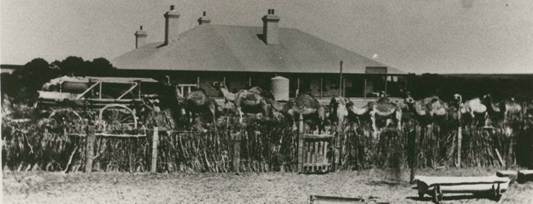
Israelite
Bay, even today, is very 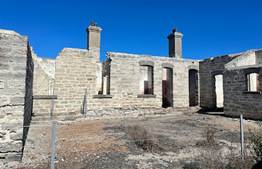 isolated. This
earlier photo of the telegraph repeating station is in the collection of the
Esperance Historical Society. The total population was four people, and Parnell
says they made the fliers very welcome
isolated. This
earlier photo of the telegraph repeating station is in the collection of the
Esperance Historical Society. The total population was four people, and Parnell
says they made the fliers very welcome
The modern photo of the telegraph station comes from Google Earth.
Saturday 16 May 1924 – Israelite Bay to Ceduna (aka Murat Bay, Denial Bay)
9.27 am to 6.03 pm, 8 hours 36 minutes, 1046 km, 565 nm, the longest flight in a single day.
The wind held from the west all night and they were able to get away at 9.27 am Melbourne time. The wind was then from the SW, the sky overcast, and very heavy seas were running. Most of the coastline there is sheer cliff, so they stood well out to sea, making directly for Eyre, from where a sandy beach extended to Eucla. They had been flying between 800 and 1,000 feet between Israelite Bay and Eyre, but to avoid the clouds they climbed to 3,000 feet on reaching the coast. The airspeed immediately dropped, so they descended into the cloud again to get the benefit of the wind.
Eucla was reached at 10.35 am Residents had telegraphed Goble and McIntyre to land there, but as the surf on the beach was too rough, they flew around for a few minutes and dropped a letter 'with a streamer’ (a strip torn from the tail of McIntyre's shirt) explaining why they could not land.
From Eucla the sand gave way to cliffs again, so they stood out to sea and steered a course to Cape Adieu, through clouds and drizzle. Fowler's Bay was reached at 12.41 pm. It was intended to land there to refuel, but because of the exposed harbour, they carried on to Ceduna (Murat Bay) where emergency supplies had been laid down. They arrived there at 1.30 pm.
Murat and Denial Bays were full of rocks, particularly at low tide, and residents there saw more flying than at any other place visited. McIntyre kept flying. from one part of the bay to another trying to find a safe place to beach the seaplane. It was eventually anchored on a mud bank half a mile from the shore. The airmen were cold, wet to the necks, and their teeth chattered; they thought they might get a small nip at the local hotel -- but it was ten minutes past six, and under South Australian licensing laws nothing could be bought... but a good Samaritan slipped them something ‘off the hip.
Refuelling was helped by Mr Betts (agent for Vacuum Oil), Mr Norman (schoolmaster) and Mr Reid (manager of Betts and Co) carrying petrol half a mile over the mudbank. (Parnell).
(According to Google Earth, the bay on which Ceduna is built is Murat Bay, named by the French Explorer Nicolas Baudin. Ceduna is on the eastern side of the bay and Denial Bay is on the western side of Murat Bay. Denial Bay was listed by Parnell as the destination of the day. It was named by Matthew Flinders, who thought that the inlet might lead to the ‘inland sea’ that many people thought might exist. Very confusing!)
Saturday, 17 May 1924 – Ceduna to Port Lincoln
11.49 am to 2.55 pm, 3 hours 6 minutes, 433 km, 234 nm.
They had reached larger towns again, and the newspapers covered the story widely. This was the first visit of any kind of aircraft to the area, Thus, the Adelaide News, with an illustrated coverage:
Port Lincoln was agog with excitement today in anticipation of the arrival of Wing Commander S J Goble and Flight Lieutenant J E McIntyre, who are engaged in a flight around Australia in a seaplane. Word was received at noon that the airmen had left Denial Bay at 11.40. At 2.30 this afternoon a huge machine was seen coming over the hills toward Port Lincoln. Practically all the residents assembled on the pier and beach.
The machine circled the harbour, taking snaps preparatory to alighting, and then gracefully circling lower and lower, skimmed along the surface, coming to rest at the water's edge. The crowd cheered lustily, and soon the aviators were surrounded by a crowd of admirers. Both jumped into the water up to their knees and for a quarter of an hour were engaged in mooring the machine and looking to the engine.
‘Had a very easy ride,’ said Mr Goble in answer to a question. ‘We are practically wet through.’ Taking off their high India rubber boots, under the direction of Mr R D Cook the men carried cases of petrol to the machine, which looked like a monster bird on the water's edge.
Regardless of getting their feet wet, the crowd clustered around to inspect the machine. The airmen had to fight their way through them. They were prevailed on to pose on the plane while numerous cameras clicked.
'‘We thought you would be here last night,’ called a voice.
‘Give us a chance,’ shouted Mr Goble. ‘We left Israelite Bay only at 9 last night by your time.’ ‘But we are on the home stretch now,’ he said. ‘We have only another nine hours' run. We had trouble in Western Australia with the engine, but put in a new Rolls Royce in record time’.
After receiving some refreshments ashore, the aviators returned and helped to fill the petrol tank, which holds 136 gallons. ‘In Western Australia we were ahead of petrol supplies, but now they are ahead of us.’ said Mr Goble. ‘Yes, it is rather dirty,’ he said, when his attention was drawn to the oil bespattered wings of the seaplane. ‘We used to give them a clean-up every day, but lately have dropped off. We have been going for six weeks.’
The men had no change of clothes, but the hospitable residents entertained them at tea and provided them with a change.
The seaplane is a Fairly (3D type). The wings measure 40 ft, tip to tip. There is a two-bladed propeller, 12 ft in diameter. The engine is more than 400 horsepower. If the weather is favourable a start will be made for Beachport tomorrow morning.
It appears that the winds were favourable over these last two sections!
Sunday 18 May 1924: Port Lincoln to Beachport
11.36 am to 3.05 pm, 3 hours 29 minutes, 563 km, 394 nm
They left Port Lincoln at 11.03 am on the 18th of May and had a good passage to Beachport, arriving at 2.35 p.m. A bad rain squall was experienced off Kingston en route. They were met by Flight Lieutenant Harman and a mechanic from Point Cook, who refuelled and checked the seaplane. (Parnell)
The South Eastern Times, published in nearby Millicent, recorded that the average speed was about 100 miles per hour. Enquiries were made of prominent local residents as to the suitability of Lake George as landing place. In the future we may see Beachport a prominent seaplane base Lieutenant Herman, of the Air Forces, assisted by a corporal and a mechanic, had charge of the local arrangements, and the machine was rapidly overhauled and filled with petrol and oil. (Tuesday 20 May 1924, page 3).
Monday 19 May 1924: Beach Port to Point Cook, via St Kilda
10.12 am to 2 pm, 3 hours 48 minutes, 692 km, 374 nm.
Photo from RAAF collection, Point Cook
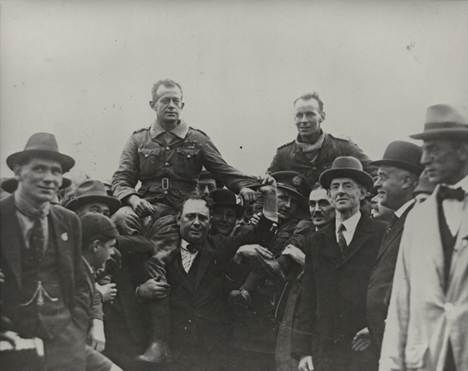 A
fresh NE wind was blowing on the ground, but although the sky was clouded over,
they were able to climb to 5,000 feet where a north-west wind helped the
aircraft along. They had excellent visibility and the smoothest trip of the
whole flight. A good time was being made so they spent a few minutes circling
Portland, Warrnambool, Port Fairy and Lorne.
A
fresh NE wind was blowing on the ground, but although the sky was clouded over,
they were able to climb to 5,000 feet where a north-west wind helped the
aircraft along. They had excellent visibility and the smoothest trip of the
whole flight. A good time was being made so they spent a few minutes circling
Portland, Warrnambool, Port Fairy and Lorne.
Approaching the entrance to Port Phillip Bay, a steamer coming out gave them a reception by blowing its whistle; they answered by running up their ensign and dipping the seaplane's wings. At Point Cook, another Fairey IIID in charge of Squadron Leader Murray Jones, CO of Point Cook, and 15 other aircraft formatted with them and escorted the seaplane to St Kilda Esplanade, where approximately 10,000 people had lined the foreshore. (Parnell).
The arrival was a media sensation. Googling videos for Goble Fairey should bring you to https://vimeo.com/239920253 which is the only known RAAF Fairey movie, and shows the excitement of the arrival. This is a lightly edited description of the seaplane’s arrival, from The Age, 20 May 1924:
ROUND AUSTRALIA: NOTABLE AIR FLIGHT COMPLETED. 8500 MILES IN 93 HOURS. Enthusiastic Welcome at St Kilda
Round the ‘island continent’ of Australia in 93 hours' travelling time, or approximately 8500 miles at an average speed of 92 miles an hour! With this fine achievement to their credit, Wing Commander Goble and Flight Lieutenant McIntyre, of the Royal Australian Air Force, yesterday returned to Melbourne. The flight averaged nearly 92 miles an hour and 120 mph was attained at times. The remarkable nonstop flight of 630 miles in five hours and a half across the Bight last Friday provided an interesting ‘curtain raiser’ to the scene enacted at St Kilda yesterday, where the long flight round the Commonwealth terminated, and the aviators were accorded receptions by the State Governor, the Federal Government and St Kilda municipality. Yesterday the flight from Beachport commenced at 10.10 a.m. (Melbourne time), and at 2.10 p.m. the seaplane was circling its home at Point Cook, preparatory to alighting off St Kilda at 2.30 p.m., in accordance with arrangements for the formal receptions. Fifteen air force aeroplanes and a sister seaplane, in charge of Squadron Leader Murray Jones, who commands Point Cook station, took part in an aerial demonstration to welcome the returning aviators. An overcast sky and a strong headwind met the aviators as they came up over Port Phillip Bay.
St Kilda Esplanade presented an animated scene long before the seaplane was due there. By 1.30 p.m. the foreshore in the vicinity of the pier was lined with men, women and children desirous of witnessing the seaplane's arrival in completion of the unique flight. Trams and trains from the city to St Kilda were crowded, and motor traffic was equally heavy. Special arrangements had been made in the vicinity of the pier for parking motor cars. The pier was reserved for persons holding invitations from the Commonwealth Government.
Prominent amongst a display of varicoloured bunting was a large blue banner, expressing in gilded letters a welcome to the aviators. Beneath this banner the mayor of St Kilda and the councillors of that city formally received Wing Commander Goble and Flight Lieutenant McIntyre, subsequent to the Federal Government welcome at the pier head. The crowd had been kept informed of the seaplane’s progress by means of telegrams from coastal postal stations and radiograms from the RAAF seaplane above Barwon Heads. At 1.05 the Fairey had passed Lorne, then Queenscliff at 1.42 and at 2.10 it was reported as being over Point Cook. It could soon be seen from St Kilda: away up against the grey cloud-covered sky were five speck-like objects approaching in ‘V’ formation. The machine forming the base was Goble's Fairey seaplane, piloted by Flight Lieutenant McIntyre. As the objects took definite shape the floats of the seaplane became conspicuous. hanging below like huge feet. Further escorting aeroplanes from Point Cook appeared, and within the next few minutes, to the obvious consternation of the seagulls and the marked interest of the ‘humans’ on shore, the sky above St Kilda became alive with a flock of sixteen noisy mechanical birds, including the seaplane.
Sweeping around to the south of the pier the seaplane manoeuvred until punctually on the fixed time for descent it gracefully detached itself from the escorting land planes, swooping down onto the waters of the Bay, where it alighted just oft the head of St Kilda pier. Skimming along the water by means of the floats, the aviators taxied in a wide circle back to the southwestern side of the pier. Amidst the cheers from pier and shore, the seaplane proceeded direct for a spot on the beach to facilitate closer public inspection of the machine than would have been possible had it remained at moorings on the water. Barriers were erected on the sand around the seaplane, which was rushed by a crowd of eager spectators from the Esplanade.
On beaching the machine Goble and McIntyre were taken aboard the air force motor launch, which conveyed them to the landing stage, where Squadron Leader McBain met them and formally conducted them to the waiting State Governor and members of the Federal Government party. Here the aviators were welcomed by the Minister of Defence (Mr Bowdon) and Senator Pearce, Minister for Home and Territories. On behalf of the Prime Minister, who sent expressions of regret at his inability to be present, Senator Pearce congratulated the aviators on their successful conclusion of a magnificent flight. Senator Pearce also expressed congratulations on behalf of the Commonwealth Government.
The official party on the pier in addition to the State Governor and the Minister of Defence and Senator Pearce, representing the Federal Government, included Sir hours Chauvel (representing the army), Rear Admiral Hall Thompson (navy), Colonel Brinsmead (Civil Aviation department), Colonel Thomas (Defence department), Squadron Leader McBain and Major Coleman (Air Board).
Philately – and the 1974 celebration
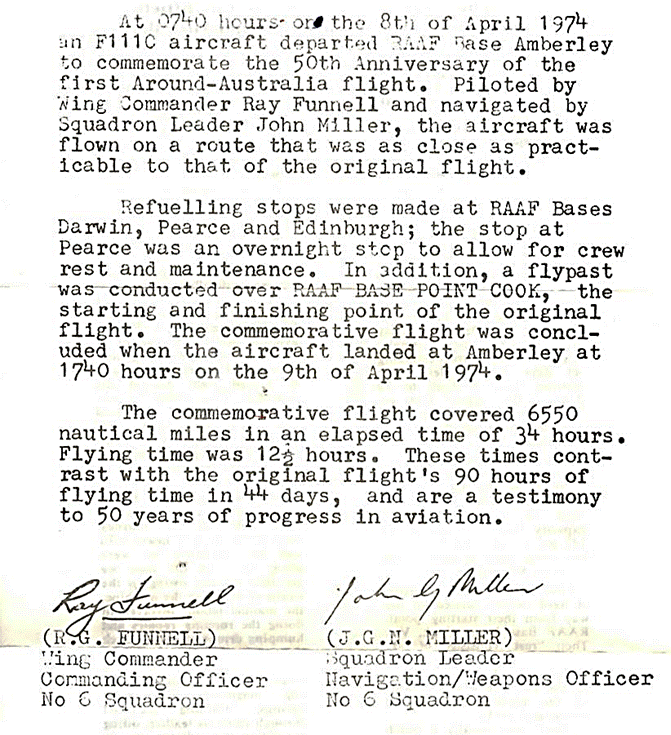
Ray Funnell served as chief of the air staff 1987-1992.
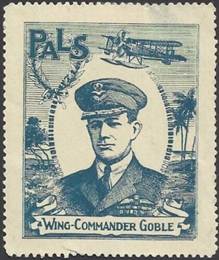
 There
were a few unofficial philatelic items carried on the 1924 journey, but they
are very rare. The Herald and Weekly Times produced a boys’ magazine
called Pals, and it produced a ‘Cinderella’ unofficial stamp which sells
for about $150.
There
were a few unofficial philatelic items carried on the 1924 journey, but they
are very rare. The Herald and Weekly Times produced a boys’ magazine
called Pals, and it produced a ‘Cinderella’ unofficial stamp which sells
for about $150.
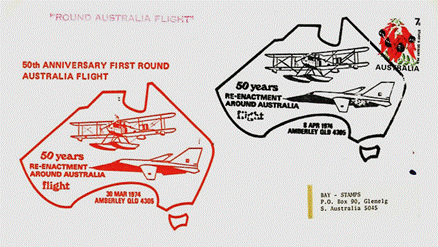
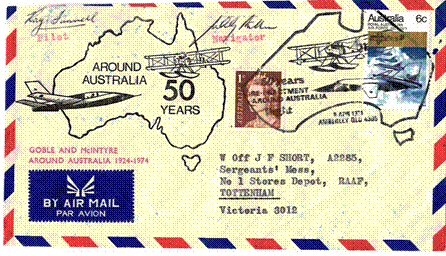
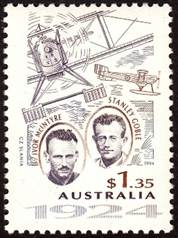
In 1974, as part of a philatelic issue with an aviation theme, the flight was celebrated with the stamp on the right.
The upper ‘cover’ was listed in the catalogue of stamp expert Nelson Eustis in his catalogue as #1775, and he noted that 9797 ‘covers’ were carried on the flight, backstamped at Amberley and Pearce RAAF bases.
The sole surviving Fairey III:
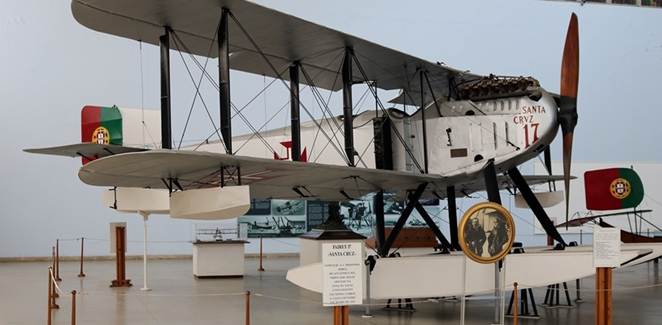
The Fairey IIID Santa Cruz at the Museu de Marinha (Naval Museum) in Lisbon,
Portugal.
To mark the centenary of Brazil’s independence, Portuguese naval aviators Gago Coutinho and Sacadura Cabral attempted the first air crossing of the South Atlantic from Lisbon, Portugal to Rio de Janeiro, Brazil in 1922.
Their aircraft, named Lusitânia, was lost upon landing on heavy seas near Saint Peter and Saint Paul Archipelago in Brazilian waters on April 17th, 1922. A second aircraft was sent to take over, but it was also destroyed.
A third Fairey, Santa Cruz, was shipped to Brazil, and finally, Coutinho and Sacadura flew to Santa Cruz and returned to Rio to complete the journey.
Fortunately, Santa Cruz has been preserved and is a great reminder of this interesting aircraft.
The second flight around Australia, 1924: H C Brinsmead
Lieutenant Colonel HC Brinsmead, OBE, MC had a distinguished wartime career in the army. He was appointed as Controller of Civil Aviation, and administrative head of the CAB, on December 16, 1920.
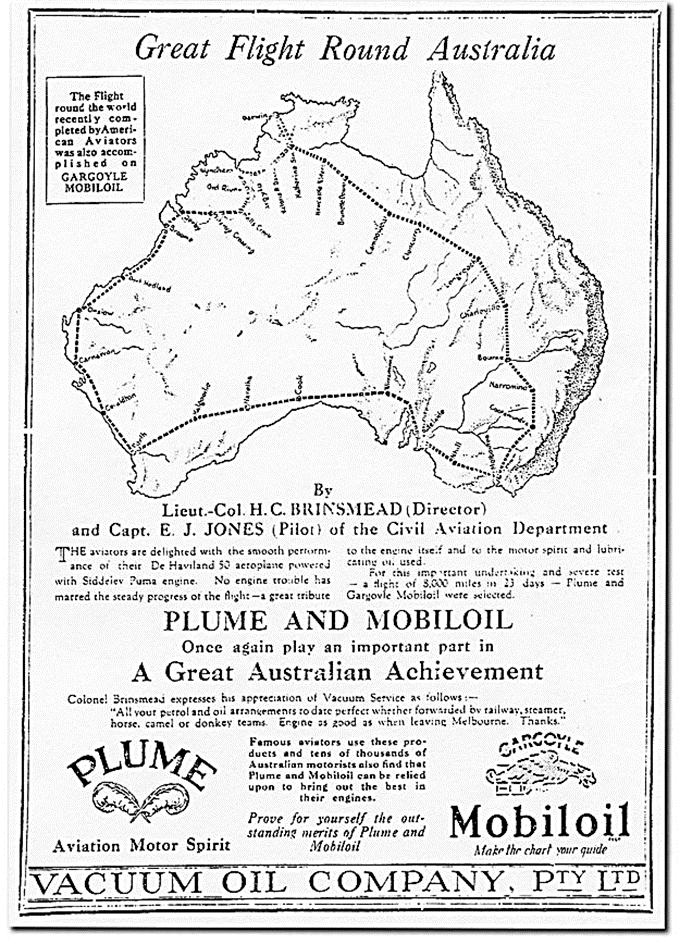
Brinsmead introduced new airworthiness checks for planes, qualifications for those who serviced them, and new medical inspections and licensing requirements for pilots. Some sectors of the industry were bitterly opposed to the changes. He made several flights around eastern Australia, and in 1924 undertook a flight around Australia, with Captain Edgar Charles Johnston MC DFC, Superintendent of Flying Operations and Personnel, who was usually the pilot, and mechanic Mr RH Buchanan, assistant Superintendent of Engineering for the CAB.
The flight left Melbourne on August 7, 1923
In comparison with the Goble / Macintyre flight, Brinsmead’s flight is not well documented. The route appears to have been Melbourne / Cootamundra / Narromine / Bourke / Charleville / Longreach / Cloncurry / Camooweal / Brunette Downs / Newcastle Waters / Darwin / Katherine / Victoria River Downs / Ord River Downs / Moola Bulla / (not on Google Earth) / Fitzroy Crossing / Derby / Broome / Port Hedland / Onslow / Carnarvon / Geraldton / Perth / Kalgoorlie / Naretha / Cook / Wirrumina / Adelaide / Nhill / Melbourne. These stopping places come from the West Australian, Friday 8 August 1924 and the map overleaf. There are a few inconsistencies between these sources.
The DH50 at Wyndham, August 17 1924.
More history from 1924
This was a very exciting year, not just for the reasons already mentioned. Among other things
· Laurence Wackett took over control of was in control of the Naval Wireless Workshops at Randwick NSW and work was well under way to produce the Wackett Widgeon seaplane.
· In Queensland, QANTAS fitted out its first aerial ambulance.
· The aero club movement was taking shape.
· Richmond Airfield, NSW, was being refurbished as a RAAF base.
· A major air show was held at Essendon showcasing the latest in airliners such as the DH50 and sporting aircraft such as the DH 53 Hummingbird and the DH.37; events included balloon chasing by DH.53s and there were military displays of aerobatics, mock dogfights and smoke bombing.
· A major light aircraft competition, sponsored by Lebbeus Hordern, was held in December at Richmond.
 Events
in Western Australia were particularly significant.
Events
in Western Australia were particularly significant.
West Australian Airways was undergoing an exciting period of development. Established in 1921 by Norman Brearley, WAA was Australia’s first airline to have scheduled flights, serving the isolated, but prosperous townships along the coast and in the mining areas. Among the early pilots was one Charles Kingsford Smith. In 1924, he and Keith Anderson took a break from flying and established the Gascoyne Transport Company, based in Carnarvon, to gather funds for the planned trans-Pacific flight. Smith and Ulm soon returned to flying and in 1927 established a new record for an around-Australia flight: despite unexpected delays, they completed the journey in 10 days 5½ hours.
The major development in Western Australia in 1924 was the opening of Maylands Aerodrome, Perth. It remained the centre of operations until superseded by Jandakot in 1963, and was the venue for many historical events.
One hundred years later
Tribute flights were conducted by Michael Smith, Australia’s well-known adventure pilot, and a flight led by David Geers, past President of the Seaplane Pilots Association of Australia, and more information can be found elsewhere in this website.