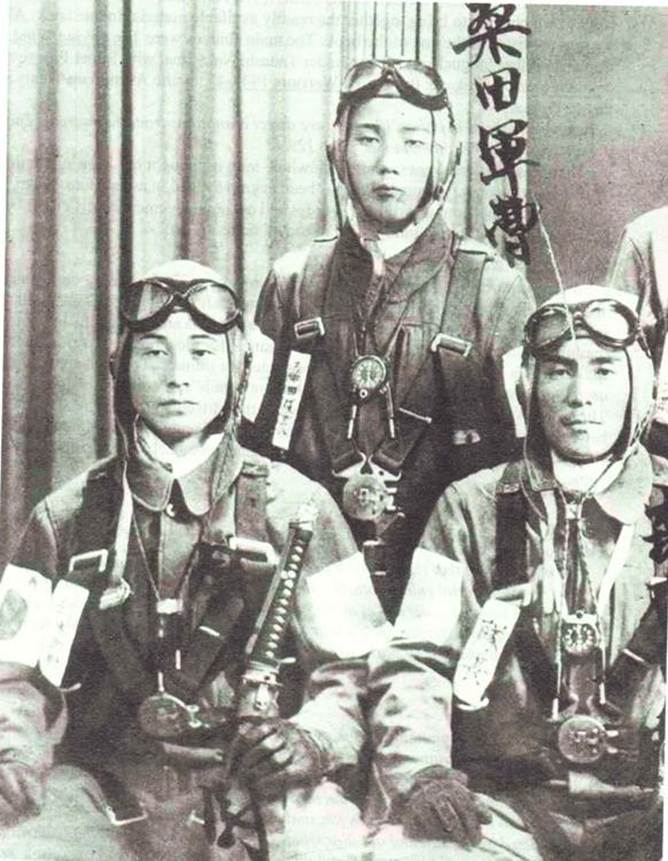
Tom's Book of the Kamikaze
ISBN 978-0-9803693-1-1
Dedication
14 April 1942 was a dismal day for Australia.
In four months Japan had blasted the US and British fleets throughout the Pacific. Hong Kong, Thailand, Borneo, Malaya, the Philippines, Burma, The Dutch East Indies (Indonesia), the Solomon Islands and many small Pacific islands were subdued.
Darwin had been bombed and largely destroyed. A handful of Australian aircraft defended Darwin: Wirraways, converted training aircraft, were the main fighters, and Hudsons, converted airliners, were the bombers. They were armed only with light machine guns.
Facing them in the Dutch East Indies was a Japanese air force that at the time had the best aircraft in the world. Their fighters were a hundred miles an hour faster than the fastest Australian aircraft. Their pilots were highly trained, and hardened by years of warfare in China. The Australians were finding it difficult even to fly the Hudsons, which had recently arrived to replace the even slower Avro Ansons.
A young Pilot Officer had just arrived at Darwin. He was ordered off on his first action, a raid on the Japanese fleet at Timor. He did not return, obviously shot down by overwhelming force ranged against him. He expected to die, and had written a letter offarewell to his family.
Two years later, it was the young Japanese men that were flying the forlorn, hopeless, useless missions against overwhelming force. They met the challenge with equal bravery and a patriotism and dedication that is inspiring, even if misguided. Their sacrifice was made even more moving by the fact that their superiors condemned them inevitably to death in suicide missions that offered no hope at all of survival.
This book is dedicated to the memory of Pilot Officer Albert James Verdun Lockley and the countless other soldiers who gave their lives for their countries, willingly but uselessly. May we appreciate their valour, understand their motivation, and try to conduct our world in such a way that their sacrifices are not needed and their lives are not wasted.
Contents
1: Japan enters the European World
The 1600s: Early European Contact with Japan
6 July 1853: The arrival of the US; The Perry mission
18 October 1907 — The Great White Fleet in Tokyo.
July 19 1921 — Mitchell and the death of the battleship
2. The early years of World War Il
Pearl Harbour , 9 December 1941
7 December 1941: Japan ascendant A brief chronology:
18 April 1942: American retaliation
8 May: Battle of the Coral Sea
The Battle of Santa Cruz, 26 October 1942
April 18, 1943: assassination of Admiral Yamamoto
19—20 June 1944 Battle of the Philippine Sea
14 July: Japan moves towards securing peace
3. Japanese attacks on the US mainland
27 May 1944: Operation at Biak
4 July 1944 Saburo Sakai at Iwo Jima
9 July, 1944 : Suicide at Saipan
June — August 1944: Genesis of the Oka
5. The attack on the Philippines
15 October: Admiral Arima's sacrifice
Macarthur's invasion of the Philippines
The Philippines defence plan — Sho—l
20 October — Proclamation of the Kamikaze unit
21 October 1944 — The first sortie from Malacabat
20 October: landing at Leyte Gulf: Army air force attacks on the invasion fleet
21 October 1944 : the first attack from Cebu
24 October: Arrival of Second Air Fleet from Formosa
27 October 1944: Lieutenant Fukabori
November 1944 : extension Of the Naval Kamikaze.
2 November 1944 : mission of Lieutenant Inoguchi
November 15: Naval Pilots' Party 48
December 5—7: attacks on landing at Ormoc Bay
23 December 1944: Formation of The Second Kamikaze Corps
2 January 1945: landing on Luzon.
6 January 1945: the navy's last Philippines kamikaze mission
January 8 to 15: the last army attacks
26 February 1945: Recapture of Corregidor
Lieutenant Kanno, a model soldier
Final sumnary of kamikazes in the Philippines campaign
18 January 1945: Formation of the Nil taka unit at Formosa
21 January: attack on allied task force
7. Strikes
against Iwo Jima and Ulithi
19 February: The invasion of Iwo Jima.
The kamikaze attack on Ivo Jima: 21 February
11 March 1945: The 'Azusa' Unit Attacks Ulithi
8.
Australian connections to the kamikaze story .....
.....
6 August, 1944: The Cowra breakout
Kamikaze attacks on HMAS Australia
6 January 1945: action in Lingayen Gulf
9. Okinawa: the war comes closer!
'Overall considerations for defence'
19 And 20 March 1945 — Okinawa: The Opening Sorties
21 March 1945: First deployment of the Oka
23 March 1945: Carrier attacks
25 March Bases near Okinawa seized
April, 1945 : compulsory kamikaze
April 1: the landing on Okinawa
Kamikaze at Okinawa: from 'The World At War'
6 April 1945: Yamato: the largest kamikaze mission
27 April 1945: Heavy kamikaze attacks at Okinawa
April 1945: Kamikaze pilots at Kanoya help with the harvest
Apr 13 1945: Death of President Roosevelt
May: the high point of kamikaze attacks
May 3: ordeal of USS Aaron Ward.
The role of the kamikaze at Okinawa
8 May: another attack on the British.
6-16 June: end offighting on Okinawa
10. Letters from Kamikaze pilots
Last Letters Home: the pioneers102
Towards the end of the program...
Case study: Corporal Yukio Araki
11. Notes from a suicide manua1
Nearly Kamikaze: marine operations from other countries
March 9: the first fire raid on Tokyo
June 17 1945 — fire raids on the smaller cities
Case study of a Japanese pilot
Japanese plans for 'Meeting the Invasion Armada.
6 August 1945: First atomic bomb on Hiroshima' 23
9 August: Nagasaki and surrender
August 15 1945 Admiral Ugaki' s Kamikaze Sortie.
15 August 1945: Halsey's anti Kamikaze order
16 August 1945 Last Days Of Admiral Ohnishi
16 August 1945: the small—boat Kamikazes
20 Aug 1945 Hashimoto, captain of 1—58
Did the kamikazes have a chance of success?
Kamikaze in the modern world: the Internet
About this book
There is no original research in this book. It is a collection of notes from various sources which aims to bring together the readily available material in one book. All sources are listed at the end of the book. The main sources were The Divine Wind, by Captain Rikihei Inoguchi and Commander Tadashi Nakajima, with Roger Pineau as US co-author, and Kamikaze the Sacred Warriors 1944-45, by the Australians Denis and Peggy Warner.
Indented sections in italics, like this, are direct quotations from the sources. These are fully acknowledged in endnotes, page 129.
In normal text passages sometimes a whole train of thought has been summarised from a primary or secondary source. This has been acknowledged in an endnote. Of ten, however material has come from a variety of sources and acknowledgement is difficult. I believe the facts are as stated, but the interpretations are all mine.
Aircraft Names
Japanese aircraft have names given by the army or navy, depending on which service ordered them. There is also a name given by the aircraft manufacturer, and another name system based on the year of production. All these systems are very confusing. For this reason the US and Australia introduced code names for the aircraft — boys' names for fighters, girls' names for bombers and tree names for trainers. To avoid confusion I have used these names in general narrative, with more details at the end of the book as relevant. There are two exceptions: the Zeke, technically the Mitsubishi A6M type 0, which is far better known by the more commonly used name 'Zero' and the Oka piloted bomb which was named 'Baka' (Japanese for 'stupid') by Allied personnel. I have preferred the former name.
Tom Lockley
Food for thought:
It is paradoxical that the Pacific War, which ushered in the atomic age, should have seen resort to aerial suicide attacks. Indeed, it may seem ridiculous that these should even have been considered, let alone put into use, to combat the scientific weapons and tactics of modern warfare. It is understandable that many people should regard such attacks as an example of barbarity, ifnot insanity, andprefer to forget that they ever occurred.
Captain Inoguchi, Japanese navy.
We watched each plunging kamikaze with the detached horror of one witnessing a terrible spectacle rather than as the intended victim. We forgot selffor the moment as we groped hopelessly for the thoughts of that other man up there. And dominating it all was a strange admixture of respect and pity-respect for any person who offers the supreme sacrifice to the things he stands for, and pity for the utter frustration which was epitomized by the suicidal act. For whatever the gesture meant to that central actor out there in space, and however painful might be the consequences to ourselves, no one of us questioned the outcome of the war now rushing to its conclusion.

Vice-Admiral C. R. Brown, USN. 2
Introduction
Suicide bombing is a current phenomenon. A handful of people crashed planes into the New York Trade Centre, and this event is changing history. Rather more have blown themselves up in their struggle against Israel. Daily, in Iraq, there are sucide bombings — against invading forces and between warring religious factions. But the Japanese remain the main proponents: in World War Il a special organisation was sent up which sent at least 4 605 airmen to their death. Thousands more soldiers and others blew themselves up as human bombs. Hundreds of thousands, or even more, accepted death rather than be captured as war prisoners.
As a child in the early post-war years I simply explained this as Japanese barbarism. Then I travelled to Japan and found a gentle, pacifist nation with ingrained moral values.
I read more about the kamikaze, and found that their pilots were generally not coerced, but were happy to take part. Many were highly educated and thoughtful people. But the story is not simple, and generalisations are precarious.
This is not a history of the Kamikaze, but a selection of writing about the phenomenon. It is not a morbid investigation of death, and it is not a condemnation of the Japanese mentality. It is an attempt to understand the message of these suicide soldiers. I found that they had something to say to me, and the more I read, the more I began to understand.
It is necessary to put kamikaze activities into context — social, political, military and personal. Hence the preliminary sections.
The kamikaze phenomenon needs to be understood by today 's world, but already knowledge of these events is being lost to current society, as I demonstrate in section 15.
I hope that some day the Israelis will realise that when young people are willing to blow themselves up in an attempt to be heard that perhaps it might be a good idea to listen and to think about what is happening. As for the Americans, the events of 9/11 have set the country on a course that seems to have no end in sight. President Bush called the attackers cowards; they certainly are not. Dealing with the aftermath will require sensitivity, skill, humanity and understanding. Perhaps the lessons of the past will assist.
HIROSHIMA PEACE MEMORIAL MUSEUM
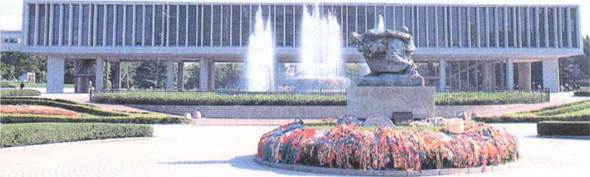
page I
1: Japan enters the European World
Historical Japan
 Europeans
have a tendency to consider the history of other countries as beginning only
from the time European contact began. Nowhere is this more ignorant than with
the history of Japan. Civilisation can be traced back to prehistoric times:
Japanese pottery, (about 10 000 BC) is among the first discovered anywhere. At
about the time of Jesus, a functioning society had advanced technology for the
time, and there is clear evidence of a literate society by 300 AD. By 400, the
country was united and under centralised rule.
Europeans
have a tendency to consider the history of other countries as beginning only
from the time European contact began. Nowhere is this more ignorant than with
the history of Japan. Civilisation can be traced back to prehistoric times:
Japanese pottery, (about 10 000 BC) is among the first discovered anywhere. At
about the time of Jesus, a functioning society had advanced technology for the
time, and there is clear evidence of a literate society by 300 AD. By 400, the
country was united and under centralised rule.
The system was fundamentally feudal, based on a clan system. The feudal system of government is seen by many modern people as a centralised dictatorship, but this is not the case. Though the supreme ruler is in theory the owner of all, in practice he depends on keeping 'on side' a sufficient number of his subjects to ensure his continued rule. The system is one of mutual obligation.
The period of Yamato rule, about 380 till after 500, is seen as a golden age of Japanese history. Its mythical quality is similar to that of King Arthur's England, but it is much more well known to the populace and much more a part of their values system. The kimono takes its origin from this period.
 Japan
had relationships of varying warmth with its neighbours China and Korea from
about the beginning of the Christian era. At first, Japan was seen by the more
civilised Chinese as being a cultural backwater, but the influence of Confucian
values was very great in Japan. Buddhism had been introduced in the 500s, and
elements of both Buddhism and Confucianism were adapted into the state religion
of Shinto, which places great emphasis on concepts of duty, obedience and
honour. The position of the Emperor was complex• nominally the head of state,
the chief priest and the chief bureaucrat he was really in the control of the
senior nobles who ensured that he followed the 'rules' set by custom and
precedent.
Japan
had relationships of varying warmth with its neighbours China and Korea from
about the beginning of the Christian era. At first, Japan was seen by the more
civilised Chinese as being a cultural backwater, but the influence of Confucian
values was very great in Japan. Buddhism had been introduced in the 500s, and
elements of both Buddhism and Confucianism were adapted into the state religion
of Shinto, which places great emphasis on concepts of duty, obedience and
honour. The position of the Emperor was complex• nominally the head of state,
the chief priest and the chief bureaucrat he was really in the control of the
senior nobles who ensured that he followed the 'rules' set by custom and
precedent.
Japan, during the period 800 to 1100, in general enjoyed a period of peace and cultural growth, very much influenced by Chinese culture and art forms. The Emperor grew more and more distant from his subjects. Eventually a military government was formed, led by the warrior Samurai class, with headquarters at Kamakura, just south of Tokyo. This military rule is known in English as the Shogunate. Tensions developed between the aristocracy surrounding the Emperor and the Shogunate. However the ambitions of the Mongolian monarch Kublai Khan occupied Japanese attention during the 1200s. In 1274 huge army of 40 000 of his soldiers sailed from Korea to invade Japan, which would have certainly been overrun if the invasion fleet had not been scattered and largely destroyed by a huge typhoon, a kamikaze or 'divine wind' as the Japanese were quick to proclaim.
P 2
Japan settled into another period of relative calm, believing strongly that they were a divinely protected people. As happens so of ten in systems of centralised rule, there was a gradual weakening of centralised power so that by 1400 various groups were asserting their local rights. The system evolved to a relatively stable arrangement whereby the farmers groups and the local military Shugo groups had considerable power and influence.
In the late 1500s and early 1600s this cohesion was in danger because of local wars, when the European contact with Japan began.
The 1600s: Early European Contact with Japan
In the early 1600s Portugal and Spain made attempts to establish contact with Japan, but in 1641 the Tokugawa family came to power and decided to remove this foreign influence. The hereditary leader offeudal Japan was the Shogun, and he banned all firearms and contact with the west, except for allowing one Dutch ship per year to visit Nagasaki for trade. The Japanese refused to trade with the British, who by 1800 had established a mighty empire.
Thus, the coming of the Europeans did not have a major effect on Japan. For the next 250 years, the government continued as previously; there were periods of civil war, and periods of stability, with remarkable developments in culture, the arts and architecture. Secluded Japan remained a traditional feudal society.
6 July 1853: The arrival of the US; The Perry mission
The United States came late to the colonial race, and in 1852 it was decided to open up the Eastern Pacific to US influence. The Tokugawa regime was still in full control, and Japan was at peace under their rule.
Commodore Mathew C Perry was appointed officer in charge of the US Navy's East India Squadron and sent by President Fillmore to secure 'friendship, commerce, a supply of coal and provisions, and protection for our shipwrecked people'. A few years before, some sailors had been seized by the Japanese, who took the view that their borders were sacrosanct and that no excuse was possible for their violation.
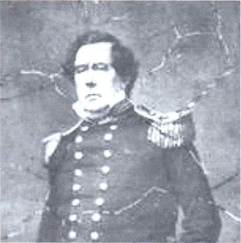 Perry's
four paddlewheel steamships sailed into Edo Bay, (later known as Tokyo Bay)
early on a windless July 6, 1853. Each belched black smoke and towed a sloop;
the guns of all were prepared for action and a thirteen gun salute fired,
announcing his arrival to the 'weak and semi-barbarous people' as he anchored
defiantly within sight of the sprawling city of Edo.
Perry's
four paddlewheel steamships sailed into Edo Bay, (later known as Tokyo Bay)
early on a windless July 6, 1853. Each belched black smoke and towed a sloop;
the guns of all were prepared for action and a thirteen gun salute fired,
announcing his arrival to the 'weak and semi-barbarous people' as he anchored
defiantly within sight of the sprawling city of Edo.
Shrewdly assessing the Japanese character, the Commodore, dressed resplendently in his dress uniform, refused to treat with the underlings, and made the unheard-of demand of an audience with the Mikado. He threatened to blow the Shogun's boats from the water when they ordered him to Nagasaki.
Perry was a believer in 'manifest destiny'; he also saw his mission as 'God's purpose' and thought it was his responsibility to 'bring a singular and isolated people into the family of nations.' (He also wished to forestall a similar approach from the British, and warned the Japanese against the perfidy of England and Russia).
His show of bravado impressed the Shogun. The priests prayed for a 'Kamikaze', a 'Divine Wind' to scatter the foreign vessels, as the great storm of 1281 had saved Japan from a Mongol invasion. But it did not eventuate, and the Shogun agreed to a ceremonial acceptance of a casket containing a letter from the President to the Mikado. Perry sailed away, promising to return with a stronger fleet.
Perry returned with a fleet of 24 ships and gifts, including guns, 100 gallons of whisky, clocks, farm implements, a telegraph, and a small steam train. Japan agreed in principle to a trading treaty, part of which stated that the US would act as 'friendly mediators' by extending American good offices 'in matters of difference as may arise between the government of Japan and other European nations'.
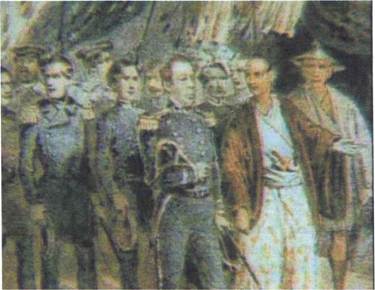 The
illustration is the view presented to the Americans of the meeting of the
cultures.
The
illustration is the view presented to the Americans of the meeting of the
cultures.
It was five more years before the Treaty of Kanagawa was signed, giving the United States the right to trade through five ports and establish an embassy at Edo. Americans were also told by Senator William H Seward that the United States was destined to civilise and reform 'the constitution, laws and customs of the land that is greeted by the rising sun'.
In the 1860s the US was preoccupied with its own brutal Civil War. Britain took advantage of this, establishing its ovm relationships with Japan, and part of the process was a naval bombardment of the port of Kagoshima.
There was considerable civil strife between the traditionalist Japanese and the younger progressives who believed that if Japan did not modernise, it would be dominated by foreign powers as China had been. The progressives prevailed, and in 1867 set up a new government structure with the young Emperor Meiji as figurehead.
Their efforts to modernise Japan were amazingly successful: a modern financial system was built up and the military forces were developed. Britain provided the model for the navy; initially France assisted with the army but after their defeat in the Franco-Prussian war of 1870 the Prussians and indeed the Russians assisted.
In 1882 the Japanese showed that they were learning from the westerners when they acquired control of Formosa, which was retained until 1945.
After the civil war, the Americans returned, but their influence was diminished.
Reconstruction of the US meant that the resources available for the navy were fewer.
Nevertheless William H Seaward arranged the purchase of Alaska from the Russians for $7.2 million, for which he was widely criticised. He annexed Midway Island as a coaling station for the US fleet.
In the US, mighty industries grew, with the help of millions of immigrants. Gradually it rebuilt its navy and restored its influence. The idea emerged of taking over the Philippines, to become 'an American Hong Kong '. Theodore Roosevelt was president.
On February 18 1898 the battleship Maine blew up in Havana harbour, Cuba. Spain was blamed, and William Randolph Hurst's newspapers led the cries for revenge. Roosevelt,
against the advice of senior ministers, ordered the US fleet to Manila, capital of the Spanish held Philippines, with only five light cruisers and gunboats.
The command of Commodore Dewey to the captain of his flagship USS Olympia, 'You may fire when you are ready, Gridley,' 6 has entered US mythology. Dewey's ships promptly sunk all the Spanish warships in Manila Bay. The Philippines was at the mercy of the US. There were some in the US who thought that taking over the Philippines would be more trouble than it was worth, but Roosevelt went ahead. There was civil war and rebellion, but after a war that cost 40 000 lives, the US had its new possession.
In the early years of the century Japan was extending its influence in Manchuria, an area that had been largely ignored by the colonial powers. The Russians extended the Trans Siberian railway line into Manchuria, and on February 8 1904 the Japanese attacked the Russian fleet in Port Arthur and destroyed the Russian eastern feet. Enraged, the Tsar ordered his Baltic fleet to sail to Japan. They were so unskilled that they could barely make the journey, and were defeated by Admiral Togo at the Battle of Tsushima.
The Japanese ships were fewer in number and the total number and size of guns in the Russian fleet was far greater than that of the Japanese. The Japanese ships were, however, far faster, more modern and better armoured than the Russians. Crews were better trained and better motivated. For all of the first day the Japanese ships pulled ahead of the Russian ships and fired broadsides at them; the Russians could only reply with their front guns. By nightfall the Russian fleet was battered, and the following morning saw the surviving ships, seriously damaged, surrounded by the undamaged Japanese fleet. The Russian admiral surrendered.
Only a few Russian ships escaped. One was the modern cruiser Aurora which called at the Philippines for coal and was detained by the US. Russia had to pay a large ransom for her release.
The British and Americans were not unhappy to see Russia defeated, but the event served to awaken them to a realisation of growing Japanese power. A reaction to this was evident; first came closer relations between the British and the Americans. A letter exists in which President Roosevelt sought the assistance of King Edward VII to achieve this.
Australia had already enacted its 'White Australia Policy' to bar Japanese immigration. This was not well accepted in Japan.
Many Japanese immigrants had been brought to Hawaii to work on the plantations, and a large proportion of these came on to California. Again whipped up by the press, there was a wave of protest against the Japanese, with headlines screaming 'JAPANESE MENACE AMERICAN WOMEN'. Tension in general was heightened after the 1906 earthquake, and the San Francisco City Council called for a halt in immigration and or segregation between Oriental and white children. In Japan there were street demonstrations protesting the 'national insult'. After a session of intensive diplomacy, a 'gentleman's agreement' was reached in which the Japanese government 'voluntarily' restricted emigration.
18 October 1907 — The Great White Fleet in Tokyo
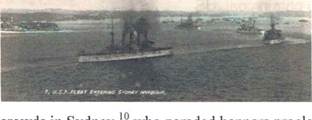 To
conclude his presidency with a grand gesture, President Theodore Roosevelt
ordered the voyage of the 'Great White Fleet '. All sixteen of the US Navy 's
battleships sailed around the Pacific, the aim being public relations and to
demonstrate the US' ability to project is power. There were rumours that some
of the ships were rigged with fake wood and canvas 'armour ' and certainly the
fleet had some mechanical and logistic problems, but the tour was very successful.
To
conclude his presidency with a grand gesture, President Theodore Roosevelt
ordered the voyage of the 'Great White Fleet '. All sixteen of the US Navy 's
battleships sailed around the Pacific, the aim being public relations and to
demonstrate the US' ability to project is power. There were rumours that some
of the ships were rigged with fake wood and canvas 'armour ' and certainly the
fleet had some mechanical and logistic problems, but the tour was very successful.
An ecstatic welcome was given by crowds in Sydney, who paraded banners proclaiming WHITE AUSTRALIA and MONROE DOCTRINE FOR THE PACIFIC. This tended to annoy Britain!
It took some diplomatic manoeuvring to have Japan accept the visit, but On October 18, 1907, the line of American battleships dropped anchor in Tokyo Bay. The visit was a great success: there were elaborate banquets, balls and icecream receptions, and at one event 10 000 children sang 'Yankee Doodle Dandy'. Even the Emperor made an unprecedented appearance, and the hero of Tsushima, Admiral Togo, joined in a blanket-tossing ritual with American sailors. One of the young ensigns present, William H Halsey, was later to write: 'if we had known what the future held, we wouldn't have caught him the third time!'
The US in this year established Pearl Harbour as the main base for the Pacific fleet. The need for such a base was evident, and even at this stage the US was wary of making its main base in the Philippines, where the Japanese could easily make a strike such as the one they had made on Port Arthur.
There was still tension between the US and Japan. WAR PLAN ORANGE was prepared by the US, to be used in case of war between the two nations. It relied on the ability of the Philippines garrison to hold out until the arrival of the US fleet.
1914: World War 1
From the outset Japan supported Britain and occupied the Marshall and Mariana Islands (German colonies in the Pacific) and notably the German base at Tsingtao, China. They also assisted with convoy protection: in his memoirs, Winston Churchill, then First Lord of the Admiralty, includes many examples of cables to the Japanese government, in which they agreed to his requests for the placement of Japanese ships at various places to assist the hunting down of German raiders. His description of the sinking of the Emden on 9 November 1914 is interesting: a convoy carrying thousands of Australian soldiers was heading across the Indian Ocean towards the Middle East, escorted by the cruiser HMAS Sydney and her sister ship Melbourne, and the far larger heavy Japanese cruiser Ibuki.
On the 8 November, the Sydney, 11 cruising ahead of the convoy, took in a message from the wireless station at Cocos Island that a strange ship had entered the bay. Thereafter, silence from Cocos Island. Thereupon the large cruiser Ibuki increased her speed, displayed her battle ensign, and demandedpermissionfrom the British Officer in command of the convoy to pursue and attack the enemy. But the convoy could not divest itselfof this powerful protection, and the coveted task was accorded to the Sydney. At 9 0 'clock she sighted the Emden and the furst sea fight in the history of the Australian Navy began. It could only have one ending.
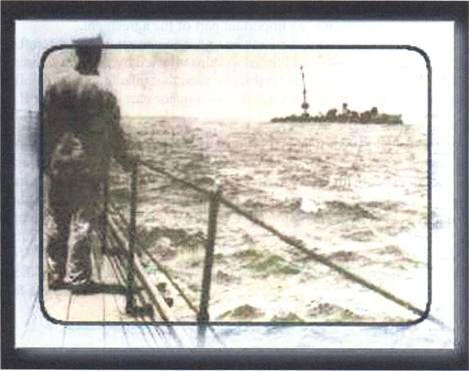
The famous picture above shows the shattered Emden aground at Cocos Island.
Churchill was happy to use the Japanese fleet, but I feel he was happier to have them under close control and probably underestimated their power. (He wrote in his World War Il memoirs of his reaction when he heard of the sinking of the Prince of Wales and the Repulse at the start of the war with Japan in 1941, 'Iwas glad to be alone. 12 In all the war I never received a more direct shock. There were now no British or American capital ships in the Indian Ocean or in the Pacific, except the American survivors of Pearl Harbour, who were hastening back to California. Over all this vast expanse of waters Japan was supreme and we everywhere were weak and naked. ')
When the US entered World War I, the German submarine menace was at its height, and it was soon realised that all major fleet units were needed in the Atlantic. An agreement was reached with the Japanese, which effectively gave Japan a free hand in northern China. At the end of the war, Japan received the former German colonies as League of Nations mandates. These were the Marshall Islands, Micronesia (with its major port, Truk,) the Mariana Islands and Palau.
Britain was impoverished as a result of the war, but nevertheless established a naval base at Singapore to protect its interests.
July 19 1921 — Mitchell and the death of the battleship
General Mitchell, head of the US Army Air Corps, 13 believed that aircraft would be able to sink a battleship. On July 21, 1921 he conducted a demonstration, and eight bombers quickly disposed of the German dreadnought Osfriesland, anchored as a target. This demonstration did not impress the establishment: the navy and the army agreed that 'the battleship is still the backbone of the fleet and the nation's defences'.
It was in the interests of both Britain and the US to limit their naval spending, and late in 1921 Britain and the US agreed to reduce fleet numbers, also persuading Japan to accept a treaty which limited their battleships to 60% of the number of both the US and Britain.
This was not a great disadvantage to Japan; Japan was still able to increase its strength, and while the US and Britain tended to retain older ships, Japan was able to develop a more modern fleet. Further, when it was considered that Britain and the US had to cover the Atlantic, Africa, the Indian Ocean and South America, the agreement made Japan the most powerful force in the western Pacific. France and Italy agreed to accept navies half the size of Japan 's, and Germany of course was completely disarmed at this stage. A ten-year 'naval holiday ', limiting new construction, was an important part of the agreement.
The US converted two battlecruisers, which were under construction, two aircraft carriers — Lexington and Saratoga. These were additional to ships allowed by the treaty: aircraft carriers were not considered as capital ships, and Japan used the same loophole to build the aircraft carriers Kaga and Akagi. All these ships played a major part in World War Il.
1929 — The depression
America in the 1920s had a great financial influence on Japan. American luxury goods were popular and Japan became increasingly dependent on American raw materials and especially oil. The boom ended with the Wall Street crash of 1929. Japan 's silk exports to the US — their main source of income — collapsed, and the market for Japanese manufactured goods also disappeared as nations erected protective tariff barriers. Hardships in the rural area were particularly pronounced: there were stories of daughters being sold into prostitution to ensure the survival of many rural families.
Prime Minister Inukai planned to curb the power of the military by persuading the Emperor to intervene directly, but on May 15, 1932, naval officers were responsible for a terrorist attack in Tokyo in which Inukai was killed. egge3
 The
League of Nations objected to the actions of Japan which was expanding its
influence in China, but took no action. This inaction was due to two factors —
isolationism caused by the depression, and vigorous peace movements in the
major countries. The United States could also have been affected by economic
considerations: in 1930 her total investments in China were about $200 million,
and her trade with Japan was worth $200 million each year.
The
League of Nations objected to the actions of Japan which was expanding its
influence in China, but took no action. This inaction was due to two factors —
isolationism caused by the depression, and vigorous peace movements in the
major countries. The United States could also have been affected by economic
considerations: in 1930 her total investments in China were about $200 million,
and her trade with Japan was worth $200 million each year.
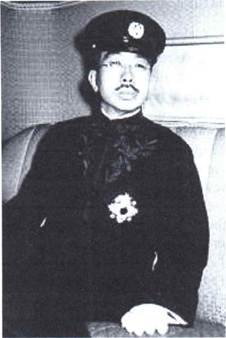
Hirohito became Emperor in 1926 at the age of 25, and died in 1989, a reign of 62 years. He was a learned man, with a lifelong interest in marine biology, a subject on which he wrote several books. Debate rages on how much influence he had on the events leading to World War Il, though it is likely that he may have been simply unable to restrain the military hierarchy. Traditionally, the Emperor was surrounded by a ruling oligarchy which made the decisions, and the rule was that these decisions had to be unanimous. He is credited with ending the war; his position was preserved but became ceremonial only. In 1946 he also proclaimed that he had no divine status.
1930s: the drift to war
In China, the army sought to extend Japanese power, 14 but there were elements in the government opposed to this. The consistent strategy of the militants was to act — making an attack on a Chinese outpost for example, thereby presenting the government with accomplished facts, which the government had then to support. If the attack failed, it could be blamed on army hotheads and suitable scapegoats found. The power of the imperialist faction was strong, and the civilian government in Tokyo could not stop the army, and even army headquarters was not always in full control of the field
In a further disturbance on February 26, 1936, Prime Minister Okada Keisuke escaped when the assassins mistakenly shot his brother-in-law. For more than three days the rebel units held much of downtown Tokyo. When the revolt was put down on February 29, the ringleaders were quickly arrested and executed. Within the army, the influence of the young extremists now gave way to more conservative officers and generals who were less concerned with domestic reform, while sharing many of the foreign-policy goals of the young fanatics.
The young emperor Hirohito had been enthroned in 1926, taking as his reign name Showa ('Enlightened Peace'). He probably was not in favour of the aggressive policies of the military. However the military factions were so powerful that the non-military factions were afraid to take strong action. International criticism of Japan 's aggression grew, but many Japanese supported the army. The depression had hit Japan very hard, and for many people the appeal of hitting back through military expansion was very great. In Italy and Germany, Mussolini and Hitler were taking advantage of a similar situation.
In 1932 Japan set up Manchuria as an 'independent' state, Manchukuo, but it was totally controlled by the Japanese army. The League of Nations again sought to have the Japanese withdraw, but Japan 's response was formally to withdraw from the League of Nations in 1933. Japan exploited Manchuoko 's rich resources to establish the base for the heavy-industry complex that was to be the basis of its 'new order' in East Asia. Japan also made it clear that
it would brook no interference in its China policy and that Chinese attempts to procure technical or military assistance elsewhere would bring Japanese opposition.
This situation aggravated domestic tensions, as described above. The pacifist factions continued to lose influence.
On July 7, 1937, Japanese troops initiated war between China and Japan. Japanese armies took Nanking, Hankow and Canton despite vigorous Chinese resistance; Nanking was brutally pillaged by Japanese troops. To the north, Inner Mongolia and China 's northern provinces were invaded. A Japanese regime was established at Nanking in 1940.
Japan 's relations with the US and Britain deteriorated steadily. The US and Great Britain tried to help the Chinese Nationalists, sending some supplies via the Burma Road into southern China. Japan endeavoured to close this route. Japan also sunk a US gunboat (the Panay) on the Yangtze River in 1937. In 1939 the US renounced the 1911 treaty of commerce with Japan, and thus embargoes became possible; however President Franklin Roosevelt was unable to persuade his country to get involved in such actions.
There was an undeclared war between Japan and the Soviet Union in May 1939, along the Mongolian/Siberian border, when Japanese troops entered Siberia. This 'Nomonhan Incident' ended the following August when the Russian General Zhukov, later to become famous in World War Il, encircled the Japanese, who lost 18 000 soldiers and retreated to the original border. Zhukov deployed no less than 45 divisions. In April 1941 a neutrality pact was signed with the Soviet Union, with Germany acting as intermediary.
There are two interesting outcomes from this war.
 First,
the Japanese refined their military methods and equipment, including especially
their aircraft. For example, the Russians had an excellent streamlined twin
engined bomber, the Ilyushin DB-3, which could match the Japanese fighters' speed
and this caused them great problems. Japan began to develop the Mitsubishi G4M
(later given the US code name 'Betty') and other aircraft of this type. These
were faster, and had better range, than any of their US and British
contemporaries, and played an important part in the early Japanese successes in
World war 11 15 .
First,
the Japanese refined their military methods and equipment, including especially
their aircraft. For example, the Russians had an excellent streamlined twin
engined bomber, the Ilyushin DB-3, which could match the Japanese fighters' speed
and this caused them great problems. Japan began to develop the Mitsubishi G4M
(later given the US code name 'Betty') and other aircraft of this type. These
were faster, and had better range, than any of their US and British
contemporaries, and played an important part in the early Japanese successes in
World war 11 15 .
Second, this salutary defeat may well have made the Japanese very cautious about engaging the Soviet Union in World War Il. This in turn enabled Stalin, at a crucial part of the war, to denude his eastern front and rush the Siberian garrisons to the defense of Moscow and Stalingrad, where they played a vital part.
Beginning in 1936, Japan formed links with Germany and Italy. When the war broke out on 3 September 1940, the Tripartite Pact recognized Japan as the leader of a new order in Asia; Japan, Germany, and Italy agreed to assist each other if they were attacked by any additional power not yet at war with them. Interestingly, USSR was also invited to join in this pact in 1940, having already signed the non-aggression pact with Germany.
Germany had long been a supplier of aircraft, and aircraft designs and technology, to Japan. The Heinkel aviation company was a major participant in this process. In fact, during the 1920s, when the Germans were not allowed to build military aircraft, they were building forbidden machinery for the Japanese and others, including the Swedish air forces. The Japanese had representatives on the inspection committees, and when a visit to a Heinkel factory was imminent, a phone call would come to the factory and all illegal projects would be hidden! 16
At the beginning of the war, the process of co-operation continued, several shiploads of material being delivered by blockade-running German cargo ships which maintained sporadic contact from the beginning of the war until late 1943.
Until the invasion of Russia, Japanese diplomats and military attachés travelled overland to Germany; after the invasion of Russia there was occasional contact with Japan by means of long range aircraft such as the Junkers 290 which flew to Manchuria. Among the things taken by these aircraft were some of the plans for German jet and rocket aircraft engines.
Nevertheless, Japanese-German ties were never close or effective. Both parties were limited in their cooperation by distance, distrust, and mutual claims of racial superiority. The Japanese were uninformed about Nazi plans for attacking the Soviet Union, and the Germans were not told of Japan 's plans to attack Pearl Harbour in Hawaii.
The fall of France in June 1940 left a kind of vacuum in Indochina (Vietnam); the administration tended to give its allegiance to Vichy France and co-operated with Japan. In July 1941 Japan established a joint protectorate with Vichy France over the whole colony. This caused some armed conflict with Thailand. The history of this area at this period would make a very interesting study!
A war incident of particular interest to the Japanese was the attack by Royal Navy aircraft on the Italian port of Taranto on the night of 11/12 November 1940. Twenty Swordfish aircraft from British carriers attacked with bombs and torpedoes and sunk three Italian battleships and damaged three more.
Churchill gloatingly wrote to President Franklin Roosevelt, proclaimed that this attack had altered the balance of naval ower, and added the snide remark 'I expect the Japanese are doing their sums all over again'. 7 They probably were, but not in the way Churchill meant; their calculations probably considered what would happen if such an attack was made by 300 modern aircraft instead of twenty antiquated biplanes. The result of their calculations can be seen in the Pearl Harbour attack.
When the Germans attacked the Soviet Union in 1941, they urged the Japanese to join them against the Soviets, but Japan refused. Japan preferred to move further into south-east Asia.
The United States reacted to the Japanese occupation of Indochina by freezing Japanese assets and refusing to supply oil to Japan. The Japanese now faced the choices of either withdrawing from Indochina, and possibly China, or seizing the sources of oil production in the Dutch East Indies. The situation in Japan was explosive: civil war threatened as the privations of the oil shortage became apparent.
At this stage the militarists prevailed, and Japan decided to make its surprise strikes in Pearl Harbour, Hong Kong, Malaya and elsewhere.
Japan 's war aim was to establish a 'new order in East Asia', built on a 'co-prosperity' concept that placed Japan at the centre of an economic bloc consisting of Manchuria, Korea, and North China that would draw on the raw materials of the rich colonies of Southeast Asia, while inspiring these to friendship and alliance by destroying their previous masters.
This was a very powerful idea: if the Japanese had been indeed been able to motivate and mobilise the Malaysians, Burmese, Indonesians, Chinese, and even the Indians, they may have altered the course of the war and of history. It is interesting to note that an Indian force of some 20 000 was voluntarily allied with the Japanese in Burma. Generally, however, the Japanese regarded the peoples they conquered as being inferior beings. They treated their new subjects with some cruelty, particularly being brutal towards the Chinese. This was a huge strategic blunder.

2. The early years of World War Il
1941 — Voices of dissent
There was not unanimous supporti8 for the declaration of war, particularly among the navy.
Among the pessimists was Vice Admiral Shigeru Fukudome, Chief of the Operations Bureau of the Naval General Staff at the outbreak of the war, who will appear later in our story (page 22) said that while the nation was indeed on the brink of civil war, a civil war would not be fatal to the nation but an external war that had no chance of success would spell disaster. Accordingly, he was vigorously opposed to the idea of going to war.
Prince Hiroyasu Fushimi, Admiral of the Fleet from 1932 to April 1941, was blunter: 'If war breaks out, Japan will lose all that has been achieved since the beginning of the Meiji Era.
But it seems that there is no way to avoid war. I am filled with anxiety.'
Admiral Nagano, chief of the naval staff, also anticipated defeat: 'It is agreed that if we do not fight now, our nation will perish. But it may well perish even if we do fight. It must be understood that national ruin without resistance would be ignominy. In this hopeless situation, survival can be accomplished only by fighting to the last man. Then, even if we lose, posterity will have the heritage of our loyal spirit to inspire them in turn to the defence of our country. In war, soldiers ask only the chance to fight in support of the Emperor. We shall fight to the last drop of blood'.
Admiral Yamamoto, commander of the Combined Fleet, is credited with the remarkable naval victories of the early part of the war. He was born in 1886 and graduated from the naval academy in 1904. He fought as an ensign in the Russo-Japanese War and was naval attaché at the Japanese embassy in Washington, DC, during 1926-27. He became commander in chief of Japan's Combined Fleet in August 1941.
One of the few Japanese leaders with first-hand knowledge of the US, he opposed war because he feared Japan would lose a protracted struggle with such a powerful opponent. Once the decision to go to war was made, however, he asserted that Japan's only chance for victory lay in a surprise attack that would cripple the American naval forces in the Pacific, after which Japan could seize the rich lands of Southeast Asia and move eastward across the Pacific unopposed. Hence the attack on Pearl Harbour. Meanwhile he was predicting that, if the war with the United States lasted more than one year, Japan must eventually lose.
After Pearl Harbour, Yamamoto was widely congratulated. His pessimism is demonstrated by the quoted remark, 'we have awakened a sleeping giant'. He also wrote this traditional poem as a warning to those who thought that the war was already won. He drew an analogy from the card game of bridge, which he loved to play:
Hardly a grand slam have I played, Modestly I have to say, It ‘s more like a redoubled bid barely made.
Pearl Harbour , 9 December 1941
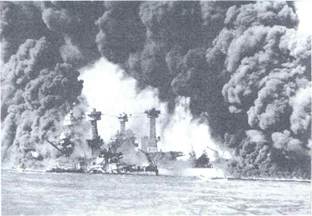 ‘Battleship
row’ ablaze and sinking after the Pearl Harbour attack.
‘Battleship
row’ ablaze and sinking after the Pearl Harbour attack.
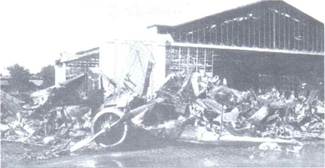 The
building in the picture is featured in Tora Tora Tora, made in 1970, and
a thoroughly excellent film on Pearl Harbour. (The recent remake, Pearl
Harbour, is badly done in every aspect and has no relevance to reality). In the
film, a Zero fighter is hit by ground fire, and climbs while on fire, then
deliberately crashes into the hangar. This re-creates a report from Fujita, a
fighter leader of the attack, describing the death of his friend Iida. However,
the US writer Gordon Prange investigated this in detail and produces evidence
that it is not true; a pity as it is the first documented Japanese
suicide-style attack of World War 11! 20
The
building in the picture is featured in Tora Tora Tora, made in 1970, and
a thoroughly excellent film on Pearl Harbour. (The recent remake, Pearl
Harbour, is badly done in every aspect and has no relevance to reality). In the
film, a Zero fighter is hit by ground fire, and climbs while on fire, then
deliberately crashes into the hangar. This re-creates a report from Fujita, a
fighter leader of the attack, describing the death of his friend Iida. However,
the US writer Gordon Prange investigated this in detail and produces evidence
that it is not true; a pity as it is the first documented Japanese
suicide-style attack of World War 11! 20
7 December 1941: Japan ascendant A brief chronology:
7 December: Pearl Harbour: 350 carrier-based aircraft sank five battleships, three cruisers and, two destroyers. Many aircraft and support facilities were destroyed on the ground but the oil supplies were not destroyed and the three US aircraft carriers were luckily absent. This was only one of many actions: in fact, in northern Malaya Australian aircraft were in action attacking landing forces a few hours before the Pearl Harbour attack. The landings were successful and Japanese troops began to march down the Malayan peninsula towards Singapore. Hong Kong was also attacked.
Early chronology
8 December: air attacks on the Philippines destroyed many planes on the ground despite the warning given by the attack on Pearl Harbour.
9 December: Bangkok was taken by the Japanese. Thailand quickly surrendered.
10 December: The battleships Prince of Wales and Repulse, the most significant allied naval force in the eastern Pacific, (and almost the only British ships of any kind) were sunk by aircraftoff the Malayan coast. Japan occupied Tarawa.
17 December, 1942
Tojo made a speech to the Diet (parliament) with this momentous news:
At daybreak on December 17, Imperial forces effected a surprise landing on the northern part of the island of Borneo. The Japanese units report that the enemy had destroyed the oil refineries and taken out machinery. Howeverfrom the total of 170 oil wells, it will be possible to extract oil from 70 wells in a month 's time, enabling a daily production of about 1700 tons. It is further reported that during the next year there is a possibility of extracting 500 000 barrels of oil. 21
It had taken only two weeks for Japan to accomplish its major war aim, to secure oil supplies.
22 December: Wake Island was taken by Japan after the garrison had previously repulsed an invasion attempt. This temporary setback to Japanese expansion was atypical.
23 December: Japanese landings in Sarawak to secure the Borneo oil fields.
24 December: Major Japanese landings in the Philippines.
25 December: Hong Kong fell to Japan after a fortnight offighting.
30 December: US forces in the Philippines withdrew to the Bataan Peninsula.
1 1 January 1942: Major landings in the Dutch East Indies (Indonesia).
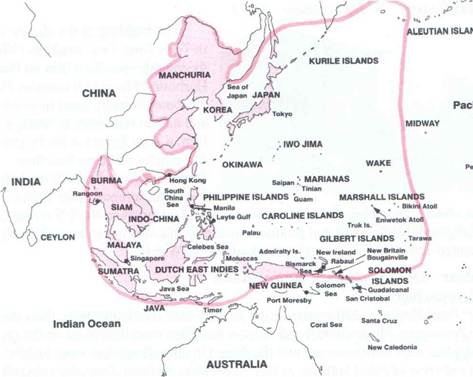
15 January: Japanese moved into Burma — whose air defences were 4 RAF Blenheim bombers and 44 obsolete Buffalo fighters.23 January: Japanese landed in New Britain, Borneo, New Ireland and the Solomon Islands.
30 January: Japanese reached Singapore: the causeway joining Singapore to Malaya was blown up.
15 February: Singapore was taken by Japanese. Japanese had lost 3 500 troops killed, 6 150 wounded and took 138 000 allied prisoners.
19 February: first air raid on Darwin, from carrier-based and land-based aircraft, caused vast damage. Japanese landed on Bali.
27 February: Battle of the Java Sea; allies lost two cruisers and three destroyers, Japanese nothing.
1 March: Japanese landing on Java.
7 March: Rangoon taken; British forces in Burma in full retreat.
9 March: Dutch General Ter Poorten surrendered in Java with 100 000 soldiers. 11 March: Macarthur fled the Philippines, reaching Australia to set up a headquarters.
12 March: Japan was in full control of Solomon Islands.
24 March: Major attacks on Bataan Peninsula, to which US troops had withdrawn in the Philippines.
27 March: RAF forces and the American Volunteer Group aircraft were forced to withdraw from Burma.
5 April: Japanese fleet raided Ceylon, causing considerable damage to British bases and sinking two heavy cruisers, 22 transport ships and aircraft carrier Hermes within a period of four days.
9 April: Resistance in Bataan finally came to an end.75 000 prisoners were taken by the Japanese, of which 12 000 were US soldiers. Some troops continued to hold out in Corregidor Island fortress until 6 May.
Thus ended the first four months of the war.
18 April 1942: American retaliation
On 18 April, 16 B-25 medium bombers flew from the aircraft carrier USS Hornet, led by Colonel James Doolittle, bombed Tokyo and elsewhere and flew on to China. Little damage was done, but there were huge effects on Japanese strategy:
 A
retribution campaign in China causing 100 000+ deaths; Japanese army advanced
in China to take areas which were convenient for airfields attacking Japan.
A
retribution campaign in China causing 100 000+ deaths; Japanese army advanced
in China to take areas which were convenient for airfields attacking Japan.
Japan
decided to take Midway Island to help the defence of Japan rather than push
west to link up with Germans or to invade Australia.
8 May: Battle of the Coral Sea
Japan sent her fleet to take Port Moresby was thwarted in the first naval battle which involved only aircraft carriers. The Japanese lost the small aircraft carrier Shoho and the larger Shokaku was damaged; the US lost the larger Lexington and also Yorktown was badly damaged. The Japanese lost less, but the invasion was abandoned. Yorktown was rushed to Pearl Harbour and patched up by 28 May but it was months before Shokaku rejoined the war.
4 June: Battle of Midway
The Japanese plan to attack Midway was very complex. On 2 June Japan took the Aleutian Islands in an effort to divert attention from the Midway attack. However the US had deciphered Japanese codes and were not deceived. On 4 June occurred the Battle of Midway. Japan lost the aircraft carriers Akagi, Soryu, Kaga and Hiryu, and the US lost Yorktown. This was an unmitigated disaster for the Japanese, a major factor being the loss of the trained pilots. The Japanese naval leadership went to great lengths to conceal the loss: survivors were isolated and sent to remote parts of the empire, and even the Prime Minister was not informed for four weeks.
Mid—1942: Land campaigns
Having been rebuffed at sea, the Japanese tried to invade Port Moresby by moving overland, landing at Gona on 21 July. Bitter fighting along the Kokoda Track saw the Japanese forces halted, virtually in sight of Port Moresby, by Australian citizen soldiers, by mid-September. This, with the less-known defence of Milne Bay by Australians, was the first land defeat of the Japanese. However, compared to the battle of attrition at Guadalcanal, the New Guinean fighting was on a small scale.
The Solomons had been occupied by the Japanese since March, and on August 6, 1942 an improvised attack was made by the US. The Japanese retreated to caves in the mountains and fought to the death. Of the 2 000 defenders only 23 were taken prisoner.
A Japanese naval fleet attacked on 9 August, sinking 4 cruisers. This left HMAS Australia as the only large ship to defend the landing. Both sides rushed naval forces to the area, with reinforcements and supplies.
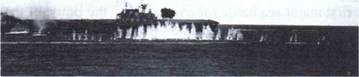
 Val
bomber diving on USS Hornet at Santa Cruz; it actually crashed on the ship, but
was not a specific kamikaze attack.
Val
bomber diving on USS Hornet at Santa Cruz; it actually crashed on the ship, but
was not a specific kamikaze attack.
 On 22
August the Japanese aircraft carrier Ryojo was sunk and the USS Enterprise was
damaged. On 27 August Saratoga was damaged, leaving the newly commissioned Wasp
as the only US carrier in the Pacific. Hornet was rushed to assist, just in
time, as Wasp itself was sunk on 15 September. On 31 August Japan landed 1200
more soldiers on Guadalcanal. Reinforcements came in from both sides, and a
bitter war of attrition was fought in the jungles around Guadalcanal.
On 22
August the Japanese aircraft carrier Ryojo was sunk and the USS Enterprise was
damaged. On 27 August Saratoga was damaged, leaving the newly commissioned Wasp
as the only US carrier in the Pacific. Hornet was rushed to assist, just in
time, as Wasp itself was sunk on 15 September. On 31 August Japan landed 1200
more soldiers on Guadalcanal. Reinforcements came in from both sides, and a
bitter war of attrition was fought in the jungles around Guadalcanal.
The Battle of Santa Cruz, 26 October 1942
This was a Pyrrhic victory for the Japanese. Hornet was sunk, and the newly arrived Enterprise was seriously damaged. Many US cruisers, destroyers and transports were sunk. The Japanese carriers Shokaku and Zuho were badly damaged and compelled to withdraw without being able to attack Guadalcanal. The Japanese heavy carrier Zuikaku and the smaller Junyo were very successful in the action, and withdrew undamaged. The Japanese authorities proclaimed a great victory. However the loss of skilled pilots from all Japanese carriers was very great.
Another night naval action on 12 November was a similar materiel victory to the
Japanese, but they were unable to break through to reinforce their land forces. By 15
November the naval forces were in retreat. Fighting continued on Guadalcanal until February 7, when a daring destroyer convoy evacuated the last 10 000 defenders. Guadalcanal was a turning point in the war — the 'fork in the road to victory' as one Japanese commentator described it.
Late November was important elsewhere, too. In Africa Montgomery pushed back the Germans at the Battle of El Alamein, and the US landed in Morocco. The ferocious battle of Stalingrad led to defeat for Germany with the loss of 110 000 men. New Guinea was also being cleared of the Japanese. Churchill famously called this period 'the end of the beginning'.
On February 1 a Japanese fleet tried to bring reinforcements from New Britain to New Guinea. They were met by waves of US aircraft (and a squadron of Australian Beaufighters) and all transports were sunk. Not one soldier reached his destination. This was typical of actions from then on. The leader of the Beaufighter squadron was Wing Commander 'Black Jack' Walker, who had an amazing career in Australian aviation.
April 18, 1943: assassination of Admiral Yamamoto
Admiral Yamamoto made a morale-raising tour of the island bases, but unfortunately for Japan he was assassinated by the US. Codebreakers had gained knowledge of his itinerary. A group of the new Lockheed P-38 long range fighters, based on Guadalcanal, intercepted his aircraft and shot down the two bombers carrying Yamamoto and his staff. There were only two survivors, one of whom, Admiral Ugaki, will become very important to our story in future pages.
1943 — Japan on the defensive
1943 was a year of consolidation by the US. This does not imply that the fighting was minor: New Guinea, the northern Solomons, and the Aleutian Islands were bitterly contested and allied victories were never easy. The US navy and General Macarthur, leading the military operations from Australia, were able to broadly agree on an 'island hopping' strategy, where some Japanese strongholds would be taken while others would be cut off and simply left alone. US supremacy in the air, and at sea, (especially in submarine warfare) made this possible.
19—20 June 1944 Battle of the Philippine Sea
On June 18 1944 came the first major sea battle for over a year — the Battle of the Philippine Sea. The US landed in the Marianas Islands, and war production had been such that the force was supported by 106 warships, including 16 carriers with 900 aircraft. Against them Admiral Toyoda had nine carriers, with 450 aircraft and also some land-based aircraft.
Invoking memories of the Battle of Tsushima, Toyoda attacked. But this time it was the other side that had the modern machinery: the new Grumman Hellcat carrier-borne fighters were faster and stronger than the Zeros, and the pilots were better trained. Guided by radar, US planes intercepted the enemy and the losses were enormous. Taiho, Japan's huge new carrier, lost 141 of the 200 aircraft sent out in its first two sorties. Taiho and the veteran Shokaku were sunk by US submarines. Hiyo was sunk by aircraft and Zuikaku and Junyo were badly damaged. In one action the Combined Fleet had lost a third of its remaining carriers and all but 36 of their aircraft.
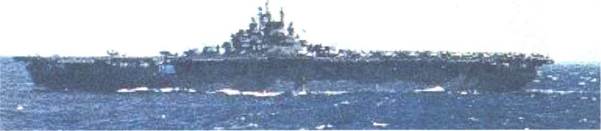
The new Lexington, namesake of the carrier sunk at the Battle of the Coral Sea, was a mighty addition to the US fleet.
US Admiral Mitscher was not satisfied: he believed that the Japanese fleet was still a threat. Too many had escaped. But to any realistic observer, there was only enough naval power left to make a bit of a show of resistance, and not nearly enough to have any sort of reasonable chance of success, or even survival. Apart from shortage of ships and aircraft, the pilot shortage was critical. But an even greater problem was fuel oil for the ships. Japanese tankers had been hunted down by surface raiders and submarines. The bulk of the navy had to stay near Borneo, close to the source of the oil and even had to use unrefined oil, which gave off smoke and handicapped performance.
Okumiya, a senior staff officer, blamed the defeat on deficient quantity, but above all, lower quality, of aircrew; declining quality of aircraft (the Zero could no longer hold its own); and poor leadership: the Japanese leaders had not learnt how to control a carrier battle. He was in favour of negotiations to end the war, but certainly could not prevail against the prevailing Bushido ideology.
14 July: Japan moves towards securing peace
Nevertheless, some changes occurred in the Japanese cabinet. General Tojo lost influence, and there were signs that the Japanese were seeking peace. However, the Allies had made it clear that only unconditional surrender would be accepted, The lesson of the resurgent Germany after World War I was used as justification for this attitude. The result of this was a strengthening of the will to resist: the war faction could urge that all methods of resistance must be used, as even destruction of the country was preferable to being enslaved by the victors. Thus was the stage set for the dramatic final acts of the war.
3. Japanese attacks on the US mainland
It is not widely known that the Japanese made three attacks on the American mainland in 1942. The main reason for mentioning them is to indicate the puny nature of Japanese power in comparison with that of the US. When we look later at the devastation wreaked by the US we see how understandable are the US mindset of superiority, and a lack of understanding of what it is like to be attacked, that go a long way towards understanding the current military actions.
On February 23, 1942 at 7:00 pm, Japanese Submarine 1-17 shelled an oil field near Santa Barbara, California and damaged a pump house. 25 shells were fired from a 5 1/2 inch gun, using shells of just over 40kg, in other words a bit more than a ton of explosive. It took three minutes to fire the shots, and the submarine dived as aircraft approached, leaving a bamboo dummy periscope float to distract the attackers. The attack caused an inordinate reaction; the US mainland had not been attacked since 1812.23 On the night of June 21, the submarine fired 17 rounds from its deck gun at Fort Stevens - a coastal defence installation on the north coast of Oregon. The only reported damage was to the basketball backstop. However, the real impact was the alarm to the American public when it was reported that the Japanese Navy had attacked the American mainland.
On Wednesday morning, September 9, 1942, the Imperial Japanese Navy submarine 1-25 surfaced west of Cape Blanco and launched a small 'Glen' seaplane piloted by Chief flying Officer Nobuo Fujita (pictured). Fujita flew southeast over the Oregon coast, dropping 4 30kg incendiary bombs on Mount Emily, 10 miles northeast of Brookings. There are unconfirmed reports that 1-25's aircraft made another attack a few weeks later. These exploits of 1-25 similarly had a great effect in the US, causing considerable alarm.24 Fujita survived the war, and visited the US, and was made an honorary citizen of Gold Beach, Oregon..
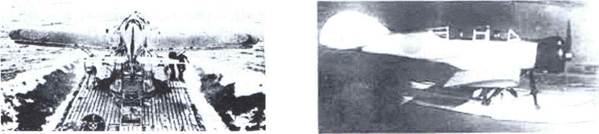
The Yokosuka E14Y1, US code name Glen, was powered by a 9-cylinder, 340-hp Hitachi Tempu 12 radial engine, could reach about 150 mph, although speeds of 85 mph were more common. It had an operating radius of about 200 miles. The frame was constructed of metal and wood, with fabric-covered wing and tail surfaces. It weighed 3,500 pounds, had a wingspan of 36 feet, and carried a pilot and crewman. One flew over Sydney on 30 May 1942 prior to the raid described on page77.
The Japanese submarine 1-15 surface of San Francisco on Christmas Eve, 1941, and its captain reported to Tokyo by radio that he was about to fire on the Golden Gate Bridge. He was ordered not to make the attack because of the importance of the Christian festival.
The balloon offensive
In 1944 it became very important for the Japanese to be seen to be hitting back at the US, which was beginning to prepare large-scale B-29 raids on the Japanese mainland. An amazing project was begun to drop bombs at random from balloons launched from Japan and designed to fly to the US mainland. 26
The balloons used the high-altitude winds later known as the 'Jet Stream' and could reach the US in about three days. They were hydrogen-filled, and as temperature fluctuated, eg between daytime and night time, they rose and fell; mechanisms were devised that either vented hydrogen if the balloon went too high (above 1 1.6km) or dropped sandbag ballast if the balloon went too low (9km). When the ballast was expended the mechanism dropped the bombs and then set off a fuse that ignited a flash bomb that destroyed the balloon.
Early balloons were made from rubberised silk, but the majority of later balloons were constructed with paper made from mulberry bushes, glued together in three or four layers with a vegetable glue. The first balloon of Project Fu-Go was launched on the Meiji Emperor's birthday (November 3, 1944). Up to 9000 were launched in the period to mid-April 1945, when the operation concluded. Monthly totals were November 1944 700;
December 1944 200, January 1945 2000, February 2500, March 2500, early April 400.
A major difficulty in continuing the operation was the destruction of the hydrogen production facilities by the massive bombing raids. It is also said that he starving Japanese workers were eating the glue provided.
It seems that a maximum of 1000 balloons reached the US. One was shot down by a P38 fighter, and another was actually forced down by an army fighter. It was examined by US authorities, whose main fear was that it would be used in the dissemination of germ warfare material which they knew the Japanese were developing.
Many US experts thought that the balloons must have been launched from a far nearer site than Japan, and even Japanese internment camps in the US were suspected as launch sites. Geologists were called in to examine the sand from dropped sandbag ballast, and found that this could only have come from Japan, and even determined the beaches from which the sand came from. Records indicate they landed in an area as far north as Alaska, as far south as the California/Mexican border, and as far east as the Great Lakes!
Fortunately the period of the year that had the best winds for the Japanese were mainly in the winter months, when the forests were covered with snow.
Negligible damage was caused though six people were killed. A minister and his wife had taken some children on a fishing trip in southern Oregon, when they discovered a balloon bomb that exploded while they were gathered around it, killing the woman and five children. Japanese propaganda broadcasts announced great fires and an American public in panic, declaring casualties as high as 10 000, but the six people killed in Oregon were the only casualties inflicted by the Japanese on the American mainland in World War 11.
On 10 March 1945, one of the last paper balloons descended on electrical lines near a production site of the Manhattan Project at Hanford, Washington. The reactor producing plutonium for the Nagasaki bomb was shut down for a few hours. This was one of the most successful balloons!
Added to 120kg dropped by the single plane raid, and the perhaps five tons of shells fired by the submarines, the total explosive delivered to the US by Japan would be lucky to reach 200 tons, causing the six casualties mentioned above. A very conservative estimate of US explosive dropped on Japan is 150 000 tons, with 320 000 casualties.
4. The road to kamikaze
The German experience
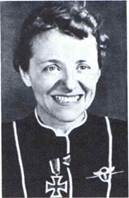
Even in this era of institutionalised suicide attacks by Palestinians and others, Japan remains unique in the extent to which it organised suicide operations as a formal part of their warfare. However, there is evidence that the use of the tactic was considered in Germany, but almost certainly the Japanese did not even know about it. The story is not widely known, even in Germany or Britain; in fact the main source I have found is Hanna Reitsch's book27 The Sky My Kingdom, published in 1955. I include her story because of the interesting similarities that appear in the Japanese story as it unfolds.
Hanna Reitsch, born in 1912, was addicted to flying. In the 1930s she was a world champion glider pilot, and an emblem of Hitler's Germany. On the outbreak of war she became a test pilot, among other things for the first helicopter (the Focke-Achgelis). Her book is a fascinating account of her career.
 As
regards the proposed formation of a suicide unit, she writes that in 1943 she
and her friends could see that the war was lost; therefore the war must be
brought to an early end if Germany were to be saved from disaster and that this
could only be secured through a negotiated peace. To prepare the ground for
negotiation, it would be necessary to weaken considerably the enemy' s military
strength, concentrating on key targets such as generating stations, waterworks
or key production centres. Particularly, an invasion attempt must be repulsed.
As
regards the proposed formation of a suicide unit, she writes that in 1943 she
and her friends could see that the war was lost; therefore the war must be
brought to an early end if Germany were to be saved from disaster and that this
could only be secured through a negotiated peace. To prepare the ground for
negotiation, it would be necessary to weaken considerably the enemy' s military
strength, concentrating on key targets such as generating stations, waterworks
or key production centres. Particularly, an invasion attempt must be repulsed.
They felt the necessary pinpoint accuracy could only be achieved by suicide attacks by piloted missiles. The volunteer pilots would need to be assured that their sacrifice would be successful, and so the suicide plane would need to be completely and absolutely dependable, and could be proved to be so. In discussions with friends they found that many people were willing to volunteer.
She then approached Field-Marshal Milch, Deputy-Chief of the Luftwaffe and Goring's Second-in-Command. He refused to consider the idea, despite her argument that if the participants were volunteers, no-one had any right to object. Late in 1943 a conference of all interested scientists, technicians and tacticians declared that the plan was practicable, and recommended that the VI flying bomb should be adapted. However, trials were first conducted with the Messerschmitt 328 piloted pulse-jet aircraft, which was already built.
On 28th February 1944 she was a guest at the Berghof , Hitler's mountain home, to mark the award of the Iron Cross (First Class). Over tea, she put the idea to Hitler. He did not think that the war situation was sufficiently serious to warrant suicide tactics and also thought that public opinion would be adverse. He then launched on one of his notorious monologues, in which he expounded his opinions in rambling form and with little real content. He stated that he expected much from the deployment of jet aircraft, but Hanna knew that their practical use was a long time off. She interrupted him, something that was never done — 'Mein Fuhrer, you are speaking of the grandchild of an embryo'. She went on to explain that jet aircraft were still having many problems and could not fulfil his hopes.
Hitler brushed aside her objections, saying that she was ill-informed. She again brought up the subject of suicide-pilots and gained approval to continue experiments and development if they 'did not worry him further'.She claims that thousands volunteered for the project, and about 70 were selected.
They signed a declaration that they were aware that they were facing inevitable death. Hanna also signed the declaration at once, and went on to help the chief test pilots for the ME 328, Heinz Kensche, who had also volunteered as a suicide-pilot.
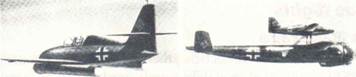 The Me
328 — proposed as a fighter to attack allied bombers, with pulse-jet engines.
This had to be air launched to have enough speed to start the engines, as did
the piloted VI (below).
The Me
328 — proposed as a fighter to attack allied bombers, with pulse-jet engines.
This had to be air launched to have enough speed to start the engines, as did
the piloted VI (below).
The powered version of the ME 238 had problems, and a glider version was planned. However not even the glider version was produced. Hanna was losing support, but late in April she was approached by the famous commando, Otto Skorzeny. He had become famous for rescuing Mussolini from an hotel in the Abruzzi Mountains where he was held prisoner by the Badoglio Government. Hanna's book says that he used a helicopter, but this was not so. He had used a Fiesler Storch light plane.
Skorzeny, it appeared, had recently been told by Himmler about Hanna's project and was himself concerned in the development of special weapons. He was already in contact with those in the Navy who sponsored the use of one-man torpedoes and frogmen. He was also keen to use the piloted VI as a suicide bomber. Skorzeny had been given extraordinary powers by Hitler, and testing began.
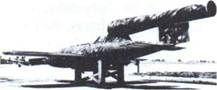 Several
versions, were made, including a glider version and a two-seater trainer. These
had only retractable skids as undercarriage, and were very dangerous to fly.
There were three crashes, injuring the test pilots, so Hanna herself and Heinz Kensche
took over the testing. Thanks to their skills, the operational model was made
ready — not without some horrendous incidents!
Several
versions, were made, including a glider version and a two-seater trainer. These
had only retractable skids as undercarriage, and were very dangerous to fly.
There were three crashes, injuring the test pilots, so Hanna herself and Heinz Kensche
took over the testing. Thanks to their skills, the operational model was made
ready — not without some horrendous incidents!
Training of other pilots began, but before they could be deployed the D-Day invasion of June 6, 1944, took place. The volunteers felt that once the landings had succeeded, their project could not be of much use. Himmler and Goebbels also refused to support it. Himmler suggested that the suicide-pilots should be recruited among the incurably diseased, the neurotics and the criminals so that through a voluntary death they might redeem their 'honour'. This idea, not surprisingly, had already proved to be a failure with frogmen. Goebbels invited the trainees to a meeting where he praised their attitude, but the project itself was quietly allowed to fade away.
Incidentally, attempts were made to achieve the kind of results Hanna was expecting, in another way. Radio-controlled glide bombs were first used against the landing at Salerno on 16 September 1943, damaging the battleship Warspite. Another sortie on 26 November sunk a troopship. By 22 January when glide bombs were again used the Americans had radio jamming devices which interfered with their control system.
There were several projects for remote-controlled pilotless aircraft bombs, under the generic heading of 'mistel' (Mistletoe). These consisted of such arrangements as Heinkel 1 1 1 bombers attached to Me 109 fighters; the fighter pilot would takeoffin control of the whole contraption and fly to near the target; the bomber would be detached and guided by radio to its target. The first of these was used on 29 January 1945 and sunk the cruiser HMS Spartan. The problem for all such vehicles was their vulnerability during the approach phase if the enemy had air superiorly, and this was the fundamental reason why such tactics did not have significant results either for Germany or Japan.
On April 7 1945, a desperate attempt was made by over 120 fighters of 'Special Force Elbe' to inflict serious damage on the marauding daylight bombers of the allies. The dedicated Nazi pilots were expected to ram the bombers, with a similar attitude to the Japanese Kamikaze. Their losses were appalling; less than 15 returned, and the US claimed to have lost only eight bombers. This was the most notable of all 'suicide' efforts by German airmen.28
Japan adopts suicide flights
Precursors to the Kamikaze
Japanese fighting men were never loath to sacrifice themselves for the greater good, and there are many examples of wounded airmen deliberately crashing on their target. The Japanese believed that one such example had occurred at Pearl Harbour..
27 May 1944: Operation at Biak
Richard O'Nei1129 claims that a deliberate suicide attack was made by Japanese Army pilots on 27 May 1944 at Biak, New Guinea. The commander of the Fifth Army Air Squadron called for volunteers for a 'tai-atari', literally 'self-blasting' attack on the US invasion transports. Two Kawasaki Ki-45 twin engined bombers ('Nicks') were escorted by five Nakajima Ki-43 'Oscar' fighters. One Nick was shot down as soon as it reached the area but a second narrowly missed a destroyer before hitting a submarine chaser. Despite a huge explosion the ship did not sink and only two men were killed.
4 July 1944 Saburo Sakai at Iwo Jima
Saburo Sakai, Japanese fighter ace who had been grievously wounded at Rabaul, had been sent to Japan and was regarded as unfit for operations: such men were valuable instructors. He was distressed at the poor standard of the trainees, and at the skimpy training they received in comparison with his own.30 'Men who would never have dreamed of getting near a fighter plane before the war were now thrown into the battle. Everything was urgent! We were told to rush the men through, to forget the fine points, just to teach them how to fly and shoot. One after another, singly, in twos and threes, the training planes smashed into the ground, skidded wildly through the air. It was a hopeless task. Our facilities were few, the demand too great, the students too many.'
Eighty Zero fighters were sent in July to defend Iwo Jima from carrier raids. Despite poor vision resulting from massive head injuries, the veteran Sakai was sent with them.
Forty returned from the first sortie, and seventeen from the second, with no appreciable damage to the US. The US outnumbered the Japanese aircraft by at least 40 to 1. The remainder were ordered to make a suicide attack, as described by Sakai. Captain Muira spoke:
You will strike back at the enemy. 31 From now on our defensive battles are over. You men are the fliers chosen from the Yokosuka Air Wing, the most famous in all Japan. I trust that your actions today will be worthy of the name and the glorious tradition of your wing. (He hesitated for several moments) ... ...In order for you to perpetuate the honour which is ours, you must accept the task which your officers have put before you. You cannot, I repeat, you cannot hope for survival. Your minds must be on the word attack! You are but seventeen men, and today you will face a taskforce which is defended perhaps by hundreds of American fighter planes.
Therefore, individual attacks must be forgotten. You cannot strike at your targets as one man alone. You must maintain a tight group of planes. You must fight your way through the interceptors, and... you must dive against the enemy carriers together! Dive - along with your torpedoes and your lives and your souls.
Sakai was shocked.
We had been sent out before this on missions where our chances of survival seemed hopelessly remote. But at least we had the chance to fight for our lives! This was the first time a Japanese pilot had actually been ordered to make a suicide attack. In our Navy it was an unwritten convention that once a plane was crippled on the high seas far from its base, the pilot would dive against an enemy warship or transport, since he had no chance to get home. We were not the only ones to do so: it had happened with the Americans, with the Germans and with the British. It would always happen so long as men fly and fight. But no Japanese commander had ever told his men, 'go out and die '.
Sakai and his fellow pilots took off, but well away from the targets the Japanese were surrounded by US fighters and could not break through to the attacking ships. Sakai led his two wingmen back to base, and one other pilot also survived. Iwo Jima was not taken at this time: the carrier force was not a precursor to an invasion. The troops at Iwo Jima had to wait until the following year before the island was invaded. Sakai was evacuated and survived the war as a fighter pilot.
The Zero (US code name Zeke) was the backbone of the Japanese Navy fighter strength. It was light, fast, manoeuvrable and well-armed. This view was the last seen by many hapless allied pilots at the beginning of the war.
9 July, 1944 : Suicide at Saipan
At Saipan, as usual, Japanese troops fought to the last. A desperate Banzai charge on July 7 was the last military action, with waves of soldiers of ten armed only with swords and sticks charging the dug-in Americans at dawn. Over 4000 were killed, and buried by bulldozer in mass graves.
Even more horrifying was the suicide of civilians. They had been taught that the Americans would kill them, and preferred to kill themselves.32 On July 8 hundreds of civilians, with some soldiers, emerged from the caves where they had been hiding and leapt from the 800-foot high Morubi Bluffs, watched by horrified American soldiers.
The capture of Saipan cost 50 000 lives, of which 3000 were American. Nearby Tainan and Guam were also taken, creating airstrips from which Japan could be bombed by the mighty new B-29 bombers. Large-scale raids began on November 24.
Attempts to launch the B-29 attacks from China had proven to be unsatisfactory. It was too difficult to get the aircraft and bombs to suitable places, and the China campaign was not progressing well. The Chinese Communist and Nationalist forces were more interested in contending with each other than with fighting the Japanese, and the Japanese army could roam at will in China. This was the time of Mao's 'Long March ', but that is another story.
In Japan Prime Minister Tojo was replaced with the more moderate General Kosiso, and there was desire for peace among some factions. However the military leaders still dominated the decision-making process, and fighting went on.
June — August 1944: Genesis of the Oka
On June 19, 1944, there was a high level discussion about establishment of suicide groups and even the manufacture of a special aircraft for suicide attacks. The argument was simple: there were few skilled pilots, and there was no possibility of training pilots to an adequate standard for combat flying; time and resources did not permit. Okamura, leader of the 201st air group, was a principal proponent of the use of suicide pilots. He pleaded with the meeting to provide him with 300 planes, and he would turn the tide of the war.
The argument was not accepted at this time, but by August, the Marianas had fallen and the climate was changing. The 'official' line is that a certain Ensign Ohta had been considering this since late 1943, having seen the front-line situation on visits to Rabaul. Ohta invented a piloted rocket- driven projectile 33 which could be loaded beneath a Type-I land bomber ('Betty '). It was to be dropped 20 kilometres from the target, and use its rocket engines in the final phase. 1800 kilograms of explosive were carried. (For more technical details see pages 168ff). The aviation research department of Tokyo Imperial University helped Ohta to draw the plans, which were submitted to the Naval Aeronautical Depot at Yokosuka. A secret decision was made to produce the aircraft and train pilots.
Even a two-seat trainer version was built: this program was very well resourced.
In fact, the first Oka flew on August 9, and was ready for action in September 1944, before the formal beginning of the kamikaze corps in the Philippines. The suicide torpedo Kaiten was also ready about this time. High authorities of Japan obviously were well prepared for the use of suicide tactics. The 'official' line is that these tactics developed among comparatively lower ranks; to me, this is, to say the least, questionable.
Captain Okamura was given command of the Oka unit in September 1944. The unit was based near Tokyo and later moved to Kanoya, in the southern mainland island of Kyushu.
The first group of young men selected for Oka training had six months of intensive training before they were sent on their only mission on 21 March 1945, as described on page 51. Nakajima makes the point that this long period would be more difficult than that of the pilots on the Philippines, who only had a few weeks to wait before their final mission.
An Oka can be seen below the 'Betty' bomber in the picture.
5. The attack on the Philippines
On March 2, 1944, the US chiefs of staff decided to attack Formosa, rather than the Philippines as the best stepping stone for the final attack on Japan. By June, Japan's strength had diminished so much that it they even considered bypassing both Formosa and the Philippines. However, having vowed, 'I will return', Macarthur insisted that the Philippines should be recaptured. Eventually it was decided that there would be a landing on Mindanao in the south, followed by an attack on Leyte on about December 20. After that, a decision would be made on whether to attack Formosa or Luzon.
Arrival of the British fleet.
In October a British carrier task force joined in the final attack on Japan. At this stage of the war this relatively tiny fleet itself would have been competitive with the entire Japanese air forces.
There is an interesting background to this development, which was not universally welcomed by the US leadership.34
There was a long-standing antipathy between Admiral King, naval chief of the US, and the British. In the desperate early months of the war, Britain had in the Indian Ocean two large carriers, Indefatigable and Inflexible, and the small carrier Hermes. The US had Yorktown and Saratoga in the Pacific, with Hornet and Wasp participating in the Doolittle raid. I have been able to find primary sources proving that Macarthur begged the Royal Navy to send at least one aircraft carrier at least towards the Netherlands East Indies, modern Indonesia. There is also some evidence that King also asked for this help. It was not given. In early April 1942 the rampaging Japanese carriers, having bombed Darwin, entered the Indian Ocean. While Hermes was sunk near Ceylon on 5 April, Indefatigable was sailing round in circles, deliberately staying out of range of Japanese aircraft. It appears that the argument against committing the British carriers was twof old: they had no modern fighter aircraft for defence, and had to be held in reserve against possible Japanese moves into India. So the Battle of the Coral Sea and the Battle of Midway were fought by all available US carriers, while the Royal Navy was an ocean away. It is said that King was furious, and never forgave the British.
Whether or not this is so, the Royal Navy were not exactly welcomed to the final Japanese campaign. Churchill himself had to intervene and take the matter up with Roosevelt before the carriers were allowed to participate in the final attack on Japan, and indeed even then were assigned only minor targets. They also had to provide their own 'fleet train'; ie the fleet of transport ships that brought all supplies, including food, munitions, fuel and the myriad of other things needed by a fleet operating thousands of miles from its base. This was a very difficult undertaking for the British: they were used to operating in the North Sea where distances were small and logistics were much simpler. For example, a MONAD, Mobile Naval Air Detachment, known as HMS Nabberley, was established at Bankstown, Sydney, to prepare aircraft for use by the British carriers.
The 'Formidable ' class of aircraft carriers consisted of six ships of 23 000 tons. They could steam at 31 knots, and carried about 40 aircraft and about 1400 crew.
General Macarthur
disliked the US Navy: he disliked the British even more. He suspected that they
wanted to spread their influence in areas which he regarded as his own. 'The
British have contributed nothing to this campaign, and, in fact, opposed the Australian
proposal to make available Australian troops for the defence of their own
country,' he informed Washington. 'They now propose to enter this theatre at
the moment  when victory clearly lies before us in
order to reap the benefit of our success.' Let the British operate in their own
area against Burma, Malaya, and Sumatra and the east coast of
when victory clearly lies before us in
order to reap the benefit of our success.' Let the British operate in their own
area against Burma, Malaya, and Sumatra and the east coast of
Asia, he said. He accused them of wanting only to establish a command structure, 'supplanting the American commander who has been entrusted with this duty for more than two years'.
Admiral King, with good reason, was also not impressed with the fleet's capabilities for this type of warfare. Their antiaircraft gunnery had not the up-to-date director systems of the US ships, and all firing was controlled visually and manually. Gunners had to estimate their targets' speed and guess how far to 'lead' when firing.
The British had a shortage of suitable carrier planes and US types such as the Avenger, Corsair and Hellcat were used. The Seafire, naval version of the Spitfire, had excellent speed and manoeuvrability but was built too weak to withstand the rigours of repeated deck landings. The Americans also criticised the Fairey Firefly, then just coming into service, but this was not reasonable: the Firefly was rugged, quite fast, and could carry two tons of bombs. Fireflies even performed well in the Korean war in the early 1950s. However in 1945 they were just coming into service and not available in great numbers.
The British carried fewer aircraft than the larger US carriers, and their handling procedures were not as efficient. Until recently, they had landed each plane and stored it below deck before landing its successor, but they improved on this process when they reached the Pacific.
Another problem was that the British ships were designed for cold-weather operation. They had no air-conditioning or even good ventilation. While the British sailors bunked in the working areas of the ship, the US sailors had separate dormitories. The US ships had cafeteria-style dining areas, but the British sailors still had the traditional messing system where a representative from a small group would collect food from the galley, which the men would eat at their work place.
Finally, the US ships had good entertainment and news facilities. Luxuries like ice-cream were served regularly. Near Okinawa, Lieutenant Commander Bill Stewart, of Ballymoney, Northern Ireland, a 26-year-old Avenger pilot, and his crew, crashed and were rescued promptly by an American ship. They were amazed to be eating inch-thick steaks. 'We were treated like fighting cocks,' said Ian Davis, one of Stewart's crew. 'We haven't had such good food since the war started. '
Nevertheless, the fleet was strong and well balanced, with two battleships, four carriers, (Indomitable, Formidable, Indefatigable, and Victorious), five cruisers and fifteen destroyers. It first made its presence felt in a series of raids against Formosa between 10 and 15 October 1944, which made life very difficult for the Japanese.35
15 October: Admiral Arima's sacrifice
Even before the Kamikaze units were officially formed, Admiral Arima provided another example of the deliberate use of suicide attacks. He was the commander of the 26th Air flotilla at Manila,36 and was greatly respected by his men. Though he came from a learned family from Kyushu, and was entitled to live in the luxurious Manila headquarters, he preferred a tiny shack at Nichols Field. He was always in full uniform, despite the heat.
On 21 September US aircraft began to attack the airfields and major cities. The high command had ordered a maximum effort, as the 'destiny of the homeland' depended on a Japanese victory. But the forces were overwhelming. On 15 October a huge US naval force was discovered heading for Luzon. All available aircraft were launched, and Arima himself joined the mission. He flew as a passenger in a bomber, and the plane was last seen, according to the Japanese, 'crash-diving into an enemy aircraft carrier'. It seems likely that Arima knew the position was hopeless, and did not wish to continue.
Macarthur's invasion of the Philippines
The invasion of the Philippines was a mighty operation. When it is considered that the forces ranged against the operation consisted mainly of unsupported infantry, it is hard to escape the conclusion that the invasion was not necessary. A fraction of the resources could have been put into tracking down the remainder of the Japanese fleet and disposing of the Philippines-based aircraft, and the whole area could have been isolated from the war. The invasion was mainly a product of Macarthur's vanity. Matters of 'face' are not the exclusive property of the Japanese!
Yamashita and forward defence
General Yamahsita is regarded by many as one of the greatest military leaders. He led the invasion of Malaya and the capture of Singapore, and his army offewer than 30 000 soldiers, virtually out of supplies, took the surrender of over 130 000 allied troops. He was the victim of a plot to remove him — possibly because he was too popular and not one of the inner clique, and spent most of the war in a backwater in China. However he was recalled to take over the defence of the Philippines when the incumbent General Kuroda 'indicated defeatist tendencies', in September 1944.
The High Command in Japan was ambivalent about the Philippines. On one hand they wanted it defended to the utmost, and on the other did not want to expend more resources to do so.
Yamashita had 438 000 troops, not an inconsiderable number. He decided to concentrate his forces around Luzon rather than make strenuous efforts to defeat the landing on the beachhead at Leyte. However, when the ambitious Sho plan was proposed by the Navy, he was ordered to make a stronger effort at Leyte. Against his better judgement, he did this on October 25 — the same concept of forward defence that caused the fall of Malaya and Singapore had a similar eventual outcome.
Divine Wind
(Much of the information in the remainder of the book comes from the most significant source I have found, Divine Wind, a jointly written memoir by Captain Inoguchi and Commander Nakajima. These two were naval staff officers of wide experience and high social status, and were responsible for the running of major kamikaze missions.
Their work is flawed, as I mention from time to time, particularly in regard to their adulation of Ohnishi and the emphasis on the Japanese navy at the expense of the army. However, the work is detailed, personal and sincere; it expounds the Japanese viewpoint very well.)
The Philippines defence plan — Sho—l
The Japanese navy resolved to commit its total strength in an effort to defeat this invasion, despite the army 's pleas that this force should be held intact to defend Japan itself, (see page 48).
At the time of the invasion, Japan could gather together 7 battleships, 4 carriers, 2 hybrid battleship carriers, 20 cruisers and 29 destroyers, backed by 150 aircraft. The US force consisted of 12 battleships, 32 carriers, 23 cruisers, 100 destroyers and could put 1400 aircraft in the air. 430 transport ships carried the invasion fleet.
This state of affairs led to the Japanese Sho-I plan. This, like the Midway battle plan, was very complex. It was more important than ever to try to scatter the American ships so that the Japanese could converge and gain temporary superiority in the invasion area.
Four separate fleet groups were involved: each was under a Vice Admiral with Vice Admiral Ozawa in nominal overall control. Ozawa left the Inland Sea in Japan on 20 October with four aircraft carriers, with 118 aircraft in total; he also had two old battleships, three light cruisers, and nine destroyers. Vice Admiral Kurita left Brunei Bay, Borneo, on October 22, with five battleships, ten heavy cruisers, two light cruisers and 15 destroyers. His main asset was the mighty battleship Musashi, which had 18-inch guns, the largest ever to equip a battleship. Its task was to blast the invasion forces. On the same day Vice Admiral Nishimura also left Brunei Bay with two old battleships, a heavy cruiser and four destroyers. Vice Admiral Shima was coming from the Ryukyu Islands with two heavy cruisers, a light cruiser and four destroyers.
Basically, Ozawa's force would be a decoy to draw off the larger carriers and other major units. Kurita would force the San Bernardino Strait and head south to Leyte, and the other two forces would attack Leyte from the east. However, even if the larger US battle force was decoyed to the north, there would still be many ships left around the San Bernardino Strait and to the east. It was decided that the naval air force would attack these ships and distract them so that the big battleships could break through to close range. The 18-inch guns of the Musashi could then blast the invading ships. However, the newly appointed naval air commander, Admiral Ohnishi, had about fifty airworthy aircraft — about what is carried on the smallest US carrier. It was this dilemma that made inevitable the first formal move to establish kamikaze groups.
The whole process was, by any realistic assessment, hopeless. But the Japanese were a long way from admitting that the war was totally, irrevocably, lost.
The Appointment of Ohnishi
Admiral Ohnishi was appointed to the Philippines as commander of the naval air force. Nakajima gives an interesting background ('spin?') regarding this appointment.
Ohnishi" was sent to the Philippines to take over from Admiral Teraoka. These men had been in the same class at the Naval Academy, but Ohnishi was not allowed to sit the final exam because an incident in which he had slapped a geisha girl.
Teraoka had been under pressure to use suicide attacks, but refused. Nakajima paints a moving picture of Ohnishi complaining to his wife that he did not want the posting, and that it was as though the Emperor had presented him with the 11-inch hara-kiri sword with the sanbo, a wooden tray to hold offerings to the Shinto gods. 38 He cried out in despair and asked his mother to sing him a lullaby. Nevertheless, he took the position and moved to the Philippines. It is clear that he also knew that the Oka unit had been formed and would be used. He was on a mission to introduce the routine use of suicide attacks.
19 October: Ohnishi in charge
He reached Manila on 17 October. Only fifty planes, in poor condition, were available to his First Air Fleet. On 18 October Onishi formally took over from Teraoka and on 19 October addressed the senior pilots:
As you know, the war situation is grave. The appearance of strong American forces in Leyte Gulf has been confirmed. The fate of the Empire depends upon the outcome of the Sho Operation which Imperial General Headquarters has activated to hurl back the enemy assault on the Philippines. Our surface forces are already in motion. Vice-Admiral Kurita 's Second Fleet, containing our main battle strength, will advance to the Leyte area and annihilate the enemy invasion force. The mission of the First Air Fleet is to provide land-based air cover for Admiral Kurita 's advance and make sure that enemy air attacks do not prevent him from reaching Leyte Gulf To do this, we must hit the enemy 's carriers and keep them neutralized for at least one week
Nakajima describes how twenty-four men volunteered for the first assignment, and the group was christened the 'Shimpu Special Attack Corps'. It was divided into four units: Shikishima, Yamato, Asahi, and Yamazakura. These names were taken from the waka (poem) by Norinaga Motoori, a nationalistic scholar of the Tokugawa period: The Japanese spirit is like mountain cherry blossoms, Radiant in the morning sun.
Nakajima claims that he suggested the name 'Shimpu Unit' for the group. Shimpu is another way of reading the characters for 'kamikaze', the divine wind that dispersed the invading Koreans in 1275 as described on page 2.Lieutenant Yukio Seki, an 'Academy man' (graduate of the prestigious Naval Academy at Eta Jima), had agreed to lead the corps. Ohnishi was pleased with the airmen's attitude.
20 October — Proclamation of the Kamikaze unit
Formal proclamation of the unit was made on 20 October 1944, 39 and the battle orders were to organise a Special Attack Corps, 'Special Attack' being a euphemism for suicide attacks. Their task was 'to destroy or disable, if possible by 25 October, the enemy carrier forces in the waters east of the Philippines'. Twenty six fighter planes were selected, of which half were to make crash-dives on their targets, and the others were to escort them, being ready to sacrifice themselves if necessary to ensure that the attackers got through..
Ohnishi addressed the men chosen: he stressed the danger that faced Japan, and that he prayed for their success. He continued:
'You
are already gods, without earthly desires. But one thing you want to know is
that your own crash-dive is not in vain. Regrettably, we will not be able to
tell you the results. But I shall watch your efforts to the end and report your
deeds to the Throne. You may all rest assured on this point. ' There were tears
in his eyes as he concluded, 'I ask you all to do your best. 
21 October 1944 — The first sortie from Malacabat
The enemy task force was sighted, and the kamikazes prepared to sortie. Led by Lieutenant Seiki, the pilots jogged to the operations room as usual and lined up for a farewell drink of water from a container left by Admiral Ohnishi. Their fellow pilots, standing by to see them off, sang an ancient song:
If go away to sea.
I shall return a corpse awash;
If duty calls me to the mountain,
A verdant sward will be my pall; Thus for the sake of the Emperor I will not die peacefully at home.
Before take-off, Seki handed a small folded paper to his commander, and it contained strands of his hair — a traditional memorial from Japanese warriors which is sent home to their loved ones. However they were unable to find the enemy, and returned to base. With tears in his eyes, Seki apologised for his failure.
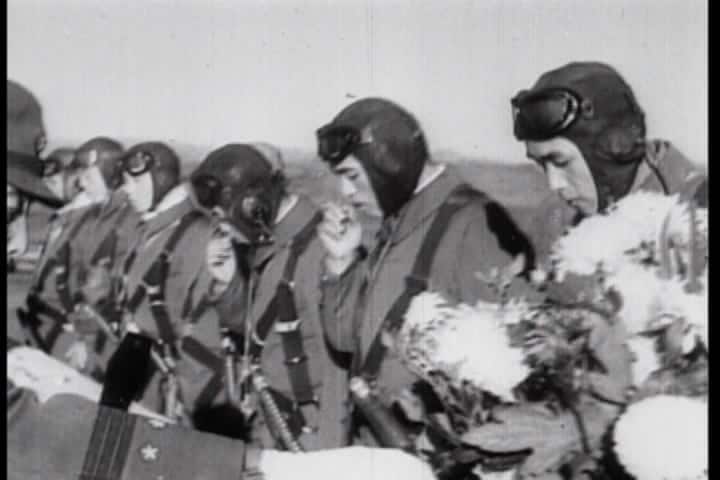
 Pilots
sharing a final drink before departing on a kamikaze mission.
Pilots
sharing a final drink before departing on a kamikaze mission.
20 October: landing at Leyte Gulf: Army air force attacks on the invasion fleet
474 army aircraft made sorties to attack the invasion fleet in the period 24-26 October, of which 116 were lost. Extravagant claims of success were made: these were shortly shown to be false, but even if they had the success they had claimed, it would not have made any difference. The US dominance was complete.
21 October 1944 : the first attack from Cebu
Cebu was hot and humid. Weather was turbulent. US raids were frequent. Aircraft were hidden in the jungle and brought quickly to the airstrip when needed.
When six US carriers were reported, and five 'Special Attack' were prepared, but a US raid destroyed them before take-off. Two more bomb-laden Zeros and an escort plane were then brought to the airstrip, and the plan was to follow the returning US aircraft to their aircraft carriers.
At 1625, the aircraft took off, led by Lieutenant fig) Yoshiyasu Kuno. But they reencountered bad weather and failed to locate the enemy. Two of the planes returned - but not Lieutenant Kuno.
The previous night Kuno had had a discussion with Inoguchi, objecting to the use of escort planes as a waste of resources, mainly interested in bringing back reports for propaganda purposes. He also asked that his guns be removed from his plane as they had no purpose. Kuno had expressed his determination to make his attack, and on the mission had left the formation to seek a target when the others turned back. However he had no success. Further sorties were sent out, but could not find the carriers.
Meanwhile Kurita's force was under attack by US submarines. They sunk two of Kurita's heavy cruisers — Atago (the flagship) and Maya, and disabled a third.
24 October: Arrival of Second Air Fleet from Formosa
Vice-Admiral Fukudome's Second Air Fleet had arrived from Formosa with 250 aircraft, but these were unsuccessful in their first attack on 24 October. They succeeded in damaging only two enemy cruisers and three destroyers. 41
Inoguchi claims that a
group of fourteen Zero fighters was sent to give air cover to Kurita's ships in
their passage through the Sibuyan Sea, but was driven off by antiaircraft fire
from the very ships they were supposed to protect. Meanwhile US carrier planes
struck the force severely, sinking one battleship and, shortly after, the
enormous battleship Musashi. This was a severe blow to the kamikaze, who had
hoped to sink the carriers and  prevent such a catastrophe.
Seki then led a strike which had the first major success of the kamikaze — the sinking of the escort carrier Saint Lo. Another three carriers were hit and damaged. For the loss of only four aircraft and pilots this was a major success. On 26 October the Yamato unit also damaged an aircraft carrier, the Suwanee.
The Emperor heard of the kamikaze missions 42 and sent a message. Nakajima called his pilots to hear it.
Everyone snapped to attention and I read the message from Admiral Ohnishi. I relay to you His Majesty 's words to the Naval Chiefof Staff upon hearing the results achieved by the Kamikaze Special Attack corps.
When told of the special attack, His Majesty said, 'was it necessary to go to this extreme? They certainly did a magnificent job '. His Majesty 's words suggest that His Majesty is greatly concerned. We must redouble our efforts to relieve His Majesty of this concern.
I have pledged every effort toward that end.
Nakajima realised that this was a serious criticism of Ohnishi, who was also very upset about the matter. One report of this scene has Nakajima drawing his sword and brandishing it while promising redoubled efforts.
27 October 1944: Lieutenant Fukabori
Lieutenant Fukabori 43 was chosen to be the leader of the Second Kamikaze Special Attack Corps, set off from Nichols Field to make his attack on 27 October. After the incidents described below, he wrote this report. He slept, soundly, according to Nakajima, then set out the following morning as calmly as if going to the office.
To: (1) Commander, 701st Air Group, Nichols Field.
(2) Lieutenant Commander Ema, Mabalacat Eastern Field.
Today I made an emergency landing at Legaspi, because of trouble with my bomb fuse. After it was fixed I joined my unit and proceeded to Leyte, arriving there at 1850. We circled over the gulf at 1000 metres but the sun had set and enemy ships were not distinguishable. Heavy ack-ackfire indicated their presence. The two planes with me appeared to have plunged into enemy ships, but there was insufficient light for me to identify a worthwhile target. I therefore abandoned the attack and headed for the airfield at Cebu.
Landed safely at Cebu about 2030. It is my intention to fly from here early tomorrow morning and find a suitable target for attack. The following observations are made in the hope that they will prove of value to those who come after me.
l. The bomb fuse lock should be checked carefully before departure.
2. Loaded with one 250-kilogramme bomb and four 60-kilogramme bombs, a plane can cruise at 125 knots. Bearing this in mind it is essential to calculate a proper time of departure. Ship types cannot be recognized readily unless the target area is reached by 1820 at the latest. From the air it is difficult to find a target at sea, even in the brightest moonlight.
3. In a properly timed dusk attack I believe that even a Type-99 carrier dive bomber ('Val can succeed in making a special attack.
4. I recommend consideration of dawn attacks, using Cebu as a stopover base. In a dawn attack there is less chance of being caught by enemy fighters, and additional fuel in the plane will add to the destructiveness of the blow.
5. Above all, do not lose patience. Wait until conditions for attack are satisfactory.
Ifa pilot loses patience he is apt to plunge into an unworthy target. Naoji Fukabori.
Postscript: The good faith of our pilots makes me confident that the Imperial prestige will last forever. Our pilots are young but their behaviour is brilliant. There is no need to worry about selecting kamikaze pilots. I wish you the best of luck and good health.
Good- bye.
Interestingly, there was a case of a kamikaze pilot aborting his mission and landing in the sea, probably deliberately, on November 11. He told his US captors that he was not avolunteer. He had arrived from Formosa on 22 October and his commanding officer had informed the Aichi dive bomber squadron that they had been reclassified as kamikazes.
November 1944 : extension Of the Naval Kamikaze
The Sho operation was another dismal defeat for Japan. The four remaining functional carriers, Zuikaku, Chitose, Chiyoda, and Zuiho were sunk. Within the space of three days the Japanese Navy had lost 3 battleships, 4 carriers, 10 cruisers, and 9 destroyers over half its vessels engaged. The Japanese lost over 300 000 tons of warships, the US a total of 36 000 tons.
Ohnishi and Fukudome had a meeting, and Ohnishi45 was able to show that his aircraft were far more successful than the 250 aircraft of the Second Air Fleet which had reached Clark Field on 23 October. It took two days for persuade Fukudome to use 'special attack' tactics. The key argument was that Fukudome's aircraft had made conventional attacks with 250 planes on both the 24th and 25th, the most important days of the operation, but they had succeeded only to the extent of damaging two cruisers and three destroyers. However on the 25 October alone, only five kamikazes of the first Air Fleet Shikishima unit had sunk one carrier and damaged another two or three.
2 November 1944 : mission of Lieutenant Inoguchi
A new arrival was Inoguchi's nephew,46 Lieutenant (jg) Satoshi Inoguchi. He brought six fighters to Cebu. The young Inoguchi was the son of Captain Toshihira Inoguchi, captain of the giant battleship Musashi which had been sunk by US planes on 24 October.
Captain Inoguchi had stayed aboard after ordering the crew to abandon ship.
On 2 November twelve fighters prepared to attack Tacloban airfield, now in US hands. As the aircraft taxied out, the young Inoguchi ordered a warrant officer from his plane and took his place. Only ten days after his father's death the son also died in action.
November 5: The Army adopts Kamikaze
The army air force took
part in the action attacking the invasion fleet, actually flying  more missions
than the naval planes. The army had 650 aircraft, including many heavy bombers,
but these tended to bomb from a very high altitude and had little success.
more missions
than the naval planes. The army had 650 aircraft, including many heavy bombers,
but these tended to bomb from a very high altitude and had little success.
The navy claimed great
success from its kamikazes, and the army came to the  conclusion that this
tactic was the only possibility for success.
conclusion that this
tactic was the only possibility for success.
The army quickly transformed existing squadrons into kamikaze groups and sent them to the Philippines. The pilots were not volunteers: but there is evidence that there was no major objection from the pilots selected. Six squadrons were organised from among the students of the training schools, whose shortened courses were barely sufficient for them to be able to fly their planes at all.
The whole process was bedevilled by the traditional rivalry between the army and the navy. The army was reluctant to seek advice from the navy: traditionally the navy had been responsible for attacks on shipping — when the USS Panay was attacked before the war in China, this was done by naval pilots even though the boat was well up the Yangtze River.
A problem for both army and navy was the supply of suitable aircraft. The kamikazes got worn-out, slow aircraft, but these were very vulnerable. The army fighter, Nakajima type 1 'Oscar' was preferred, and considerable quantities were available; it had similar specifications to the navy's Zero.
The first army kamikaze mission was on November 5. It was necessary for the mission to be a resounding success, so experienced commissioned officers were sentoffunder the leadership of Captain Iwamoto. A formal parade was held, and General Tomonaga made a speech:
When men decide to die like you 47 they can move the heart of the Emperor. And I can assure you that the death of every one of you will move the Emperor. It will do more — it will even change the history of the world.
32
I know that what you feel now as you put the sorrows andjoys of life behind you because the Emperor 'sfortunes are failing. Do not worry about what happens when you die and what you leave behind you —for you will become gods. Soon I hope to have the privilege of joining you in glorious death.
The group offive aircraft flew towards Leyte Gulf where they met a large force of US carrier-based aircraft; Iwamoto led his aircraft into attack and each rammed an enemy plane. This was reported to the Imperial General Headquarters who informed the Emperor. The Emperor was deeply moved and issued an Imperial Edict declaring them national heroes.
That afternoon another four aircraft set off, having received the same speech from Tomonaga. They turned back because of heavy cloud, but the leader broke off, radioed that he had found a break in the clouds and was attacking. Nothing more was heard of him and no damage was done to US ships at that time.
The army was now down to a total of 43 aircraft.
November 12: Army attacks
On November 12 another army mission of four aircraft set out. The leader returned because of engine problems, and the other three made dives on transport ships. The Japanese claimed that four transports were hit; the US said that two were damaged on that day. There were two more missions of similar size before November 16, with no useful results.
The Americans were by now well established on Leyte, and already land-based aircraft were operating from Philippines bases.
The shortage of Japanese fighters was acute, so the heavy bombers were organised into kamikaze groups. Also, some new aircraft had arrived from Japan. The Imperial General Headquarters ordered that the navy and army co-operate in attacking the invading fleet, but the lack of communication continued.
November 15: Naval Pilots' Party 48
One night when weather obviously was so bad there would be no operations of the following day, Inoguchi sent some sake for a party, to which he was later invited. Lieutenant Kanno, who was recovering from a leg injury, was also invited and he was carried in on the shoulders of several happy pilots. The party table was laden with a variety of delicacies, and sake flowed freely. For a forward combat area, it was a gala affair and everyone was having a fine time. Even in these circumstances, Inoguchi was besieged by men asking him to select them for suicide missions.
November 26: a futile
'maximum effort
General Yamashita asked for a maximum effort from 23 to 27 November. A major Japanese convoy was expected to arrive from Formosa on November 25. Attacks were made by Japanese conventional aircraft in an attempt to cover the arrival of this convoy, but the four transports were sunk near Manila. None of the vital supplies and troops reached the Philippines.
The naval kamikazes were launched to attack the shipping. Simultaneously army units were ordered to attack, but US raids on airstrips destroyed many aircraft. Three aircraft did get off the ground but had no success, of ten losing their way among clouds and rain. Another group went out on November 26, and their escorts reported a successful attack, with three transports damaged. On November 27 both army and navy kamikazes attacked. The USS battleship Colorado and cruiser Montpelier were hit. On November 28 more attacks damaged the battleship Maryland and two destroyers. Attempted attacks on November 30 were forced to turn back because of bad weather.
The US press was giving publicity to the kamikaze attacks; this was reported by neutral countries and the information got back to the Japanese. This was very encouraging. Admiral Ohnishi had the better publicity machine and therefore the navy got most of the
33.
glory. The army attacks had concentrated on the transport ships, and the records of these losses are hard to find, even today.
Army and Navy relationships
I have mentioned above the interaction, or rather lack of interaction, between the Japanese army and the navy. Hoyt explains it well.49 Since the Meiji restoration, the remains of the Samurai class tended to join the navy, which had higher social status at the upper levels than the army. On the hand the army was more open, and a peasant boy could rise through the ranks far more easily than he could in the navy.
The army, however, was dominant in the political field, and in actual fact controlled Japan in the immediate pre-war years. The navy felt that it was discriminated against in the allocation of resources. The services disliked each other to an extent that 'bordered on hatred'.
When the time came for the employment of kamikaze, the navy, as a general rule, called for volunteers. It is true that those who did not volunteer did not prosper, but there was an option not to participate. The army gave their cadets no option. Army members were simply told that they would become kamikaze pilots, and as time went on whole squadrons were simply ordered to participate. For example, on March 20 1945, all army squadrons from numbers 46 to 116 were reallocated for 'special attack'.
In general, members of both forces participated willingly. It is interesting that the navy was the first to specifically train kamikaze pilots, namely the first group of Oka pilots which began training in about August 1944.
In the post-war era the navy has the better publicity machine. In Divine War the word 'army' figures twice, inconsequentially, in the index; yet the authors list all missions in their appendices, without acknowledging the army's contribution. All information on the army activities has been gleaned from reports of other sources. But the overall evidence indicates that the army was at least as important as the navy in the kamikaze defence of the Philippines.
December 5—7: attacks on landing at Ormoc Bay
Meanwhile the position on land was deteriorating for the Japanese. Desperate kamikaze efforts continued. A US convoy was attacked by combined army and navy formations on December 5, sinking a landing ship and damaging other vessels. On December 7 another major joint army / navy attack was made on a new landing by the US at Ormoc Bay. The attack was fiercely pressed home, both by kamikazes and conventional aircraft. The army sent out 20 kamikazes in two raids and claimed a warship and four transports sunk, and four other ships damaged. This was a high point of the campaign. The US reacted with even more vigorous attacks on airfields, including the attacks on Formosa described elsewhere.
The defence of the Philippines now was moving into its final phase — retreat to the mountains. The navy had fewer than 150 planes; the army had more, but they were not organised in kamikaze units.
23 December 1944: Formation of The Second Kamikaze Corps
By the time of the Lingayen landings, however, the total Japanese air strength in the Philippines was reduced to fewer than 100 planes. On 23 December the last reinforcement group of thirteen Zeros reached Mabalacat airfield in the Philippines, under the command of one Lieutenant Kanaya. A very keen young officer, Kanaya always listed himself as first candidate for every mission. He spent a great deal of time training his pilots in quick takeoffs, as the field was under constant attack. 50 A particularly heavy raid occurred on 28 December, but the dispersed Japanese aircraft were not damaged.
2 January 1945: landing on Luzon.
The landing at Luzon was an even greater shock to the Japanese, who had husbanded their remaining kamikazes to resist this attack.
A reconnaissance plane reported a group of 300 enemy vessels west of Mindoro
Island, course north, speed 14 knots, and almost immediately reported a second group of 700 enemy vessels sighted to the south offirst group. They did not even find the third group of 400 ships; over 1500 ships were being used by the US! Against these, only forty aircraft could be mustered. At last Kanaya had his flight: on 5 January he attacked the approaching armada, and the Japanese authorities claim that he was successful in hitting an enemy ship.51
The army units attacked the convoy as they came in range, and seemed to have better intelligence than the navy. On January 2 a single Ginga bomber broke through the defences and hit the escort carrier
Ommaney Bay, which eventually sank. (left)
It is clear that army pilots clamoured to be allowed to fly kamikaze missions. In the end, pilots were chosen by seniority. January 5 was a day of maximum effort, as described on page 70. The navy had no aircraft available after January 6, but army aircraft continued to attack. 27 aircraft successfully attacked on January 6 and 7, seven ships being either sunk or gravely damaged.
6 January 1945: the navy's last Philippines kamikaze mission
The very last naval kamikaze mission in the Philippines was carried out by five aircraft which had been cobbled together overnight from all the wrecked aircraft at Malacabat.52 The remaining pilots were eager to participate in this final mission, even though two planes were so frail that they could carry only 60k of bombs.
One Lieutenant Nakano, who was suffering from tuberculosis, was selected as leader and four other pilots were selected on the basis of skill levels. The planes were in poor condition and the field was very rough from bombing, so only the best pilots would do. As each pilot tookoff they shouted their thanks to Inoguchi for selecting them for this mission. An observer plane reported hits on a cruiser, a battleship and three transports.
The remaining pilots were evacuated or became ground troops. The navy personnel fought street by street in Manila, causing great destruction. The army retreated to the northern mountains, where they continued the fight till the end of the war.
January 6: Newcomb
The destroyer Newcomb was hit by 6 kamikazes on January 5 and January 6. She could still navigate, and sailed away for repairs.
Like Australia and Aaron Ward, described elsewhere, she demonstrated the surprising lack of explosive power in the kamikaze crashes — and also the bravery and fortitude of the sailors.
January 8 to 15: the last army attacks
On January 8 the army scraped together anything that would fly and sent them out as kamikazes. The quality of the attack was diminished, and the US were gaining in their ability to defend themselves — the combat air control patrols were gaining in effectiveness, but the most successful defence was by anti-aircraft fire.
These last few days had given the US navy its greatest casualty list since the desperate days of the Guadalcanal campaign, and there was serious talk of withdrawing the attacking fleet. But the Japanese had exhausted most of their resources, and the invasion was able to proceed.
On January 9 the landing at Lingayen occurred. The navy put their last seven aircraft in the air and the army sent in a small kamikaze group. The army's attacks were uncoordinated and the kamikazes were shot down as they attacked one by one.
Kamikaze tactics were also very much in evidence elsewhere during these days; on land some defending troops made suicide attacks carrying explosives, becoming human bullets. Some desperate night attacks were also made by small boats, which at this stage were not yet specifically designed for suicide attacks.
On January 10 two army kamikazes were successful in damaging two ships, a destroyer and a transport ship.
Forces were marshalled for another aircraft kamikaze attack on January 12. Thirty aircraft attacked, beginning at dawn. A Japanese radio operator witnessed one attack, by a 'Betty' bomber:
Just as dawn appeared3 a kamikaze plane — a large plane — came roaring in overhead (down over the mountains). A deafening roar reverberated as it flew over. Then dimly a large enemy warship became visible and the plane dived into it, I thought. There was a thunderous noise, and a great cylinder of fire rose up. One part of the surface area was concealed by fire which spread out. In the camp all the officers and men stood up together and shouted, Banzai!
Please tell the men of that unit, thank you!
This aircraft hit the destroyer USS Gilligan. The next attackers were all shot down, and then four fighters made a co-ordinated attack on the destroyer transport USS Belknap.
A hit caused 87 casualties. Further attacks resulted in hits on four transport ships.
On the following day, a group offour aircraft attacked, hitting a transport ship. Two aircraft, the last planes of the Thirtieth Fighter command, attacked simultaneously, and one hit and seriously damaged the escort carrier Salamaua. This was the last of the organised attacks; during the next few days a number of single, unsuccessful, attacks were made and the air defence of the Philippines came to an end.
The escape of the leaders
It is interesting to note what happened in the final stages of the Philippines land fighting, when the remains of Ohnishi's forces became land troops. They fought mainly in the city of Manila, in a brutal hand-to-hand, house-by-house struggle, 54 and were defeated with very few survivors. Many Filipinos were also killed. Yamashita withdrew to the mountains, where he had more room to move, and conducted resistance there till the very end of the war. He surrendered to US troops on 3 September , 1945.
Ohnishi himself, and Nakajima and Inoguchi, were withdrawn from the Philippines; this took some subtle management to make it appear that Ohnishi was being ordered from on high to leave his men. Shikata ga nai was the Japanese phrase for it. Also pilots and expert technicians were saved where possible.
General Tomonaga, in charge of the army air forces, also fled on January 17 to
Formosa. Yamashita accused him of cowardice and desertion, and Tomonaga was sent to Manchuria in disgrace. This episode did a lot of harm to the army effort: volunteers became harder to find.
26 February 1945: Recapture of Corregidor
The Japanese army took down the Stars and Stripes over Corregidor on May 6, 1942; the US army in the Philippines had held out far longer than the army of the British Empire in Singapore. After the US invasion in October 1944, the fortress of Corregidor was retaken on 26 February 1945. s5
Lieutenant Kanno, a model soldier
Lieutenant Kanno had a reputation for bravery, based on such incidents as his ramming of a B25 bomber, and came to the attention of Nakajima when he was training fliers for skip bombing. Skip bombing was a way of using the faster fighter aircraft to attack shipping. They would fly in low, and drop bombs to bounce off the water into the side of the target.
Kanno immediately applied for posting as a kamikaze. Nakajima refused this request, because Kanno was a very skilled pilot and such people were becoming very scarce. Nakajima noted that Kanno had bundled up his personal belongings — which were very few — and had labelled them 'personal effects of the late Lieutenant Commander Naoshi Kanno'. He had no intention of surviving the war.
Kanno led the new Raiden fighters in a successful action on October 27, then was sent to Japan. On August 1, 1945, he was killed when an anti-aircraft gun he was manning exploded. There was no fuel to enable him to fly.
Pa

Final sumnary of kamikazes in the Philippines campaign
The balance sheet:
• The army lost 719 suicide pilots and the navy lost 480 aircraft in kamikaze missions, including escorts.
• The results as reported in The Kamikazes are as follow:
|
Source of figures |
Ships claimed sunk |
Ships claimed dama ed |
|
Japanese Na |
37 |
68 |
|
Japanese Arm |
116 |
191 |
|
Total Japanese claim |
153 |
257 |
|
American loss reports |
16 |
87 |
The Japanese claims are exaggerated, but even on the American figures, more US ships had been sunk and damaged in the three months of kamikaze attacks in the Philippines than on all the previous battles of the Pacific War, including Pearl Harbour. Divine Wind lists the following as the actual results of 424 naval aircraft sorties:
|
Type of Enemy Shi |
Claimed sunk |
Claimed Damaged |
Actually Sunk |
Actually Damaged |
|
Carriers |
5 |
13 |
2 |
23 |
|
Battleship s |
|
3 |
|
5 |
|
Cruisers |
5 |
8 |
|
9 |
|
Destro ers |
3 |
|
3 |
23 |
|
Trans orts |
23 |
34 |
5 |
12 |
|
Destroyer escorts |
|
|
|
5 |
|
Others |
|
|
6 |
10 |
|
Total |
37 |
59 |
16 |
89 |
There is more than a bit of 'spin' in the presentation of these figures; it is implied that all the victories were achieved by the navy!
More illuminating than the figures is following basic point:
In the second battle of the Philippines the Japanese had lost the super battleship Musashi and two other battleships, the veteran aircraft carrier Zuikaku, three light carriers (Chitose, Chiyoda and Zuiho) six heavy cruisers, four light cruisers and eleven destroyers, which was at least half the effective strength of the navy at the time.
From their overwhelmingly bigger force the US lost the light carrier Princeton, the escort carriers Gambier Bay and Saint Lo, two destroyers and a destroyer escort.
6. Action from Formosa
On 6 January 1945 carrier aircraft from US Task Force 38 made strong attacks on airstrips that were bases for kamikaze aircraft. There was virtually no opposition. The aircraft from just a few US carriers outnumbered those available to the Japanese for defence.
18 January 1945: Formation of the Nil taka unit at Formosa
As mentioned before (page 37), Ohnishi fled from the Philippines to Formosa. Here there were only about 100 planes, both army and navy. Ohnishi quickly organised the Naval aircraft as kamikaze. This extract from Divine Wind is interesting because Ohnishi, for the first time, is seen as publicly admitting the possibility of defeat:
The christening ceremonies 6 of this corps took place at Tainan at 1700 on 18 January, and Admiral Ohnishi was personally in attendance. This was the first special attack corps to be formed in Formosa, and it was designated the Niitaka Unit, after the Formosan mountain of that name ('Climb Mount Niitaka' had been the code order for the attack on Pearl Harbour. Mount Niitaka was the highest mountain in Japanese territory of the time). Admiral Ohnishi delivered a speech on this occasion, the gist of which was the same as that of the speech he had delivered almost three months before at Mabalacat. But this time he made a special point of adding, 'Even if we are defeated, the noble spirit of this kamikaze attack corps will keep our homeland from ruin. Without this spirit, ruin would certainly follow defeat. '
The words, 'Even if we are defeated, ' sounded strange to us who had hitherto been thinking only in terms of winning the war. In retrospect it appears that Admiral Ohnishi 's determination in continuing these superhuman tactics was directed not solely toward victory in the war, but also toward the far greater goal of perpetuating Japan, even in defeat.
There was the usual celebration, with sake and whatever food luxuries were available. Immediately after the party, however, the new kamikaze flyers insisted that a scheduled lecture on kamikaze attack methods be given by Nakajima.
21 January: attack on allied task force
The Niitaka Unit was sent into action on 21 January against an allied task force east southeast of Formosa. There were three attack sections, eighteen aircraft in all, of which five were escorts. Four 'Judy' bombers were included.
The airfields were under constant attack, and the groups spent a lot of time practicing so that their aircraft could be brought to the airstrip and despatched quickly. However, one group was disorganised and flew off in the wrong direction, typical of the problems that occurred for the increasingly untrained pilots.
Most aircraft, including all the bombers, were shot down, but those that returned reported successes. Indeed, the US aircraft carrier Ticonderoga' was hit at this time.
Page
7. Strikes against Iwo Jima and Ulithi
19 February: The invasion of Iwo Jima.
Iwo Jima had been left alone since the heavy raids of the previous July when Sakai was ordered to make his suicide attack (page 22), but now the US needed it as a base. lt was only 660 nautical miles, 1220 km from Tokyo, ideal for fighters and as emergency landing field for bombers. It was not an inviting place: literally the name means 'Sulphur Island'. It was only 8 square miles, 20 square kilometres, and very mountainous. General Kuribayshi commanded the garrison of 20 00 men. He had lived in the US as an assistant military attaché, and had no illusions about the outcome of the invasion:
We must defend this island 58 to the last of our strength. That is our total responsibility. Each of your bullets must kill many of the enemy. We must not allow ourselves to be captured. If our positions are taken, we will use bombs and grenades. We will infiltrate the enemy lines to annihilate him. No man must die before he has killed ten of the enemy. We will harry the enemy until the last man has died. Banzai!
He ordered his men to dig into the rock of Iwo Jima and to construct a maze of shelters and tunnels. This was very successful. Iwo was heavily bombed by B-29s and B-24s and a fleet pounded the tiny island for three days before the invasion, on February 19. Adding up the numbers of shells of calibres from 6 to 16 inches fired on the island, I have calculated that warship bombardment alone poured nearly five thousand tons of explosive on to the island. 59 A conservative estimate for the aerial bombardment is two thousand tons, with another thousand tons of rocket and other bombardment to directly cover the landing. This is four tons of explosive per hectare, nearly half a kilogram per square metre! Yet US casualties were so great that the official debriefing of the battle says that there should have been more bombardment.
When the invasion occurred, the defenders emerged from the deep caves they had constructed and fought with extreme bravery. Almost 30 000 US troops landed on the first day, and 2 500 were killed or wounded. Armoured vehicles were brought ashore, and were met by Japanese suicide soldiers with explosives strapped to their backs. Three days of bitter fighting led to the taking of the highest point on the island, Mount Suribachi, subject of the famous photo reproduced overleaf. The Japanese occupied a network of tunnels in the north of the island and had to be subdued; flamethrowers were a favourite US weapon for this purpose. Bitter fighting continued until March 25, only 216 of the 20 000 Japanese defenders surviving as prisoners. Only a very few of these surrendered voluntarily. 6 000 US soldiers were killed and more than 17 000 were wounded: in other words, one third of the US troops were killed, injured or suffered severe battle fatigue.
On March 4 the first of many B-29s made an emergency landing on Iwo Jima even as fighting raged in the area. 2251 emergency landings were made on Iwo before the end of the war.
On April 7 108 Mustang escorts joined an attack on Japan, operating from an Iwo base. Okumiya had claimed a (vastly exaggerated) figure of 9.7% losses among B-29s for January, but only 0.4% for July. Japan had completely lost air superiority.
The kamikaze attack on Ivo Jima: 21 February
There were two major kamikaze missions outside Okinawa and the area around the home islands. These were the Fifth Air Fleet attack on the huge US base at Ulithi, described in full in the next section, and the Third Air Fleet attack on Iwo Jima.
Inoguchi claims that both attacks were urged by the pilots themselves after standard attacks had failed. We will see later that the motivation for the Ulithi attack may not have been as high as Inoguchi claimed.
However, the Iwo Jima attack was made by the Third Air Fleet, based in Kanto in the central Japanese plain. The 601st Air Group was used for the mission. I These were elite airmen who had the skills needed to land on carriers. No carriers were left, but when its commander asked for volunteers, the pilots vied with each other for the positions available. Admiral Teraoka christened Mitate Unit 2 on 19 February. It consisted of thirty-two planes organized into five groups — three groups of eight (4 fighters, four bombers) and two groups off our (torpedo-bombers).
On 21 February they made the long flight to Iwo, refuelling at Hachijo Jima en route. Two pilots' aircraft were faulty, but they begged for replacements and flew on. According to Japanese records, Iwo Jima's defenders radioed that one United States carrier and four transports had been sunk, and another carrier and four other warships damaged. But actually the main actual damage was the sinking of the escort carrier Bismarck Sea. Saratoga was also damaged (below). This was the only effective aerial intervention against the invasion fleet.
Fire fighting on the deck of Saratoga, 21 February.
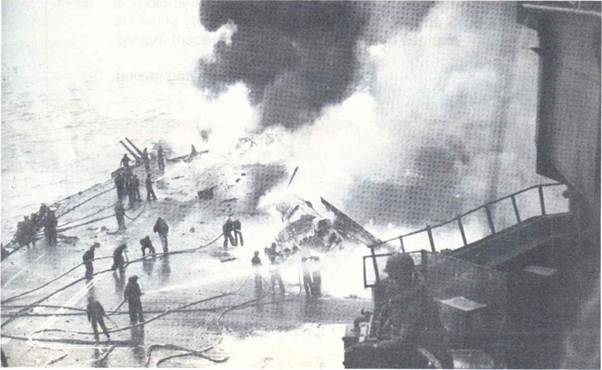
11 March 1945: The 'Azusa' Unit Attacks Ulithi
Following the relative failure of the Iwo Jima mission, it was decided to attack the US fleet in its base at Ulithi, after it withdrew from covering the invasion of lwo Jima. Ulithi Atoll, in the Marianas, had been taken over as a fleet base. Ohnishi 'went out on a limb' to get the aircraft for this mission, from which much was hoped. The aircraft came from the
Pa

Third Air Fleet, based in central Japan. It was planned that 25 aircraft should each crash on a major ship, and this might cause such a disaster as to postpone the future invasions. The
Japanese had been, utterly irrationally, clinging to hope for victory for some time now, and
62 this was a mission of great importance for them.
A Saiun plane ('Myrt') of the Fourth Fleet, flying from Truk, reported on 9 March that enemy task forces were anchored at Ulithi. The attack was to be launched on the following day, consisting of 24 Ginga ('Frances') bombers, guided by flying boats to assist navigation. The mission was aborted when a new message advised that only one carrier was present at Ulithi. This was found to be an error, and on 11 March the mission was sent out again.
During the flight, rain squalls and a head wind caused delay. The sun had set at 1852 and Ulithi was already dark when the kamikaze planes drew near.
Of the twenty-four attack aircraft, thirteen developed engine trouble en route but most were able to land on islands on the way. The remaining eleven apparently made their attacks by 1930 hours. The next day a reconnaissance aircraft from Truk confirmed that there were no damaged aircraft carriers at Ulithi, and the attack was judged to be a failure.
However the US carrier Randolph (CV-15) was, in fact, hit and quite seriously damaged by an aircraft on this raid.
Ohnishi was privately very angry, claiming that the large percentage of aircraft which dropped out indicated that the pilots did not have the necessary total dedication to the task. However he, and the supporters of the kamikaze idea, hid the failures and proclaimed only successes. The Japanese public were being bombarded with news bulletins which proclaimed these mythical victories.
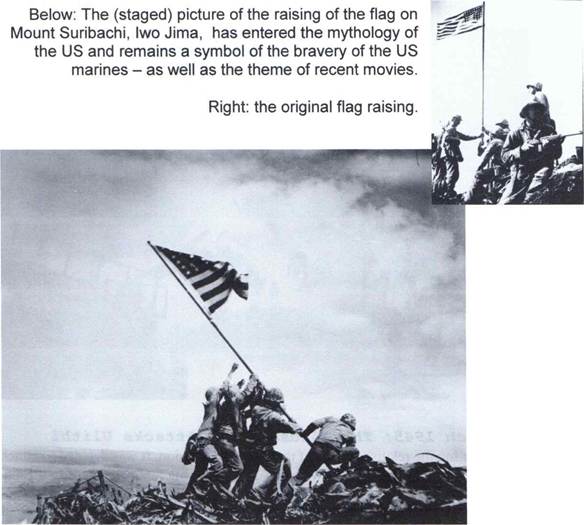
8. Australian connections to the kamikaze story
6 August, 1944: The Cowra breakout
The book Cowra describes the incident of the Cowra breakout from the Japanese viewpoint. When captured, the subject of the book wanted only to die: he had been unconscious and seriously ill when captured, and was treated well, which surprised him. His hands were tied so he would not attempt suicide, and he received good food and excellent medical treatment, including the use of scarce and valuable penicillin.63
He was flown to Australia; during the flight he attempted to kill the pilot, with a view to causing the plane to crash and kill everyone. When he arrived at Cowra he gave a false name and rank, (Captain Shiego Kaji), which was not an uncommon practice — many other prisoners did this; at least three prisoners had adopted the name Togo Heihachiro, Japanese admiral at the Battle of Tsushima, 1904. Kaji was impressed with the care given the prisoners. The prisoners objected to eating bread, and rice was provided. Fish was specially brought to Cowra for them. Full medical care was given, and Kaji, being a doctor, took part in this process. Early in August he protested the plans of the administration to split the NCOs from the men and send a group to a new camp at Hay, and was put in solitary confinement. The soldiers were very upset about this and had also heard the news of the fall of Saipan and the mass suicides. On 7 August the inmates broke out, charging the Australian guards with home-made weapons. A machine gun was manned by Private Hardy and Private Jones, and they fired on the swarming Japanese until they were overrun. As they were hacked to pieces, one of them, as a last conscious act, threw the breech block of their machine gun away so the swarming Japanese could not turn it on the other Australians. These were not front-line troops, but reserve soldiers drafted to the task at random. Supreme courage in the face of death is not the sole property of the Japanese!
Of about a thousand prisoners, 600 had taken part, and 229 were killed or committed hara-kiri. During the ensuring nine days 334 prisoners were retaken, and in the recapture process 25 had died. Of the dead, 1 1 were found hanging from trees and two had been killed by trains. Kaji was surprised at the small participation rate.
All the escapees expected to be shot, but no reprisals were taken. The Japanese had first thought that this was because the Australians wanted to curry favour with the Japanese because they knew that Australia would lose the war, but as the war progressed this was proved false. They felt that if Japan lost, there would be few survivors, and all those would be enslaved by a cruel victor. The prisoners also feared a Japanese victory, as they would be treated as social outcasts for the shame of having been imprisoned.65
It was said that the reason that Japan did not sign the Geneva Convention on Prisoners of War was because it was felt that this might encourage soldiers to surrender rather than die. To an extent, this explains the cruelty with which the Japanese treated their captives, which is well documented in many war memoirs.
Eventually the surrender came. Kaji returned home, but his family was ashamed that he had been a prisoner and he moved away from home and told no-one, not even the lady he later married, of his wartime experiences.
Japan and Australia have co-operated in establishing a memorial garden in Cowra. Kaji is pleased, but still has nothing to do with the process. The garden, and post-war Japanese-Australian relationships, is a very good tribute to the control strategies adopted with these exceedingly difficult prisoners, something that could well have been studied in the context of modern Iraq.
Kamikaze attacks on HMAS Australia
In the fleet supporting the Leyte landing was a sizeable Australian group. The veteran heavy cruiser HMAS Australia had had a long career, in the Mediterranean and in the Pacific. She played a very important part in the battles around Guadalcanal (see page 15). HMAS Shropshire, a similar ship, had been recently received from Britain. There were two destroyers, Warramunga and Arunta; the frigate HMAS Gascoyne; and a survey vessel. Also in the group were three Australian storeships and a tanker. Unlike the American ships, Australia had no air-conditioning to make life more bearable in the extreme heat. She was also under-ventilated. The crew suffered from prickly heat and poor food, had no mail for many weeks, sometimes months, and suffered from the feeling that the war might go on endlessly.
Marking the fact that the kamikaze attacks occurred 60 years previously, the April 20, 2004 Melbourne Age had an article by Roger de Lisle, which is the basis for this section.
At dawn on October 21, 1944 Australia was one of hundreds of ships anchored off Leyte. There had been little air action from the Japanese in recent months, but suddenly enemy planes appeared. The gunnery officer, Lieutenant Hamer, ordered the close-range Oerlikon guns to open fire, but the larger guns could not fire: the target was at water level and the pom-pom 2 inch antiaircraft guns and the main 4-inch guns could not fire at an angle less than 300.
Two Japanese aircraft were shot down, but the third hit the Australia. It hit the tripod mast. The lookout had an amazing escape from death as burning petrol spread over the bridge area. The ship's electrical system was knocked out and the steering was damaged.
Seven officers and 23 sailors were killed, and another 56 were wounded or burned. The captain, Captain Emile Dechaineux, and the navigator, Commander Rayment were mortally wounded. The flag officer commanding the Australian contingent, Commodore John Collins (later Vice Admiral Sir John Collins) was also wounded.
##Roy Ashton, Chief Petty Officer of the control party after the kamikaze attack.
Roger De Lisle and many other commentators — usually Australian — claim that this was the first kamikaze attack. This is wrong in detail: the attacker was not part of the formal kamikaze groups, which came into action later that day.66 The bomb carried by the Zero did not explode; it was prepared for air dropping, and armed itself in flight. Kamikaze aircraft were equipped with bombs which exploded on contact, and had a device operated by the pilot which armed them after take-off. However, Roger De Lisle's reporting of the present-day recollections of participants is moving.. ...
• Jim Bell, of Bentleigh, was 23 years old, and a gunner on a pompom, a two inch anti-aircraft gun. He had swapped positions on the gun with one of his mates — a mate who died in the attack. He vividly remembers the explosion. One man ran past their position, on fire all over; a member of his gun crew lost both legs and died that night.
• Richard Peek, later a vice-Admiral, was gunnery officer and was on the bridge at the time of the attack. The bridge was covered with burning petrol, and he was badly burned. The captain was mortally wounded but remained concerned with the activities of his ship.
• Cliff Anderson remembers how crowded the anchorage was. 'You felt you could walk from one ship to another'. There was no room to zig-zag or manoeuvre, even though the ship had just weighed anchor.
• Roy Ashton, of Williamstown, was a Chief Petty Officer. As a shipwright, he had to get the ship running again, and he described how everyone put the horror and shock out of his mind and concentrated on his work, even when the bridge was on fire behind them.
## pic Australia was a County Class Heavy Cruiser of 1000 tons displacement, 630 feet long, with maximum beam of 68 feet 4 inches. Built in Scotland, she was launched on 26 August 1925, reaching Australia on 23 October 1928. Her oil-fired turbine engines gave her a speed of 31 1/2 knots with a cruising range of
10,400 miles. Basic armament was 8 x 8-inch guns, 8 x 4-inch guns, 4 x 3-pounder guns. Wartime crew was 848 men. Australia was put into mothballs in April 1938 but brought back to service in
September 1939. Her wartime career was especially distinguished and she was scrapped in 1954. 67
Three days later, 24 October, saw the biggest Japanese air strike so far on the invasion fleet. About thirty planes got through and eight were shot down by anti-aircraft fire.
Australia was badly equipped for anti-aircraft work. Shropshire was slightly better off than Australia because her 4-inch guns could be aimed by radar. Shropshire also claimed another secret weapon, a gunner named Cazaly, the son of the most famous Australian footballer. He refused orders to abandon his gun when the kamikazes got within 400 yards, and kept firing to the end. Shipmates credited him with two aircraft destroyed. Australia was sent to Manus Island for repairs, and was back in action in six weeks.
Repairs to the Australia
The Warners' account deserves to be reprinted at length:
The Australia was due to leave Manus in the Admiralty Islands on Christmas Day. Her new commander, Captain Jamie Armstrong, had decided that, under the circumstances, it would be sensible to hold the Christmas festivities on 22 December. These were in full swing when Rear Admiral R S Berkey, commander of the close support group, of which the Australia was to be a part, came alongside. The flight deck was covered withflour bombs and fire hoses were in full play.
The admiral saluted as he came aboard. A seaman dressed as a lieutenant appeared not to approve of his appearance. 'Your cap is notflatterback, Admiral Berkey, ' he complained. Berkey ignored the reprimand but remarked to Commodore H B Farncomb. 'I don 't want to criticize, but I suspect your flagship is in a state of mutiny. ' Admirals were not the most popular officers aboard the Australia. Vice Admiral Sir Guy Royle, RN, Australia 's First Navy Member, and an Englishman, had flown to Manus to address the ship 's company after the kamikaze attack. The crew had expected to learn that the ship would be returning to Sydney for a refit. Instead, the admiral told them they were to be refitted at Espiritu Santo. While the crew groaned, Royle went on to say that he was sure the men who had died on 21 October would have been proud to die on the same day as the heroes of Trafalgar! To the Australians, this was a novel thought. The Aussie concept of service did not quite embrace this British version of bushido.
Australia was supposed to be fitted with more small-calibre anti-aircraft guns, but this was not done before she returned to the action in the Philippines.
On 4 January while approaching Luzon through the Suriago Strait a large kamikaze attack and Australia was hit. The US aircraft carrier Ommaney Bay was severely damaged and later sunk (see page 35).
The crew of HMAS Arunta were already annoyed by not being able to listen to the Japanese propaganda radio, which they liked for its jazz music (the hierarchy must have been concerned about the effect of the propaganda) but in the evening was heavily damaged by a kamikaze. After five hours dead in the water the crew patched her up and got going again.
Furious action continued throughout, with hits on the aircraft carrier Savo Island and again on Australia. This time the plane hit the port side of the upper deck and wiped out most of the port weaponry and some other smaller guns on the starboard. Twenty five men were killed and thirty badly injured. A young gunner named Bill Brown was killed; at that time his parents were on holiday on the Mornington Peninsula in Victoria at the time, taking with them Bill's dog. About the time the kamikaze hit the Australia, the dog began to howl. The family could not console the dog. They feel that in some way that dog knew long before the rest of the family that Bill was dead.
Many sailors were understandably terrified as they helplessly watched the approach of the aircraft, but the new Captain, Jamie Armstrong, stood unprotected on the bridge throughout. Some sailors said that it was because he had very poor eyesight and ears damaged by constant exposure to gunfire! But he certainly set a fine example.
6 January 1945: action in Lingayen Gulf
This was the biggest single day of kamikaze action in the Philippines: recorded events include: 1 1 am: destroyer minesweeper Long, near miss; 11.22 am: destroyer Richard P Leary, near miss; 1 1.59 am: battleship New Mexico, hit; Noon destroyer Walke, hit; 12.06 pm: destroyer Allen M Sumner, hit; 12.08 pm: cruiser Australia, near miss; 12.09 pm: battleship Mississippi„ near miss; 12.11 pm: cruiser Shropshire, near miss; 12.15 pm: destroyer minesweeper Long, hit; 12.15 pm: destroyer transport Brooks, hit; 2.06 pm: battleship New Mexico, hit; 2.27 pm: destroyer O'Brien, hit; 2.27 pm: destroyer Barton, near miss; 3.00 pm: cruiser Columbia, near miss; 5.20 pm: battleship California, hit; 5.30 pm: destroyer minesweeper Long, hit; 5.30 pm: cruiser Columbia, hit; 5.31 pm: cruiser Louisville, hit; 5.34 pm: cruiser Australia, hit.
Japanese records suggest that twenty-seven suicide planes took part; twelve hit their targets and seven had near misses. Five Zeros took off from Clark field at 1 1 am followed shortly after by and later another group of nine Zero kamikazes, one Judy and five escorts. Just before 5 pm another group of five Zeros and a Judy took off from Mabalacat, and each plane appears to have hit a target.
Australia had few defensive weapons left, and attracted a lot of attention. The main damage was caused by the second attack, which killed fourteen men and wounded another twenty-six, including this time the starboard gun crews.
8 January 1945
At dawn, Australia accompanied the fleet into Lingayen Gulf to bombard the beaches.
Australia was last in line and at 7 20 am a Dinah kamikaze attacked from behind. Four US Wildcat fighters were in pursuit, but the plane crashed into the side of Australia. Damage was comparatively slight. Australia's guns, however, shot down one of the Wildcats, though the pilot bailed out at dangerously low level. The Warners describe the next attack: Nine minutes later, a second Dinah attacked from the same quarter and hit the ship on the waterline below lhe bridge. Its bomb exploded against the ship 's side and ripped a hole 14 feet by 8feet.
One engine, a propeller, and the head and trunk of the pilot landed on the ship. 'My God, he 's still breathing, ' a seaman shouted 'He won 't be for long, ' said a cook, who 46 then jumped on the head of the dying pilot. The crew threw the engine, the propeller, and the pilot into the sea. The badly battered ship restricted her speed to 18 knots and could no longer continue with safety to fire her 8-inch guns on the port side. Cooks, stokers, and stewards now manned the remaining anti-aircraft guns and the US destroyer Moale moved in to provide extra firepower.
9 January 1945
The kamikaze campaign was almost over, but two aircraft made an attack. One hit the US battleship Mississippi. The second came straight for Australia's bridge. Lieutenant Hamer, the gunnery officer, had been broadcasting an account of proceedings over the ship's PA system, from his position just above the bridge. As the few guns that could fire blazed away, the crew were amazed to see Lieutenant Hamer step out of his shelter and shake his fist at the approaching plane. They were even more amazed when the plane swerved away. 'It threw the pilotoffcourse, it really did,' said Lieutenant Schrader. The plane hit the front funnel and crashed into the sea beyond, and miraculously there were no casualties. In later life, Hamer had a career as MHR and senator in Federal parliament in the 1960s and 1970s, and died in 2002.
But not surprisingly, Australia was now in a bad way, both in terms of actual damage and crew morale. The ship was sent close to the undamaged US battleship West Virginia, which was bristling with guns. Hamer attempted a feeble joke and broadcast to the ship's company that the Australia was moving to protect the battleship. The joke fell flat. 'What the hell's wrong with her?' the disconsolate crew asked.
The US commander, Oldendorf, ordered Australia to withdraw with the 'cripple convoy' returning to Leyte. The battered ship passed down the line of US ships and was cheered by all.
Oldendorf signalled: 'your gallant conduct and that of your ship has been an inspiration to all of us. Sorry to lose you at this time.' Vice Admiral Kinkaid recorded in his action report: 'The only undamaged heavy ships are Pennsylvania, West Virginia, HMAS Shropshire and Portland.
The return to Sydney of the damaged Australia was a very moving sight. A funnel was completely missing and the temporary repairs were obvious.
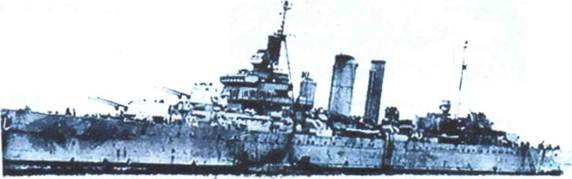
9. Okinawa: the war comes closer!
'Overall considerations for defence'
Imperial Headquarters 69 was bitterly disappointed over the failure of the Ulithi attack,(page 41), made more galling by the disastrous fire raid on Tokyo in the night of March 9. The raids of carrier borne aircraft had been severe enough, and the high-level raids of B-29s were disrupting industry. But the fire raids were even more terrible: hundreds of B29s came in at low altitude — 9000 feet — at night, armed with incendiary bombs. This is described in Chapter 1 3, page 129ff. Though this chapter is mainly concerned with the further employment of the kamikaze tactics, the background against which the decisions are made must be kept in mind.
The allies demanded unconditional surrender, but the Japanese military leaders would not agree. They proclaimed that this would lead to the enslavement of all Japanese and the destruction of the nation.
At last, in January 1945, the grave position of the war caused the army and navy leaders to meet to discuss strategy and prepare a combined plan. But even now there was no real co-operation.
There was general agreement that Japan was faced by hugely superior forces, but even so, their assessments were serious under-estimations, while Japanese strength was overestimated. 70 Japan still had six aircraft carriers, it is true, but there was almost no fuel, and the logistic problems of getting them to sea were almost insurmountable. The supposed 1280 army planes and 1515 navy planes on strength on January 15 could only be used sparingly in small formations, again because of fuel shortage. Aircraft factories had been decentralised, but the transport of materials and complete aircraft was extremely difficult, so new production would not assist.
An attack on a British aircraft carrier off Formosa. It is interesting that the aircraft is an American Corsair. The armoured decks of the British carriers were a great advantage and the carrier was quickly back in action.##
The army believed that they could, and must, hold the main land areas of the empire:
Japan, Korea, Manchuria and North China. The other islands, including Taiwan and even Okinawa, could not be defended. The army proposed to withdraw to these land areas and to fight to the death.
The defence of the Sea of Japan, which separates Japan from Korea, had long been an army priority. They had even produced their own aircraft carriers, beginning with the Akitsu Maru, launched in 1941. 71 These six carriers were all either sunk or never completed, but they remain as an emblem of the army's determination to defend the home waters.
The navy plan was to make an all-out effort against the next major allied attack, wherever it came. They expected an attack on either Okinawa, Taiwan, the south-east China Coast or Kyushu, and indeed all these options were being considered by the allies at that time,. (It was remarkable how military minds worked in the same channels, for all these plans were under consideration by the Allies that winter.)
The army and navy chiefs of staff went to the Imperial Palace on January 20 and told the Emperor they had a plan for combined operations. It called for the strengthening of Okinawa, Iwo Jima, Taiwan, Korea and the Central China coast around Shanghai. As well, the home islands would be strengthened and air forces husbanded for use against invasion of Honshu and Kyushu. After this, however, each service largely went its own way.
Inoguchi makes the point that there was one point of agreement, and that was to expand the kamikaze forces. New pilots were trained and normal squadrons were converted to 'special attack' squadrons.
An interesting example occurred at Hiro air base in western Honshu, Captain Yoshiro
Tsubaki was ordered to convert his Fourth Fighter Squadron to a suicide unit. 72 Corporal Yasuo Kuwahara had just finished a very basic training program and wrote this report of the process:
First the captain repeated the dreary and depressing facts of the Allied advances, then announced that the time had come for a great decision.
'Any of you unwilling to give your lives as divine sons of the Great Nippon Empire will not be required to do so. Those incapable of accepting this honour will raise their hands-now. '
The room reverberated with silence. Then, one by one, hands went up until there were six. This was not the way it was supposed to go. The newspapers had reported on the formation of other units, navy and army, and the story was always the same: young men leaping over one another to be the first to declare for death.
The captain grew furious. He summoned the six who did not want to die to the front of the room. The captain castigated the honest dissenters as cowards and then announced shamelessly that he had lied to them all, that the six were now to be set up as horrible examples to the others They were to be the first to die. Captain Tsubaki did not stop to wonder what sort of impetus would impel these young men when they took offfor that last mission. It was the way of the Japanese army that no one questioned him, neither from the bottom, where it was impossible, nor the top, where such disparities were ignored.
Even when ordered to become kamikaze the young men accepted their lot with resignation.
This was the new breed, young boys sixteen and seventeen years old, who were promised the world to enlist, were beaten half to death in their training program, and now were promised that their reward for patriotic devotion would be death.
On February 23 an army order converted sixty-nine normal squadrons to suicide units. On March 20, all squadrons from number 47 to No. 1 16 were converted to suicide tactics. Officers as well as men would now be subject to suicide duty. However the fundamental problem was the shortage of experienced pilots and the woeful inadequacy of the training of new pilots. Many newcomers to the squadrons could not even control their aircraft. These pilots would be led into action by the few remaining skilled pilots. As the Warners say, 'From this point on, 73 nothing that happened in the war could be regarded with rational eyes as anything but madness. '
The invasion of Okinawa
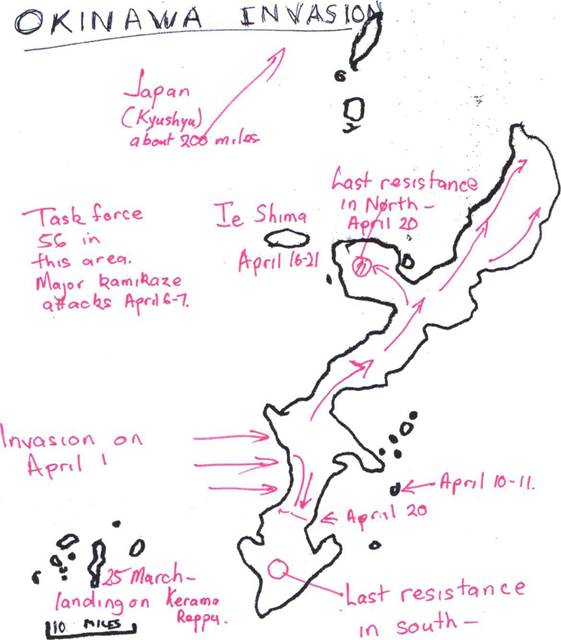
19 And 20 March 1945 — Okinawa: The Opening Sorties
On 19 and 20 March 1945 a huge allied task force attacked the southern home islands in preparation for the invasion of Okinawa. 74 About fifty kamikazes were launched on 19 March, and a few carriers were indeed damaged. Japanese losses were however very heavy. The following day twenty 'Judy' bombers were launched and another two hits were claimed.
Enterprise (below) was so badly damaged that though it could still navigate it took no further part in the war. Flying through the air at the top of the explosion cloud is actually the hatch cover for the aircraft lift, shown by the arrow .
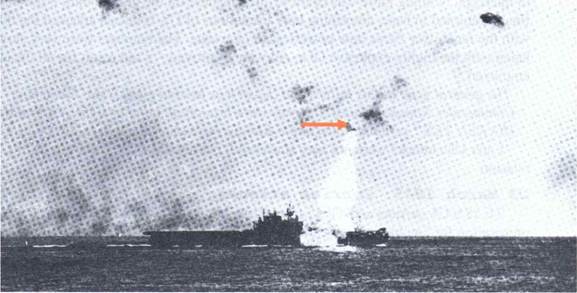
21 March 1945: First deployment of the Oka
On 21 March the specially designed Oka suicide planes were deployed.75 Many resources, human and material, had been devoted to them, and much was expected.
Vice Admiral Ugaki ordered them out to attack a group of aircraft carriers that had been reported. Their commander, Captain Okamura, was dismayed: he knew that the allies dominated the air, and that his slow Betty bombers, carrying the Okas to their targets, would be at the mercy of the marauding allied fighters. Ugaki's chief of staff, Rear Admiral Yokoi, explained that all available fighters would be sent up to cover the mission, but that only fifty-five planes were flyable. Okamura was still obdurate, but Ugaki insisted that the Okas should be sent out. 'If the Oka cannot be used in the present situation, there will never be another chance for using it. '
 Okamura
obeyed, but with heavy heart. He knew that his pilots faced certain death, but wanted
them to have a chance of success. Eighteen bombers were prepared, sixteen of
which carried Okas. Okamura wished to fly himself, but was persuaded not to by
the designated leader, Lieutenant Commander Goro Nonaka, a highly skilled
veteran. Nonaka had done a good job preparing his pilots, who were 'a congenial
group, united and loyal, happy and proud to follow their leader even unto
death'. Indeed, one Lieutenant Kai begged Nonaka to let him take Nonaka's place
in leading the attack, but Nonaka refused this request.
Okamura
obeyed, but with heavy heart. He knew that his pilots faced certain death, but wanted
them to have a chance of success. Eighteen bombers were prepared, sixteen of
which carried Okas. Okamura wished to fly himself, but was persuaded not to by
the designated leader, Lieutenant Commander Goro Nonaka, a highly skilled
veteran. Nonaka had done a good job preparing his pilots, who were 'a congenial
group, united and loyal, happy and proud to follow their leader even unto
death'. Indeed, one Lieutenant Kai begged Nonaka to let him take Nonaka's place
in leading the attack, but Nonaka refused this request.
By all reports, the Oka pilots were in good spirits as they departed, 'all shouting their thanks and farewells and running toward
the mother planes of their own craft. Nonaka smiled as he spoke his last words, "This is Minatogawa," (an allusion to the rebirth of Japan)76 and hurried to his plane. Admiral Ugaki stood beside the command post for the take-off. There were tears in his eyes as he watched the sortie of the Okas. At 1135 the bombers began taking to the air in rapid succession, Nonaka's plane leading the way. The hachimaki (white cloth wrapping) around each pilot's helmet was conspicuous and impressive to the spectators, who waved sad farewells'.
In the event, only thirty escort fighters took part in the mission. The six carriers that were within range picked up the approaching raid on their radar and launched their fighters to intercept. Nothing more was heard by the Japanese on the ground until a few fighters finally returned to base, describing how formations of US Wildcats attacked the bombers, with the far slower Zeros now powerless to intervene. The bombers were very slow, and laden with the highly explosive Oka. All were destroyed — a sad result for all the effort employed.
Later Oka attacks were not very successful, but none was as disastrous as this first mission.
23 March 1945: Carrier attacks
TF 58 's US carriers and TF 57 from Britain attacked Okinawa as part of the preparation for landing and were attacked by kamikaze aircraft. Some kamikaze explosive laden motor boats were also used, with little effect.
25 March Bases near Okinawa seized
On 25 March, American forces began landing78 on Kerama Rettu, fifteen miles west of Okinawa, as a stepping stone and also to neutralise the forces there, which included suicide attack boats.
April, 1945 : compulsory kamikaze
The naval kamikaze pilots in the Philippines and in Formosa were all volunteers. They may have even believed that their tactics might make a fundamental change to the war's outcomes. But by the time of the Okinawa landings the bombing was obvious to all: no one could hope for any kind of eventual victory. Even in the navy, the pilots were put under great pressure to participate: no longer could even Inoguchi pretend that all were eager volunteers.
Most, however, accepted their lot. Inoguchi describes one such example:
An example of the achievement of this spiritual calm was seen in the case of Lieutenant (ig) Kuno, who was extremely perturbed upon arrival at the base. Then suddenly, after several days of sulking about, he came with jaunty step and a spark in his eye, asking permission to divest his plane of all unneeded equipment, saying that it was being inconsiderate to homeland workers to take non-essentials along on a kamikaze mission.
Kuno went on to perform admirably in his mission. Another pilot is described by Nakajima: though he was a gifted academic, he could not be persuaded to abandon his mission:
Among the special attackers 80was a young officer who had graduated from a technical college in Muroran, Hokkaido. He had stayed on at the college as an assistant professor, and he continued with advanced studies right up to the moment when his application for the naval air corps was accepted. He already had several patents to his credit, and despite his youth showed great promise as an inventor.
He flew his kamikaze mission, but achieved no success.
The army pilots were never volunteers, but by this time there was less acceptance of this role. They were disillusioned and angry. Some were drunk when they took off on one-

way missions. 'How could I forget the faces of my friends who manned such crazy planes and signalled through empty eyes, "I'm going now". It was not their non-existent training, but their spirit that lifted the planes,' said Yukiteru Sugiyama, who trained with a special attack unit in Kanoya. 'The important thing was to know how to die. Volunteers or not, when the time came, they had all learned that lesson. '
April 1: the landing on Okinawa
The forces landing on Okinawa were comparable in size to the D-Day landing on occupied France. About 1500 surface vessels of all types supported a landing force offour Army and two Marine divisions - about 100 000 men, with a floating reserve of another 50 000 troops.
General Ushijima, defending the island, had about 77 000 regular troops, and about 30 000 local conscripts and militia. They had better equipment in terms of artillery, antitank guns, mortars and ammunition than would normally be the case, because the island had been a staging base for sending such items to the Philippines, but the US command of the sea had meant that it the equipment could not make the rest of the journey.
The defence plan was to defend the beaches lightly, and let the Americans advance. Pockets of resistance were encountered to the centre and north of the island, and fighting was bitter. But within four days the island was cut in two, and within twenty days the only resistance was in the south, where lines of defensive positions had been prepared. The ferocious fighting continued in this area for another two months.
The tiny island of le Shima was finally subdued on 26 April, after a brutal combat in the mountainous areas. Two thousand Japanese soldiers were assisted by the 5000 residents, and only about 2300 survived. It had an excellent airfield complex, and the battered site was quickly taken over by the US and by mid-May was a major fighter base.
Conflicting figures are given, but it seems a reasonable estimate that in the fighting on Okinawa 75 000 civilians and at least 60 000 soldiers were killed.
The Warners have collected many stories of the civilian terrors. Here are just a few:
Every male native Okinawan between sixteen and forty had been sent out to fight the enemy, but the caves and tombs and tunnels all through the island were full of old men, women and children, scared to move by day, and risking death as they scrounged for food by night.
Sachiko Ishikawa, a student at the Okinawa Prefectural Girls' High School, and many of her friends, had become nursing aides for the Japanese Army. Only 16 to 19 years old, the girls waited on the wounded soldiers, carrying bedpans, bandaging wounds, and removing for burial the bodies of men who died. 'One of us would have to hold the head and the other the feet,' she wrote. We had to drag out bodies that were too large and heavy for us to carry. When we had managed to get the corpses outside, we transferred them to stretchers so that we could carry them to the burial trenches dug by the medics. It still gives me chills of horror to think of these experiences'.
The girls of the Himeyuri (Princess Lily) Corps were warned over and over again that they would be raped and tortured if caught by the 'barbaric' Americans. 'I was also afraid of dying and hoped to live to see the day of victory that our militaristic indoctrination had taught us was sure to come,' Sachiko remembers. 'It never occurred to me that we might lose the war.' Leaflets dropped by the Americans promised humane treatment to any who surrendered, but one 16-year-old girl found with a leaflet was hideously tortured by Japanese soldiers for possessing the scrap of paper.
'I was the only one of the eighteen nurses in our group to survive,' recalled another 16year-old girl. 'The Japanese government enshrined the war dead at Yasukuni Shrine, but no one has ever apologized to us for what we suffered or for the years of our youth that were stolen from us. '
The TV documentary series 'The World at War' has some remarkable film from Iwo Jima and Okinawa.
Left: the US soldier overlooks a fraction of the lwo invasion fleet.## The best the Japanese could do was send a small suicide air attack.
Even before all fighting ended, Black Widow night fighters (right) and Mustang escort fighters (below) began operations from lwo Jima.
Kamikaze at Okinawa: from 'The World At War'
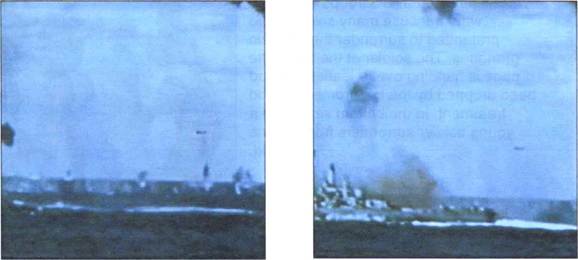
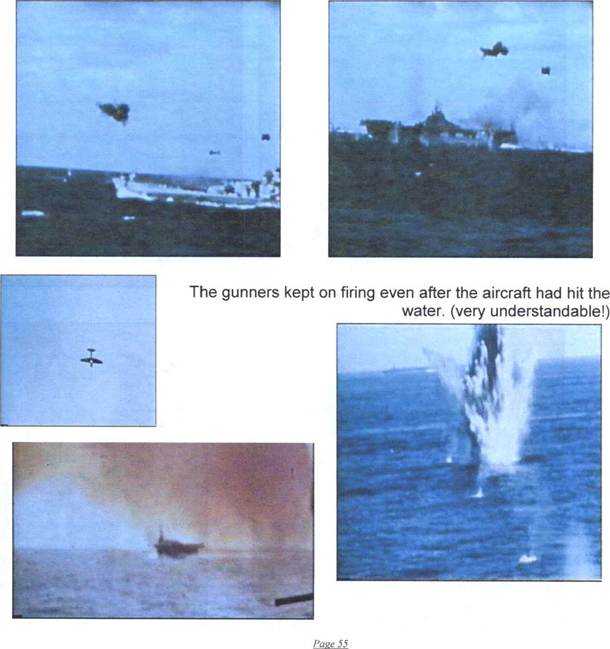
|
|

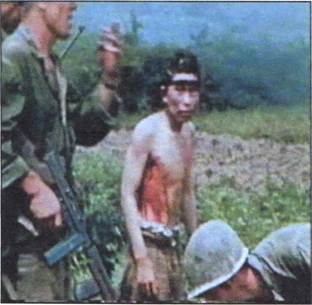
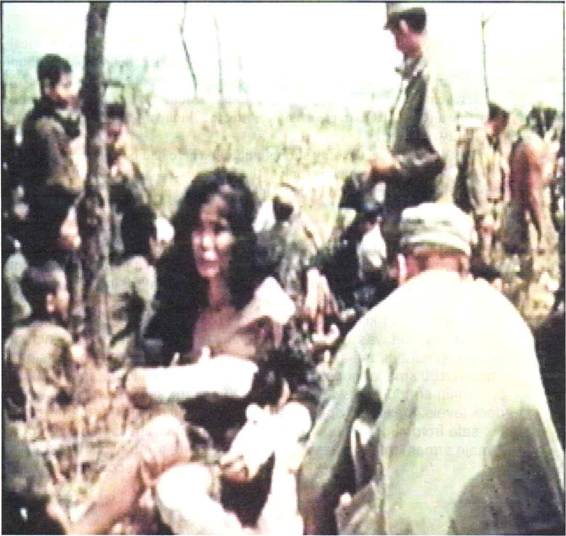
Civilian casualties are attended by US soldiers on Okinawa.
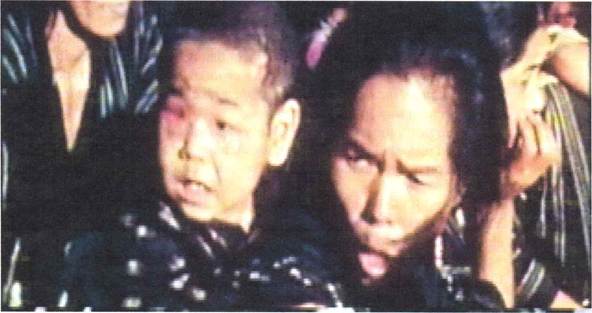
eggeéZ
6 April 1945: Yamato: the largest kamikaze mission
After the battle of Leyte Gulf the Japanese navy was no longer a practical fighting force. We have seen how it was necessary for the fleets at that battle to fill up with raw crude oil at Borneo and sail directly to the battle. Now not even that option was available. The few remaining ships were hidden in Japan 's home waters. There was only enough fuel to enable a few ships to make a single sortie to Okinawa — a one way trip, with no possibility of return.
The Yamato was the only strong unit left. There had been three ships of this basic design — Yamato, Mushashi (sunk at the Philippines — page 30), and Shinano which was converted to an aircraft carrier, but sunk by the US submarine Archerfish before seeing action.
The construction of the 68 200 ton Yamato began in March 1937 and it was completed on the 16th December 1941, when it immediately became the fleet flagship. Its main armament was nine 46cm (18 inch) guns, the biggest ever mounted on a ship. They projectiles weighed up to 1.4 tons, and the guns had a range of 41 kilometres. The turrets alone weighed 2265 tons. The secondary armament was 12 guns of 15.5 inches, with another 12 5-inch guns. Its initial equipment of anti-aircraft guns was increased for its final mission so that it had nearly 100 smaller guns. Yamato was 256 metres long, and highly armoured; the main armour belt was 18 inches, 46cm, thick. The total structure had nineteen deck levels. Maximum speed was 27 knots, (50km/hr). In an effort to keep the ship safe from aircraft, huge exploding anti-aircraft shells had been designed for the main armament, but these were, in the event, to no avail. It carried seven aircraft for the purposes of scouting and reconnaissance.
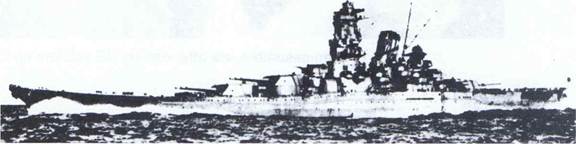
Admiral Ito at first refused to lead the mission, but was persuaded by his superiors. They recognised the truth of his ludgement that no success was possible, but was told: In short, we want you to die. Sooner or later, it will come to a special attack by the whole nation, the hundred million of them. We want you to die admirably as a model for the special attack by the whole nation.
In a logical process that is peculiarly Japanese, this argument persuaded Ito to obey his orders and make the suicide run. Japan's land-based air forces were to co-operate at Okinawa on 6 April in the first all-out suicide assault of the campaign. — Kikusui Operation no 1.
Admiral Ito led out his fleet on 6 April.84 It consisted of Yamato, the light cruiser Yahagi, and eight destroyers. They stopped at Tokuyama, where they were fuelled using almost every drop of fuel oil available in Japan, and even this was only enough for a oneway trip to Okinawa. The plan was for the fleet to run aground near the landing area and fire until the last shell had been expended or the last ship destroyed. It was planned to arrive just before dawn on 8 April, but on 7 April at 11 30 am they were spotted by a US flying boat.
Half an hour later masses of US planes arrived overhead. In all, over 300 aircraft attacked, and the fleet's only defence was anti-aircraft fire. Not even the specially designed anti-aircraft shells from the 18-inch guns of Yamato were effective, as the bombers were of ten protected by scattered clouds.
By 3 pm the large ships and two destroyers had sunk, and two other destroyers crippled. Four damaged destroyers returned to Sasebo, but over 2500 men had been lost in the largest of all suicide missions.
Kamikaze aircraft attacks were vigorously launched to coincide with the attempted attack of the Yamato and five destroyers were sunk and others damaged. 12 April 1945 Oka attack at Okinawa.
27 April 1945: Heavy kamikaze attacks at Okinawa
The Yamato suicide raid was the first of the attacks known as the Kikusui series, which lasted until June 22 (Kikusui 10). 21 ships were sunk and 60 were damaged, most very seriously. This is an extract from a description of an incident in Kikusui 2:
Seaman First Class James Fahey, 85 on USS Montpelier:
The deck near my [gun] mount was covered with blood, guts, brains, tongues, scalps, hearts, arms etc. from the Jap pilots, They had to put the hose on to wash the blood off the deck The deck ran red with blood. The Japs were spattered all over the place. One of the fellows had a Jap scalp, it looked like you skinned an animal. The hair was black, but very short and the colour of the skin was yellow, real Japanese. I do not think he was very old. I picked up a tin pie plate with a tongue on it. The pilot's tooth mark was into it very deep. It was very big and long, it looked like part of his tonsils were attached to it. This was the first time I ever saw a person 's brains, what a mess.
The defences were so strong that most kamikazes could not get past the radar picket ships of destroyer size, that encircled Okinawa about twenty miles offshore. Hence they became the most frequently struck victims. One enterprising seaman, after days of attack, put a sign out on his ship: THAT WAY TO THE CARRIERS.
The second Oka attack
Nakajima describes the Oka attack that was part of Kikusui 2. It was led by one Lieutenant Dohi, who had occupied his time in trying to improve the living conditions of his airmen. This leadership was a very doubtful privilege, bearing in mind the failure of 20 March. On 12 April 8 Okas joined 80 other kamikaze aircraft and 100 escorts for an attack on the Okinawa invaders. Only one mother plane returned to its base, and that was the one which had carried Dohi's Oka. The crew described how Dohi had had a nap while the plane flew to its target, and was awakened thirty minutes from the attack time. He shook hands with the plane commander and entered his Oka.86 The bomber plane returned, and of course reported positively on the outcome of Doha's mission.
April 1945: Kamikaze pilots at Kanoya help with the harvest
At Kanoya, the pilots were awaiting deployment. They enjoyed all the luxuries and privileges that could be accorded them, but found time hanging heavily on their hands. 87 About thirty of them joined in the work in the fields, harvesting the grain, which at that time was being done by young children and elderly men and women.
The local population showered the pilots with gifts. At a time of great food shortage, the pilots received 'thousands of fresh eggs, hundreds of chickens, three pigs and even a cow'.
Apr 13 1945: Death of President Roosevelt
On Friday, April 13 88, just after dawn, the US forces heard of the death of President Franklin Roosevelt who had had a stroke at his home. The troops were deeply affected; egge_ä2 many of the younger men had known no other president. The Japanese endeavoured to use this to their advantage:
A few
days later, leaflets boldly entitled The American Tragedy showered down
on the soldiers embroiled in the grinding struggle for Kazuku Ridge. 'The
dreadful loss that led your late leader to die will make orphans on this
island. The Japanese Special Assault Corps will sink your vessels to the last
destroyer. You will witness it in the near future.  The crude Japanese
propaganda heralded an all-out effort by Ushijima to make his threat a reality
when he launched a two-day counteroffensive against the American front which
collapsed in bloody failure and cost him 5000 casualties.
The crude Japanese
propaganda heralded an all-out effort by Ushijima to make his threat a reality
when he launched a two-day counteroffensive against the American front which
collapsed in bloody failure and cost him 5000 casualties.
May: the high point of kamikaze attacks
Fuel for aircraft was the main problem for the Japanese. At one operations conference 89 it was recorded that there was only enough fuel, made from pine roots and with an extremely low-octane rating, to keep each plane in the air for fifteen hours a month. Even this was a huge exaggeration. Therefore kamikaze missions took top priority. It was suggested that the entire fleet of aircraft, some 4000 planes, including the most elementary trainers 'Red Dragonflies' , should be used, but in the event the elementary trainers were not deployed — they were far too vulnerable. However intermediate trainers were used, especially the 'White Chrysanthemum,' a five-seater single-engine mid-wing monoplane used to train bomber crews. It had a top speed of 112 miles per hour and on suicide missions carried one 250kilogram bomb.
## The Japanese were not the only ones to prepare to use basic trainers as combat aircraft. In the desperate days of 1942 at Bankstown, Sydney, bomb racks were manufactured for Tiger Moths.
The all-out effort was indeed effective; the American losses were the heaviest they had been since Guadalcanal, and the US leaders had fears for the morale of their men. 90 But in the final analysis, the proportional damage done was negligible when compared to the total Allied strength.
May 1945: selection of pilots
Higher Flight Officer Motoji Ichikawa91 relates his experience with kamikaze recruitment. The loudspeakers in his barracks summoned all pilots on parade. The wing commander then told all men who had single parents or were the only children to withdraw. First sons were the next group sent away. Then he called the remaining men to break ranks and form a circle around him.
He explained the desperate war situation. 'We must therefore somehow mount an offense that will bring excruciating pain and damage to the enemy.. .. To achieve this, we have developed a new and very special instrument of certain death.. .. But in order for this kind of special attack to succeed, the weapon has been designed as a one-way trip. '
The wing commander then told the pilots they had to choose to take a one-way flight by writing 'Yes' or 'No' on their ID card and dropping them in a special box. Ichikawa was tempted to write 'No,' but he knew he could not. He knew he would be condemned as unmilitary, as unmanly, if he were to refuse. So he wrote the 'Yes' on his ID card.
Through a combination of circumstances, Flight Officer Ichikawa survived the war. He died in 1980 and his several volumes of notes were incorporated in the book Thunder Gods.
May 3: ordeal of USS Aaron Ward.
On May 3, during the fifth Kikusui92 the picket ship Aaron Ward underwent an incredible ordeal by kamikaze. At 1822 hours a Val attacked. It was picked up on radar and was sighted at a range of about 7000 yards. There was about a minute to shoot at the attacker before it hit, and the Val collected a five-inch shell only about 500 yards from the ship. It disintegrated and pieces fell all around the ship. The pilot's body was thrown over the deck. Other parts hit the ship, the motor hitting the exact gun (number 55) which had fired the fatal shot. The gun was brought back into action, but only on manual control.
The Val's propeller whirled across the water and cut its way into the after deckhouse, where it jammed the door of the after passageway. The clean-up crew there found the pilot's boot near the deck-house; his foot was still in it.
A second Val appeared immediately, but crashed about 1200 yards out. It distracted attention from a Zero which struck just above the waterline. The bomb exploded in after the engine room and the rudder was jammed. The ship began circling to port. Damages were severe and casualties horrific, with limbs and burnt corpses all around.
Two more kamikazes hit the ship in the next hour. Three nearby destroyers were sunk. Aaron Ward kept firing and claimed another ten kamikazes. They called for US fighter help, and some Corsairs came from Okinawa. Not surprisingly, the destroyer gunners were firing at anything, including the Corsairs.
One of the kamikaze was a twin engined Betty bomber, which crashed nearby. Eventually another Val hit the masts, showering the ship with debris. This broke steam lines to the ship's whistle and siren, which howled uncontrollably as rescue parties sought for living sailors among the carnage. There were many terrible burn cases.
Yet another Val came in, guns blazing, but was hit by number 42 gun at the last moment. Many pieces of blazing aircraft showered the ship, and the bomb burst alongside the ship. The engine room was flooded and the last usable engine stopped.
In the wardroom, the
doctor was operating on casualties with a shark knife, because the medical area
and all supplies were destroyed. He sent a message to the captain asking if the
ship was going to be abandoned. The answer came down from the bridge: 'Sir, the
captain says "Hell no!"'
Gun 43 of the immobile ship was then hit by a Zero. As the few remaining unhurt sailors rushed to assist, another aircraft hit the smokestack.
'The once trim Aaron Ward resembled a floating junkpile from the bridge aft, ' wrote Lieutenant Commander Arnold Lott. 'Stacks, guns, searchlight tower, boats, everything was smashed and battered beyond recognition. Fires raged on deck, in the officers ' and chiefs ' quarters, in both clipping rooms, and in the after engine room. The main deck was only inches above water, both firerooms flooded, after engine room flooded, after diesel engine room, machine shop, shaft alleys, crew 'swardroom, mess hall, sick bay, fantail and passageways.
And then came the
'crummy, dirty, lovely little LCS 83' to take off wounded. One was the gun
captain of the starboard 40-millimetre mount, his legs almost torn off. 'Tell
my mother my body wasn't mangled,' he whispered. He died aboard the LCS a
little later. Forty-five men were ultimately listed as dead (some were never
found); forty-nine were wounded, some fatally,  many horribly.
This small ship was hit by five kamikaze aircraft and still sailed back to the US unaided. Kamikaze were surprisingly inefficient!
May 4: a typical 'bad day'
The fourth of May, Easter Saturday, was even worse than the previous day for the radar pickets 93offOkinawa. Both army and navy kamikazes attacked from Kanoya and from Formosa with a wide variety of aircraft types.
The Kate could carry a crew of up to five as a crew trainer. ##
Again, Corsairs from Okinawa fought desperately to try to keep the kamikazes from reaching the radar pickets, but again if they ventured too near the destroyers had a grave risk of being hit by anti-aircraft fire. The destroyers were in pairs, for mutual support.
The destroyer Morrison was attacked by a series of aircraft as described in her action report. It describes milling fighter protection aircraft, which made it hard to distinguish friend from foe. Some old seaplanes came through the fighter screen and one crashed on Morrison and a ball offire engulfed the ship.
Yet another twin-float biplane broke through, and landed in the destroyer's wake. The pilot taxied up the wake, took off, and flew into a 5-inch gun. The resulting explosion caused an explosion which sank the ship, trapping most of the crew inside.
The destroyer Ingraham, patrolling with Morrison, had similar experiences, but stayed afloat. They believed that the leader of each formation of suicide planes was an experienced flyer, leading young and inexperienced flyers. Five Zeros were able to break through the fighter escorts and all crashed at various distances from Ingraham, which was showered with debris on three occasions.
After the Zeros came more lumbering sea-planes, coming in low on the water, in attempts to finish the ship. The combat air patrol shot down five. Another settled on the water, as though exhausted, and was also dived on by the Hellcats, but the slow speed and low altitude of these planes made it difficult for the fighters to make runs on them.
At this stage Ingraham found the crew of a downed American PBM flying boat, still sitting patiently on the wing of their plane. They had witnessed the entire battle. One of the rescue LCSs had offered to pick them up, but the crew declined the invitation. They were watching the attacks on the destroyers, and they felt safer where they were.
Another victim on this day was the cruiser Birmingham, to which Admiral Deyo had recently moved after his previous flagship Tennessee had been hit. Birmingham itself had recently returned from repairs when it had been damaged while rescuing sailors from the Princeton, in October 1944. It was hit by an Oscar which destroyed the medical centre and staff, and 51 sailors were killed.
The next attackers were Oka piloted bombs. One was dropped from its mother plane, a Betty, and within ten seconds crashed only 25 yards from USS Henry A Wiley. The second Oka came in at about 150 feet off the water, travelling at a terrific speed. Hit several times by small guns, it was finally destroyed by a direct hit from a five inch shell. It disintegrated and pieces showered the Wiley.
A third Oka dived on the minesweeper Gayety, which had been shortly before attacked by Vals. Similarly it was hit and disintegrated. The nose section of the Oka sprang off like the cowling of an engine cut in two, and the rest bounced over the sea about 25 yards off the Gayety's port quarter. Pieces of the bomb and scraps of the pilot were strewn over the bulkhead and the sides of the boat deck, injuring three men and knocking out the 40-millimetre gun on the starboard side. There was no explosion. Hit by Hellcat fighters, the mother Betty of this Oka also attempted to crash on Gayety.
By this time there was a great deal of smoke haze, and an aircraft, possibly an Oka, hit the destroyer Shea, on radar picket station No. 14, 70 milesoff the beaches, without being observed. 27 men were killed and 91 wounded and the Shea had to be withdrawn from the battle.
Meanwhile the British fleet of aircraft carriers was south of Miyako Rettu, a small island south-west of Okinawa. A combat air patrol of Seafires and Corsairs was orbiting at 20 000 feet when a Zero swept in at low level over the fleet, strafing Indomitable, the flagship, killing one man and wounding several others. It flew$$
arrow. Most of the radio and radar equipment was destroyed, but, thanks to its armoured deck, Inflexible made repairs and even landed its aircraft within a few hours.
Okinawa — the statistics
Mopping up operations lasted throughout July but on July 2 Admiral Nimitz formally declared the end of Operation Iceberg, the invasion of Okinawa. Over 107 539 Japanese soldiers had died in battle and 27 769 were entombed in caves. Only 10 755 prisoners were taken and an estimated 75 000 Okinawan civilians had become casualties. The land battle had cost the Americans over 7374 dead and 3 1 807 wounded. At sea, the Japanese had lost 16 warships and over 800 planes, many of them Kamikazes. The 34 ships sunk by the Japanese suicide pilots - the 763 carrier planes lost, and the 49()7 American sailors killed were the heaviest casualties inflicted by the Imperial Navy on the US Navy in any battle of the entire war. Admiral Spruance urged that the Kyushu and Formosa airfields should be obliterated as a top priority.
Army Air Force General Curtis LeMay protested to General Arnold about the delay in letting his planes resume the firebombing of Japanese cities. Admiral King, in his bluntest manner, 95 let it be known that 'if the Army Air Force was unwilling to continue supporting the Navy off Okinawa, he would withdraw his ships from the support of the Army fighting ashore. '
The number of captured Japanese soldiers was very small when compared to numbers taken by the Japanese in such events as the fall of Singapore, 1942. Nevertheless it was notable that there were soldiers who surrendered in response to the pamphlets dropped by the Americans. This was virtually unprecedented. The only prisoners taken on
Guadalcanal, for example, were some construction troops, largely from Korea.
Many soldiers and civilians did commit suicide rather than face capture. A cave on the island is known as The Virgins' Cave, in which 125 young girl students were killed by flame throwers and bombs. Strenuous efforts had been made to get the occupants to surrender, but there had been no response. The US soldiers were of ten very distressed about these occurrences, and when the civilians did surrender, the US troops noted that were very supportive. They were also impressed with the way in which the Japanese cared for each other. The national Japanese radio proclaimed the efficacy of suicide methods and held up the Okinawan resistance as an example for the whole country to follow during the coming invasion of Japan.
The role of the kamikaze at Okinawa
In a rare example of fairness to both army and navy, Divine Wind gives a full summary of the results of Kamikaze during the Kikusui series of operations, of which there were ten during the period 6 April to 22 June, 1945. They list 806 sorties by naval aircraft and 605 sorties by army aircraft, with a peak of 335 sorties in the first two days (Kikusui 1) declining to 45 sorties in the last two days (Kikusui 10). Once again, different sources give different figures, but from 1 1 to 16 ships were sunk and from 102 to 185 were damaged by kamikazes. Fuller details are in the endnote.96
 ##A kamikaze
dives on USS Vicksburg
##A kamikaze
dives on USS Vicksburg
Divine Wind is an excellent primary source, and has been widely quoted in this book. The Japanese results claimed in Divine Wind were checked against information obtained from US records by co-author Roger Pineau.
The Warners spent years in Japan researching their book Kamikaze.
But the figures presented by each source are quite different. Taking May 4 as an example.97
Divine Wind details 70 sorties, including 7 Okas. An Oka damaged the minesweeper Gayety, and the others hit the aircraft carrier Sangamon and five smaller ships.
Kamikaze lists 93 navy sorties and 37 army sorties. Two destroyers and two landing ships were sunk, Sangamon was hit so badly that she was withdrawn from the battle, and ten smaller ships were damaged, some seriously. Also the British aircraft carrier Formidable was hit. The Okas were credited with a hit on Gayety and on the destroyer minelayer Henry A Wiley.
The only reasonable conclusion that can be drawn from these data is that the records are incomplete, contradictory and sketchy; nevertheless it is undeniable that the fighting was indeed on a major scale, and fought with bitter determination on both sides.
Divine Wind claims that only 1228 naval kamikazes were sent out during the entire war, and if we accept the commonly quoted figure of 4065 pilots killed, this means that the naval kamikazes were outnumbered by the army by more than two to one.
8 May: another attack on the British.
Once again the fleet was attacked at low level by a group of Zeros.
One of them hit the flight deck of Victorious and bounced off into the water, where its bomb exploded. Two more dived at Formidable and one was hit by antiaircraft fire and disintegrated. The second hit Formidable on the flight deck in exactly the same place as a previous hit and this time the damage was so bad that the aircraft carrier took no further part in the war. The only man killed was a gunner who remained with his hands on the controls. Every bit of clothing had been burned off his body. It was obvious from his position that he had died instantly. When they were clearing up the decks towards the bow, a working party found what was left of the dead pilot and threw it overboard in a shovel.
The report that Captain Ruck-Keen of formidable made to Admiral Vian is memorable: 'We shot down one bastard. Got another with the flight deck.'
May 1945 : US censorship
A US officer
noted, 'As we were returning to the States in May 1945, 98 we were
ordered not to mention the word 'Kamikaze' or to mention damage caused by these
suicide tactics. The Navy did not want US citizens to know the extent of
damage, nor did the Navy want the Japanese to know how effective these tactics
were. We have similar challenges today.'
9 May 1945: Ensign Ikariyama
Divine Wind describes the reaction of the kamikaze candidates. It describes with approval the attitude of Ensign Tatsuya Ikariyama, a reserve officer, who arrived at Shikoku to participate in a kamikaze mission to Okinawa. He met old friends, but when they pressed him to have a drink and eat some luxury foods that they had saved for such an occasion, Ikariyama refused. He would take no action which might interfere with his mission the following day. He left at 10 pm and flew to his death the next day. But Imamura is by now admitting that this type of devotion was not universal:
Such devotion to duty, however, was not always the rule at this critical stage of the war. The special attackers were neither saints nor devils. They were human beings, with all the emotions and feelings, faults and virtues, strengths and weaknesses of other human beings.
So they sang songs, laughed, cried, and got drunk; did good things and bad. In this respect kamikaze pilots based in the homeland were sometimes unfortunate. In an excess of veneration some people came to look upon them as gods and were disappointed when they did not act accordingly. It was even more regrettable when a few of these pilots, unduly influenced by a grateful and worshipping public, came to think of themselves actually as living gods and grew unbearably haughty.
Then, as so of ten happens, the reputation created by a few came to be attributed to the many. I feel that any criticism against the special attackers in general was undeserved because, neither better nor worse than other men, they were after all just ordinary men.
On 23 May 1945 Tokyo was again raided; the 750 000 incendiary bombs dropped over a period of 24 hours destroyed half the city.
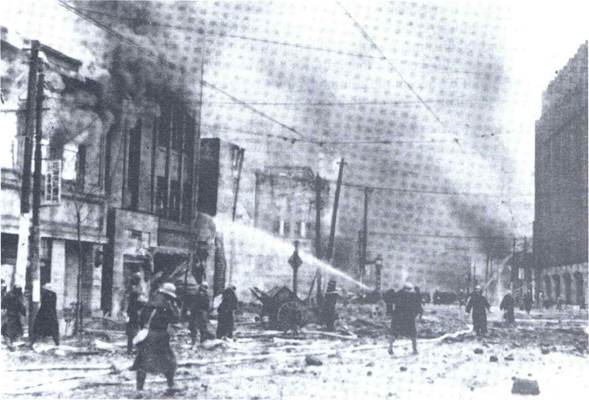
6-16 June: end of fighting on Okinawa
On 13 June Admiral Ota's naval troops on Okinawa made a final charge 100 against the forces which had landed in the vicinity of Oroku. Nothing more is known of Ota and his men. The last message received from him had been sent on 6 June:
More than two months have passed since we engaged the invaders. In complete unity and harmony with the Army, we have made every effort to crush the enemy. Despite our efforts the battle is going against us. My own troops are at a disadvantage since all available heavy guns and four crack battalions of naval landing forces were allocated to Army command. Also, enemy equipment is greatly superior to our own.
I tender herewith my deepest apology to the Emperor for my failure to better defend the Empire, the grave task with which I was entrusted.
The troops under my command have fought gallantly, in the finest tradition of the
Japanese Navy. Fierce bombing and bombardments may deform the mountains of Okinawa but cannot alter the loyal spirit of our men. We hope and prayfor the perpetuation of the Empire and gladly give our livesfor that goal.
The message concluded with thanks to the Navy Minister and other superior officers, a request for the families of his men to be looked after, three cheers for the Emperor and a short poem:
Though my body decay in remote Okinawa,
My spirit will persist in defence of the homeland.
The loyal determination of an isolated air unit, the 931st, was likewise voiced in the final message sent by its commanding officer on 10 June:
My men are in high spirits and fighting gallantly We pray for the final victory of the motherland. We will fight to the last man in defence Q/this outpost.
My contact ends with this message.
Captain Jiro Haneda, 931st Air Group Detachment.
Around 16 June the enemy succeeded 101 in penetrating the main defence positions of the Army in the south. General Ushijima rallied all his forces for a last offensive, and finally broke off communications. His last message explained that the 'arrogant enemy' forces against them were about to prevail, despite his soldiers' magnificent efforts. To my great regret we are no longer able to continue the fight. For this failure I tender deepest apologies to the Emperor and the people of the homeland. We will make one final charge 10 kill as I many of the enemy as possible. I pray for the souls of men killed in battle and for the prosperity of the Imperial Family.
Death will not quell the desire of my spirit to defend the homeland.
With deepest appreciation of the kindness and co-operation of my superiors and my colleagues in arms, I bidfarewell to all of you forever.
Mitsuru Ushijima
He also concluded with a poetic postscript:
Green grass dies in the islands without waitingforfall,
But it will be reborn verdant in the springtime of the homeland.
Weapons exhausted, our blood will bathe the earth, but the spirit will I survive; Our spirits will return to protect the motherland.
Ushijima committed seppuku and his aides decapitated the body.
10. Letters from Kamikaze pilots
Last Letters Home: the pioneers102
Namaguchi makes the point that the Bushido code stressed the willingness of the soldier to die at any moment for his cause. Death in war would lead to a hereafter in which the victim would join his ancestors and be honoured as a god. Partly to encourage other volunteers, the last letters of many kamikaze pilots were widely published.
The following was written by Ensign Susumu Kaijitsu of the Genzan (Wonsan) Air Group in Korea. Kaijitsu was born in 1923 at mura City, Nagasaki Prefecture of northern ....4 Kyushu. He had graduated from Nagoya Technical College just before entering the naval aviation school.
Dear Father, Mother, brothers Hiroshi and Takeshi, and sister Eiko:
I trust that this spring finds you all in fine health. I have neverfelt better and am now standing by, ready for action.
The other day I flew over our home and bade a last farewell to our neighbours and to you. Thanks to Mr Yamakawa I had a chance recently to have a last drink with father, and there now remains nothing but to await our call to duty.
My daily activities are quite ordinary. My greatest concern is not about death, but rather of how I can be sure of sinking an enemy carrier. Ensigns Miyazaki, Tanaka, and Kimura, who will sortie as my wingmen, are calm and composed. Their behaviour gives no indication that they are momentarily awaiting orders for their final crash-dive sortie.
We spend our time in writing letters, playing cards, and reading.
I am confident that my comrades will lead our divine Japan to victory.
Dear Parents:
Please congratulate me. I have been given a splendid opportunity to die. This is my last day. The destiny of our homeland hinges on the decisive battle in the seas to the south where I shall fall like a blossom from a radiant cherry tree.
I shall be a shield for His Majesty and die cleanly along with my squadron leader and other friends. I wish that I could be born seven times, each time to smite the enemy. How I appreciate this chance to die like a man! I am grateful from the depths of my heart to the parents.....and I am grateful as well to my squadron leader and superior officers who have looked after me as ifI were their own son... ....
Thank you, my parents... ...I shall return in spirit and look forward to your visit at the Yasukuni Shrine... ... We are sixteen warriors manning the bombers. May our death be as sudden and clean as the shattering of crystal.
Written at Manila on the eve of our sortie.
Isao.
Ensign Ichizo Hayashi, born in 1922 was a Christian. The 'last letter' is similar to the others in tone, and this paragraph is interesting:
We live in the spirit of Jesus Christ, and we die in that spirit. This thought stays with me. It is gratifying to live in this world, but living has a spirit offutility about it now. It is time to die. I do not seek reasons for dying. My only search isfor an enemy target against which to dive.
There is nothing more for me to say by way offarewell. I will precede you now, mother, in the approach to Heaven. Please prayfor my admittance. I should regret being barred from the Heaven to which you will surely be admitted. Prayfor me, mother.
Farewell. Ichizo.
Towards the end of the program...
Japan had endeavoured to keep her university students and graduates from the war, but towards the end everyone was conscripted. Some of these were not as fanatical as the professional soldiers, but in general they accepted the discipline, and the role of the kamikaze pilot.
Case study: Corporal Yukio Araki
Corporal Araki, entered the Youth Pilot Training School in October 1943, and his diaries have been preserved covering the time before he was sent to Okinawa. These would have been checked by his superiors, so he would need to 'toe the party line'. The first entries lists work done each day, and physical training undertaken. He recorded the 'warnings' he had received, for example:
There
is an attitude problem when listening to the officers. Some students seem to
smile or laugh during training, and others are being lazy..
In general there seems to be a lack of spirit. Straighten yourself. It reveals your spirit.
Usually, a hard slap in the face accompanied these warnings. The way the 15-year- old boy responded to the warning was: 'I must try harder. '
One of the listed subjects in the diary was a course called 'Spiritual Moral Lecture.' This taught the Japanese heritage, aiming at making the pilots feel 'happy and proud' to be involved in the Kamikaze attacks. He wrote a poem in January 1944 saying that a Japanese man should be praised when he dies as he should for the Emperor.
His training continued, though reduced from three years to two years. He wrote to his family, who noted a big change in his attitudes. He urged his younger brothers to follow in his footsteps, joining the military and being prepared to die for the Emperor. He urged his patents to remember him with pride: they would meet again at the Yasukuni Shrine.
In late March 1945 he returned from Pyongyang, Korea, where he had been training, and there were no diary entries or letters home for two months. He said he was too busy; probably he was in such a state of either indifference or fear that he could not be bothered. In his last diary entry on May 20, 1945, he wrote:.
 at **
o 'clock I received the thankful command to depart tomorrow. I am deeply
emotional, and just hope to sink one (American battleship). Already, hundreds
of visitors had visited us. Cheerfully singing the last season of farewell.
at **
o 'clock I received the thankful command to depart tomorrow. I am deeply
emotional, and just hope to sink one (American battleship). Already, hundreds
of visitors had visited us. Cheerfully singing the last season of farewell.
and the entry is cutoff there. He actually flew his mission on 27 May 1945.
After Okinawa
After the time of Okinawa, there was a definite decline in both pilot standard and idealism, exacerbated by shortages of fuel and serviceable aircraft.
Yukiteru Sugiyama, a pilot at the Kanoya kamikaze base, 103 described the obsolete aircraft as being like hand-made paper planes. He survived, he says, only because the war finished before he was called on to die. 'I can remember the pale, drawn faces of the crew members,' he recalls. 'They were youths, their bodies over-flowing with life. And they were waiting their turn to die. It was no longer possible to refuse to go. It was impossible to escape'.
A few men showed their feelings in last letters home. 'We are all going to die,' wrote
Norimasa Hayashi, a 25-year-old university graduate, in April. 'I will never fight for the Navy; I will fight for my country or for my personal honour, but never for the Navy, which
I hate! ... it is dominated exclusively by a clique of officers from the Naval Academy at Eta Jima.' Another said: 'The Japanese Navy - what a beast!' Most kamikaze pilots, however, were convinced that there was no other way. Their letters, usually addressed to Okaasan (mother), now merely said, 'Goodbye.' It was cowardly to find excuses, and, anyway, no one was going to survive the war. Poor health, bad eyesight, or commitments to family, were all overlooked by men caught up in the war machine.
Captain Rikihei Inoguchi lamented the falling standards. 'These youths were so reluctant to volunteer that the base commander had to call the unwilling candidates and talk them into the mission of self-sacrifice. ' This was a monumental under-statement.
Shinto and Kamikaze
Fundamentally, Shinto religion regards society as a living organism, in which all members have a part to play. The nature of human being is that they are inherently good. One 'owes his life, which is sacred, to the kami and to his ancestors'. One 'is dependent for his continued existence on both nature and society', as everyone has a social role and duty. Thus, one 'also owes much to his present family, his community, and the nation'. A man's life is 'full of blessings and so he must accept his obligations to society and contribute to the vital development of all things entrusted to him'.
The person who died would live on in the form of a spirit within the society and within a shrine that would continue to influence the daily life of the Japanese people. For this reason there was also a high emphasis on ancestor worship. The kamikaze suicide would become an ancestor as he finishes the mission of his life and joins with his precedents.
The Yasukuni Shrine
The Yasukuni Shrine is a sanctuary founded in Tokyo in 1869 by the Emperor Meiji for the repose of the souls of Japanese soldiers killed in battle. There are over 2 400 000 names inscribed on the tablets in the temple. It is a shrine dedicated to the spirits of the heroic dead who have given their lives for the country.
Apart from the Grand Shrines of Ise, where Amaterasu-Omikami, the Sun Goddess, founder of the nation, is enshrined, Yasukuni, the Patriots' Shrine, or Shrine of the Righteous Souls, was the most sacred to many people in Japan. The enshrined dead were worshipped as the guardian deities of the country, especially of the military affairs. The wars Japan take part in as a nation are all holy wars, because they are all conducted in the name of the Emperor, the living god, to preserve and progress toward the universal harmony and peace. Thus, death in these battles was a privilege, and the dead would join the ranks at the Yasukuni Shrine.
While researching this book I sought a picture of the Yasukuni shrine, but it is not featured in Japanese or other material. I thought that it may be that the Japanese do not want it advertised to foreigners. However on 13 July 2004 the Sydney Morning Herald had this photo of traditionally dressed Japanese girls publicising a new mobile phone — at the Yasukuni Shrine! There actually is a museum of the kamikaze strategy at the museum.104 ##
11. Notes from a suicide manua1
The handbook made its initial appearance in November 1944.
The mission of to-go units Transcend life and death. When you eliminate all thoughts about life and death, you will be able to totally disregard your earthly life.
This will also enable you to concentrate your attention on eradicating the enemy with unwavering determination, meanwhile reinforcing your excellence in flight skills.
Exert the best in yourself
Strike an enemy vessel that is either moored or at sea. Sink the enemy and thus pave the road for our people's victory.
Take a walk around the airfield
When you take this walk, be aware of your surroundings. This airstrip is the key to the success or failure of your mission.
Devote all your attention to it. Look at the terrain.
What are the characteristics of the ground? What are the length and width of the airstrip? In case you will take off at dusk, or early morning, or after sundown, what are the obstacles to be remembered: an electric pole, a tree, a house, a hill?.
How to pilot a fully dressed-up [heavily equipped] aircraft that you dearly love Before taking off. (After taxiing the plane from the camouflaged emplacement to the airstrip.)
You can envision your target firmly in your mind as you bring your plane to a standstill.
Breathe deeply three times. Say in your mind: 'Yah' (field), 'Kyu' (ball), 'Joh' (all right) as you breathe deeply.
Proceed straight ahead on the airstrip. Otherwise you may damage the landing gears.
Circle above the airstrip right after take-off. Do so at the minimum height of 200m. Circle at an angle within five degrees and keep your nose pointed downwards.
Principles you should know
Keep your health in the very best condition. If you are not in top physical condition, you will not be able to achieve an ideal hit by tai-atari (body-crashing).
Just as you cannot fight well on an empty stomach, you cannot deftly manipulate the control stick if you are suffering from diarrhoea, and cannot exert calm judgment if you are tormented by fever.
Be always pure-hearted and cheerful
A loyal fighting man is a pure-hearted and filial son.
Attain a high level of spiritual training
In order that you can exert the highest possible capability, you must prepare well your inner self.
Some people say that spirit must come first before skill, but they are wrong. Spirit and skill are one.
The two elements must be mastered together. Spirit supports skill and skill supports spirit.
Aborting your mission and returning to base
In the event of poor weather conditions when you cannot locate the target, or under other adverse circumstances, you may decide to return to base. Don't be discouraged. Do not waste your life lightly.
You should not be possessed by petty emotions. Think how you can best defend the motherland. Remember what the wing commander has told you. You should return to the base jovially and without remorse.
When turning back and landing at the base
Discard the bomb at the area designated by the commanding officer. Fly in circles over the airfield. Observe conditions of the airstrip carefully.
If you feel nervous, piss. Next, ascertain the direction of the wind and wind speed. Do you see any holes in the runway? Take three deep breaths.
The attack
Single-plane attack. Upon sighting a target, remove the (bomb's) safety pin. Go full speed ahead towards the target. Dive! Surprise the enemy. Don't let the enemy take time to counter your attack. Charge! Remember: the enemy may change course but be prepared for the enemy's evasive action. Be alert and avoid enemy fighters and flak fire.
Dive attack
This varies depending on the type of the aircraft. If you are approaching the enemy from a height of 6 000m, adjust your speed twice; or from a lower height of 4 000m, adjust speed once.
When you begin your dive, you must harmonise the height at which you commence the final attack with your speed. Beware of over-speeding and a too-steep angle of dive that will make the controls harder to respond to your touch.
But an angle of dive that is too small will result in reduced speed and not enough impact on crashing.
Where to crash (the enemy's fatal spots)
Where should you aim? When diving and crashing on to a ship, aim for a point between the bridge tower and the smoke stack(s). Entering the stack is also effective.
Avoid hitting the bridge tower or a gun turret. In the case of an aircraft carrier, aim at the elevators. Or if that is difficult, hit the flight deck at the ship's stern.
For a low-altitude horizontal attack, aim at the middle of the vessel, slightly higher than the waterline.
If that is difficult, in the case of an aircraft carrier, aim at the entrance to the aircraft hangar, or the bottom of the stack. For other vessels, aim close to the aft engine room.
Just before the crash
Your speed is at maximum. The plane tends to lift. But you can prevent this by pushing the elevator control forward sufficiently to allow for the increase in speed. Do your best. Push forward with all your might.
You have lived for 20 years or more. You must exert your full might for the last time in your life. Exert supernatural strength.
At the very moment of impact: do your best. Every deity and the spirits of your dead comrades are watching you intently.
Just before the collision it is essential that you do not shut your eyes for a moment so as not to miss the target.
Many have crashed into the targets with wide-open eyes.
They will tell you what fun they had.
You are now 30m from the target
You will sense that your speed has suddenly and abruptly increased. You feel that the speed has increased by a few thousand-fold.
It is like a long shot in a movie suddenly turning into a close-up, and the scene expands in your face.
The moment of the crash
You are two or three metres from the target. You can see clearly the muzzles of the enemy's guns.
You feel that you are suddenly floating in the air. At that moment, you see your mother's face. She is not smiling or crying. It is her usual face.
All the happy memories
You won't precisely remember them but they are like a dream or a fantasy. You are relaxed and a smile creases your face. The sweet atmosphere of your boyhood days returns.
You view all that you experienced in your 20-odd years of life in rapid succession. But these things are not very clear.
In any event, only delightful memories come back to you. You cannot see your own face at that moment.
But because of a succession of pleasant memories flashing through your mind, you feel that you smiled at the last moment.
You may nod then, or wonder what happened. You may even hear a final sound like the breaking of crystal. Then you are no more.
Points to remember when making your last dive
Crashing bodily into a target is not easy. It causes the enemy great damage. Therefore the enemy will exert every means to avoid a hit.
Suddenly, you may become confused. You are liable to make an error. But hold on to the unshakeable conviction to the last moment that you will sink the enemy ship.
Remember when diving into the enemy to shout at the top of your lungs: 'Hissatsu!' ('Sink without fail! ') At that moment, all the cherry blossoms at Yasukuni shrine in Tokyo will smile brightly at you.
##Commemorative plaque to Lieutenant Seki at Mabalacat, Philippines.
4
12. Kamikaze at sea
Kaiten and mini-submarines
The Japanese submarine service did not play as great a part in the Pacific war as might have been expected. Indeed, during 1943 a major use for the submarines was to keep contact with outposts such as Rabaul, which were cut off because of US naval and air blockades and the 'leapfrogging' strategy which the US employed. (Even the US had, in desperate times, sent submarines to take supplies to Corregidor and even to take aviation fuel to Guadalcanal).
There is evidence that the idea of using manned suicide torpedoes was originated by the submariners themselves. A petition written in blood (a traditional way of indicating the writer's sincerity) was submitted by Lieutenant Izawa, of submarine 1-165, early in 1943, suggesting the development of such a weapon. It would use the famous 'Long Lance' torpedo, by far the best such weapon in use at that time by any country.
After the disastrous defeat of the Marianas the idea was accepted, and the weapon was produced. The name Kaiten was chosen; a rough translation is 'epoch making' and the word also has implications of Heaven, the Emperor, and the concept of 'turning around'. On February 26, 1944, the building of a prototype was ordered. Early versions, at the insistence of the senior naval officers, had an escape hatch with a kind of ejector seat, which the pilot could use 150 yards from his target.
There were enormous design problems. The oxygen engine was dangerous and hard to control; it was impossible to go into reverse; of ten the steering locked and the torpedo circled uncontrollably; depth control was difficult; the monocular periscope gave poor vision and also caused injuries to the pilot if the torpedo was jolted in its run.
##The Kaiten, as finalised, was quite an elaborate craft, with an enclosed cabin and periscope for the pilot.
It was also difficult to find crew with the necessary skills. Eventually the aviation pilot schools were approached; 200 cadets volunteered, the sales pitch being that they would perform a vital service that would please the Emperor, but from which they need not expect to return alive. 106
In August of 1944, plans were made to bomb the Panama Canal, using four or the huge new 1-400 class submarines, each of which could carry two aircraft (see page 106). However the operation was called off and the big submarines were converted to carry Kaiten torpedoes.
Lieutenant Kokori took the lead in training and development. However, on the first full-scale trial, September 2, 1944, his Kaiten sunk to the sea floor and could not be retrieved before Kokori suffocated. Salvage parties found notes written by Kokori while he was dying
Pa

indicating his opinions on causes of the failure. Training continued — though with an improved rescue organisation!
On September 12 the Imperial Headquarters ordered an attack on the Admiralty Islands, Majuro and the Caroline Islands. Delayed by the Philippines fighting, three submarines set out on November 7, with full ceremonial. Admiral Miwa presented the twelve pilots, including the co-inventor Ensign Nishima, with small samurai swords that were traditional gifts to heroes about to die.
The 1-37 was lost near Ulithi before launching its attack. The 1-47 launched its four
Kaitens off Ulithi on November 19. Nishima carried with him the ashes of Lieutenant Kokori. The captain of 1-47 witnessed three explosions through his periscope. The attack roused the US anti-submarine forces and 1-36 was only able to launch one of its Kaitens.
A report of the attack claimed that three aircraft carriers and a battleship had been sunk, and the project was proclaimed a huge success and given increased priority. Actually a Kaiten, which may have been Nishima's, had blown up a fuel tanker, with 400 000 gallons of fuel. Fifty sailors were killed, but no other damage was done. The next operation was by the Kongo Unit of six submarines. The plan was to strike at allied anchorages in the Admiralty Islands, Burauen, Hollandia, Ulithi, Palau and Guam on January 1 1, with a follow-up by one submarine on January 20.
1-56 at the Admiralty Islands was continually hunted by aircraft, was unable to launch its Kaitens, and had to return home with no achievements. 1-47 at Hollandia launched its Kaitens successfully and the captain observed a column of smoke, and claimed a major success. 1-53 at Kossol passage had two failures in launching, (one exploded as it was launched) but claimed that two explosions had been heard. 1-58 at Guam launched its 4 Kaitens successfully and observed an explosion. 1-36 at Ulithi launched its 4 Kaitens successfully and heard 4 explosions. 1-48 was lost without trace to the Japanese, being sunk by US destroyers.
The Japanese navy claimed that the mission had sunk fifteen large transports, a cruiser, a tanker and an escort carrier. The US records show that no ship was damaged by any such attack, but the Japanese Navy enthusiastically expanded the program for midget submarines.
A third major mission of six Kaiten-carrying submarines was launched against the fleet at Iwo Jima in late February. Two submarines were sunk, one was severely damaged in a deep evasive dive and the others were recalled. The navy took some time to give submarine captains training in evasion procedures, and the next Kaiten mission took place in April.
On April 28 and May 2 respectively, 1-36 and 1-47, survivors of the Iwo Jima raid, launched KaitensoffOkinawa, again claiming hits which were non-existent. Three more submarines launched submarines on May 17, but this was the final attack attempt. The remaining mini submarines were prepared in coves and inlets to be launched against the invasion of the homeland.
The Kaiten was simply a large torpedo with a human pilot. Considerably larger was the Kairu, a two man submarine similar to those which attacked Sydney Harbour. Another submarine with a five man crew, the Koryu, was also developed. These weapons were given high priority during 1945, production figures being:
|
|
A ril |
Ma |
June |
Jul |
Total |
|
Ko u |
27 |
12 |
20 |
44 |
103 |
|
Kai u |
100 |
|
70 |
125 |
337 |
|
Kaiten |
73 |
42 |
74 |
159 |
358 |
The Shinyu, or suicide boat
The Shinyu was a fast small boat which in its original state was designed to carry a depth charge alongside a target ship, then drop the charge and flee. After its unsuccessful debut in Philippines operations it was decided to reduce the time fuse to five seconds.
When the Americans took
Geruma Island and other small islands just south of Okinawa they found over a
hundred Shinyu, most of them fully modified as suicide boats. They had not been
used; a captive told the troops that the engines would not start. A
booby-trapped Shinyu did, however, kill four US soldiers, including two officers.
The Shinyu were used on March 26, the first night of the preliminary landing at Kerama Rettu, another small island group just south of Okinawa. It was clearly demonstrated that even the new short-time fuse was ineffective, so the remaining Shinyu were completed as true suicide boats with fixed explosive charges in the bows. A major attack was made on the Okinawa invasion force on March 29-30 but all were drivenoffor sunk. Again, the remaining Shinyu were prepared to defend the mainland.
At the end of the war there were also detachments of Shinyu at Hong Kong and at Sandakan, North Borneo. More details of their fate are seen on page 152-3. Details of the results achieved by the Kaiten and the Shinyu are to be found on page 201.
One of three mini-submarines that attacked Sydney Harbour, 31 May 1942. This was not intended as a suicide mission but yet all participants were lost. 107
Nearly Kamikaze: marine operations from other countries
The idea of the manned torpedo was not Japanese. This short section mentions other similar operations that were almost suicidal, as points of comparison. The first manned torpedoes were made in Italy in 1935. They were used in action from August 1940, against British ships in Mediterranean ports. The battleships Queen Elizabeth and Valiant were severely damaged, and about five smaller vessels were sunk in attacks that were characterised by extreme bravery.
The Italian motorised torpedo, designed 1939 and copied by the British. (right) The simple control panel. The Japanese version had a periscope and an enclosed waterproof cabin for the pilot.
The idea was taken up by the British in 1942, and after the Italian capitulation, raids were made on Norwegian ports, the torpedoes being carried by boat to the launch point. These were unsuccessful, largely due to technical failure in rugged operating conditions
Ten men in five canoes were launched off the Gironde estuary in the Bay of Biscay by a submarine on 7 December 1942. They paddled some 75 miles(120 km ) upriver to Bordeaux and attacked German blockade runners, fast merchantmen used to sail to Japan. Only two canoes made it to the harbour on the night of 11/12 December and placed limpet mines on four ships. One of the ships was sunk and the others badly damaged. All of the men on the operation were drowned or captured and executed, except for two men who escaped to Spain after the attack and from there went to the UK in April 1943.
Royal Navy mini-submarines had a crew of 4. A diver would leave the submarine for such purposes as cutting anti-submarine nets and placing explosive charges.
Britain then moved into the construction of mini-submarines. Six X-Craft, as they were called, attacked the German battleship Tirpitz on 22
September 1943, in Kalten Fiord, Norway. Two were lost in transit, one with its transit crew; one disappeared without trace, two made successful attacks but were unable to return, and one returned to its parent submarine having been unable to make its attack. Tirpitz was damaged and out of action for some months.
Sydney itself was raided on 31 May 1942 by three Japanese two-man submarines, launched from I-class submarines. Two were sunk in the harbour, and the third was found only recently. 108 The ferry Kuttabul was sunk; it was being used as a depot ship and 19 sailors aboard were killed.
From Australia, two raids were made on Singapore. In the first raid, Operation Jaywick, 6 men in canoes were taken to the area in the ramshackle small boat Krait. Late in September 1943 they placed explosive charges which destroyed 40 000 tons of merchant shipping and then escaped safely. In October 1944, in Operation Rimau, an attempt was made to repeat the success with a team of 30 men who used semi-submersible electrically driven canoes, but the 30 attackers were either killed in action or executed by the Japanese. Records exist of their trial, conducted by Naval officers. There is a theory that there was no trial, but that the participants in the raid were executed without trial.
April 11, Okinawa: a Zero kamikaze is pictured a fraction of a second before it hit the USS Missouri. The photographer was Harold S Baker, a cook on the ship.##
13. The air attacks on Japan
An overview:
18 April, 1942: Doolittle attack on Tokyo: 18 B-24s flew from USS Hornet##
(left) to bomb Japan, then flew on to China. Though little damage was done in Japan, the raid caused the Japanese to decide to take Midway Island as a defence measure. Antiaircraft guns were installed in Japan and plans made for fighter aircraft defences. • Mid-1943: news of B-29 Superfortress reached Japan via the press of neutral nations.
June 15, 1944: first Superfortress raid on Kyushu from China — about 50 aircraft completed a successful attack. On the same day Saipan was invaded by the US.
July 8, August 11 and August 20, 1944: B-29 Raids from China, defences ineffective.
August 15 1944: Appointment of Captain Okumiya as Naval Air Staff Officer for Homeland Defence. Okumiya, had 192 aircraft for home defence, mainly Zeros with a few Raidens and Tonys. 36 were night-fighter 'Irvings'.
August 16 1944: First B-29s from Saipan made reconnaissance over Bonin.
August 20 1944: B-29 raid from China; Irvings with 20mm cannon mounted behind the pilot, pointing obliquely up, shot down one and damaged 2.
October 30, 1944: B-29s from Saipan raided Truk.
November 1, 1944: B-29s made a reconnaissance flight over Tokyo.
November 14 1944: Raid on Tokyo from Saipan by about 70 B-29s. Damage to aircraft engine factory.
November 21 1944: The first recorded kamikaze success over a B-29.
November 29 1944: Major raid on Tokyo hit civilian areas.
December 1944: wide-ranging attacks from China and Saipan; an additional 100 aircraft including Zeros, Jacks, Irvings, Georges and Franceses were posted to the Atsugi air base. There were some successes by defences, including 3 B-29s destroyed by Army Kamikazes.
General Yoshita, acting commander of the Tenth Air Division, responsible for defending Tokyo and the Kanto plain, decided to lighten the fighter planes so that they could reach high altitude and make attacks from above. Armour plate, and even guns had to be removed, and ramming attacks were ordered. Special attention was given to the occasional single aircraft or small formations which flew over Japan. Groups of seventy or so B-29s attacked, and were met by kamikaze attacks and normal aircraft. At the end of the year, Yoshita claimed that they had shot down 28 B-29s, with 62 damaged. Of these, 16 confirmed kills had been made by kamikaze attacks.
January 27 1944: Japanese claimed 22 of 75 attackers on Tokyo shot down. This was an exaggeration (7 lost from all causes), but losses were a cause of poor morale among B-29 crews. Some were due to enemy action but mechanical problems and weather were probably more significant.
March 4 1944: The first B-29 made an emergency landing on Iwo Jima.
April 7 1944: For the first time B-29 raids were escorted by Mustang fighters based on Iwo Jima.
March 9-10: The first fire raids were made on Tokyo.
23 May: The largest fire raid to date: 750 000 incendiary bombs were dropped on various Japanese cities and a similar number 24 hours later on Tokyo. Five hundred B-29s flew each mission. In Tokyo up to half the residential area was destroyed.
10 July: Carrier-borne aircraft begin major raids throughout Japan, with over 1000 aircraft ranging daily over the home islands, destroying transport and other infrastructure. B-29 raids also now typically consisted of up to 1000 aircraft. These raids continued for the remainder of the war but tend to be overshadowed by the use of the atomic bombs:
6 August: The atomic bomb on Hiroshima.
8 August: The atomic bomb on Nagasaki.
The atomic bombs were the equivalent of 40 000 tons of explosive. A very conservative estimate of the other explosive dropped on mainland Japan is 100 000 tons, and, being dispersed, this would have caused far more overall damage than the atomic bombs.

The mighty B-29
Japan regarded the B-24 Liberator and the B-17 Flying Fortress as formidable opponents.
They were tougher, faster and heavier than any Japanese bomber aircraft in service. Late in 1943, the neutral press started carrying articles about a new and even more powerful US bomber, the B-29. The Japanese started to prepare a home defence, equipping their fighters with larger guns and high altitude equipment. In mid-1944, the first B-29s went into action, at first from Chinese bases. To their dismay, the Japanese found that they flew at at least thirty thousand feet, well above the range of anti-aircraft guns. The defending Japanese fighters flew sluggishly at this altitude, and had little margin of speed over the bombers.
##China-based B-29
There were a few new-generation fighters available, notably the mighty Raiden (US but they could only be successfully flown by Japan's rapidly dwindling band of expert fliers. The Ki-45 Nick twin-seater fighter was another suitable attacker, with the second crew member removed and upward-slanting 20mm cannon installed, but again they were in short supply. These shortages of quality aircraft and of quality pilots led to the planning of tai-atari ramming projects. Aircraft such as the Oscar were stripped of large calibre guns and radios to enable them to reach the height and speed of the B-29. 109
The situation was worse when Saipan was developed as a B-29 base. Japanese attempts to raid the new bases on Saipan were ineffective. Sakai describes the forlorn attempts by the unescorted bombers from Iwo Jima in June and July. 110 After the B-29s were established at Tainan and Saipan, the US recorded 95 individual sorties against their bases, between 3 November 1944 and 2 February 1945 (the last raid). Of these, they claim to have shot down 35. By January, only about one Japanese plane a fortnight tried to reach Saipan, and almost inevitably was shot down, whatever the time of day or night. 1 1 1
Nevertheless, morale among the B-29 aircrew was not high. The aircraft were new, complex, not easy to fly and prone to mechanical failure because of their complexity. Weather was a big problem; the area is stormy, and the discovery of the high-altitude 'jet stream' strong winds played havoc with bomb aiming until the navigators learnt about their influence. The pilots also felt gravely threatened by the fanatical tai-atari suicide ramming attackers, and if they were damaged they faced a long flight over the sea to their home base. The fundamental reason why the US decided to take Iwo Jima was to provide a base for escort fighters and an emergency landing ground for the bombers.
##This picture of B-29s raining bombs on the Japanese cities was used in propaganda pamphlets dropped on some Japanese cities before major attacks were made.
In late 1944-early 1945, a very high priority was given to the defence of the mainland against the B-29s. New aircraft were used, and when flown by experienced pilots, had some success. Older aircraft, such as the Zero and the Oscar, were lightened and used for ramming attacks by less experienced pilots. Both tactics had some successes, but the overriding problem was lack of fuel and the general disintegration of the necessary infrastructure. There was also no effective radar system in Japan.
It is very difficult to assess the success of the defences as such. Up until March, considerable success was claimed by the Japanese, but certainly the figures were inflated. The B-29 of ten was able to survive even successful ramming attacks. The problem of assessment is exacerbated by the inherent unreliability of the B-29, which of ten crashed for purely mechanical reasons.
Psychological war
The damage being done by the B-29s and carrier-borne aircraft was obvious to all, and the US began dropping leaflets as well as bombs. The Warners describe an interesting precedent — legend had it that in fighting in the time of the shogunate, skies had filled with of uda, 'charm papers'. They had come, it was said, from Ko-Tai-lingu, the Grand Imperial Shrine of Ise, and were messages from the gods. The authorities forbade the reading of the American leaflets, but there were so many that they had no chance of enforcing this order.
On one side of a typical leaflet was a coloured picture of a big B29 dropping fire-bombs, and maps showing cities to be attacked. On the reverse appeared in Japanese an 'Appeal to the People':
You are not the enemy of America. Our enemy is the Japanese militarist who dragged you into this war. We believe that peace will make you free from the oppression of the militarists, and a better Japan will then be born anew... However, bombs have no eyes, and there is no knowing where they mayfall. As you know, America, which stands for humanity, does not wish to injure the innocent people, so you had better evacuate these cities.
March 9: the first fire raid on Tokyo
The start of the fire raids marked a change in tactics by the bombers. It was believed that the raids on industry had not been successful in diminishing the Japanese will to resist the US, and that major attacks on population centres might achieve this aim. Major-General Curtis Le May, advocate for this policy, was appointed to command the B-29 attack. In China, he had tried out the process on the city of Huangzhou. His first fire raid was on Tokyo.
Grainy film depicting the fires do not give any idea of the magnitude of the fire. Let us hope that humans will never again experience such a horror.
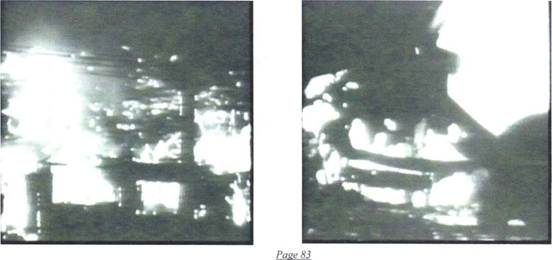
 This
had been planned with typical US thoroughness. An imitation Japanese housing
area had been built in the US and various methods had been tried out. The best
bombs were found to be 7 pound napalm incendiary bombs, dropped in clusters of
100. A B-29 could carry about 18 000 of these bombs. 334 bombers took part in
the raid on March 9, flying at comparatively low level — about 7000 feet. So
more than half a million of these bombs were dropped on this raid alone.
This
had been planned with typical US thoroughness. An imitation Japanese housing
area had been built in the US and various methods had been tried out. The best
bombs were found to be 7 pound napalm incendiary bombs, dropped in clusters of
100. A B-29 could carry about 18 000 of these bombs. 334 bombers took part in
the raid on March 9, flying at comparatively low level — about 7000 feet. So
more than half a million of these bombs were dropped on this raid alone.
A Gekko (Irving) defending fighter photographed from a B-29 above a
Japanese city.
Each home had to have a dugout shelter and a drum of water and paper bags of sand, but these were quite inadequate. Tokyo had just over 8 000 trained firemen and 2 000 auxiliaries, with
1 117 vehicles, to cover an urban area of 213 square miles with millions of people. Even with adequate fire appliances, the Japanese were handicapped by their training, which relied on ritual rather than science; cases are recorded where the brigade's standard bearer threw himself into the flames to spur on his colleagues.
'The darkest hour is just before the dawn,, 113 was the homily with which the NHK announcer on Tokyo Radio had chosen to close the day's broadcasting, after forecasting fine spring weather for the next morning's Armed Forces Day parade. Just after midnight the attack began, with pathfinders laying down markers in Shitamachi, the most densely populated area on earth. There was a strong wind, and this spread burning fragments over a wide district. People who tried to flee were trapped among walls offire. People tried to find shelter in pools and rivers in the parks but were still killed as the water heated. Thousands of bodies were packed together in these pools. The flames were fanned by the winds to heat the air to temperatures of 6000 Celsius, and metal melted and wooden buildings, and even people, spontaneously ignited.
In the morning a terrible sight greeted the rescuers. Sixteen square miles, including more than half of the city's commercial centre was completely devastated; a quarter of a million buildings had vanished. A million people were fleeing to the countryside in panic, having lost their homes and all possessions. The US estimated a death toll of 80 000, but there were at least 100 000 killed, 114 and the exact total will never be known.
The people above had sought shelter in the water, but were asphyxiated. Thousands more were burnt beyond recognition, or literally cooked in the ##heated pools.
June 17 1945 — fire raids on the smaller cities
After the middle of June the bombers launched similar attacks against the smaller cities. 1 15 By August 14 over fifty centres had been bombed. The weak fighter defences were powerless, especially when raids were made on several cities simultaneously, and the few anti-aircraft guns were also ineffective.
217 B-29 aircraft from Tinian lined up for a take-off.
Case study of a Japanese pilot
The overwhelming problem for the Japanese defence was the shortage of fuel. Nagatsuka, a pilot who began training in mid-1944, Il spent some months learning to fly on gliders and then he began using powered trainers. However in October training was suspended because no fuel at all was available.
Nearly a month later some fuel became available, petrol mixed with wood alcohol called A-GO, which was extremely flammable and also caused engines to run erratically. 1 17 Each pilot trainee had one short flight every fifth day.
Appointed to a front-line squadron in December, he had a few flights as passenger in a two-seater 'Nick' and a few more training flights in a Ki-27, 'Abdul', of 1937 vintage with fixed undercarriage; he then flew this in interception sorties against the B-29, with no chance of catching it!
In February missions were again restricted from lack of fuel, and on March 31 the squadron was assembled and the first flight was 'invited' to volunteer for a suicide bombing mission. They were then given special priority for fuel, but even so it was two months before they had completed the four or five flights needed to learn the special skills of the kamikaze. On April 4 the squadron had no fuel at all, and this state of affairs continued for nearly a fortnight.
On June 29 in heavy rain the flight was ordered to attack aircraft carriers over 300 miles off the coast. They flew out into worsening weather, and visibility was effectively nil; it was hard for the formation to keep in contact, much less find the target. The flight leader led Nagatsuka's flight back to base.
After landing, the pilots were hit by superior officers for abandoning the mission; the other flights had flown on and obviously run out of fuel and crashed uselessly.
There was absolutely no fuel at all on the base, but some was distributed on July 29.
On August 12 Nagatsuka made a final sortie, to intercept bombers, but the Oscar fighters were intercepted by Grumman fighters from a carrier and Nagatsuka was shot down. He crashed and was in hospital until December. He was very lucky to survive! His story, however, illustrates the futility of any defence efforts at this stage of the war.
Summary
By the end of the war the US had dropped at least 145 000 tons of bombs on Japan excluding the two atomic bombs, the equivalent of 40 000 tons. They had destroyed 105 square miles (260 square kilometres) in six major Japanese cities, and many other smaller cities had also been devastated. 1 18 To this must be added at least a thousand sorties a day from the rampaging carrier forces surrounding Japan, and a major warship bombardment.
What were the casualties?
No-one knows. All figures are suspect.. The official figures were about 310 000 dead and over half a million injured .Superfortress reports of damage were not exaggerated.
14. The Final Act
Conditions in Japan
According to studies carried out by the US after the war120 total civilian casualties in Japan resulting from all air attacks were about 806 000 of which approximately 330 000 were fatalities. Combat casualties were estimated at approximately 780 000 during the entire war.
As mentioned previously, this was certainly not an over-estimate.
The principal cause of civilian death or injury was burns. Of the total casualties, approximately 185 000 were suffered in the initial attack on Tokyo of 9 March 1945. In some later cases, however destruction of property was high but casualties were comparatively low. Yokohama, a city of 900 000 population was 47 percent destroyed in a single attack lasting less than an hour. The fatalities suffered were less than 5000.
2 510 000 buildings were destroyed by the air attacks. Another 615 000 were destroyed by the Japanese themselves as firebreaks. This was the major preventative measure undertaken and was surprisingly successful.
The figures themselves do not give any idea of the horror of the attacks and their aftermath. But as well as this there were many other effects of the bombing and the blockade.
The main problem causing debilitation of the Japanese people was the food shortage. Prior to Pearl Harbour the average per capita caloric intake of the Japanese people was about 2000 calories as against 3400 in the United States. To provide this food the small area of arable land was intensively farmed, using more manpower and larger quantities of fertilizer than in any other country in the world; fishing was developed into a major industry; and rice, soybeans and other foodstuffs amounting to 19 percent of the caloric intake were imported. Food rationing was begun in April 1941 but the food situation became critical. Imports became more difficult, and fishing was restricted because of fuel shortage and shortage of labour. Farming was also affected by the drafting of the younger males and by an increasing shortage of fertilizers.
By 1944, the average per capita caloric intake had declined to approximately 1900 calories. By the summer of 1945 it was about 1680 calories per day. Beriberi and tuberculosis became prevalent. Undernourishment caused poor morale and absenteeism among workers.
From 1943 onwards there were also shortages of fabric. Cotton and wool could not be imported. Various substitutes were tried, but their quality was so poor that of ten they could not withstand washing.
Heating fuel of all kinds became very scarce. This brought difficulties in cooking as well as providing warmth. Cruelly, the winter of 1944-45 was one of the coldest ever.
As the B-29 raids increased after March 1945 the cities' infrastructure collapsed. Whole factory areas were devastated, and a high priority was given to dispersal and concealment of factories. Air bases also had to be hidden; a major industry was the production of dummy planes to be placed on unused airstrips to attract strikes from allied aircraft. From March on, the home islands were subjected to constant raids from carrier-based aircraft, joined within a few weeks by aircraft based on Okinawa. Transport ground to a halt. Attacks were made on electricity stations, ports, water supplies and many other targets. Occasionally a small group of veteran pilots would find the fuel to get airborne with late-model aircraft, and would achieve good results against raiders, but in general the allied carrier-borne aircraft and land based attackers had no opposition.
I cannot find any evidence of significant air defence of Japan after the end of June. The bombing was continually intensifying, and it is almost impossible to imagine the state of Japan by March, 1946, the date of the proposed landing on the Tokyo plain.
July 1945
July was a period of preparation by the US — mainly for the invasion of Japan itself, and of the atomic bomb. There were major attacks on Japan by carrier aircraft, which generally were unopposed, and continuing raids by the heavy bombers. 10 July 1945 was an especially notable day. A thousand heavy and medium bombers raided the cities, and another eleven hundred fighter-bombers ran amok over the countryside, and only ten or twenty fighters could be put into the air by Japan. It was estimated that in terms of actual strength, the odds were 200 to one, and in terms of quality, the Japanese were individually inferior.
Kamikaze attacks continued fitfully, but the military hierarchy proclaimed that resources were being husbanded for the actual invasion. Civilians were issued with sharpened stakes, and the propaganda still proclaimed the need for defence of the homeland to the death, because the barbarous Americans would enslave all Japanese and destroy the traditional values of the society.
On 26 July 1945 HMS Vestal, a UK minesweeper, was sunk by kamikaze attack and was the last UK ship sunk in the war.
On 29 July 1945 the Japanese submarine 1-58 sunk the US cruiser Indianapolis which was on its way home after delivering the atom bombs. This was one of the major Japanese submarine successes of the war, and the sinking was so sudden that the ship was not able to radio its plight. Many sailors died in the following days before the few survivors were rescued.
Japanese plans for 'Meeting the Invasion Armada
There were no usable naval ships, and only aircraft could make any real effort at defence. The Japanese guessed rightly that the first invasion would be on southern Kyushu followed by a landing in the Tokyo area. The US feared that there would be up to 10 700 aircraft of which half would be kamikaze.
Indeed, the army claimed about 6150 planes 122 with 340 suicide squadrons. Potentially up to 2000 planes per month were still being made. The army had 2 350 000 trained troops in the home islands and estimated that sixty million, civilians, men women and children, would fight with sharpened sticks, explosives and improvised weapons.
When the Emperor's brother went out to see a new army unit training he found that they had no uniforms or guns, and consisted of young teenagers and elderly men. His report to the Emperor was a major factor in causing the Emperor to decide to end the war.
6 August 1945: First atomic bomb on Hiroshima' 23
In this context the first atomic bomb was dropped. Hiroshima had a very clear aiming point, the river junction in the centre of the city. Weather reconnaissance confirmed that the skies were clear, and Hiroshima, the primary choice, became the target. The people had been warned by leaflets two days before that there would soon be a heavy attack, but so far Hiroshima had not been hit.
At 17 seconds past 8:15 the bomb was dropped. It exploded at 1800 feet, taking milliseconds to release energy equalling 20 000 tons of TNT.
'Suddenly a glaring whitish-pink light appeared in the sky accompanied by an unnatural tremor that wasfollowed almost immediately by a wave of suffocating heat and wind that swept everything away in its path, ' was how one observer recorded that moment of detonation. The fireball blossomed to a temperature thousands of degrees hotter than the surface of the sun, melting granite and imprinting the shadows of people and objects on the ground and the walls of what few buildings survived the 'Pika ' of the nuclear reaction flash and the 'Don ' of the thunderous shockwave that instantaneously flattened the centre of Hiroshima.
'Within
afew seconds the thousands of people in the streets and the gardens of the
centre of town were scorched by a wave of searing heat. Many were killed
instantly, others lay writhing on the ground, screaming in agony from the
intolerable pains of their burns. Everything standing upright in the way of the
blast, walls, houses, factories and other buildings, was annihilated and the
debris spun round in a whirling wind and was carried up into the air. 
'There
was the mushroom cloud growing up, and we watched it blossom, ' Tibbets
recorded, after the Enola Gay had reared in the blast. 'And down below it the
thing reminded me more of a boiling pot of tar than any other description I can
give it. It was black and boiling underneath with a steam haze on top of it. 
A Japanese journalist 's account recorded the turmoil raging below that ugly cloud.
'Beyond the zone of utter death in which nothing remained alive, houses collapsed in a swirl of bricks and girders. Up to about three miles from the centre of the explosion, lightly built houses were flattened as though they had been built of cardboard. Those who were inside were either killed or managed to extricate themselves by some miracle, found themselves surrounded by fire. And the few who succeeded in making their way to safety generally died about twenty days later from the delayed effects of the deadly gamma rays. '
A feature of the city was the river junction, which made an excellent aiming point.
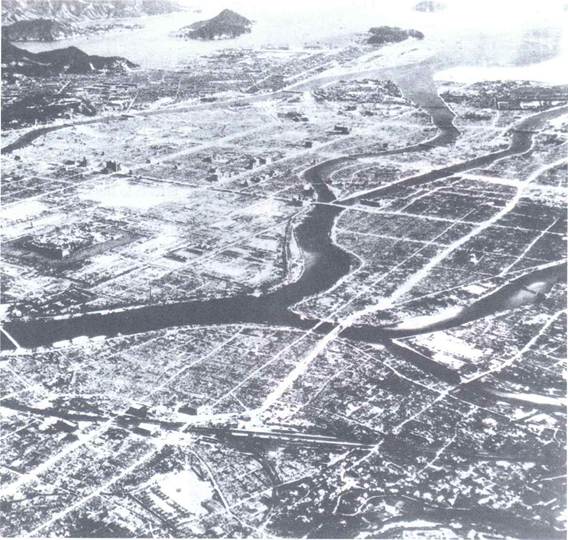
The site is a sacred area to all, and when we visited, thousands of Japanese students were imprinting this tragedy on their minds.
Up to 130 000 people were killed within a few minutes, including US prisoners in Hiroshima Castle. The follow-on effects to the bomb were as yet unknown and added a new dimension in horror to the war.
The news of the bomb's success was greeted with elation throughout the military hierarchy and at Los Alamos, where the bomb was made.
Truman called it 'the greatest thing in history,' and issued a press release stating that the bomb was 'harnessing the fundamental power of the universe.'
9 August: Nagasaki and surrender
The atomic bomb dropped on Nagasaki tends to get overlooked. The city is in a valley, and this concentrated the blast. But the effect was no less horrific than that at Hiroshima.
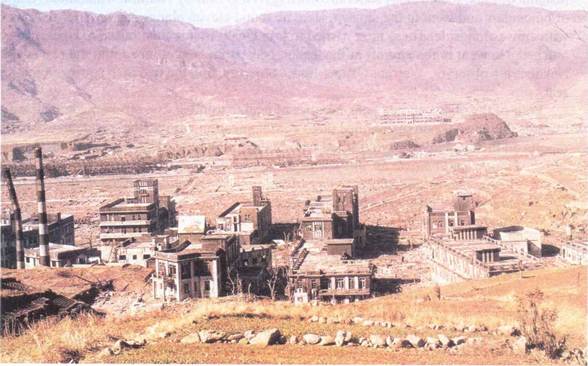
Following the dropping of the atom bombs, the Emperor was presiding at a meeting of the Supreme Council, which met in the bomb shelter of the Imperial Palace. The military faction still wanted to continue with the war.
The day is near 124when the hundred million people as one man will be in active resistance to the enemy who does not allow any consideration of humanity and of cultural values to stand in the way of establishing a hegemony over the world.
The politicians were not convinced, but it was hard to argue without seeming to be unpatriotic. Prime Minister Suzuki appealed directly to the Emperor. This was against all precedent, but was entirely legal.
The Emperor spoke. He supported the politicians. He went on to give his reasons: he had had reports of the poor standards of equipment and training of the remaining troops and could see no hope for success. this is the time when we must bear the unbearable to restore peace to the nation and to the world'.
The next steps were not easy. Eventually the Emperor recorded a message for broadcasting to the nation on 15 August, but individuals in the military factions tried to seize the recording. After a great deal of intrigue at last the Emperor's message was broadcast.
August 15 1945 Admiral Ugaki' s Kamikaze Sortie
Because of continual bombing from land-based and carrier-based aircraft, the Fifth Air Fleet headquarters had been moved to Oita in north-eastern Kyushu. The command post was set up in a bunker built into a hill on the southeast side of the field and the living quarters were also underground. According to Divine Wind Ugaki gave orders for the preparation of two Judy bombers to sortie for Okinawa.125
Several officers tried to talk Ugaki out of participating, but he said that he had the right to choose his own death. 'This is my chance to die like a warrior. I must be permitted this chance'.
Ugaki heard the emperor's broadcast at noon, and though reception was bad, the message was clear. His staff held a small farewell party for Admiral Ugaki. He spoke to the group, expressing regret that his efforts had failed to achieve the desired results. He removed his insignia of rank, took a short samurai sword (given to him by Admiral Yamamoto) and a pair of binoculars and went to the airstrip. Here he found eleven planes prepared for the mission, with crews alongside. These men wished to join Ugaki in this final mission. Ugaki was very touched. He went to the aircraft of the leader, Nakatsuru, and climbed into the rear seat. Nakatsuru's observer, Warrant Officer Endo, objected, and the two men squeezed into the seat.
Four of the planes turned back because of engine trouble. The others made their way towards Okinawa. Endo maintained radio communication with the base and gave occasional reports on their progress. Divine Wind reports the following as Ugaki's last radio message:
I alone am to blame for our failure to defend the homeland and destroy the arrogant enemy. The valiant efforts of all officers and men of my command during the past six months have been greatly appreciated.
I am going to make an attack at Okinawa where my men have fallen like cherry blossoms. There I will crash into and destroy the conceited enemy in the true spirit of Bushido, with firm conviction and faith in the eternity of Imperial Japan.
I trust that the members of all units under my command will understand my motives, will overcome all hardships of the future, and will strive for the reconstruction of our great homeland that it , may survive forever.
Long live His Imperial Majesty the Emperor!
The message seems a bit elaborate for the available radio technology. Further, there are no Allied records of any such attack. Probably Ugaki, wishing to die as a kamikaze but not wishing to disobey an Imperial command, deliberately led his flight into an empty expanse of ocean.
These were probably the last of the kamikaze pilots to die in action: the total, quoted by two Japanese sources, was 4615 (2409 of the Imperial Japanese Navy; 2206 of the Imperial Japanese Army).
A lot of rubbish has been written about the kamikaze, and a typical example is from a book by the French fighter pilot Pierre Clostermann, 126 who had a very distinguished career fighting as a Free French airman in World War Il.
He gives an extremely detailed minute by minute description of Ukagi's last flight (in an Oka!) culminating with a dive into the US aircraft carrier Savo Island.
The date he gives is wrong, Okas had not been used for some months, and the Savo Island was at the timeoff the west coast of America.
Another book, Born to Fly, states:
On 16 August the Chief of Staff of the 5th Air squadron took off at the head of thirty aircraft and every one of them crashed on the American air base at Okinawa.127
This story is repeated in other accounts, and it is said that it is suppressed by the US who wanted to indicate that the surrender was completely accepted. My view is that the US air patrols would never have allowed this to happen, that the Japanese could not get such a large group airborne, and that the benefit of the obedience of the Japanese is that though they would adopt kamikaze when ordered they would, by and large, cease fighting when ordered!
After the war, it was said that Ohta, the designer of the Oka, flew off and crashed a Zero three days after the end of the war. Another false story! He lived on under an assumed name and died in 2004. 128
15 August 1945: Halsey's anti Kamikaze order
At 0700 on 15 August, 129 the day of Emperor Hirohito's surrender broadcast, Fleet Admiral Nimitz ordered an end to all offensive action. But Admiral Halsey, commanding 3rd
Fleet while TF 38 (including British and Commonwealth units) launched strikes against the Tokyo area, nevertheless strengthened his combat air patrols and gave instructions that all 'snoopers' should be shot down 'in a friendly sort of way'.
15 Aug 1945 Emperor’s Message
The Japanese people had never heard the Emperor's voice. He spoke in an archaic Royal dialect. He said that the war had developed to a situation 'not necessarily to Japan's advantage'.
Moreover, the enemy has begun 130 to employ a new and inhuman bomb, the power of which to do damage is indeed incalculable, taking a toll of many innocent lives. To continue the war under these conditions would not only lead to the annihilation of Our Nation, but to the destruction of human civilization as well.
To avoid the death of millions of Japanese, he had ordered the acceptance of the requirement of unconditional surrender. He apologised for the failure to bring stability to East Asia, and to all those who had suffered from the war.
We have resolved to pave the way for a grand peace for all the generations to come by enduring the unendurable and suffering what is unsufferable.
 .
Beware most strictly of any outbursts of emotion which may engender needless
complications, or any fraternal contention and strife which may create
confusion, lead ye astray and cause ye to lose the confidence of the world.
.
Beware most strictly of any outbursts of emotion which may engender needless
complications, or any fraternal contention and strife which may create
confusion, lead ye astray and cause ye to lose the confidence of the world.
We ask you, Our subjects to be the incarnation of Our will.
By and large, this plea to cease resistance immediately was obeyed, though individual acts of defiance were seen. For example, fighter ace Saburo Sakai claims to have takenoffand shot down an B-29 bomber after the broadcast, but the US claims no losses on that day. Many military men committed suicide. Ugaki's death, detailed above, was carried out after the Emperor' s broadcast, and Ugaki was well aware of its contents and the Emperor's commands.
16 August 1945 Last Days Of Admiral Ohnishi
Ohnishi was one of the leaders who protested against surrender, seeking to employ various delaying tactics. However, after an interview with Prince Takamatsu on 6 August he knew that surrender was inevitable and would shortly be announced.
Inoguchi
131 reports that on the evening of on 1 5 August Ohnishi had some
staff of officers at his residence until about midnight, then in the early
morning committed hara-kiri. He had disembowelled himself with the traditional
cut, but  had not, as was usual, had a 'second' to
kill him with another blow. When his aide found him, Ohnishi refused both
medical aid and a coup de grace, and lingered in agony until six o'clock that
evening. He seemed to seek such an end to emphasise his contrition for his
failure. His final message was as follows:
had not, as was usual, had a 'second' to
kill him with another blow. When his aide found him, Ohnishi refused both
medical aid and a coup de grace, and lingered in agony until six o'clock that
evening. He seemed to seek such an end to emphasise his contrition for his
failure. His final message was as follows:
I wish to express my deep appreciation to the souls of the brave special attackers. They fought and died valiantly with faith in our ultimate victory. In death I wish to atone for my part in the failure to achieve that victory and I apologize to the souls of these dead flowers and their bereaved families.
I wish the young people of Japan to find a moral in my death.
To be reckless is only to aid the enemy. You must abide by the spirit of the Emperor 's decision with utmost perseverance. Do notforget your rightful pride in being Japanese.
Other leaders who suicided at this time included132 General Korechika Anami, Minister of War; General Seiichi Tanaka, commanding in the Tokyo area; Field Marshall Hajime Sugiyama, commanding 1st General Army, whose wife died with him; General Shigeru Honjo of the Kwantung Army; and Prince Fumimaro Konoye, Prime Minister in the immediate pre-war period. General Hideki Tojo, Japan's supremo from October 1941 to July 1944, attempted suicide but survived to be executed as a war criminal.
General Yamashita was still fighting in the Philippines, and surrendered. It is said that he, deliberately refrained from seppuku in the hope, probably justified, that his judicial murder by the Allies would serve to moderate the western mob's clamour for the trial and degradation of Emperor Hirohito.
'The world I knew is now a shameful place', commented Yamashita shortly before his death by hanging.
16 August 1945: the small—boat Kamikazes
The Shinyo explosive motorboat squadrons 133 were involved in two tragically unnecessary actions following the surrender. On 16 August, a rumour spread at Shinyo Squadron No 128's base in southern Shikoku that an Allied task force was approaching Tosa Wan, apparently to invade in spite of the surrender decision. In a frantic scramble to prepare the EMBs for action, engine fires broke out and a chain of warhead explosions killed 111 of SS 128's personnel.
Another unhappy incident happened in Hong Kong. When the British fleet steamed into the harbour a Japanese officer came to meet them in a Shinyo boat. The British suspected an attack and launched an air strike from their carriers against the Shinyo base. There were many casualties. The Japanese claimed that the boat was unarmed and had been sent because they had nothing else that would function.
The small groups of suicide boat crews at Sandakan, North Borneo and at Hainan Island, near China, surrendered peaceably and without incident.
The commander at Hainan later wrote 'My men were not "war machines": they were young, they loved their country, and they took no thought for themselves. The spirit that inspired them stems from the warrior tradition of Japan; but, really, men of all nations are capable of summoning up a similar spirit. It isn't something that belongs to Japan alone. The reason for Japan's great recovery since the war is, I believe, that these many human sacrifices brought good fortune to the homeland.'
20 Aug 1945 Hashimoto, captain of 1—58
Having sunk USS Indianapolis 134 on his last cruise (29 July 1945) (see below),
Lieutenant Commander Hashimoto was taking his submarine to surrender when he met six 'Type SS' transport submarines of the Ha 101 class, whose skippers proclaimed that they were sailing out from Kure to 'fight to the death'. The gesture was purely symbolic: these small (420 ton) boats had no torpedo tubes and mounted only one 25mm gun. Perhaps influenced by the prestige of the 'ace' submariner Hashimoto, they abandoned the idea and followed him to Kure.
The story of Hashimoto has an interesting postscript. 135
In
November of 1945 Captain McVay of the Indianapolis was brought to trial over
the loss of his ship. It was alleged he had been reckless by not zigzagging,
and thereby was responsible for the loss of his ship. Hashimoto was flown to
the US, under guard, as a witness. He was amazed at the courtesy with which he
was treated. Hashimoto stated that he would have been able to sink the
Indianapolis whether it had been zigzagging or not, but the court-martial board
found McVay guilty anyway, and Hashimoto was returned to Japan. He felt that
the trial result was a foregone conclusion, the shore bound authorities
unfairly convicting an honest frontline sailor. He later said I would say the
Navy side did not accept some testimony that were inconvenient to them .
On December 7, 1990, survivors of the Indianapolis met Hashimoto in Pearl Harbour on the 45th anniversary of that attack. Speaking through a translator, Hashimoto said, 'I came here to pray with you for your shipmates whose deaths I caused.' This greatly affected the US survivors, who assured Hashimoto of their forgiveness.
In 1999 an effort was made to clear McVay's name. Hashimoto wrote a letter in support of McVay, repeating what he had said in evidence in 1945. Concluding his letter, Hashimoto wrote: Our peoples have forgiven each other for that terrible war and its consequences. Perhaps it is time your peoples forgave Captain McVay for the humiliation of his unjust conviction.
Hashimoto died on October 25, 2000, at the age of 91 , having spent the last years of his life as a Shinto priest in Kyoto, Japan.
_gge_25P
15. Some final thoughts.
Did the kamikazes have a chance of success?
Imperial General HQ believed 136 (rightly) that an Allied invasion would be directed first against southern Kyushu and, once a beachhead was established there, against the Tokyo area, southeast Honshu. The actual dates planned by the US were:
1. Decoy raid against Shokaku, 30 October 1945
2. Invasion of Kyushu 1, November 1945
3. Invasion of mainland, two landings in Tokyo region, March 1 1946.
These would be preceded by continuing carrier raids — say a thousand sorties a day, and at least the current rate of B-29 bombings. For the period from June 17 to August 8 an average of over 1 100 tons of bombs were dropped each day by B-29s alone, making an average of over 150 sorties. The numbers of B-29s was growing daily. B-24s were being assembled from all over the Pacific. Britain was in the process of sending a special force, including the famous 617 Dambusters squadron. The matter of additional atomic bombs is another possibility. All this would be applied to a country that was literally starving, and had no oil reserves, or working transport services.
The prime example of the suicide aircraft is the Oka: designed at the command of the highest authorities, with a strong supporting structure. Yet it was a failure; very few hit their targets, because the air defences were too strong and the Oka-carrying Betty bombers were too vulnerable. The most effective aircraft was probably the Zero, which had the necessary speed to give it a chance to break through.
Let us assume that the Japanese were able to launch ten thousand kamikaze aircraft at the final invasion. Let us assume that each detonated with force equivalent to three tons of explosive, and that the accuracy of each attack was as great as that of the standard unopposed bombing attack. All these figures are wildly optimistic: even at their most successful, it was lucky for 25% of kamikazes to hit their target, and stories such as that of the Aaron Ward indicate that the blows of the kamikaze were not mortal even to small ships.
But even in the very best circumstances the Japanese could deliver the equivalent of only 30 000 tons of explosive.
Despite their early success, the Japanese never did have a strategic bombing capability. On 30 May 1942 the RAF launched its first thousand bomber raid on Germany. This was minor, in comparison to the huge raids of later in the war. But the Japanese never had even this capability; their maximum 'heavy bomber' strength was 512 on 1 April 1945 137 . The smallest British bomber used in 1942, the Wellington, carried twice the bomb load of the largest operational Japanese bomber. Lancasters, in use by 1942, carried up to four times the load.
B-29s alone could easily deliver eight tons each per mission. Four hundred of them flying every second day would deliver thirty thousand tons within six days. At the end of the war the US was well on the way to having two thousand of these bombers. The marauding carrierbased aircraft could deliver an equivalent amount in the same time. This is equivalent to three Hiroshima-sized atomic bombs.
Kamikaze would never have had a significant effect, much less altered the course of the war.
The main influence of the kamikaze can be seen in the psychological effect on their enemies and on their own countrymen.
Their adversaries found them terrifying because of the complete disregard the kamikazes had for their own safety. They were the one weapon that the US did not have. When they hit there was a personal aspect of the attack that increased the horror. It is understandable that
they were regarded with loathing; we have several examples of pilots' bodies being thrown overboard with no ceremony. The Australian cook on the Australia who jumped on the head of a still-alive pilot and then pushed him overboard is typical.
The kamikaze provided an example to their soldiers and the citizenry, and, supported by propaganda that emphasised the barbarity of the US, set the scene for a horrifying conclusion to the war.
They hardened the resolve of the US; there was no second thought in President Truman's mind about using the atomic bomb. There is a sound argument that by bringing the government to its senses the atomic bomb shortened the war, but to suggest that it was the only cause is to accept the simple answer that is always wrong. The fire bombings had created more damage, and killed far more people. The marauding fighter-bombers, from the aircraft carriers and from Okinawa, were making daily life impossible everywhere in the country. Food was so short people were starving. There was no fuel for heating, and even the supply of clothing was so poor that people were struggling to keep warm by any means. Finally, on 8 August the USSR at last declared war on Japan, and two and a half million troops were already prepared to attack the Japanese forces in Manchuria. The army's cherished possessions in Asia (Korea, Manchuoko and North China) were doomed to be immediately lost, and any sentient Japanese would prefer occupation by the US to occupation involving the Russians.
Kamikaze was the tactic of despair. If the situation had not been hopeless, it would neve have been tried. But the bravery and commitment of the kamikaze is undoubted. The same qualities were more prof itably used in the reconstruction of Japan. Within thirty years the Greater East Asia Co-Prosperity Sphere, the aim of the war, was created by the processes of peace, and has been far more successful than the original would ever have been.
Japanese self-analysis
There was much soul-searching among the surviving Japanese, and many commentators offered their opinions on the Kamikaze phenomenon. Of these, the following is fairly typical, and more cogent than most! It is by Captain Okumiya, author of Zero in a book written in cooperation with Mitsuo Fuchida, offers these comments. He saw that the war was lost after the Battle of Midway.
In the final analysis, the root cause of Japan 's defeat, 138 not alone in the Battle of Midway but in the entire war, lies deep in the Japanese national character. There is an irrationality and impulsiveness about our people which results in actions that are haphazard and of ten contradictory. A tradition of provincialism makes us narrow-minded and dogmatic, reluctant to discard prejudices and slow to adopt even necessary improvements ifthey require a new concept. Indecisive and vacillating, we succumb readily to conceit, which in turn makes us disdainful of others. Opportunistic but lacking a sprit of daring and independence, we are wont to place reliance on others and to truckle to superiors. Our want of rationality of ten leads us to confuse desire and reality, and thus to do things without careful planning, Only when our hasty action has ended in failure do we begin to think rationally about it, usually for the purpose of finding excuses for the failure. In short, as a nation, we lack maturity of mind and the necessary conditioning to enable us to know when and what to sacrifice for the sake of our main goal.
Such are the weaknesses of the Japanese national character. These weaknesses were reflected in the defeat we suffered at the Battle of Midway, which rendered fruitless all the valiant deeds and precious sacrifice of the men who fought there. In this weakness lie the causes of Japan 's misfortunes.
Kamikaze in the modern world: the Internet
As part of the research for this book I made a Google search on the internet on the word Kamikaze. In the first 8 pages of results I found only three references to the events of World War Il or the original kamikaze.
Some of the other modern entries were links to the Chambord Kamikaze cocktail recipe, a karate competition, suppliers of martial goods supplies, suppliers of sex equipment including genuine Japanese schoolgirls uniforms, Anime and Manga (Japanese comics and cartoons), web development sites, a record label and a very popular German heavy metal band; this latter took up nearly a third of the references.
The very first reference was to the blog site http://kamikazelunchbreak. blogspot.com/.
For the uninitiated, a blog is a website where people recount their daily doings This particular blog is particularly vacuous, the young American lady protagonist not having a thought in her head beyond retail therapy.
The message of the kamikaze
The purpose of the preceding section is to underline the fact that the story of the kamikaze is being lost in the clutter and banality of modern life. It is a story of noble but futile sacrifice. The appendices contain more facts and figures, but the real meaning of these events does not emerge from the facts and figures. In fact, what they have to say to us is not simple, but it is a clear message with many facets:
• The raw courage of the actions.
• The fact that most kamikazes accepted their fate and that at least a large minority were happy in their actions.
• The cultural background and the social situation that achieved this high motivation. • The might of the US, - their ability to produce aircraft carriers, aircraft such as the B29, the atomic bomb, a world-wide military and logistic operation of staggering size and complexity.
• The bravery of the allied front line soldier: the US marines who took Iwo Jima, the gunners who stood to their guns as kamikaze crashed into them are but a few examples.
• The fragility of this military power: there were occasions, such as on 5 January, when it was thought that plans may have to be modified because of the Kamikaze.
• The way that extreme measures on one side breed similar reactions on the other side. The actions of the kamikaze indicated that resistance would be bitter, and responses from the US included the atomic bombs and the even more powerful fire bomb raids.
• The incredible resurgence of Japan, which shows what can be done when the human spirit applies to peace the energies and dedication that their soldiers applied to war. • Yet if the Japanese had not resisted so strongly, if they had surrendered when the war was clearly lost, there would not have been the destruction that was wreaked by the fire raids and the atom bomb.
• The success of the peacetime rule of General Macarthur. There are reasons why this was successful, where the process being used in Iraq will fail. These reasons should be studied, and learnt from.
On several occasions in this narrative the US and Australian targets of kamikaze attacks are shown expressing loathing for their attackers and as behaving very callously towards, for example, their bodily remains. Any tut-tutting about this from people who have never experienced the horror of war misses the point: war is brutal and obscene, and is demeaning to all.