Tom’s book of Air Control: web version
The Royal Air Force in the Middle East and the Indus Valley, 1919 to 1939
Tom Lockley, February 2009, book ISBN ISBN 978-0-9803693-2-8
Introduction
‘For every complex problem, there is always a simple answer – and it is always wrong’.
These notes concern the activities of the Royal Air Force in the Middle East and the Indian subcontinent between World War I and II. This largely involved Air Control. As will be seen, this is a specific method by which Britain, as a colonial power, could control ‘primitive’ subject peoples. However, it must be put into the context of history, current politics and economics, and other air force activities: hence, these notes are rather wide-ranging.
In dealing with historical matters, it is easy for one’s judgement to be coloured both by hindsight and by one’s own beliefs and preferences. I acknowledge that some of my comments are affected by an interest in ancient history and what is possibly an over-appreciation of the sophistication of ancient cultures. I also do understand how the originators of Air Control were shaped by their own backgrounds and beliefs. They were not consciously evil in their intentions, and sometimes the outcomes of their actions were positive.
Nevertheless, two things are clear.
Firstly, the peoples affected by air control were certainly skilled at defending their territory, which they have been doing since prehistory. The Afghans were conducting successful guerrilla war in the time of Darius – and it is said that the last successful invader was Alexander the Great, though I am not convinced that even he was successful!
Secondly, the period 1919-29 was an unrivalled tutorial in modern warfare methods. It is clear that the subjects of these attacks would be ready to withstand even the most modern technology. If the same mistakes are being made now as were made eighty years ago, there is no excuse for this.
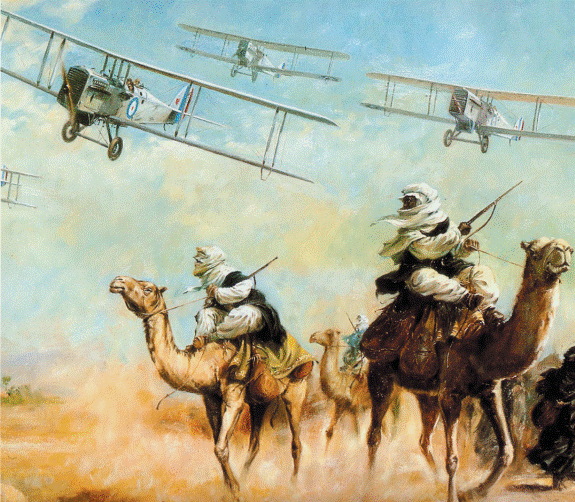
From the RAAF website www.raf.gov.au/airpower
Contents
Air Control ‘standard operating procedure’
Section 1: Historical background
Amritsar, 1919: an ‘informal’ action
Section 3: The development of Air Control
The Cairo Conference – the inauguration of Air Control
Section 4: The North-west Frontier, 1919-1939
Evacuation from Kabul (23 Dec 1928-to February 23, 1929)
The 1930 Frontier Disturbances
The role of 39 Squadron, ‘The North-West Frontier’, 1928-30
India 1935-6, as described by Slessor
Section 6: Iraq and surrounding countries, 1919-1939
‘Pure’ Air Control in Iraq and surrounding areas
A campaign in detail II: Iraq/Nejd Border Operations 1927/29
South Persia 1918-1919, North West Persia 1920
Section 8: Air action in Palestine 1936-39
Section 9: Matters of judgement
Justification for the mandate system
Witness #1: Flight Lieutenant McLoughry
Summing up: Trenchard’s submission on Air Control, 1929
The military authorities had little understanding of the overall picture
‘Air Control’ was socially dysfunctional
Multiculturalism cannot be imposed by airpower
Air Control was not ‘only used against isolated, unsophisticated tribes’
Air-Control skills did not translate well into other war-fighting skills
Reporting of Air Control to the British public (and others) was dishonest
There was no real effort to minimise damage
The airmen making the attacks sometimes developed a very callous attitude
There was not ‘full disclosure’
‘Air Control’ is an impediment to development of political solutions
Appendix 1: the Kabul airlift, 1929
Appendix 2: Resources deployed, 1927 to 1934
Appendix 4: The RAF in Aden, post World War II
Appendix 5: Graduates of the ‘Air Control School of Training’
Appendix 6: Relief of the Chitral Garrison, 1940
Aircraft information boxes
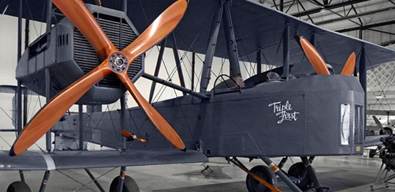
Handley-Page V/1500 heavy bomber
RAF squadron crests influenced by the Middle East
The ancient Harappan civilisation of the Indus Valley
It’s a tough life, but someone’s got to do it….
The view of Lawrence of Arabia
An airman’s description of the Pathan
The Kabul airlift for young children
Bombing technique, Hawker Harts in Afghanistan, 1934.
Background to the Mohmand troubles
The first Cranwell DFC: fighting the ‘Marsh Tribes’.
‘Order of Battle’, 1927 and 1933
The US Air Force and Air Control in recent times
The Middle East between the wars
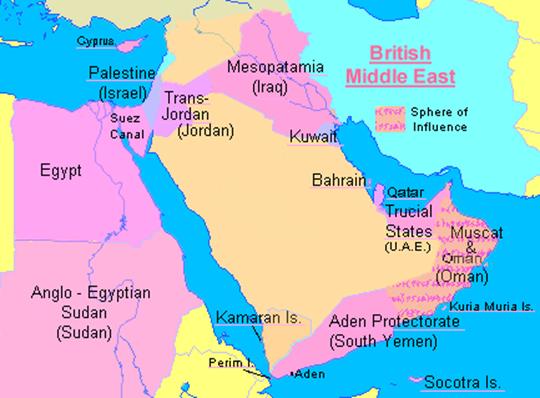
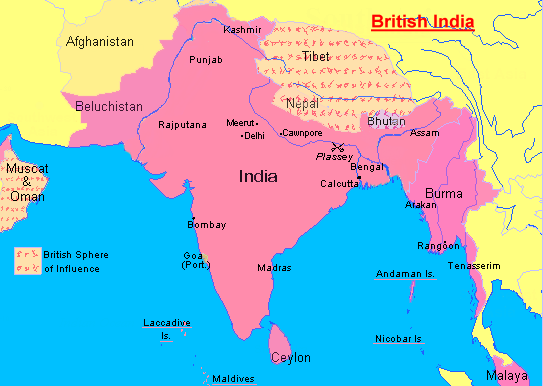
These maps give an approximate idea of British influence in the Middle East and India between the wars. Note, for example, that modern Pakistan is still part of India.
Air Control ‘standard operating procedure’
Air Control, in its ‘purest’ form, as specified at the Cairo Conference of 1922, was a structured procedure for dealing with recalcitrant tribesmen in British mandated areas or colonies.
The planned method of operation was as follows:[1]
- The tribe was told what the government terms were: perhaps the payment of a fine in cash, rifles or livestock; the return of captives or looted property; the production of named villains or hostages, withdrawal from an area belonging to another tribe or other similar conditions, with a date for compliance.
- If these terms were not met by the given date, they were told clearly what was going to happen to them. They were warned to evacuate a clearly defined area before a further given date, and told to remove their women and children, and sometimes all their livestock, household goods and agricultural implements. Until the terms were met, any ‘village, house, palm grove or cultivation’ could be bombed by day or night. Any people or livestock seen moving in the area were liable to be attacked from the air, and they were warned that delayed action bombs would also be used.[2] Details were also given of how they could submit, eg where the Political Officer would be found to receive their representatives. Warnings were given in several ways – proclamations dropped from the air, by agents, by neighbouring tribesmen, or by by loud-speakers from aircraft, a method often used in Iraq.
- A final warning of at least twenty-four hours was given before bombing began. Action was never undertaken ‘against anything but laslakars or raiding parties in open hostility..... without previous warning of at least twenty-four hours’ or even longer.[3]
- Operations were begun and the only course open to the enemy was acceptance of the conditions laid down.
This formal process for Air Control is embodied in the final version of the policy, adopted in August 1921, and scheduled to take effect after October 1922[4].
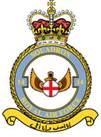
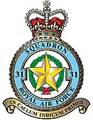
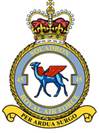
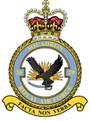
Box 1: RAF squadron crests influenced by the Middle East
|
At least fifteen RAF squadrons took part in Air Control or other military action between the wars in the Middle Ease and Northwest Frontier. The importance of the area in building up the tradition of the RAF as can be seen by the ‘eastern’ influence of these sample Squadron Crests. The events mentioned are officially recognised military ‘actions’ in which the squadron participated. |
|||
|
|
Dagger: 8 Squadron, (Kurdistan 1922-1924, Aden 1928, Aden 1929)
|
|
Crusader badge: 14 Squadron. (Transjordan 1924, Palestine 1936-1939) The squadron’s motto, uniquely in the RAF, is in Arabic. It reads ‘I spread my wings and keep my promise’,and is an extract from the Koran suggested by the Emir of Transjordan. |
|
|
Star of India: 31 Squadron (North West Frontier 1916-1918, Afghanistan 1919-1920, Mahoud 1919-1920, Waziristan 1919-1925, North West Frontier 1939)
|
|
Camel: 45 Squadron (Kurdistan 1922-1924, Iraq 1923-1925)
|
|
|
Eagle and Sun: 20 Squadron (Mahsud 1919-1920, Waziristan 1919-1925, Mohmand 1927, North West Frontier 1930-1931, Mohmand 1933, North West Frontier 1935-1939) |
|
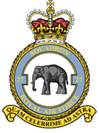
Elephant: 27 Squadron (Mahsud 19420, Waziristan 1920-1925, Mohmund 1927, North West Frontier 1930-1931, Mohmund 1933, North West Frontier 1935-1939)
|
|
|
Crane: 47 Squadron (Sudan, 1920) (motto means The Nile is an omen of our strength).
|
|
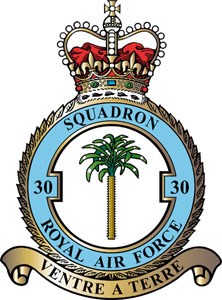
Date Palm: 30 Squadron (Iraq 1919-1920, North West Persia 1920, Kurdistan 1922-1924, Iraq 1912-1925, Iraq 1928-1929, Kurdistan 1930-1931, Northern Kurdistan 1932)
|

A summary of RAF actions
The RAF history lists the following actions as official combats in which its aircraft took part ‘between the wars’. They may not be claimed as ‘battle honours’ but are listed as actions in the squadron histories and similar documents, so certainly some ordinance was discharged with warlike intent at these places and times.
Not all these actions were ‘pure’ Air Control.
It is clear that
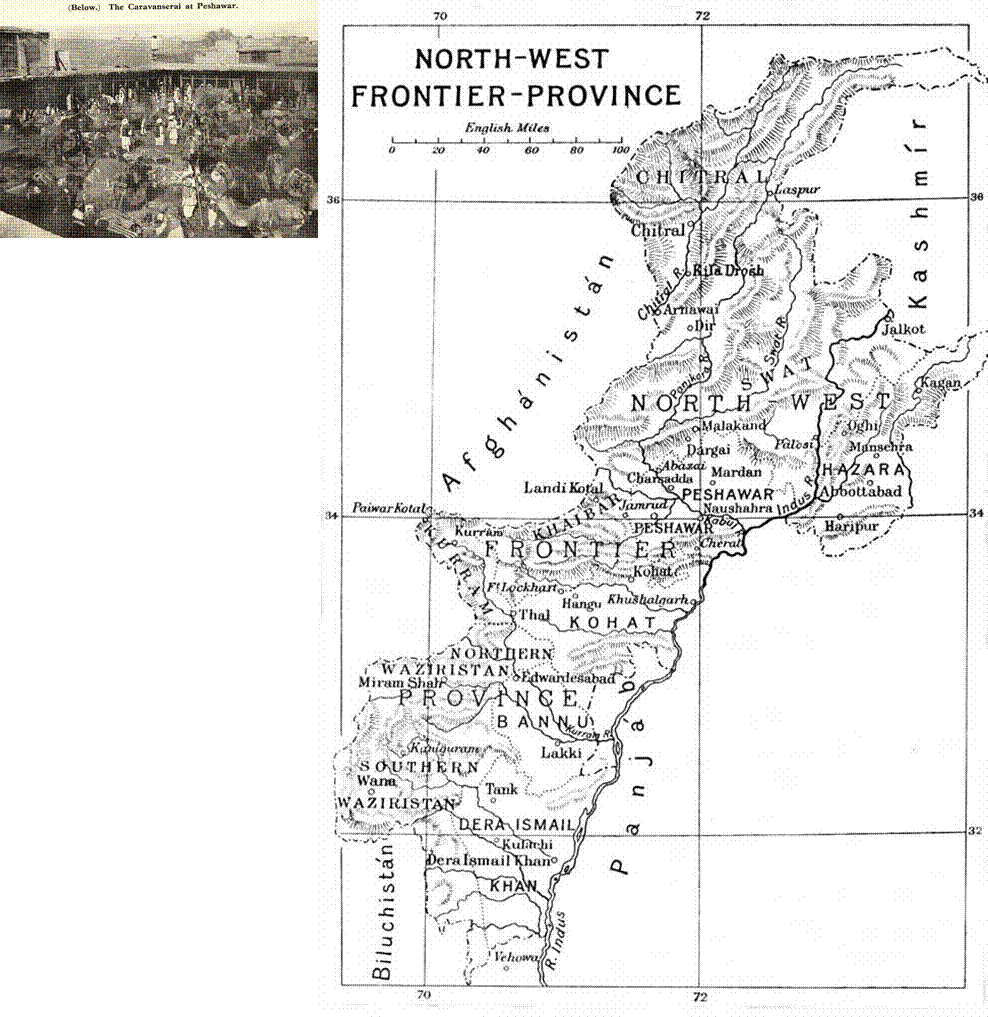
· The North West Frontier Province, the area around Peshawar received concentrated attention; mostly this also involved at least the border tribes of Afghanistan
· almost of the remainder of the actions were in the Middle East;
· not all combat actions were officially listed.
Action in Afghanistan or along the present Pakistan, Afghanistan border: – the ‘Northwest Frontier[5]‘ and surrounds…
- Afghanistan 1919-1920, part of the ‘Third Anglo-Afghan War’, pages 59ff.
- Action within about 200km of Peshawar area: Waziristan 1919-1925; Mohmand 1927, 1933 (the Mohmand tribes were distributed over several areas, mainly between Kabul and Peshawar); Mahsud 1919-1920, (the Mahsud were tribesmen from near Mohmand). General recognition of the North West Frontier was given for years 1930-1931, and 1935-1939.
Actions in other areas:
Sudan 1920
Somalia 1920
Iraq 1919-1920, 1923-1925, 1928-1929, including Kurdistan 1919, 1922-1924, 1930-1931, Northern Kurdistan 1932
South Persia 1918-1919, North West Persia 1920
Transjordan 1924
Aden 1928, 1929, 1934
Palestine 1936-1939[6]
There were other actions undertaken by the RAF outside of the Middle East, not dealt with in these notes[7]
There are certainly other actions, not recognised by the official list. Obvious examples are the air attacks at Amritsar, following the Amritsar riots (English term) / Amritsar massacre (Indian term), page 3 and the ‘Akforce’ action, page 59.
Box 2: The ancient Harappan civilisation of the Indus Valley
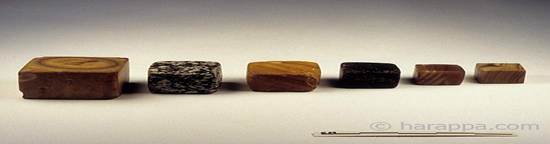
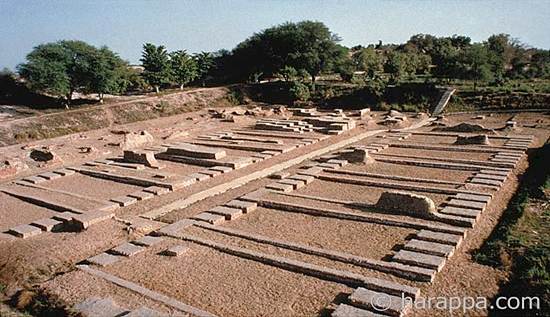 To
the south is the magnificent city of Mohenjo-Daro, but at Harappa itself
archaeologists have also uncovered the remains of large public buildings.
To
the south is the magnificent city of Mohenjo-Daro, but at Harappa itself
archaeologists have also uncovered the remains of large public buildings.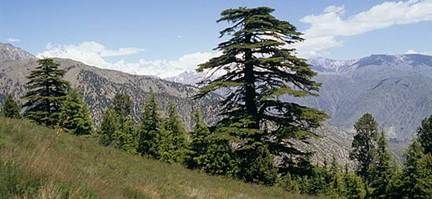 There is also clear evidence of unified government reaching as
far north as the Himalayas. Chitral, seen left, is famous for supplying
scented cedar for Harappan buildings, and was also the gateway to the trade
in Lapis Lazuli, which extended throughout the Mediterranean.
There is also clear evidence of unified government reaching as
far north as the Himalayas. Chitral, seen left, is famous for supplying
scented cedar for Harappan buildings, and was also the gateway to the trade
in Lapis Lazuli, which extended throughout the Mediterranean. Section 1: Historical background
General
The Middle East and the Indian subcontinent are basic sources of European civilisation.
Writing probably originated in Mesopotamia about 3000 BC: and about the same time cities developed. In about 2200 BC, further to the north, Sargon of Akkad established an empire that extended from the Mediterranean to the Persian Gulf, including modern Afghanistan.
In Egypt a highly developed culture persisted from at least 3000 BC and was a world leader in erudite matters until well into the Christian era. The Pyramids were built about 2850 BC.
From modern Israel and Lebanon came the Phoenicians, rivals to the Greeks and the Romans.
The three great monotheistic religions, Jewish, Christian and Moslem, came from the Middle East and shaped our core values.
In modern Pakistan, the Indus rises in Tibet and passes through modern Pakistan to the Arabian Sea. It supported the Harrapan culture,(see opposite page) – a literate and highly skilled society From the early third millennium BC this civilisation traded with Sargon’s empire as an equal. On its decline, a new civilisation arose, involving the start of the Indo-European family of languages of which English is a part.
It would be impossible to detail the innumerable wars, invasions, civil conflicts and guerrilla actions that occurred in the area before the period under discussion in these notes. But it must be emphasised that, of all areas of the world, the Middle East and the Indian subcontinent have a complex, exciting and fascinating history that has no equals.
The spread of Islam after 632 caused fundamental change in the region. This great religion obviously met the people’s needs; it spread with amazing rapidity. It came into conflict with Christianity; the rights and wrongs of this conflict are irrelevant to this story, but by 1453 Islam had taken control of Constantinople, the chief city of the Christian Roman Eastern Empire, and was dominating all the areas under discussion in these notes. Modern India, as distinct from modern Pakistan, is of course basically Hindu.
For a whole series of reasons, Britain first became a great world-wide Imperial power in the period beginning about 1750. By the early 1800s Britain had great influence over the Middle East and the Indian sub-continent, and from that time on, the importance of the region continued to increase.
The mid-century saw the Crimean War (1853-56). Britain and France were locked in struggle with Russia, whose Imperial ambition was feared to the extent that Fort Denison in Sydney Harbour was constructed specifically to meet the Russian threat.
France was responsible for the building of the Suez Canal, opened in 1869, and this revolutionised communication with India. Britain bought a share in the canal from the Egyptian Pasha in 1875 for four million pounds. The Convention of Constantinople in 1888 made the canal zone a neutral zone under the protection of the British, who had moved in to protect the canal during a time of civil unrest in Egypt, and maintained control until the 1950s.
The coming of the steamship meant that the ports along the route, such as Suez, Port Said and Aden were very important, for example as coaling stations.
Finally, in the early 1900s, oil became strategically important. A steam-driven battleship at full speed needed two hundred men shovelling coal; an oil driven ship required only power-driven pumps, and loading and storage processes were similarly simplified. Oil became essential for driving these new ships, vital to British military might. In 1909 Churchill, as First Lord of the Admiralty, signed the Anglo-Iranian Oil Agreement and Britain embarked on a huge program of building oil-driven ships.
Afghanistan
Afghanistan was famed for the invention of bronze, or at least its very early adoption, probably before 2000 BCE. Its main city, Kabul, was a major trading centre at least from this time.[8]
Because of its mountainous topography Afghanistan has always been on the fringes of the major empires. But because it was also a major crossroads, it was strategically important, and hence the target of imperialist neighbours. About 500 BC Afghanistan was invaded by Darius the Great, ruler of an empire that extended from the western Egyptian Desert to the Persian Gulf, north to the Black Sea and west almost to Greece. The next major invader was Alexander the Great of Macedon. The Afghans were always troublesome subjects: neither of these great rulers was able to establish permanent control. A more gentle invasion was that of Buddhist ideas, which travelled north from Ghandara in northern Pakistan. Buddhism reached its peak about 50 AD. Afghan history remained fairly turbulent, with constant power struggles, both internal and external (the latter, mainly with the Persians).
Afghanistan was swept into the world of Islam fairly soon after 642. Islam obviously appealed to the Afghans; the land quickly became a leading centre of Islamic power and civilisation, particularly under the Ghaznavid Dynasty (962-1140). The Ghorid dynasty not only controlled Afghanistan but also conquered areas of northern India.
In 1219 the marauding Mongols of Genghis Khan swept through Afghanistan. Afghans blame the Mongols for the destruction of their ancient irrigation systems, turning fertile soil into permanent deserts.
The Ghorid rulers regained control, but were swept away by the next conquerors, a new wave of Mongols, led by Tamerlane after 1370. Again, local control was re-established, and by 1519 the ruler of Kabul was Babur, founder of the Moghul dynasty. These rulers, literate and cultured, ruled over much of India until the 1700s, when the European powers arrived. The Taj Mahal is a Moghul building.
In Afghanistan itself, the Moghuls lost power. After a period of Persian domination, the tables were turned when Mir Mahmud of Afghanistan invaded Persia in 1622. The situation was fluid; a brief period of stability began when Ahmad Shah Abdali in 1747 expanded Afghan rule so that by 1773 his empire extended from Central Asia to Delhi, from Kashmir to the Arabian sea. It became the greatest Muslim empire in the second half of the 18th century. However, succeeding generations were unable to maintain unity and control, and by 1846 the external empire was lost.
Into this situation came the British.
Section 2: Early air actions
Amritsar, 1919: an ‘informal’ action
Amritsar is on the border between modern India and Pakistan.
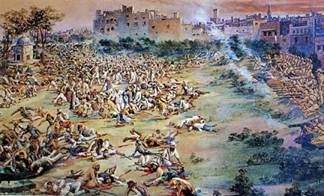 ‘On 13 April 1919 came the first of a series of riots
at Amritsar’. This is how the history of 31 Squadron RAF
describes the event that has now become infamous as the ‘Amritsar Massacre’.
Here, a group of ten thousand people gathered, contrary to edicts of the
British. The local commander, General Dwyer, ordered fifty soldiers to fire
into the group; 1650 rounds were fired, and over 400 of the protesters were
killed, with 1200 more injured, left with no medical aid. Dwyer argued that his
action was necessary to produce a ‘moral and widespread effect,’ to stop the
unrest that had developed because of economic problems following the war. The
gathering was, however, principally a religious occasion and not even Dwyer
claimed that the crowd had any hostile purpose.
‘On 13 April 1919 came the first of a series of riots
at Amritsar’. This is how the history of 31 Squadron RAF
describes the event that has now become infamous as the ‘Amritsar Massacre’.
Here, a group of ten thousand people gathered, contrary to edicts of the
British. The local commander, General Dwyer, ordered fifty soldiers to fire
into the group; 1650 rounds were fired, and over 400 of the protesters were
killed, with 1200 more injured, left with no medical aid. Dwyer argued that his
action was necessary to produce a ‘moral and widespread effect,’ to stop the
unrest that had developed because of economic problems following the war. The
gathering was, however, principally a religious occasion and not even Dwyer
claimed that the crowd had any hostile purpose.
The Indians were ‘packed together so that one bullet would drive through three or four bodies’; the people ‘ran madly this way and the other. When fire was directed upon the centre, they ran to the sides. The fire was then directed to the sides. Many threw themselves down on the ground, and the fire was then directed on the ground. This was continued for eight or ten minutes, and it stopped only when the ammunition had reached the point of exhaustion.’ [9] This description is by Winston Churchill, a commentator hardly likely to exaggerate British brutality.
It is not commonly mentioned that the RAF played a significant part in the affair. BE-2c aircraft of 31 squadron were flown to Lahore and to Amritsar. Several flights were made over Amritsar before the massacre, and though bombs were available, they were not used within the town before the massacre. Raids were, however, made on the small town of Kasur, just south of Lahore, ‘as no troops were available to deal with the disturbances’.[10]An aircraft made a reconnaissance flight over Amritsar on 12 April and again on 13 April., and this aircraft reported the gathering in the Jillianwala Bagh to Dwyer prior to the massacre[11]
Not surprisingly, after the shooting, the situation became very unsettled and riots broke out. The squadron history continues:
As the riots continued a strong army column was sent into the city to seize various strong points, and they were supported by low flying patrols. Then fresh riots began at Gujranwalla and 31 sent three BEs to help disperse the rioters and aid the civil authorities. Captain D H M Carberry MC DFC, who had been a distinguished flyer in France during the war, with Lieutenants Oddie and Vincent were the three pilots and on arrival they found several buildings on fire. All three pilots began to fire on groups of Indians they found in the open or making towards nearby villages. Bombs were dropped on other groups. Soon afterwards the riots died down and then ended.
Box 3: Brigadier-General Dwyer
|
In April 1919 he took over military command of Amritsar following unrest There were several minor incidents Two advocates of non-violent resistance were arrested; this led to more unrest in which several dissidents were shot y soldiers. An English missioarly lady was attacked by a mob and was rescued by other Indians.
After the Amritsar incident, Dwyer led an expedition to relieve Thal, besieged by Afghans and other dissidents as part of the third Angl-Afghan War, 1919-20. For this he was again commended, but protests against his action at Amritsar were growing. Many people, however, strongly supported Dwyer. A Committee of inquiry was set up, under the chairmanship of Lord Hunter, a Britsh Liberal politician and lawyer. The committee heard detailed evidence. The verdict was split among racial lines: the Indian members of the committee were very critical of the massacre, and the British members were criical of many aspects of the affair while giving Dwyer considerable support. Meanwhile, among the British, support for Dwyer was growing. Dwyer was allowed to retire to Britain, with the substantive rank of Colonel. His health was very poor. The imperialist Morning Post sponsored a collection for Dwyer, which raised the not inconsiderable sum of £26317.1s.10s; Dwyer lived in England until his death in 1927- his funeral (pictred) was a major event. |
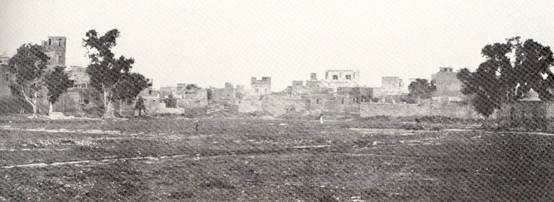 Reginald Dwyer was born in India in 1964, son of a British
merchant. After schooling in Britain, he joined the Indian army and worked
his way through the ranks. He spent World War I mainly in India, but did lead
in incursion into Iran. He was promoted Colonel in 1915, and was awarded a
CB.
Reginald Dwyer was born in India in 1964, son of a British
merchant. After schooling in Britain, he joined the Indian army and worked
his way through the ranks. He spent World War I mainly in India, but did lead
in incursion into Iran. He was promoted Colonel in 1915, and was awarded a
CB.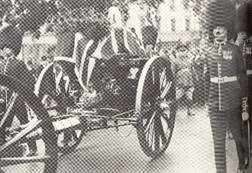
The ‘unrest’ was an early manifestation of an independence movement in India which persisted until the subcontinent achieved independence, divided into two nations of India and Pakistan, on August 15, 1947. The Amritsar action was by no means the only violent action by the British, and there were many violent acts from the Indian side. But the most effective strategy in the whole process was passive resistance, sponsored by the great Mahatma Ghandi, setting a model of successful political action that has been widely followed.
Afghanistan and Britain
A great deal of our future story will concern the border areas between modern Pakistan and modern Afghanistan – the North-west Frontier area – so it would be worthwhile to remind ourselves of the early interactions between Afghanistan and Britain.
The first eighty years
The British, in collaboration with an ex-king (Shah Shuja), invaded Afghanistan in 1839. Probably the main reason was to establish a buffer between Russia and the Indian sub-continent. The ruler, Amir Dost Mohammad Khan, surrendered to the British and was deported to India and Shah Shuja became a ‘puppet ruler’ for the British.
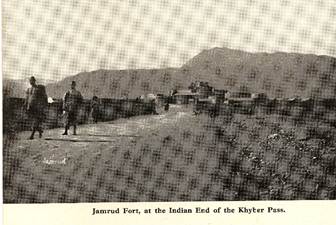
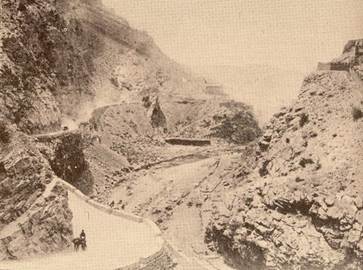 The fabulous Khyber Pass, between Peshawar(in modern Pakistan)
and Jalalabad in Afghanistan.
The fabulous Khyber Pass, between Peshawar(in modern Pakistan)
and Jalalabad in Afghanistan.
Resistance was ferocious. In January 1842 16 500 British-Indian soldiers (and 12 000 dependents) were massacred in Kabul, only one survivor surviving to reach Jalalabad. Dost Mohammad Khan was restored, and reigned to 1866, In 1859 Britain took control of Baluchistan, to the south of Afghanistan, thereby blocking Afghanistan’s access to the sea.
Meanwhile Russia was extending its influence from the north. In 1878 the Second Afghan War broke out as Britain moved north: the Afghans resisted strongly but in 1879 Amir Yaqub Khan surrendered areas near the Khyber, which have been permanently lost to Afghanistan.
 Resistance continued: for
example, at the Battle of Maiwand, in July 1880 an Afghan woman named
Malalai carried the Afghan flag forward after the soldiers carrying the flag
were killed by the British. She has become a national hero. Eventually a peace agreement
was reached. Abdur Rahman became Amir and many border areas were taken over by Britain.
Britain also retained the right to handle Afghanistan’s foreign relations.
Resistance continued: for
example, at the Battle of Maiwand, in July 1880 an Afghan woman named
Malalai carried the Afghan flag forward after the soldiers carrying the flag
were killed by the British. She has become a national hero. Eventually a peace agreement
was reached. Abdur Rahman became Amir and many border areas were taken over by Britain.
Britain also retained the right to handle Afghanistan’s foreign relations.
The border to the Russians was settled in 1885, and in 1893 border with the British was established by the Durand line. This has remained basically unchanged, although it splits various tribal areas between Afghanistan and modern Pakistan.
Slowly, Afghanistan began to modernise. Its final boundaries were settled in 1907 by the convention of St. Petersburg, in which Afghanistan was declared outside Russia’s ‘sphere of influence’.
 It is very difficult to generalise about any country, because any
generalisation has exceptions. When we do generalise, we are only making a
temporary model that will to an extent illustrate a point. Nowhere is this more
true than in Afghanistan.
It is very difficult to generalise about any country, because any
generalisation has exceptions. When we do generalise, we are only making a
temporary model that will to an extent illustrate a point. Nowhere is this more
true than in Afghanistan.
Thus when we talk about the ‘dynasty’ of Amir Abdur Rahman Khan, the grandfather of Amanullah and the ruler of the Kingdom of Afghanistan from 1880 to 1901, we must not overlook the fact that in Afghanistan there are many competing forces. Tribal loyalties dominate, and there are almost too many to summarise[12]. Then there are religious forces of Islam, overlaid with almost medieval concepts of honour, and these are all very strong. Nevertheless, the dynasty did establish some sort of clear leadership and exhibited power, prestige and ambition, including a desire to modernise the country. Amamullah became leader on the assassination of his father in 1919. He moved against the British, taking advantage of their perceived post-war weakness, mainly to assert his leadership. We must not underestimate the power of the traditional forces ranged against him, and certainly there were, and remain, many evil aspects of tribal society: one of the main reasons for not wanting British rule in the remote areas is that these tribesmen resented the threat to their traditional ‘raiding rights’.
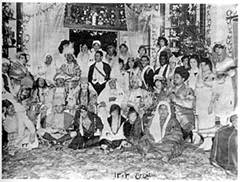
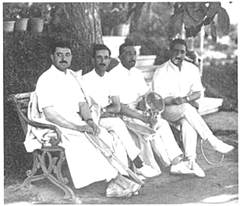
The pictures: previous page, the court of Amanullah; above – Amanullah is at the front of the picture.
The Third Afghan War, 1919
Amanullah declared war on Britain on May 15, 1919[13], with an address at the central Id Gah mosque in Kabul; these are some of the words that he is purported to have spoken on that day:[14]
The treacherous and deceitful English government twice shamelessly attacked our beloved country and plunged their filthy claws into the region of the vital parts of our dear country which is the burial ground of our ancestors and the abode of the chastity of our mothers and sisters, and intended to deprive us of our very existence, of the safety of our honour and virtue, of our liberty and happiness, and of our national dignity and nobility… It became incumbent upon your King to proclaim jihad in the path of God against the perfidious English Government. God is great. God is great. God is great.
Evans explains how he ‘presses the right buttons’ to appeal to his audience.
The British were not depicted as an honourable adversary but as bestial, dirty, and animal-like in their method of assault. They were the attackers, and in their attack they violated the inviolable: the sanctity of the community, defined here in culturally coded terms as ‘the burial ground of our ancestors’ and ‘the abode of the chastity of our mothers and sisters.’ At stake here was more than land; it was honour, liberty, and dignity — values that Afghans esteem above all other virtues. Finally, Amanullah framed his response in religious terms as a jihad, a struggle on behalf of Islam, and he concluded with the traditional rallying cry of Allah-o akbar (God is great).
World War I had brought new skills to the region. Some of the dissidents had actually been soldiers, on both sides, in World War I. These men had good appreciation of tactics coupled with excellent local knowledge. The advance (and particularly, the retreat) of armed columns often met with highly skilled ambushes. The .303 rifle was widely available to dissidents, and it had an effective range of over 1000 yards, about a kilometre, [15] whereas the older rifles were very inaccurate after about 300 yards. For this reason, aircraft found it necessary to make their bombing attacks from no lower than 5000 feet. 1.25 km.[16]
The best of the British soldiers had been deployed to the main theatres of World War I. Their replacements, Territorial soldiers, were of lesser quality. The Field Service Regulations, which governed the conduct of military operations, were very much out of date. A new training program was to be introduced – against some resistance from many traditional soldiers – in 1916, in response to the success of the insurgents.
After some early Afghan successes, the British mobilised large forces as soon as they became available at the end of World War I. In a single month’s bitter fighting some two thousand British and an indeterminate number of Afghans, possibly as low as a thousand or so, were killed. However an armistice was concluded (the 1919 Rawalpindi Agreement). Among other factors, British bombing of Kabul and Jalalabad was a factor in persuading the Afghans to agree to the armistice, while the British were reluctant to undertake a major invasion.
The later treaty of 1921 tacitly accepted Afghan relationships with the Soviet Union (one of the first countries to recognise the new regime). The treaty recognised Afghan independence but did not accept Afghanistan’s rights to control the Pashtun tribes, some of which were on the British side of the Durand Line. Amanullah was able to maintain his leadership position.
Air action
Most of the air action was carried out by 31 squadron, RAF, and its history provides some interesting light on RAF procedures and attitudes. From its history:
Hostilities were finally declared on 6th May, 1919 and during early air operations, 31’s BEs often returned to base sporting bullet holes and flapping fabric, a sure indication of the shooting abilities of the Afridi tribesmen, although the BE pilots often flew so low they presented easier targets. The tribesmen were occupying high ground bordering the, Khyber Pass and the area of Dakka. Dakka itself was successfully bombed on 9th May, a total of 16 aeroplanes making continuous attacks throughout the day. Later reports indicated as many as 600 casualties among the tribesmen plus two elephants killed!
|
|
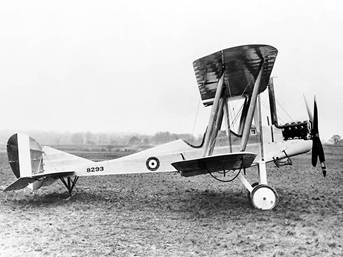
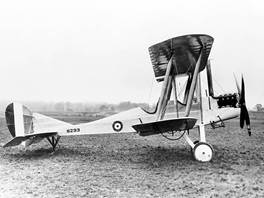 The
Royal Aircraft Factory BE2c was designed in 1915. Despite the enormous gains
that were made in aircraft technology during the war, this aircraft was still
in service after the war in India. Its tiny 90 hp, 67 kw, power gave it a
speed of 90 mph, 145 km/hr, at sea level. It had so little spare power that
only one machine gun was fitted, and it could only carry a few small bombs.
The
Royal Aircraft Factory BE2c was designed in 1915. Despite the enormous gains
that were made in aircraft technology during the war, this aircraft was still
in service after the war in India. Its tiny 90 hp, 67 kw, power gave it a
speed of 90 mph, 145 km/hr, at sea level. It had so little spare power that
only one machine gun was fitted, and it could only carry a few small bombs.Neither the 31 squadron or official RAF records are complete as regards the use of the big Handley page bombers. The 31 squadron history mentions that on 13 May a Handley Page bomber was flown in from Lahore to fly in the campaign, but was destroyed in a storm while still on the ground. Certainly, BE2cs were used widely: a BE crashed during a reconnaissance, but the crew of two were ransomed from Afridi tribesmen, for 30,000 rupees.
The actual events that occurred are not documented to a standard that clearly indicates what happened. According to the 31 squadron history,
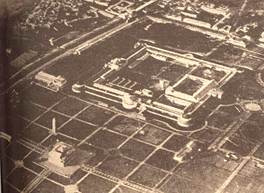 Jalalabad was bombed on l0 May, one bomb hitting
the Amir’s palace,(see picture) and four falling among Afghan troops. There
were large casualties and a deputation of Afridis and Mohmands, who had arrived
to discuss their co-operation with the Afghans as well as to collect guns and
ammunition, found themselves in possession of the town. Making the most of
their good fortune they proceeded to thoroughly loot the bazaar.
Jalalabad was bombed on l0 May, one bomb hitting
the Amir’s palace,(see picture) and four falling among Afghan troops. There
were large casualties and a deputation of Afridis and Mohmands, who had arrived
to discuss their co-operation with the Afghans as well as to collect guns and
ammunition, found themselves in possession of the town. Making the most of
their good fortune they proceeded to thoroughly loot the bazaar.
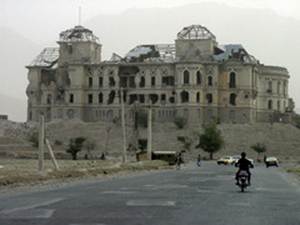 This
statement is really a terrible indictment of the methods being used, The RAF
knew that they were not dealing with uncouth savages. The palace at Jalalabad
was relatively new – only about 350 years old – and was an imposing building,
as seen from the aerial photo above. Incidentally, it is reported that its
successor building was, in October 2001, destroyed by American bombing.[17]
This is not so: the building destroyed by the US was the Kabul palace (pictured
left).
This
statement is really a terrible indictment of the methods being used, The RAF
knew that they were not dealing with uncouth savages. The palace at Jalalabad
was relatively new – only about 350 years old – and was an imposing building,
as seen from the aerial photo above. Incidentally, it is reported that its
successor building was, in October 2001, destroyed by American bombing.[17]
This is not so: the building destroyed by the US was the Kabul palace (pictured
left).
Aircraft 2: Handley-Page V/1500 heavy bomber
|
.A number of these aircraft were sent to the Middle East;
but they were not very reliable. Only one seems to have been used for
bombing. This was a big aircraft (length: 64 ft (19.50m) span: 126 ft (38.41m) height: 23 ft (7.01m)). Up to seven men formed the crew. It is interesting to note that aircraft of this size were not built for many years after the end of World War I, the RAF preferring smaller bombers. The Avro Lancaster of World War II had a shorter wingspan and was only a few feet longer than the V/1500.
It is interesting to note that the majority of the military work done in the inter-war period was done by single-engined aircraft, despite the dangerous terrain. |
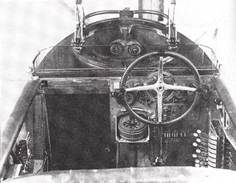 The Handley Page V/1500 was about to enter
service at the end of World War I. Potentially, the V/1500 could carry up to
7 500 lb (about three tonnes) of bombs. Two machine guns were in a nose
turret. It had four Rolls-Royce Eagle engines of 360 kW, 360 hp, and had a
range about 800 miles, 1100 km, with a speed of about 100 mph, 160 km/h.
The Handley Page V/1500 was about to enter
service at the end of World War I. Potentially, the V/1500 could carry up to
7 500 lb (about three tonnes) of bombs. Two machine guns were in a nose
turret. It had four Rolls-Royce Eagle engines of 360 kW, 360 hp, and had a
range about 800 miles, 1100 km, with a speed of about 100 mph, 160 km/h. 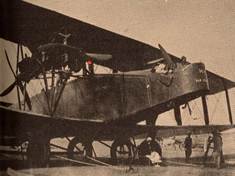 It is believed that the only mission flown was to Jalalabad,
Afghanistan
It is believed that the only mission flown was to Jalalabad,
Afghanistan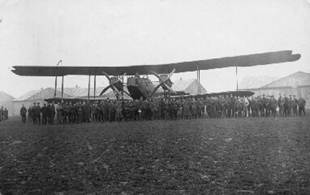 A predecessor of the
V/1500, the 0/400, was flown in Mesopotamia towards the end of the World War
I. The most successful aircraft was serial number C9681, flown by Captain
Ross Smith, from No. 1 Squadron of the Australian Flying Corps, later to be
more famous as being the first to fly from England to Australia.
A predecessor of the
V/1500, the 0/400, was flown in Mesopotamia towards the end of the World War
I. The most successful aircraft was serial number C9681, flown by Captain
Ross Smith, from No. 1 Squadron of the Australian Flying Corps, later to be
more famous as being the first to fly from England to Australia.The squadron history continues:
By now the Afghans were completely demoralized by the constant attentions of the RAF. With Jalalabad badly damaged, large numbers of enemy troops and tribesmen began to retire from the front without taking any part in an offensive.
To a large extent, it was this conflict that was to set the stage for the use of ‘Air Control’ in the North-West Frontier Province, the border area east of Afghanistan, which remains troublesome to this day.
The bottom three pictures: Start of the Khyber Pass; Peshawar fortress; Peshawar markets.
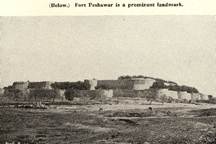 |
Box 2: The Afghan air force
|
They received three Bristol fighters in 1919 and two Avro 504ks and two DH9s in 1924. In 1927 there were about 15 machines, mainly with Russian crews, which arrrived in 1925.[20] It is also documented that in 1928 there were some rather decrepit DH-9s (not the Liberty-engined DH-9a, used by the RAF in the inter-war period) in use, again with Russian pilots. These were used for control measures against dissident tribes. It is fascinating to note that when the British were negotiating with both sides of the civil war when setting up the Kabul airlift. One of the problems was that many of the revolutionaries thought that all aircraft were associated with the Afghan air force and shot at them whenever they came into range[21]. The same source also indicates that there was at least one Junkers aircraft, possibly even an early three-motored monoplane, in use in Afghanistan at the time of the Kabul airlift (1929)[22]. It appears that the air force was not operational for a few years after the civil war of 1929. During the 1920 and 1930s the RAF exercises had in mind that a potential enemy was Afghanistan (see page 11). Nevertheless in 1937 Afghanistan purchased eight new Hawker Hind light bombers, new, direct from England, and at least 20 more, ‘used’ examples were acquired from the RAF during World War II. These aircraft were in service until the late 1950s, and their remains have been eagerly sought by aircraft restorers[23]. The picture: A Hind recovered from Afghanistan which is now in the British Shuttleworth Collection. |
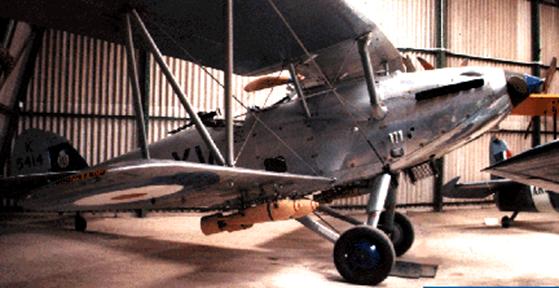 Some sources mention that Afghanistan had an
air force after World War I, staffed by Russian aviators and flying Russian
aircraft
Some sources mention that Afghanistan had an
air force after World War I, staffed by Russian aviators and flying Russian
aircraft
Egypt and the Sudan
The drawing comes from an adventure story set at Farafra
Oasis in the Western 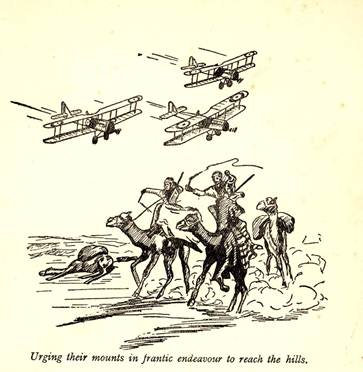 Desert of Egypt, printed 1933. There are no recorded
actions in this area.
Desert of Egypt, printed 1933. There are no recorded
actions in this area.
European influence came to the Sudan with the famous explorers such as Baker and Speke in the 1850s and 1860s. The famous British imperialist, ‘Chinese’ Gordon became governor of the Sudan in 1873 as British influence developed; his reforms, including attempts to stop the slave trade, were resisted. He was assassinated in 1881 and Muhammad Ahmad declared himself to be the Mahdi (‘the divinely guided one’).
Britain took over Egypt in 1882 when a nationalist revolution broke out, and the Sudan was reconquered by building a railway from the navigable Nile to the south. Kitchener’s troops were thus able to bring a modern industrialised army to Sudan. Kitchener’s 25 000 men defeated the 60 000 strong army of the supporters of the Mahdi of Sudan at the Battle of Omdurman in 1898.
France also was interested in moving into the area: they even an expedition to the Sudan from their possessions in central Africa, and there were even dreams of damming the Nile so as to control Egypt. After a lot of political argy-bargy the Anglo-French agreement of 1899 agreed that the Nile basin was a British possession.
A nice romantic picture of Fairey IIFs on the Nile.[24] See page 67 for information on the Fairey IIIF.
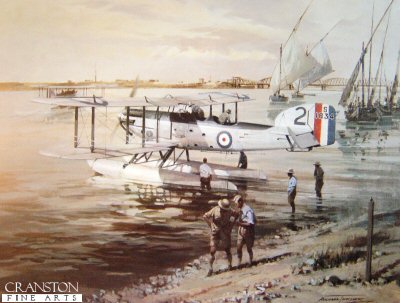 There
is a report that aircraft were used for ‘pacification’ of Egypt as early as
1916. [25]. Certainly
after 1920 there were many air strikes against the Nuer, a tribe of the Darfur
region of west Sudan. It is said that they built an earthen pyramid, 60 feet
high, as a site for animal sacrifice intended (in part) to ward off British air
attacks.
There
is a report that aircraft were used for ‘pacification’ of Egypt as early as
1916. [25]. Certainly
after 1920 there were many air strikes against the Nuer, a tribe of the Darfur
region of west Sudan. It is said that they built an earthen pyramid, 60 feet
high, as a site for animal sacrifice intended (in part) to ward off British air
attacks.
In 1920 47 Squadron RAF was reformed at Helwan in Egypt, flying DH-9as. Their history says that they ‘bombed the Nuer in Sudan in the 1920’s’. The following year the unit began ‘air policing’ duties in the Sudan.[26]
The Neo-Mahdists, angry about the way that traditional culture was being eroded, began to become troublesome after World War I. In the Sudan itself a major revolt, which included some Egyptian army groups, was put down in 1925. The amount of air action in this event is not clear.
47 squadron later received Fairey IIIFs fitted with floats for operating off the Nile. ‘In 1929 the Nuer were again revolting against the government, but were quickly brought to heel with two days of bombing and some demonstration flights’. [27].
Air Control of the Sudan has resonances in very recent times. The US destroyed some pharmaceuticals plants in Khartoum in a cruise missile strike on August 20, 1997, in retribution for some bombing of US embassies in Nairobi, Kenya, and Dar es Salaam, Tanzania.
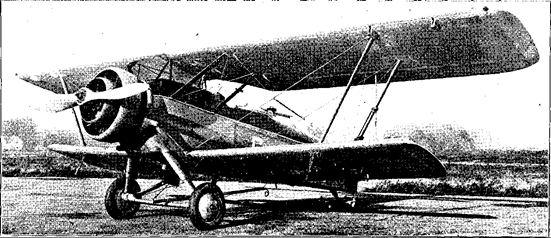
Aircraft 3: The Armstrong-Whitworth Atlas
|
Its Armstrong Siddeley Jaguar engine produced 450 hp (336 kW), giving it a top speed of 142 mph, 229 km/h. With the standard Vickers front gun / Lewis moveable gun, it could carry up to 4 112 lb (50 kg) bombs, and had a range of about 400 miles, 650 km/hr. Its main virtue seems to be its ruggedness; it had a strong metal substructure. The Atlas was itself replaced by the Hawker Hart and Audax within five years.
|
Somalia 1920
A successful action in Somalia (then called Somaliland) in 1920 was a real boost to the RAF’s reputation.
Somalia was probably the ancient land of Punt, celebrated as a trading partner of Egypt, notably in the time of Hatshepsut, about 1500 BCE. Much of the coastal area of the northern ‘Horn of Africa’ was occupied by Britain in 1884, as part of its policy of protecting its trade routes. The remaining area became an Italian colony in 1889.
Mohammed Abdullah Hassan (1864-1920) was an Islamic scholar and member of the Salihiyah, a militant, reformist, and puritanical Sufi order. At the end of the 1800s he began to call for the expulsion of the English ‘infidels’ from his native Somalia and strict observance by all Somalis of the Islamic faith. Between 1900 and 1904, four major British, Ethiopian, and Italian expeditions were sent against him; a truce was concluded in 1905, limiting him to a small theocratic state in the Italian protectorate. He began his holy war again in 1908: by the end of World War I he was posing a very strong challenge to British rule.[28] He had obtained help from the Turkish-oriented Ethiopian Emperor, Lij Yasu, who provided him with weapons, ammunition and a Turkish fortress architect. Soon there were about 30 new stone forts in Northern Somalia and the Ogaden (the point of the ‘horn’).[29]
By May, 1919, the British government, under Lloyd George, had determined that
military action was essential if the ‘Mad Mullah’ was not to take over the
entire county. However, the cost of sending the necessary two divisions to Somalia
and subsequent costs of control, was enormous[30].
Milner, the Colonial Secretary, asked Trenchard what the RAF could contribute to any operation – and Trenchard offered to solve the whole problem by use of air weapons, assisted only by the locally based two battalions of infantry and a detachment of camel-mounted troops.
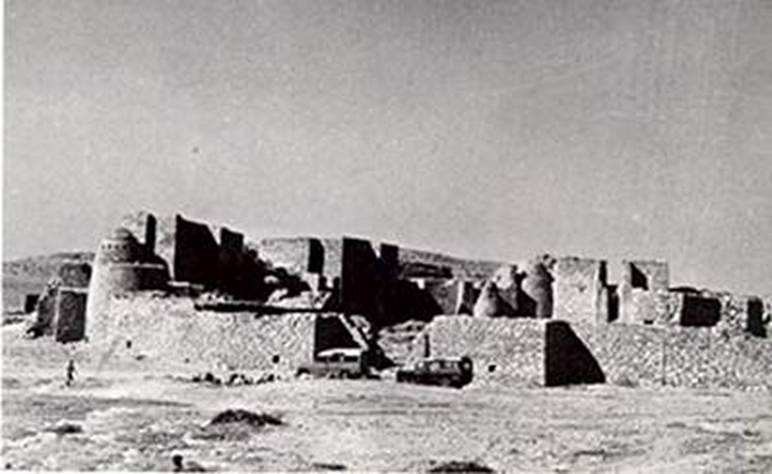
Fort, possibly the one at Taleh
This idea was strongly resisted by Wilson, the Chief of the Imperial General Staff – the senior military officer of Britain. A conference was called, which was attended by Winston Churchill, Wilson, and others. Churchill, as chairman, overruled Wilson and the project went ahead. Wilson prophesied that the idea would be a complete failure, but Churchill and Trenchard kept up the pressure to launch the operation[31].
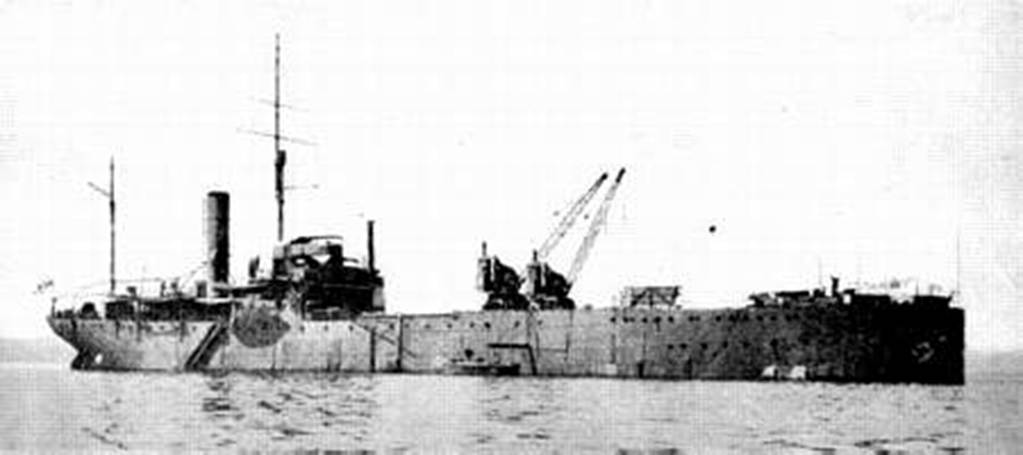
Ark Royal, the seaplane carrier which took the squadron to Berbera.
Group-Captain Robert Gordon[32]
was given orders ‘to drive the Mullah’s forces into the open by attacking their
camps and forts, the primary targets, then to pursue and harry at leisure’. In
November 1919 he and two others arrived at Berbera, pretending to be the
advance party for an oil-exploring company.
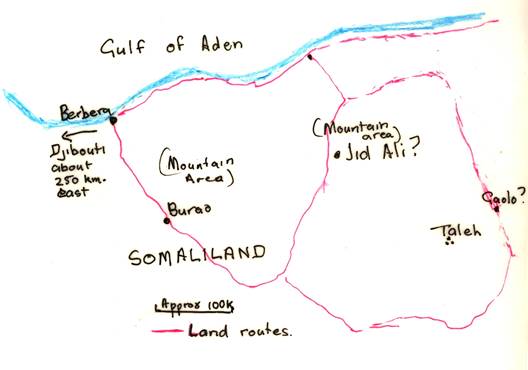
They started up with preparing an aerodrome (‘site for drilling equipment’) at Berbera. Next an aerodrome was made near Burao, 140 km. from Berbera and 150 km. from Eli Dur Elan fort, where the Mullah was suspected to be. Camels brought up over twenty tons of supplies to Burao, a six day ride.
This was not a regular unit: it was simply labelled ‘Z Force’.
On 30 December, the Royal Navy’s seaplane carrier, Ark Royal, arrived in Berbera with 12 de Havilland 9A aircraft; supported by twelve Ford trucks, two Ford ambulances, six trailers, two motorbikes and two Crossley light trucks. There were 36 officers and 183 men.
The same day the Governor, F G Archer, circulated pamphlets to ‘the Dervishes of the Mullah Mohamed Ben Abdullah Hassan of Ogaden’ granting safe conduct for the followers of the Mullah if they surrendered and offering a reward for the capture of the Mullah of 5000 piastres, with lesser amounts for his male relatives.
This DH-9 of Z Force, serial no D3117, was fitted as an aerial ambulance, the rear fuselage opening to hold a stretcher.
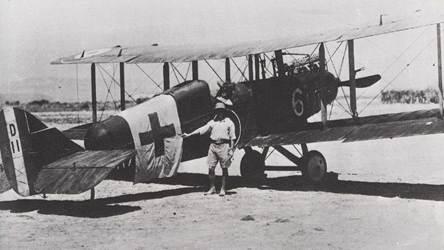
On the 19th January [33],
Force Z was at Burao and two days later the forts of Medish and Jid Ali were
bombed. Mohamed Abdullah had no idea of what was happening, and his sister and
the man standing next to him were killed. More raids occurred, in which many
camels and cattle were killed.
On the 27th, the camel corps surrounded Jid Ali Fort while the RAF bombed it. The defence collapsed, and the Mullah fled eastward to Taleh, where he had built a large fortress. This was photographed by the RAF: he main fort was 100x200 yards and had 12 turrets more than 10 meters high, with grain silos for each turret and accommodation for more than 5.000 soldiers with camels.
The RAF built a new base at Gaolo, and this took about three
weeks. The fort was them bombed with 112 lb (50kg), 20 lb (9kg) and 2 lb (1kg)bombs,
the village was bombed with incendiary bombs and the cattle and camels 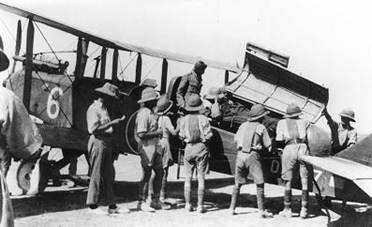 strafed with machine guns. Other
tribes also attacked the Mullah’s supply train and captured more than 1400
camels.
strafed with machine guns. Other
tribes also attacked the Mullah’s supply train and captured more than 1400
camels.
On 9 February the ground troops reached Taleh, and the Mullah fled, reaching temporary safety with only two or three companions. The ground troops killed six of his sons, and captured four wives, four daughters and other family members. The Mullah was shortly afterwards assassinated in Abyssinia.
Amery, Milner’s deputy, wrote a jubilant report.
The borrowed planes flew back to Cairo. The King’s African Rifles were sent back to Mombassa. The tribal levy returned to their lands laden with loot. All was over in less than three weeks. The total cost, including transport of the King’s African Rifles, extra pay to the Camel Corps and petrol for the Royal Air Force, worked out at £77,000, the cheapest war in history. For the next twenty years, till the Italians invaded it in the last war, Somalia enjoyed the blessings of an undisturbed peace.
More sympathetic sources indicate that he is still remembered in Somalia as a freedom fighter who fought the British and the Italians.
He was a gifted poet, a natural leader of men, a religious leader and up to the end was believed to have supernatural powers.[34]
This event was very beneficial to the future of the RAF, but having resoundingly demonstrated their capability, they needed to find new work, preferably of longer duration.
|
It could carry up to 209 kg, 460 lb, of bombs and had a forward firing fixed .303 machine gun and a moveable gun for the second crew member The DH-9a had an American Liberty engine, of 298 kW, 400 hp, and this enabled the aircraft to carry up to 299 kg, 660 lb of bombs. This version was popular for overseas service. The DH-9 in various forms had a long career; it was an early QANTAS aircraft, and was still in service in the Spanish Civil War in the late 1930s This DH-9a of 8 Squadron RAF served in India in the 1920s.. An extra radiator has been installed below the engine. They often carried other equipment such as a spare wheel strapped to the side of the fuselage. |
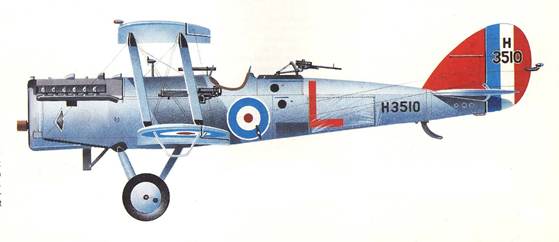 The brilliant designer Geoffrey de Havilland designed the DH-9 as a
bomber in 1917, when the German Gotha bombers had shocked Britain by bombing London.
There was demand, from public and politicians, for more bombers for the RFC.
Essentially, the DH-9 was a development of the earlier DH-4, a major design
difference being bringing the crew positions closer together.
The brilliant designer Geoffrey de Havilland designed the DH-9 as a
bomber in 1917, when the German Gotha bombers had shocked Britain by bombing London.
There was demand, from public and politicians, for more bombers for the RFC.
Essentially, the DH-9 was a development of the earlier DH-4, a major design
difference being bringing the crew positions closer together.Box 4: It’s a tough life, but someone’s got to do it….
|
Certainly, many aspects of the life of the Air Control airman were not pleasant: the extremes of temperature, the use of open-cockpit aircraft, and so on. Fatalities, from accidents as well as enemy fire, were not infrequent. But they certainly had a good life in other ways. Flying Officer Dudgeon, who served in the North-West Frontier Province (NWFP) in 1934, describes his life. He had six personal attendants: Kali, his ‘bearer’. controlled the staff and personally waited on Dudgeon, assisted by a ‘chokra’. Washing was done by the ‘dhobi’ and often there were four changes of clothes in a day. A shared ‘mali’ looked after the garden and surroundings of the accommodation building, which contained four officer units. A ‘chowkidar’ stood watch at night-time to guard against burglars and assassins. Finally, the ‘sweeper’, of the lowest caste, emptied the toilet pan and bath water, and also did some cleaning. Each was a member of an hereditary caste, which restricted them from participating in the others’ duties. In the morning, for example, Kali brought him a cup of tea in bed, then prepared his bath, shaving gear and toothbrush. After Dudgeon’s bath Kali helped him dress. ‘My shirt was over the chair, rank badges already buttoned in place on the epaulettes. One stocking was over each chair-arm with the feet folded in for easy putting-on. Shorts on the chair seat. Gleaming black polished shoes on the floor with the laces undone. Brush and comb, coins, wallet and clean handkerchief in a line on the dressing table. Kali only produced and filled my cigarette-case for evening wear, as I was a non-smoker’. When breakfast was served…. ‘In the toast-rack, two slices of freshly made toast, with the marmalade, and butter in a dish with ice to stop it melting. Also, a glass of iced coffee with just the right amount of sugar and milk already in it’.
Slessor made the point that Air Control was not terribly demanding on the pilots: – ‘the officers who had been in action in Waziristan in the morning could be playing polo in Risalpur or Peshawar in the afternoon’.[36] The formal sport of hunting was also popular, as well as less formal shooting expeditons. ‘Beau’ Carr[37] spoke about the mess arrangements in Iraq in 1934. Whisky was 2/6d a bottle, gin 1/6d. If an officer’s drink bill was more than £5 a month, ie 40 bottles of whisky, the Commanding Officer would interview him to suggest that this might be excessive. Carr also describes the airfield at Habbaniya[38], completed in 1937. ‘It had playing fields, golf course, riding stables, polo pitch, hospital, the finest swimming pool in the Service, 56 tennis courts and a magnificent gymnasium’. Gardens were irrigated from the nearby Euphrates – ‘lawns and flowerbeds were everywhere’. The 28 miles of tree-lined streets were had British names such as Piccadilly.
|
|
|
|
|
 Polo was a very important activity. If an officer did not
 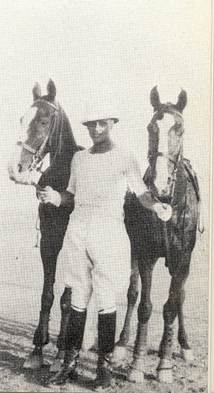 have the money to buy ponies, there was a
special mess fund to enable him to do so. Broken-in, properly trained ponies
cost up to 1000 rupees, £80, but others could be bought from the Bedouin for
around 150 rupees
have the money to buy ponies, there was a
special mess fund to enable him to do so. Broken-in, properly trained ponies
cost up to 1000 rupees, £80, but others could be bought from the Bedouin for
around 150 rupees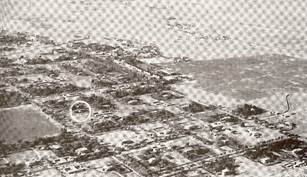
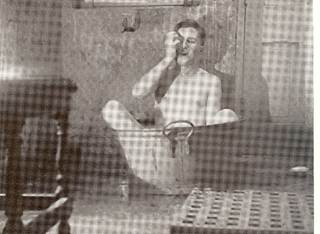
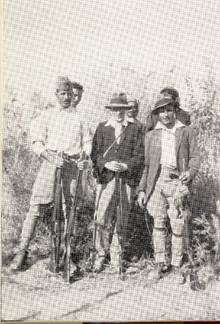
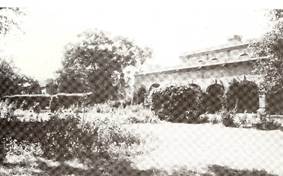 Illustrations: Dudgeon and his polo horses, crosses between ‘Walers’
(Australian Cavalry horses) and Arabian horses; the bathroom was rather
primitive; view of Risalpur (polo grounds to the left of Dudgeon’s bungalow,
circled); Dudgeon’s bungalow; some hunting parties.
Illustrations: Dudgeon and his polo horses, crosses between ‘Walers’
(Australian Cavalry horses) and Arabian horses; the bathroom was rather
primitive; view of Risalpur (polo grounds to the left of Dudgeon’s bungalow,
circled); Dudgeon’s bungalow; some hunting parties.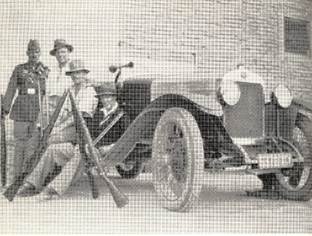
Section 3: The development of Air Control
Some background
World War I was tremendously expensive. Germany was subjected to the punitive Treaty of Versailles, involving disarmament, payment of reparations, and loss of her colonial empire. The Austrian empire and the Ottoman (Turkish) empire were dismembered. The colonies were awarded, mainly to France, Britain, and (in the Pacific) Japan, as ‘mandated territories’, to be ruled, in theory, on behalf of the newly-formed League of Nations.
In the light of the assistance that had been given to the British and the consequent assurances of support given by T E Lawrence ‘of Arabia’ the Arabic colonies of the Ottoman empire could reasonably have expected to become independent. But new mandated territories were established – Iran, Persia, Palestine and Transjordan under the control of Britain, and Syria and Lebanon, under the control of France. The border lines were drawn to suit the political desires of Britain and France rather than by reference to the tribal groupings of the people, with consequent problems that remain to this day as is explained on page 51. Kuwait had been a British protectorate since 1899; the British had taken sides in a tribal squabble and bought the loyalty of the tribal chief. Now, in the age of oil, it was a funnel through which oil could pour.
The Liberals had governed Britain since 1902. David Lloyd George had been Prime Minister of Britain since 1916, when he replaced Henry Asquith; at the same time Churchill had been demoted following the failure of the Dardanelles expedition of 1915. Lloyd George was keen to reap the rewards of ‘winning’ the war, and Churchill was back in favour, in the critical role of Secretary of State for War. Both were keen to extend the Empire and the power of Britain. However the shortage of money in Britain was compounded by a reluctance, both in Britain and in India, for conflict that caused loss of life and expense. There was opposition, led by the ‘Press Barons’[39], Lords Northcliffe and Rothermere to the idea of spending money for ‘Empire’, There was strong support for the idea of abandoning these troublesome overseas possessions and concentrating exclusively on the solution of domestic issues. The political situation was already rather shaky. But Churchill was determined to hold on to the empire. In the House of Commons, 15th December, 1919 he said
I must remind Hon. Members that we have still an Empire to defend. Odd as it may seem on the morrow of unheard-of victories, we have all those dependencies and possessions in our hands which existed before the war, and in addition we have large promises of new responsibilities to be placed upon us….
And he also had the solution:
The first duty of the Royal Air Force is to garrison the British Empire….[40]
The Royal Air Force
The RAF as a separate organisation had come into being on 1 April, 1918, amalgamating the Royal Flying Corps (RFC) of the army and the Royal Naval Air Service (RNAS). air operations into a single command.
With the end of the war, the budget for armament was, of course, vastly reduced, and there was competition among the three services for the money that was available. The army and the navy had a long history, and many friends in high places, so there was considerable pressure for the abandonment of the air force to save money. 5 Soon after the war, development of armaments was further impeded by the adoption of the ‘ten-year rule’ – the idea that there would be no major conflict for ten years, so long-term planning was unnecessary.
Each service sought to establish its needs for special priority. The navy proposed that Japan’s increasing naval capability was the most serious threat to British interests; and the army proclaimed Britain’s danger from Europe, needing forward defence along the Rhine[41]. The army and the navy agreed on only one thing: the RAF should be split into two small air arms, supporting each service.
In 1923 the total defence budget was about £122 millions. The presence of 60,000 troops in Iraq had not prevented a rebellion in 1919-1920 which cost Britain 2,000 casualties and about £100 million to suppress[42].
Lord Trenchard of the Somme
Trenchard, inaugurating an Auxiliary Air Force squadron in 1935.
Hugh Trenchard was from a family that traced its military
lineage back to one Raoul de Trenchant, who had served with William the
Conqueror at the Battle of Hastings. His supporters were 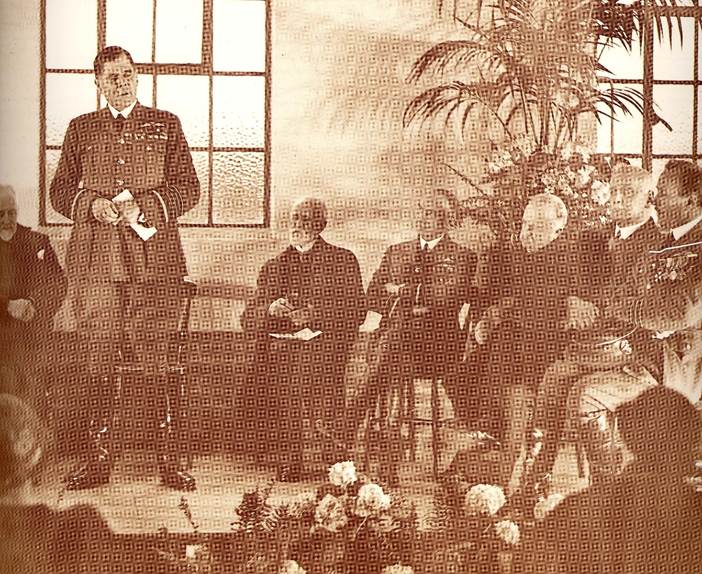
impressed with his intellect, but he actually had difficulty in expressing his
thoughts, both in speech had in writing. ‘He used always to have someone whom
he called ‘my English merchant’ to translate his thoughts into ‘readable
English’ said his sometime assistant, Slessor. However, he was stubborn and
shrewd, self-assured, loyal to his superiors, and able to inspire his own men.
 He had served in the Boer War, actually with Australian horsemen,
whose skills he greatly appreciated. Having been wounded, he learnt to fly and
advanced through the ranks of the Royal Flying Corps to become leader of the
forces in France. Due to a quarrel with Lord Rothermere, then Air Minister, he
did not take supreme command of the RAF when it was formed. He did lead the
Independent Air Force, a combined English / French / American strike force
during the last six months of the war, but after the war was ‘unattached’.
After a short period in the wilderness, Churchill appointed him Chief of Staff
of the RAF on 31 March 1919.
He had served in the Boer War, actually with Australian horsemen,
whose skills he greatly appreciated. Having been wounded, he learnt to fly and
advanced through the ranks of the Royal Flying Corps to become leader of the
forces in France. Due to a quarrel with Lord Rothermere, then Air Minister, he
did not take supreme command of the RAF when it was formed. He did lead the
Independent Air Force, a combined English / French / American strike force
during the last six months of the war, but after the war was ‘unattached’.
After a short period in the wilderness, Churchill appointed him Chief of Staff
of the RAF on 31 March 1919.
He is justly remembered as the ‘father of the RAF’. After he retired in 1930 he was asked to become Metropolitan Police Commissioner, and during World War II he acted as Inspector General of the RAF. He died in 1956.
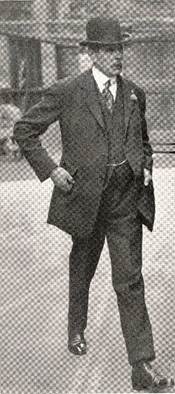
Trenchard in 1922.
Trenchard was determined to build a strong foundation for the air force. The first year’s budget was £25 million and of this £15 million was spent on permanent stations and administrative facilities at home – including the establishment of such famous bases as Hendon and training facilities such as Cranwell. Only £2 million was spent for maintenance, research, and civil aviation.
His deployments were also controversial. He had 25 ½ squadrons, and he based 19 of them overseas: 8 in India, 3 in Mesopotamia, 7 in Egypt, and 2 divided among the various naval bases. Only 2 fighting squadrons were left to protect Britain, after 2 ½ had been allocated for work with the home fleet and 2 for army co-operation.
I believe that there were two reasons for this deployment. [43] Firstly, he saw the potential of the air force to control recalcitrant subjects of the empire. Secondly, it appears that the local imperial government was responsible for paying for the squadrons’ operations[44]. This latter point may also explain the poor state of repair of RAF aircraft in India in 1921. Of the 8 squadrons, only about a dozen aircraft were typically serviceable. Airmen were annoyed that they were flying obsolete aircraft, equipped with engines that had only single ignition systems, while modern aircraft and engines with dual ignition systems were being sold for scrap value in Britain.:
The famous World War II bomber command leader Arthur Harris, whom we will meet again, was commander of 31 squadron, flying Bristol Fighters. First he was at Cawnpore, India, and later at Peshawar. He was on the point of resigning over the state of repair of his aircraft when Sir John Salmond arrived on an inspection tour. Salmond agreed with his complaints, and the situation improved.
It is fair to point out that Trenchard’s emphasis on laying a strong organisational base for the RAF at home was proven to be very wise. [45] The RAF was quickly expanded during the late 1930s, and had an excellent command structure and, above all, good organisation for defence of the country. This contrasts with the ad hoc organisation of the Luftwaffe – but this theme is outside the scope of this discussion.
|
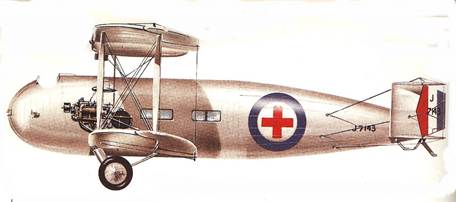
The Vernon is the civil transport version of the Vickers Vimy, a 1918 bomber design that, like the V1500, did not see service in World War II. The Vimy was the first plane to fly the Atlantic and the first to fly from England to Australia. But it was a pretty fragile thing by modern standards, with open cockpits for its crew of up to 4. Its two engines of about 270 kW (330 hp) gave it a tested maximum speed of about 103 mph, 166 km/hr. Its range was about 1450 km, 900 miles, and it could carry a little over a tonne of bombs. Two moveable machine guns, one at the front and one at the back, were also often fitted. Though Vimys were sent to Egypt and other places in the Middle East they do not figure much in the various narratives of action. The Vernon was a later civil conversion. It had a much fatter fuselage than the Vimy and could carry nine passengers, though, as the engines were much the same, speed was greatly diminished. 100 mph, 160 km/hr was claimed, but normal speed was around 70 mph at best. In fact the Vernon’s climbing ability was so poor that in Mesopotamia Harris’ squadron improvised an instrument which located rising streams of hot air so that it could reach a respectable altitude. The instrument consisted of a petrol can with no bottom and a small hole in the top, linked by a tube to a dial on the instrument panel. It was copied from similar devices on dirigible balloons.
Vernons were big aircraft for their time. Wingspan was 68 feet, 20.75 metres, and they were 43½ feet, 13.25 metres long. The pictures show a Vimy (above) and a Vernon with ambulance markings as used in the Middle East. |
 Harris’ 47 squadron also modified their ‘civil’
Vernons to serve as bombers. They were used as such in Mesopotamia at various
times.
Harris’ 47 squadron also modified their ‘civil’
Vernons to serve as bombers. They were used as such in Mesopotamia at various
times.The Cairo Conference – the inauguration of Air Control
Air Control as described on page (ii) was initiated by the Lloyd George government before its defeat in 1922. The new mandates, described on page 20, had very quickly became ‘troublesome’.
In May, 1920 [46]a local rising broke out in the Euphrates valley and quickly spread. It was difficult to develop a concerted plan for action, because responsibility for the mandates had been spread among several British government departments and agencies[47]. Lloyd George therefore handed full control to the Colonial Office. A new Middle East department took over on 1 March, 1921, controlled by Winston Churchill.
A standard military action began against the rebels, with air support from a squadron sent from Egypt and army reinforcements sent by rail from India. But the revolt continued to spread, and the expense continued to mount.
Churchill, remembering Somalia, consulted Trenchard and found him prepared with a rough alternative plan for policing Iraq from the air. Churchill persuaded the Cabinet to agree to try Trenchard’s scheme for air control, and immediately convened a conference at Cairo to plan implementation. Once again, Wilson, the CIGS, opposed the idea, but was overruled, largely because of the success of the Somalia venture.
Trenchard was reluctant to go to the conference: he did not want to leave Britain for two reasons. Firstly, the RAF was still threatened with extinction. Defence policy was being dominated by the ‘ten year rule’ – the idea that there would be no major conflict during the next ten years, and the army and navy were again pressing for abolition of the RAF in favour of smaller air detachments under direct control of the army and navy. Surely two services could be run more cheaply than three!
The second reason was that Trenchard had recently married. His wife was pregnant. It was an out-of-character moment of personal affairs interfering with his career. Churchill insisted that he attend, and promised to keep the conference short!
Sir Percy Cox, the High Commissioner in Iraq, Sir Herbert Samuel, the Governor-General of Palestine, and Lord Reading, the Viceroy-designate of India were particularly antagonistic to the idea of Air Control. But Churchill dominated the one-week conference and the policy was adopted.
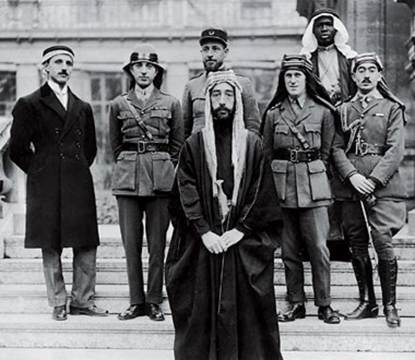
The conference also determined to chose Faisal as Iraq’s first King. This was later confirmed by a one-question plebiscite. The British hoped that he would be accepted by all groups in Iraq because he had been a strong nationalist and his family had an impeccable record of service to Islam. He traced his descent from the family of the Prophet Muhammad. This was a naïve hope[48].
Trenchard was not popular socially with many at the conference, but made two useful converts to his ideas. One was the middle-aged Gertrude Bell, a former amateur archaeologist turned administrator, and the other was the famed, eccentric T E Lawrence. Gertrude Bell agreed that, ‘psychologically, the sight of one squadron of aircraft would be a greater deterrent to trouble-makers than a brigade of infantry’. [49] Provided the air weapon was used with civilised restraint, she believed it would work: a bomb was certainly no worse than a siege-gun as a means of bringing trouble-makers to their senses’. Lawrence, who had seen something of the RAF’s power in action, was an even stronger supporter. ‘Sir Hugh is right, the rest of you wrong,’ he told Cox and the other delegates. We will meet Lawrence again in these notes.
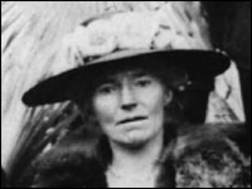
Gertrude Bell was a remarkable woman. A brilliant scholar, she had the wealth needed to devote her life to full-time study of Arabic society. She is credited by some for the creation of the Iraq state in 1919. If this is the case, she severely misjudged the importance of the tribal divisions within Iraq.
Box 5: The view of Lawrence of Arabia
|
King Faisal at the Versailles Conference, 1919. His adviser, T E Lawrence, is third from the right T E Lawrence was distressed at the state of affairs after World War I. His promises of support for Arab nationalism had been set aside. In an article in the Sunday Times on August 22, 1920, Lawrence did not hold back.
Our government is worse than the old Turkish system. They kept fourteen thousand local conscripts embodied, and killed a yearly average of two hundred Arabs in maintaining peace. We keep ninety thousand men, with aeroplanes, armoured cars, gunboats, and armoured trains. We have killed about ten thousand Arabs in this rising this summer. After the Cairo Conference, Lawrence (reluctantly, at Churchill’s urging) became adviser to Abdullah, the King-designate of Transjordan. He had to persuade Abdullah that there was no option to accepting the current arrangements, and that revolt would be useless. Aircraft were an important part in the process. |
 The
people of England have been led in Mesopotamia into a trap from which it will
be hard to escape with dignity and honour……. Things have been far worse than
we have been told, our administration more bloody and inefficient than the
public knows. It is a disgrace to our imperial record, and may soon be too
inflamed for any ordinary cure. We are to-day not far from a disaster.
The
people of England have been led in Mesopotamia into a trap from which it will
be hard to escape with dignity and honour……. Things have been far worse than
we have been told, our administration more bloody and inefficient than the
public knows. It is a disgrace to our imperial record, and may soon be too
inflamed for any ordinary cure. We are to-day not far from a disaster. Box 6: The pilot's viewpoint
|
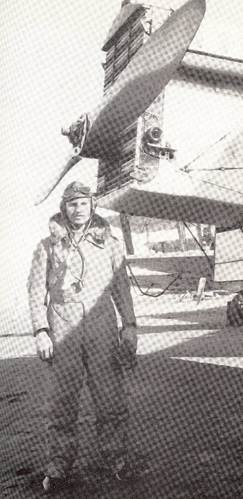
As a young officer, ‘Beau’ Carr’s first appointment was to 55 Squadron, stationed at Hinaidi near Baghdad. His explanation of his role is convincing and illustrates the prevailing understanding of the situation. Until the 1914-18 war the whole of the Middle East, including Egypt, Mesopotamia, Syria, Palestine, Transjordan, and Lebanon, had been part of the Ottoman Empire, but with the defeat of the Turks this whole vast area degenerated into a cockpit of disorganised, undernourished, quarrelsome tribes and ambitious Shaikhs. In an effort to stabilise the situation the League of Nations devised a plan whereby certain of the great powers would be given a mandate to govern these states, with the intention of leading them as quickly as possible to independence. Great Britain assumed responsibility for the security and political integrity of Mesopotamia (Iraq), Palestine and Transjordan, while France accepted the mandate for Syria and Lebanon. For this task the British had a garrison, based mainly on Hinaidi, near Baghdad, of one British and one Indian army division, a brigade of native levies, mostly cavalry, and four RAF squadrons. With this inadequate but expensive force they were expected to police a million square miles of desert and mountain and some thousands of miles of ill-defined frontier. As always, there was pressure at home to bring our boys back and let the Middle East sort out its own problems. To have done this would have been to condemn the countries to wholesale slaughter, and possibly given the Turks the excuse they needed to re-occupy the territories. They had plenty of friends among the leading Shaikhs to assist them. As so often in the past, Trenchard had a solution. He proposed a system of air control whereby the RAF should replace the army and thus reduce the military expense to a fraction of what it took to maintain the existing ground forces. There were many who considered it could not be done, and just as many, I suspect, who hoped it couldn't, but Trenchard's plan as accepted. The army was withdrawn, except for the native levies, the RAF was assigned what was called a peace-keeping role, for which purpose its strength was increased to eight squadrons plus four squadrons of armoured cars, and the first ever system of garrisoning a country from the air was under way…… That was in 1922. By 1930, so successful had the system proved that the force had again been reduced and the entire job was now carried out by five squadrons with six sections of RAF armoured cars.
|
Section 4: The North-west Frontier, 1919-1939
These actions are summarised from my most comprehensive RAF source, a lecture by Flight Lieutenant E J McLoughry, DSO, DFC given in 1933 and widely publicised.[50] The quotations come from this source unless otherwise acknowledged.
Early actions
A typical early operation occurred in March 1921, when a band of one hundred Mahsud raiders stole 50 camels. Later, the same band got in a firefight with an Indian army detachment, wounded a British officer, and inflicted 36 casualties on the Indian troops. The RAF responded with a series of raids and dropped 154 bombs on the Mahsud capital. ‘The area soon quieted down’.
Air Control as such began after the Cairo Conference. The first real test of independent air action came between March and May 1925[51]- Unspecified ‘outrages’ were perpetrated by Mahsud tribesmen in Waziristan. Aircraft from Nos. 5 (Bristol Fighter) and 27 and 60 (DH-9a) Squadrons, commanded by Wing Commander RCM Pink, bombed and strafed mountain strongholds in a successful attempt to crush the rebellion. On 1 May, the rebel leaders sought an honourable peace, and the short campaign known as ‘Pink’s War’ came to a close. A campaign in 1919 had proved inconclusive after causing 1,329 casualties; this latest action resulted in the loss of just 2 RAF servicemen.
The actual casualties of the enemy are not available it is known that they were not large. The GOC Waziristan district stated that the RAF had accomplished something which he could not, under the circumstances, have undertaken with land forces, even had they been available for the duty
Box 7: Was gas used?
|
Accusations have been made that Britain used gas dropped from aircraft to subdue tribesmen.[52] Churchill was indeed considering the use of poison gas bombing in Iraq[53]. He argued that it was actually more ‘humane’ than bombing with explosives. In a letter to Trenchard on August 29, 1920, Churchill stated ‘I think you should certainly proceed with the experimental work on gas bombs, especially mustard gas, which would inflict punishment on recalcitrant natives without inflicting grave injury on them,……… I am ready to authorise the construction of such [gas] bombs at once; the question of their use to be decided when the occasion arises.’ There is clear evidence that gas bombs dropped by aircraft were used by the British in the south of Russia in 1919. The gas used was Adamsite, similar to tear gas but more powerful, supposedly non-lethal. Lethal gas was used by the French and Spanish in Morocco in 1925. However there is no documented use of gas in Air Control or related activities. In view of the letter quoted above, it could well be that this was not because of unwillingness to use this weapon. [54] Omissi[55] makes the point that gas was especially dangerous to the health of the elderly and of children. |
In 1927 a large lashkar* from Mohmand country, led by the notorious Faqir of Alingar, was preparing to descend and attack the blockade posts on the Border. After an ultimatum the lashkar was bombed, with the result that it dispersed within forty hours. The cost of this successful campaign was under £2000, British casualties nil, and between 30 and 40 enemy killed. This compared very favourably with the army campaign cited above, undertaken in the same territory with similar objects.
In 1928[56] some other Mahsud groups, who were in their summer quarters and inaccessible to land forces, committed offences and punishment became necessary. Air operations followed the usual warning and the tribes accepted British terms within a few days. There were no British casualties, and, the RAF claimed, the enemy losses were known not to have been large. ‘Only selected houses in the guilty villages were destroyed, and those of the well disposed were left untouched’.
In July 1930 a rising of the Bajaur tribesmen also occurred. Several villages were bombed and ‘no more than 29 were killed and some dozen wounded’. When a new lashkar was assembling in Utman Khel, it was warned to disperse and did so before any bombing was needed. ‘It is interesting to notice that in no instance in the Utman Khel has any section punished by the bombing of their villages risen a second time’.
Action was also taken at Kotkai[57] in 1933. The Army Secretary to the Government if India was appreciative: the operation conducted by air cost only 15 000 rupees, with only one person injured, whereas a land invasion would have cost over 100 000 rupees and would have had many more casualties, especially seeing that the Bajauri area was malarial and there was no road for the last 30 miles to Kotkai.
|
|
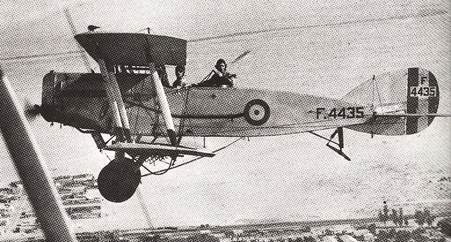 The FE2 (Bristol Fighter) was designed in 1916 and by the
end of the war about 1600 had been built. Production of many variants
continued through the early 1920s and altogether over 5000 were built. The
typical example had an engine of about 275 hp (205 kW), eg a Rolls-Royce
Falcon III liquid-cooled V12 engine. This gave it a maximum speed of about 125
mph, (200 km/h) at 5,000 ft (1,500 m) and a range of about 370 miles, 500 km.
It had a forward-firing Vickers gun and one or two Lewis guns in the observer’s
cockpit. About 240 lb (110 kg) of bombs could be carried. The Brisfit, as it
was popularly known, remained in service until the early 1930s.
The FE2 (Bristol Fighter) was designed in 1916 and by the
end of the war about 1600 had been built. Production of many variants
continued through the early 1920s and altogether over 5000 were built. The
typical example had an engine of about 275 hp (205 kW), eg a Rolls-Royce
Falcon III liquid-cooled V12 engine. This gave it a maximum speed of about 125
mph, (200 km/h) at 5,000 ft (1,500 m) and a range of about 370 miles, 500 km.
It had a forward-firing Vickers gun and one or two Lewis guns in the observer’s
cockpit. About 240 lb (110 kg) of bombs could be carried. The Brisfit, as it
was popularly known, remained in service until the early 1930s.The ‘New Boys Book of the Air’ was published about 1933.

The RAF was very pleased[58]……
Six squadrons – equipped with Westland Wapiti, Hawker Audax and Hawker Hart aircraft – were used in the largest air operation ever undertaken in India, operating under detailed restrictions imposed by the Government of India intended to prevent the death of non-combatants and attacks on friendly tribal sections. Daily reconnaissance sorties located hostile lashkars and enabled column commanders to, determine the number and location of piquets[1] and perimeter camps in advance, and to direct long-range artillery fire. Bomber Transport Aircraft frequently dropped supplies to imperial columns, maintained isolated posts and evacuated casualties.
This increased the administrative and hence the tactical mobility of columns to the extent that following the Khaisora operations it was proposed that supply drops of food, fodder and ammunition should form a normal component of military operations in tribal territory to reduce the amount of pack transport required, remove the need for a permanent line of communication, extend the circuit of action of ground columns and to increase both their speed and mobility.
Throughout 1937 the close-support tactics developed at Khanpur formed an integral part of most operations in Waziristan with aircraft engaging hostile tribesmen in contact with imperial troops and those advancing or retiring in ‘proscribed’ areas in advance or along the flanks of columns,
Even the army was impressed: Sir John Coleridge, GOC Northern Command, acknowledged the value of close support, emphasising the value of radio and other means of ground / air communication.
|
|
 The
Wapiti,
The
Wapiti,Box 8: An airman’s description of the Pathan[60]
|
The Pathan territory began about 50 miles to the west of the airfield (Risalpur) and went on from there to the Afghan border. Flight Lieutenant Carr described them thus:[61] The Pathans are primarily farmers. They are blood-brothers to the Afghans and just as fiercely independent. Family and tribal disagreement is often settled by bullet or the sword; you might say that war is a hobby of theirs. In their chosen metier of mountain skirmishing, they are most adept protagonists. When we, the British, held sway in India we felt we should be responsible for keeping the peace – not exactly a popular move with the Pathans. Initially our Army, both British and Indian, held this responsibility. In the event of trouble a punitive column would be sent up into the mountains to put down the rising. They would march along the valleys, sending protective patrols up to the hilltops at the front; these would then come down and rejoin at the rear when the column had moved forwards. The final objective was to touch the pockets of the malefactors in the affected tribal areas – burning crops, destroying buildings, or exacting fines of money and rifles. Of these penalties, losing rifles was what hurt the Pathans most – their lives depended upon them. There were locally-made Lee-Enfield rifles, with barrels made from old railway lines, looking exactly like Government issue, but lasting about five shots! A major factory was situated in the Kohat Vallley. [62] A genuine .303 was worth hundreds of rupees, and land army convoys were often attacked so as the rifles could be taken from the soldiers[63].
When our political masters wished to lay down the law – before or after punitive action – they would call a Jirga. This was a meeting with all the elders of the tribes concerned. This particular Jirga was held in the garden of the Officers’ Mess in Miramshah. The proceedings are managed by the Political Agent, who is half in shadow at the table and wearing a topee (pith helmet). The senior military commander is beside him. The PA’s assistant is to his left, wearing a homburg hat. A few armed Tochi Scouts are dotted around. The elders of the tribes, with their guns safely parked outside, are squatted in front of the great man to hear his dictat. |
 Original caption for the picture:
By Australian standards,
the distances are not great. My father often travelled
to towns over 100 miles away to play Saturday football in Western NSW in the
mid-20s, the whole team in the back of a truck. The action in NWFP was not
restricted to isolated tribes: as can be seen, many are in or near irrigated
areas, close to the railway, or within a short distance of the air base at
Risalpur.
Further, the whole NWFP area is really quite densely populated – a minimum of 50 people per square mile (see page85).
Evacuation from Kabul (23 Dec 1928-to February 23, 1929) [64]
In Afghanistan, King Amanullah faced a revolt in 1928. As mentioned before, Afghan politics is extraordinarily complex, but (over-) simplified, the revolutionaries were opposed to his schemes of modernisation. Fighting spread throughout the Kabul area. The British legation at Kabul was isolated and caught in crossfire between Amanulla’s forces and the rebel tribes led by Kabibullah Khan. The embassy residents stayed in inner rooms, as the buildings were often hit by fire from the opposing sides.
For some time it was not possible to land at Kabul, and communications were very poor – sometimes even relying on messages spelt out on the ground in the Legation gardens to be read by aircraft flying over at an altitude of four or five thousand feet, above the range of small arms fire. After negotiating with both sides, aircraft were eventually able to land.
On December 15 it was decided to fly out first the British citizens, then other Europeans. The first flight was made on December 29, and the evacuation of a total of 586 people was completed on February 23, 1929, eight weeks later.
More information about the airlift can be found in appendix 1, page 94.
An interesting little sidelight concerns T E Lawrence. After the war he was badly affected by the publicity and the controversy in which he was involved. Trenchard organised for him to join the RAF, but he insisted that he join as an aircraftman, the lowest rank. Under the alias T E Shaw, he was at Miramshah in 1926, where his task was to keep record of the sorties made from the airfield. He had his own room and many special privileges. However, when the revolt occurred in Afghanistan, he was accused by the Afghan government of being partly responsible. He was forced to leave, and returned to Britain. He remained in the RAF till 1935 and shortly after he retired in 1935 was killed in a motorcycle accident.

The
main aircraft used were Vickers Victorias, supported by DH-9as and a lone
Handley Page Hinaidi. All had open cockpits for the pilots. The aircraft had to
fly as high as 10 000 feet to cross the mountains in the northern winter, so
conditions were very arduous. The journey, from Kabul to Risalpur, 25 km west
of Peshawar, was about 210 miles, 335 km.
The airlift was trumpeted in Britain as a fine example of British technological skill, humanitarian values and bravery. While not decrying the courage of the airmen, it is clear that this was not the most efficient operation. It also clearly underlined the need for more modern transport aircraft, but ten years later the RAF was still relying on transport aircraft with open cockpits. These were derived from, and not markedly superior to the Victorias.
Fuller details of the airlift can be found in Appendix 1, page 94.
The ladies of the embassy dressed for evacuation in the height of ‘20s fashion. They wore several layers of clothing for the flight, partly because of the cold and partly because they were limited to about 30 pounds weight of luggage, usually carried by the DH-9as.

Box 9: The Kabul airlift for young children
|
The font used in the book was large, as if designed for very young readers. The vocabulary was a bit more advanced – as per the sample below. |
 The
The Aircraft 8: Vickers Victoria and Valentia
|
Just as the Vernon was derived from the Vimy bomber, the Victoria and Valentia were derived from its successor, the Vickers Virginia[65]. The Victoria could carry up to 23 fully-equipped troops. It had two 336 kW (450 hp) Napier Lion engines, enabling a speed of about 100 mph, 160 km/hr. Range was about 800 miles, 1080 km. It came into service in the mid-1920s. Most production versions had metal framework, rather than the mixed construction of the Vernon. The Valentia had more powerful 464 kW (622 hp) Bristol Pegasus engines, with slight improvement in speed (to about 120 mph) and range. Its airframe was very similar to the Victoria. Valentias came into service in 1932.
|

 Underwing bomb racks could be fitted,
carrying a maximum bomb load of about a tonne (2200 lb). Guns were sometimes
fitted as per the photo.
Underwing bomb racks could be fitted,
carrying a maximum bomb load of about a tonne (2200 lb). Guns were sometimes
fitted as per the photo. These were not really robust machines, and
despite the adulation heaped on them by the RAF, they were approaching
obsolescence. Even the Fokker tri-motor in which Kingsford-Smith flew the
Pacific in May 1928 had a total of only 660 hp in its three engines, but was
faster, stronger and more reliable. The German Junkers machines were
similar. The American DC-2 and DC-3, of the mid-1930s, and some of the de
Havilland designs of the late 1930s were vastly more advanced in every
regard. Nevertheless Valentias soldiered on till World War II, the last ones
being retired in Iraq in 1944.
These were not really robust machines, and
despite the adulation heaped on them by the RAF, they were approaching
obsolescence. Even the Fokker tri-motor in which Kingsford-Smith flew the
Pacific in May 1928 had a total of only 660 hp in its three engines, but was
faster, stronger and more reliable. The German Junkers machines were
similar. The American DC-2 and DC-3, of the mid-1930s, and some of the de
Havilland designs of the late 1930s were vastly more advanced in every
regard. Nevertheless Valentias soldiered on till World War II, the last ones
being retired in Iraq in 1944. Relief
of Chitral  1930
1930
There was a garrison at Chitral, approximately 130 miles (210km) north of Peshawar, and not far from Soviet Badaksham. It was on the other side of the Hindu Kush, through the Lawarai Pass, some 11 000ft (3350m) above sea level (pictured; the aircraft is a Hawker Hart) The 1000 Indian troops served a two-year term of duty and were then relived. A column of troops and supply animals made its way through the narrow passes, sometimes being spread out over miles of track. This was frequently ambushed, and a complex system of protection was used, as per the diagram below. A recent (12 December 2008) article in the Sydney Morning Herald indicates that it is still in use!
In 1930 the relief column had the benefit of air escort and reconnaissance, and also was supplied from the air. This added greatly to the efficiency of the process.
 |
Box 10: ‘Ghooli Chits’.
|
Carr also quotes the squadron song, a bawdy, rambling ballad with the chorus… No balls at all, no balls at all, If your engine cuts out You’ll have no balls at all.
The ‘ghooli chit’ examples shown came from the 31 squadron history and ‘Beau’ Carr’s book centring on 55 squadron. Other details are not confirmed, but there exists a letter to Trenchard from the Iraqi commander, Sir Geoffrey Salmond, mentioning that in a recent raid two airmen had had their throats cut after crash-landing in the northern Iraqi desert. He had issued cards guaranteeing handsome rewards for safe conduct of (entire) airmen back to their base. Trenchard was very much against this idea, saying that it was poor form when ‘at one moment a man is dropping bombs and trying to kill the enemy, the next he has to come down and land-and then he asks his enemy not to shoot him’..[67] |
 It was said that if a RAF aircraft crashed in hostile territory, the
crew were likely to be killed, and before being killed, the women of the
tribe would emasculate them
It was said that if a RAF aircraft crashed in hostile territory, the
crew were likely to be killed, and before being killed, the women of the
tribe would emasculate them Crews carried what they called ‘ghooli chits’ written in Arabic
and promising to pay large rewards for the return to the British of any
downed aircrew, alive and intact. The document was sometimes placed in a
sealed packet on the fuselage. Carr would have preferred to carry it with
him. His theory was that the placement was based on pre-parachute days and
the belief that the pilot would always stay with the plane.
Crews carried what they called ‘ghooli chits’ written in Arabic
and promising to pay large rewards for the return to the British of any
downed aircrew, alive and intact. The document was sometimes placed in a
sealed packet on the fuselage. Carr would have preferred to carry it with
him. His theory was that the placement was based on pre-parachute days and
the belief that the pilot would always stay with the plane.Box 11 Bombing technique, Hawker Harts in Afghanistan, 1934.[68]
|
From Dudgeon’s book, Luck of the Devil. We bombed in flights of three aircraft in close formation. Having no radio, our pattern bombing was done by using a standard procedure coupled with some hand signals. Each aircraft carried two large bombs and, after take-off, we climbed as fast as possible to get above tribesmen’s pot-shotting height. We dropped salvoes of three bombs, one from each aircraft. The leader flew as accurately as he was able, to give a really steady aim on the target. The bomb-aimer lay on his tummy, on the wooden floor, just below the pilot’s knees. Sliding back an aluminium trapdoor, he peered out through the hole in the floor and passed his corrections to the pilot through the speaking tube. Finally, about fifteen seconds before release, the aimer said ‘Stand by!’ The pilot, flying with one hand, put the other arm above his head. This warned the other two pilots who, also flying one-handed, grasped a brass handle down by their right thigh. Then, the instant they saw the leader’s bomb fall, they yanked the lever and their own bombs dropped too. From their aircraft, the crews could watch the bombs fall by looking through the hole in the aircraft floor. The bombs, moving along forwards with the same 100 mph speed as the Harts, seemed to be dropping vertically, and took 22 seconds to fall the 8000 feet from which they were dropped. Then they would circle around for more attacks. The master bomb aimer was, in this case, an Aircraftman, the lowest possible RAF rank, but had remarkable skill in calculating the bombs’ trajectory.
Pictures: A typical bomb load, 2 20-lb bombs and a 250 lb bomb under each wing; Bomb (arrowed) falling from the Hart. Bombs hitting a village, Note the ‘fighting tower’ on the dwelling in the bottom left of the picture,
|
 We kept well clear of the highest hilltops, on which sat
angry tribesmen with rifles. The thick mud walls and the fighting-towers
could take an incredible amount of punishment before they fell. It would go
on, day after day until the village was beyond a mud-and-wattle patching
operation; it would have to have a full rebuild.
We kept well clear of the highest hilltops, on which sat
angry tribesmen with rifles. The thick mud walls and the fighting-towers
could take an incredible amount of punishment before they fell. It would go
on, day after day until the village was beyond a mud-and-wattle patching
operation; it would have to have a full rebuild.
 These were the times when one really feared an engine
failure. On the ground there would be nowhere to hide, and would a tribesman
who had just lost his house pay much attention to a goolie chit – particularly
as he couldn’t read a word it said!
These were the times when one really feared an engine
failure. On the ground there would be nowhere to hide, and would a tribesman
who had just lost his house pay much attention to a goolie chit – particularly
as he couldn’t read a word it said! The 1930 Frontier Disturbances
Box 12: Background to the Mohmand troubles
|
Mohmand territory was easily defensible by its inhabitants and there had been a long history of major conflict with these people. From the 1911 Encyclopaedia Britannia: Mohmands are characterized by great pride and haughtiness, they bear a bad reputation for treachery and ruthless cruelty, and are not as brave as their Afridi neighbours. They number some 18,000 fighting men, giving roughly a population of 65,000; but all the clans would never act together under any circumstances. The British had sent punitive expeditions against them in 1851-52, 1854, 1864, 1879, and 1880. In 1894 they had been brought into the British sphere of influence by the creation of the Durand Line in 1894, demarcating the border with Afghanistan. In 1987 they made major raids. almost reaching Peshawar. All British posts in the Khyber Pass were taken. A full division of British troops was assembled, and in a long campaign, and recovered the posts of Malakand and Chakadra. From there, they moved, in concert with another division from Peshawar, aiming to meet at Bajour. Heavy fighting occurred throughout September. Several villages were burnt, and the natives were soon ‘brought to reason’. Continual punitive measures were continued, and the Malakand Field Force was finally disbanded in January 1893[69]. The expedition was recorded in a book by the twenty-three year old Winston Churchill, who participated in the Field Force, and no doubt its tribulations weighed heavily in his later actions. |
Throughout both India and modern Pakistan there was a surge of interest in independence in 1930. Even the remoter tribesmen took part, believing that British power was indeed waning. Over a period of four months, twelve distinct outbreaks of revolution occurred on the frontier, between Malakand and South Waziristan.
McLoughry squarely laid the blame for the 1930 disturbance on ‘skilful Congress propaganda, which exploited alleged local grievances’. The Mohmand tribes, over the Afghan border from Peshawar, began to move, ‘led by the aged outlaw, the Hajji of Turangzai’. They were threatening Peshawar District on the Mohmand Border. Air action was obviously called for. A problem was that the British were not able to find out exactly where the offenders came from, so therefore at first they were restricted to attacking obviously hostile groups. They later attacked villages along the invasion route, and the caves in which the invaders (and others) took shelter. Raids were also conducted, late in June, on the Hajji’s home at Lakari, and ‘his fort and some other houses were destroyed and a few men killed’.
Unrest spread to Waziristan in May 1930[70] and the Datta Khei Post was besieged by rebels on 13 May. After a 24-hour ultimatum the rebels’ villages were bombed; thirty houses were destroyed and seven persons killed, and the rebels surrendered. A second village, near Rasmak, was similarly bombed when they threatened the surrounding area. The RAF proclaimed that they had ended the conflict.
Gold payments were made to the tribesmen, and they were urged to be peaceful. But there was more unrest amongst the Mahsuds. The army sent out a column of soldiers from Rasmak, but resistance grew. The rebels besieged Sarrarogha Post with 3000 men, but this was broken off following air raids on the invaders and their home villages.
A lashkar moved from Tirah towards the fertile area of Peshawar in early June 1930. They were eventually bombed after delays ‘due to political reasons’. and after an evening bombing raid the invaders took refuge in caves. These had to be attacked by land forces, and there was some hard fighting, particularly because the weather was extremely hot. The Afridi invaders suffered considerable casualties, but the RAF claims that the bombing of their home villages was the deciding factor in the Afridis’ decision to withdraw along the Bara valley. ‘Less than 100’ Afridis were killed or wounded by air action.
In August another group of 6000 moved down the Bara Valley towards Peshawar. The authorities did not give approval for the Afridi home villages to be bombed, and the RAF was restricted to bombing the invaders themselves, and ‘the villages in the Bara Valley which were supporting and giving passage to the rebels’. This was a handicap to the invaders, but did not prevent them from forcing the garrison of Peshawar to remain behind the wire fence surrounding the encampment and the enclosed country of the Khajuri Plain and even here the invaders made some incursions. Eventually the villages in the Bara Valley stopped supplying the invaders. The government threatened to bomb the home villages of the invaders, and they withdrew. The RAF claimed that their work was the deciding factor in the outcome.
A later (1933) incursion from the Wazirs and the Mahsuds was, it is claimed, turned back by ‘the mere threat of air attack.’
Territory of the Afridi. Above: a typical village; below – bomb burst near a fortification.


The Mohmand Blockade line near Peshawar[71].
As Time magazine reported late in June, 1930, ‘Nearly 2,000 people were injured, more than 200 killed in India last week as a result of fierce riots in the north (Peshawar), east (Rangoon and Dacca), west (Bombay), and in the centre (Lucknow), as part of the independence movement[72].
‘Eventually’, says McLoughry, ‘the opposition faded away’ and the RAF was proud of its part in bringing about the ‘peace’.
The role of 39 Squadron, ‘The North-West Frontier’, 1928-30
The history of 39 squadron RAF provides an interesting day-by-day account of these activities, seen from the viewpoint of the airmen. The squadron was stationed at Risalpur, equipped with the relatively modern Westland Wapiti. [73]
Risalpur Cantonment was some 25 miles (40 km) east of Peshawar, the major town in this region, an area lush and attractive in winter but fiercely hot in the summer. It was an army station, the name meaning ‘Place of Cavalry’, and a number of army units, such as the 15/19th Hussars, were in residence. The aerodrome suffered from the dry conditions – being gravel, it became very dusty. To remedy this a special grass was imported from Australia and planted on the aerodrome. A great deal of water was needed to keep this grass alive and so a pumping system was built to draw water from the nearby Kabul River. To promote good RAF/Army relations, this water was diverted once a week to the polo pitch of the cavalry regiments.
Although most of the squadron personnel had arrived in January, the aircraft did not arrive at Karachi until March and were all at Risalpur by May.
The Squadron Commander, Squadron Leader H V Champion de Crespigny, was determined that the unit would maintain the high level of formation expertise it had acquired during the Hendon Pageants. On each sortie another aircraft flew above the formation and took a series of photographs for use later.
On May 10 the following instruction was issued, giving details of the first raid in the Mohmand campaign – and so ordering the first offensive action by 39 Squadron.
No 2 (I) WING STATION OPERATION ORDER No.2. SECRET
INFORMATION
Letters of warning should reach the HAJI of TURANGZAI and BADSHAH GUL by midday on 10th May. They are being told that if they have not removed themselves, meanwhile the government will take such action as it sees fit at any time after daybreak on 1lth. Air reconnaissance (1630 10th May) reports that a body of the followers of the above men are in the area R.2468 to R.0993 to R.3788.
INTENTION
To carry out bomb attacks on the followers of the HAJI of TURANGZAI and BADSHAH GUL in the event of the ultimatum referred to above not being complied with.
EXECUTION
(a) One aeroplane from No 39 (Bomber) Squadron is to take-off at 0600 hours and proceed to area R.2468 to R.0993 to R.3788 to find WS & D. This aeroplane is to fly at 6,400 feet above sea level and is to carry 2 way W/T. The result of the WS & D finding is to be transmitted to this Wing Station as soon as found. (b) All serviceable aircraft are to be at 15 minutes notice to leave the ground from 0630 hours 11.5.30 onwards. All aeroplanes are to be loaded with full complements of 20 lb bombs except the Parachute Test Section aeroplane which will carry 112 lb bombs. No guns or ammunition are to be carried. (c) On receipt of orders to take-off the Wing will proceed in formation of squadrons line astern and will rendezvous over PABBI with No I (I) Wing at 6,400 ft ASL. Both Wings will fly right hand circuits until rendezvous is complete. (d) No 1 (I) Wing will lead and will fly at 6,800ft ASL to the target which will be detailed later. No 2 (1) Wing will fly at 6,400ft ASL. (e) Bombing will be carried out in Wing Formations of squadrons and Flights in line astern. Both Wings will carry out four runs over the target during which all bombs are to be released. There are to be intervals of 500 yards between squadrons and 200 yards between Flights. Squadrons will be stepped down 200 ft and Flights sufficient to avoid slip streams. (1) On completion of the bombing attack the Wing is to re-form into Squadron line astern and is to return to the aerodrome. (m) Immediately after arrival all aircraft are to be re-armed and refuelled.
The tribesmen had been given, by messages dropped from aircraft, the usual 48 hours warning. The messages stated that if they did not remove themselves then they would be bombed. The aircraft dropped 20 lb bombs so that the maximum number of bombs could he dropped in the shortest possible time, thus impressing the tribesmen with the fire-power of the government. According to the local political agent. casualties were three dead and five wounded.

Risalpur Aerodrome, well watered by the Kabul River.
The amazing thing about this operation is that it was not on a remote frontier tribe. Turangzai and Bardshah are very close to Peshawar, itself only some 25 km from the RAF base at Risalpur. The areas are very close to the railway.
The Squadron was active again the next day, in the same area, but this time only with a flight of three, led by the CO. From his report:
On arrival over the area at 0700 hours I immediately sighted a party of six men dressed in white running in the direction of the Sadar Garhi. This party had obviously come down from the Loe Khwar but when sighted I estimated that they were approx 200 yards east of the Administrative Border and was thus unable to take action against them. Between 0700 and 0915 hours the whole area was completely and carefully searched and although the aircraft was fired at, no movement of any kind was observed.
At 0915 hours I saw a party of approx 20 men in a nullah bed* near some caves. A red blanket was hanging on the side of the nullah overhanging the caves. A bomb attack was immediately carried out and altogether 56 x 20 1b bombs were dropped. Of these, four in one salvo secured a direct hit in the nullah bed in front of the cave and the average error of the remainder was approx 100 yards in different directions.
This May 12 engagement was a typical attack on a small group of tribesmen being attacked in an attempt to prevent large gatherings and to show the natives that they were not safe from the power of the government. Actions sometimes seem to be quite inefficient; for example on May 21, three aircraft sighted three or four isolated tribesmen and dropped 28 20 1b bombs and 8 112 1b bombs and fired 336 rounds of .303 ammunition – without any apparent results!
The BIB, (baby incendiary bomb), an early form of cluster bomb, was widely used. Each Wapiti could carry 792 BIBs in four boat-shaped containers (198 in each) attached to the bomb carriers. Each bomb was 5 in x 1 in (127 mm x 25 mm) tin case around an aluminium cartridge containing cendite. It had a steel tip, and when this hit the ground, it pushed a firing pin into a 28-bore shotgun cartridge, which in turn ignited the cendite. This burnt fiercely at around 3000°C for three to five minutes. They had to be dropped from only 1,000ft (300m) to ensure reasonable accuracy. ‘Dropping these by the hundred looked impressive’ and they destroyed the inflammable parts of’ native villages. They were also used against isolated tribesmen hiding in rock-strewn valleys.
Patrols were often flown over the areas forbidden to the tribesmen. If no movement was seen, likely hiding places were bombed. Airmen were also encouraged to fire off some shots at the end of the patrol even if no target was sighted.
During the major campaign of 1930 the squadron flew a total of 1100 hours, dropping 107 tons of High Explosive bombs and 28 512 BIBs.
Wapiti armament on display at Mriamshah, 1930. Bombs are 230, 112, and 20 pounders, with BIBs and drums of .303 ammunition for Lewis guns and belted ammunition for .303 Vickers guns. The rockets were for signalling.

Aircraft 9:
The Hawker biplanes
|
Sydney Camm (1893-1966) was a talented aeronautical engineer whose career extended from the 1920s biplane era to the supersonic Hawker Hunter. He is credited with the design of the mighty Hawker Hurricane, which actually performed the bulk of the work done in defending Britain during the Battle of Britain, 1940. Of particular interest to these notes is the series of graceful biplane fighters and light bombers of the late 1920s and 1930s. The first, and most significant, was the two-seater Hawker Hart light-bomber. Over 900 were built. It had the standard armament for the time of a forward-firing Vickers .303 machine gun and a Lewis gun in the rear It could carry 520 lb (235 kg) of bombs. The Hart is shown on pages 37 and 39. Typically powered by a 525 hp (390 kW) Rolls-Royce Kestrel 12-cylinder V-type engine it had a top speed of 184 mph (296 km/h) and a range of over 400 miles (640 km). At the early stage of its career, it was faster than contemporary fighters. The Hart was widely used on the North-West Frontier. Special variants were ‘tropicalised’ with enlarged radiators and other modifications for this deployment. Harts were deployed to the Middle East during the Abyssinia Crisis of 1935-1936. The Hawker Audax was a Hart variant designed for the army co-operation role. The first Audax flew in late 1931, and eventually, over 700 Audaxes were produced (including export models). The Audax was very similar to the Hart, with modifications such as a hook to pick up messages. It was slightly slower with a maximum speed of 170 mph (270 km/h). Again a specialised version, the Audax India, was produced for tropical use. The Hawker Demon was a two-seater fighter variant of the Hart light-bomber, of which over 200 were built. Some of these had a hydraulically powered turret in the in the rear cockpit. The Hawker Hardy was general-purpose variant of the Hawker Hart tropicalised to meet Air Ministry Specification G.23/33 as a Wapiti replacement in Iraq. The prototype was a production Hart which was modified with a modified radiator, a message pick-up hook, water containers and a survival kit. The prototype first flew on 7 September 1934 and the first production aircraft were delivered to 30 Squadron in January 1935. The Hawker Hind was a derivative of the Hart and was intended to replace it. As is mentioned on page 11 these were bought by the Afghan air force in the mid-1930s. The Hawker Hector was a variant of the Hind and was used in the army co-operation role The Hawker Osprey was a navalised carrier-borne version of the Hart, used as a fighter and as reconnaissance aircraft. A few of these were built as floatplanes. The nicely streamlined single-seat Hawker Fury biplane fighter first flew in 1931 but was not used in the Middle East or India. These aircraft were all well-designed and at the beginning of the 1930s were at the forefront of design. However, they were well obsolete by the start of World War II. Some examples performed valuable service in the opening stages of the war in remote areas, but by 1943 they had all been removed from active service. |
India 1935-6, as described by Slessor
John Slessor was appointed commander of 3 (Indian) Wing in 1935. It covered the border from the Arabic Sea at Makran to beyond Baluchistan. Zhob, just outside Baluchistan, was a scene of action. Within a few months, there were ‘one or two minor incidents’
‘A local outlaw called Pale, for instance, marched into the Zhob at the head of a small band of trans-border desperadoes with the rather bombastically avowed intention of committing some outrage. Raiders mainly consisted of trans-border Suleiman-Khel who would slip over from Afghanistan and raid a village or shoot up a post of the Zhob Militia – the local Irregular Corps’. There had been many similar, quite large, raids of recent years.
The RAF were not allowed to fly within three miles of the Afghan border – the Militia posts were mostly close to the border, so that was a problem. Also, no aircraft were permanently based nearby due to the cost of this. Communications were also poor[74].
The prevailing military view was that the RAF and the army were there to take the field in the event of operations across the border becoming necessary, either in a war against Afghanistan (officially designated the ‘Minor Danger’) or against Russia (the ‘Major Danger’). Slessor was not happy with the unrealistic drills and manoeuvres that his aircraft were engaged in with the army to prepare for these possibilities, and wanted to get into the day-to-day work of control of recalcitrant tribesmen. He referred to his previous experiences in Waziristan as examples of this. He wanted close support operations for the ground troops, who would perform the function of locating targets for the air attacks[75]. He proposed that his aircraft could bomb, with 20 lb bombs, up to 300 yards from British troops. This gave a 50% safety margin: the 20 lb bombs were dangerous to 200 yards.
Late in April the Quetta base was rocked by a huge earthquake, causing much damage and many casualties, and Slessor became involved in higher command while repairs were made. He complained about the difficulties of working with the Government of India, but otherwise things were quite good, notably the hunting he enjoyed over the Christmas break he had with the AOC, Sir Edgar Ludlow-Hewitt. He networked well, for example being friendly with Lord De L’Isle and Dudley, later the Secretary of State for Air when Slessor was, after the war, Chief of the Air Staff. He also often rode with Lord Gort.
In 1936 the problems caused by the earthquake were overcome and 3 (Indian) Wing was reformed. Slessor’s wife, Hermoine, rejoined him and he moved to a forward area. He then pressed his ideas on Air Control.
The VBL (Vickers-Bomb-Lewis) attack was widely practiced, The aircraft dived on its objective using the forward Vickers guns to keep down enemy fire, dropped its bombs and then the rear-gunner sprayed the target area with the Lewis gun as they pulled out of the dive.
But things were quiet. Slessor was able to take a month’s leave trout-fishing in Kashmir – ‘a lovely land which it is hard to associate with the senseless and originally brutal wrangle that has been going on there since Partition’. This was followed by a training session at Chaklala. He also took part in hunting activities. He had arranged for some hunting hounds to be specially brought from England and was proud of his listing in Bally’s Hunting Directory as Field Master of the Rawalpindi Hunt[76].
However, after only one hunting day, he received orders for his wing to join the Second Rawalpindi Brigade to conduct a punitive expedition against rebel forces. ‘The Bannu Brigade had been severely beaten up by raiders in the Khaisora Valley, and that a punitive expedition, consisting of the 2nd Rawalpindi Brigade and 3 (Indian) Wing were to proceed to Waziristan as soon as possible’. Slessor was delighted at the chance to test the procedures developed during the exercises.
The enemy were Madi Khel and Tori Khel Wazirs of the Khaisora and Shaktu Valleys of North Waziristan, under the leadership of a particularly turbulent priest called the Fakir of Ipi, who survived to be still troublesome in the 1950s.
The Faqir of Ipi was [77] ‘the most determined, implacable single adversary the British Raj in India had to face amongst its own subjects’. It is probably fair to say that he mainly resented the way the British stood up to him and tried to curtail his raiding activities. He was a master of ambush and kidnapping and was thoroughly cruel in his methods, mutilation being a strong feature of his terrorist methods. He was often supported by Afghan factions, This support grew in strength throughout his life, especially after the 1949 partition of India, when he became a supporter of independence movements in northern Pakistan.
He raided at will, and retired when necessary to mountain hideouts in the mountains of Waziristan. He had fewer than 1000 warriors, and their arms were only rifles with very few machine guns and old cannon; he had no communications equipment, relying entirely on his network of informants and messengers. The British on the other hand had modern artillery, tanks and aircraft and sometimes mobilised nearly 40 000 men against him.
When he died in 1960, The Times of 20 April described him as ‘a doughty and honourable opponent... a man of principle and saintliness... a redoubtable organizer of tribal warfare.....’ ‘But only with a tinge of irony could the obituary claim that ‘many retired Army officers and political agents... will hear the news with the tribute of wistful regret. A wry smile and a curse perhaps would have been a more accurate description.’[78]
(The Fakir of Ipi , according to Dudgeon[79], was very cunning. He had an excellent intelligence service and when leaflets were printed to give warning of impending bombing he got a preview copy. He would then visit the village concerned and warn that a bombing raid was coming. However by magic powers he would change the bombs to paper. When the leaflets were dropped on the village, in which everyone was illiterate, the inhabitants were duly impressed, The Fakir would then proclaim that his magic was exhausted, and that a bombing raid was imminent. The tribe would withdraw, the bombing occurred, and the Fakir’s image was enhanced by the very measures that the British hoped would demonstrate their fairness and compassion).
Slessor’s aircraft destroyed the Fakir’s fortresses at Arsal Kot (‘after the usual warning’ and the demolition of his house at Zarinai).
An attack column assembled at Mirali in early December consisted of the Razmak Brigade. It included artillery and sappers and a company of light tanks from Peshawar. The tanks replaced horse cavalry, which had had problems in the mountains. The tanks were very successful – they could go almost anywhere, and were ‘invaluable in the advanced guard and in withdrawal…..and were an eye-opener to us all’.
Both squadrons (5 and 20) of the wing were concentrated at Miramshah. The distances were so small that it was a ten-minute flight by Hawker Audax from Mirimshah to the various target areas.[80]
 This portrait of the then Air
Marshall Slessor was taken in 1950.
This portrait of the then Air
Marshall Slessor was taken in 1950.
Slessor himself, fully equipped with Popham Panels*, Wireless Telegraphy (Morse code) and Radio Telephony sets, with a telephone line mule, joined the ground column. The plan was to build a road into the troublesome area, to ‘burn and scuttle’ – destroy such things as houses, crops, herds and so on as punishment, then withdraw. Cover was given by aircraft, who, to Slessor’s displeasure, could only be used against tribesmen who were actually in conflict with British troops or firing at aircraft. He was annoyed that villages could be shelled by artillery, but not bombed by aircraft.
Zarini was occupied, and the Fakir’s house was destroyed.
Slessor writes [81]lyrically about the beauties of the mountains and the delights of the expedition (see page 78).
Slessor returned to England, with enhanced reputation, via Singapore and Hong Kong.
(Slessor’s autobiography, The Central Blue, is a very good source. More information from his work is included as Appendix 2, page 99)
Section 6: Iraq and surrounding countries, 1919-1939

The Mandate system
In 1916 the Sykes-Picot Agreement between Britain and France was concluded.
Secret clauses agreed to divide up the Turkish provinces of Asia Minor after the war. In brief, modern Lebanon and Syria went to France, and modern Iraq and Palestine went to England. This antagonised the Arabs in general, particularly the Sheriff of Mecca. They claimed that, in return for their assistance to Lawrence of Arabia in organising the desert revolt against the Turks, they had been promised an Arab state. As an attempt to compromise, the Emir Feisal, one of the Sheriff’s sons, was appointed as provisional King of Syria, under French control. There is convincing evidence that both France and Britain took measures to ensure that the best possible ‘spin’ was put on their claim for control; for example, when a US investigation team looked at the situation they found it far more difficult to interview those opposed to the mandate than those in favour[82]!
These French and British mandates were formalised and legitimised by the League of Nations. All these countries became Class A mandates, ie countries that ‘...have reached a stage of development where their existence as independent nations can be provisionally recognized subject to the rendering of administrative advice and assistance by a Mandatory until such time as they are able to stand alone. The wishes of these communities must be a principal consideration in the selection of the Mandatory.’[83]
‘If the British government had deliberately and carefully crafted a grand strategic plan to alienate the three major groups in Iraq (Kurds, Shiite Arabs, and Sunni Arabs) and force the whole country into a massive rebellion against their British occupiers, it could not have succeeded more handily’.
Having promised freedom and self-government after the war…
· they broke their promise
· they introduced an Indian-style administration, even using Indian nationals as their agents, with few Arabic speakers
· they were more ‘hands-on than the Turks had been
· without prior consultation, they established a monarchy with a Sunni Arab as king, though the majority were Shiites and Kurds.[84]
In May 1920 revolt broke out against the British in Iraq, and two months later King Feisal, the French puppet ruler of Syria, attempted a coup d’état in Damascus which the French crushed.
In England, the Lloyd George government decided to tough it out. A major problem was lack of centralised control. Lloyd George had allowed a number of Government departments, guided by conflicting interests, to administer the new British mandates of Iraq and Palestine[85] but this administration was streamlined, largely under Churchill.
The Treaty of Lausanne
World War I in the east had ended with an armistice on 30 October 1918, but by early 1923 a final treaty had not been concluded. In the meantime, Kemal Ataturk had begun to modernise and transform the corrupt and inefficient Ottoman government.
He had also resisted encroachments by the British and others. After the war, the British had occupied the Dardanelles area around Canakkale, the area on the other side of the Bosphorus to Gallipoli. In the autumn of 1922 the Turks threatened to reoccupy the area: Churchill was prepared to resist, but the British public had no will to do this. Lloyd George’s coalition government lost the 1922 election and a Labour government, led by Bonar Law, was elected.[86]
Turkey also wished to retain Mosul, in central Kurdistan. It appeared that Turkish forces were infiltrating the area while negotiations were constantly being delayed.[87] Turkey’s attitude hardened after January 11, 1923. France occupied the Ruhr Valley in Germany as a retaliation for Germany not paying war reparations[88]. Turkey feared that similar action would be taken in Turkish areas.
The new Labour government in Britain would certainly not go to war over this matter. However, the General Officer Commanding all military forces in Iraq was Sir John Salmond, a RAF officer. He was reluctant to yield any territory; he felt that a Turkish Mosul would provide the ‘rebels’ with a strong base in the north, weakening British power in the south. He acted before being forbidden to do so, and on his own initiative move whatever forces he could find to defend Mosul.[89]
He quickly collected an emergency force, simply paying the necessary bills on RAF credit. His relationship with Faisal was ambivalent: some Iraqi troops were forthcoming, but their loyalty could not be relied on.
The troops began to arrive on 7 February.
45 squadron RAF played an important part in the campaign. Its commander, Squadron Leader Arthur Harris had moved on from 31 squadron (page 22). He was later to become leader of the RAF bombing of Germany in World War II, and incidentally, his flight lieutenants Saundby and Cochrane also had distinguished careers. His Vickers Vernon transport machines were put to various uses. Some ferried Indian troops across the northern Iraq desert in the RAF’s first major operational air-lift and were also used as bombers; Harris had had his Vernons modified in Iraq and had given his crews special training. They could carry a bomb load equivalent to several DH-9as. Others, as flying ambulances, carried back the sick and wounded. The Vernons used by 45 squadron are described in the box on page 23.
On 6th August, 1923, Turkey accepted the Treaty of Lausanne, which excluded Mosul from their territory. Trenchard was convinced that Salmond’s action had been the reason for this, though other historians disagree. ‘I cannot emphasise too much,’ Trenchard wrote to Salmond, ‘the value your successful command in Iraq has been to us.’ The cost, £100 000, was happily absorbed by the government.
Incidentally, the solution split the Kurdish people between Turkish and Iraqi territory, with consequent problems that still persist.
‘Pure’ Air Control in Iraq and surrounding areas
DH-9a over the Rowandus Valley, Kurdistan, 1935

According to the RAF, Air Control had a great string of
successful actions in the period between the Cairo Conference and 1930.
In 1920 [90]Sheik Mahmud was one of the first Kurdish nationalist leaders to rebel against the British. He was exiled but allowed to return in 1923 on condition that the would support British rule and oppose Turkish infiltration. However he began guerilla war against the British rule. His capital, Suliamania, was bombed for some months, with little effect, but a light, fast land column entered the area, with strong air support. Air reconnaissance was very useful, and ‘when British/Iraqi troops cornered the rebels, the RAF provided heavy firepower in the form of close air support. Mahmud was again exiled, but returned in October 1930. The same tactics were used again, the RAF being prohibited from widespread bombing of villages.
Similar tactics were used against another Kurdish rebel leader, Sheik Ahmed of Barzan, between December 1931 and June 1932, and Ahmed fled to Turkey.
In December, 1922, [91] ‘a number of sheikhs who lived a little to the north- east of Baghdad adopted an attitude of open defiance, and punishment became imperative’. On this occasion, although ‘these sheikhs had been notoriously truculent’ they ‘submitted without any offensive action’ after pamphlets were dropped and aircraft conducted demonstration actions. The RAF and its supporters were jubilant: this was ‘the first occasion on which [air control] was used in its proper sense’.
In April, 1923, an outlaw sheikh who had been confined to Nasiriyah, on security grounds, absconded. A land column that sought his return had several mounted policemen killed, and then an ultimatum was issued that his home would be bombed. This was done, the sheik surrendered immediately, and no loss of life resulted.
Box 13: The first Cranwell DFC: fighting the ‘Marsh Tribes’.
|
From the 8 squadron history:[92] In November and December 1923, most of the RAF Squadrons, including 8, went south again for operations against some marsh tribes in the area between the Tigris and Euphrates rivers. The Squadron was living in a train not more than ten minutes from the target area. Yet Pilot Officer Vincent, with Flight Lieutenant Jones as gunner, ran out of fuel and landed within a mile of the target! Taffy Jones was a famous WWI fighter ace with the DSO, MC, DFC, and MM. He also played rugby for Wales. The desert was quite flat so a second aircraft landed along side and the pilot suggested that Vincent and Jones should climb in and return to base. This offer was declined and the second aircraft was sent for more fuel. When they were alone again some Arabs, not unnaturally, arrived from the target area and started shooting at them. At first, Jones managed to keep them at bay by replying with his Lewis gun from the back seat. Soon the Arabs realised that the gun could not fire forwards, so they started approaching from the nose. Vincent, who was no weakling, picked up the aircraft tail by himself (normally it took two or three men to do this) and swung the aeroplane round so that Jones could continue to fire at the Arabs. This was successful for a while, but eventually they were forced into a position where Vincent had to stand in front of the nose with a revolver to keep the attackers at a distance while both flanks and the tail were covered by the Lewis gun. The situation was beginning to look black when a Sopwith Snipe arrived and drove off the attackers. The petrol arrived shortly after this and no time was wasted in refuelling and taking off. Vincent was awarded a Distinguished Flying Cross, and was the first graduate of Cranwell RAF officer training to achieve this. Cranwell was established by Trenchard after World War I. |
In April, 1924, some police were killed in a village to the south of Baghdad. Warnings were issued and the some villages were bombed. ‘Although only a few casualties were inflicted, the leader’s morale was badly shaken and he at once submitted’.
In one incident punishment by air action was confined to the recalcitrant sheikh himself. In the inaccessible marsh country in the Hammer Lake District, in the autumn of 1924 Sheikh Salim was inciting people to disobedience. Following an ultimatum, his house and guest house were bombed and destroyed without injury to any tribesman. He surrendered unconditionally. ‘These incidents, where the sheikh was singled out for punishment in the midst of his tribe, but without injury to them, had a far-reaching influence’.
Another instance, this time in the Southern Desert and Kuwait, is the January, 1930, action against the rebel Mutair and Ajman. Armoured cars were at first employed; atrocious weather prevailed-heavy rain with a piercing cold wind-and the crews, who had to live in the open, suffered tremendous discomfort and hardship, with little compensating success. Had these cars met the rebels it is certain that the casualties from machine-gun fire would have been heavy.
An ultimatum was issued, and, care being taken to avoid casualties, bombing began. The effect was immediate, and surrender unconditional, involving over 1000 fighting men. No human life was lost, and only two camels killed.
In October, 1930, the outlaw Sheikh Mahmud had collected an armed tribal force on the Persian Border and threatened the peace in Southern Kurdistan. This was rugged county, and the tribesmen were expert in guerrilla warfare.
Two columns from the Iraq army moved in, with air cover. However they were defeated and trouble was spreading until Air Control was adopted. The rebels retreated, authority was restored and Sheikh Mahmud himself surrendered.
Sheikh Ahmed of Barzan, [93] from the very rugged Central Kurdistan, was inciting trouble in October, 1927. He ignored an army column that moved into his area, but submitted to terms when an air demonstration was made.
In 1931 he again became troublesome, and an Iraqi army column was attacked and lost its supplies. In the Mazuri Bala District the RAF began Air Control, ‘bringing gradually increasing pressure to bear on selected centres’. Most villages were kept clear by use of ‘the occasional light bomb’, and one village required a heavy attack. Sheik Ahmed and his followers sheltered in caves, which were also bombed. This ‘kept his followers scattered and out of touch’. Within one month the strain proved too much for him and he crossed the Turkish Border and surrendered, and the rebel movement collapsed.
RAF casualties were three killed and two wounded. It is known that the tribesmen’s losses were not large and that there was no great damage to villages, crops, or cattle’
On 25 April 1932- British and Iraqi aircraft and troops went into action to crush another uprising led by Sheikh Ahmad. Verbal warnings in Kurdish dialect stating that villages would be bombed were issued via a loudspeaker fitted to a Victoria troop-carrier. The operation concluded successfully in June with the surrender of Sheikh Ahmad.
Box 14: Armoured Cars for Iraq
|
In the early stages of Air Control in Iraq, the RAF felt that they were not getting enough support from the army, notably in the provision of armoured cars for fast liaison between air and ground. In the end, the RAF simply built the armoured cars they needed and sent the bills to the government, trusting that their success would mean that the bills would be paid.
|
 The cars (usually Rolls Royces) were
converted at RAF workshops in Britain. The first batch was dispatched to Baghdad
before Christmas, 1921. They became a standard fixture of the RAF operations,
often staffed by Iraqi soldiers with British officers. They performed routine
ground patrolling and also often picked up airmen from crashed or shot down
aircraft.
The cars (usually Rolls Royces) were
converted at RAF workshops in Britain. The first batch was dispatched to Baghdad
before Christmas, 1921. They became a standard fixture of the RAF operations,
often staffed by Iraqi soldiers with British officers. They performed routine
ground patrolling and also often picked up airmen from crashed or shot down
aircraft.
From The Desert Air Raiders, by
Jack Hemings, Cassell, London, 1937
A campaign in detail II: Iraq/Nejd Border Operations 1927/29[95]

The national borders drawn after World War I were clearly marked on maps but
were, and still remain, less definite in practice. Tribesmen cross the borders
with impunity. I was in Syria in 2005 and even now the Bedouin wander with
their flocks over the borders between Syria, Jordan, Iraq and Iran. However
during September, 1923, some invaders, supposed to be agents of Ibn Saud, king
of Nejd (more or less modern Saudi Arabia), appeared some 250 miles within Iraq
to collect grazing taxes. Nine aeroplanes and some armoured cars hurried to the
scene and ‘a mere demonstration persuaded the raiders to submit without a shot
being fired or a bomb dropped’.
 But that was just the start of the problem. The
following is a lightly edited account of this period, taken from an article in Flypast
Magazine, November 1984[96].
But that was just the start of the problem. The
following is a lightly edited account of this period, taken from an article in Flypast
Magazine, November 1984[96].
This description is not an academic document but it seems to be credible and I think it is accurate. It is interesting that even in 1984, the treatment of the action is uncritical and non-judgemental. Of course, the magazine dwelt mainly on the use of the aircraft, but there was no examination of the justice of the action.
A description of the action given by the RAF at the time makes an interesting comparison: see the box on page 59.
Picture: Victoria of 70 Squadron at Hinaidi, about 1925
At the time, the RAF in Iraq consisted of 6 squadron (Bristol Fighters) for army co-operation work, three squadrons of DH-9a light bombers (30, 55 and 84) and 70 squadron, flying Vernon IIs and Victoria IIIs, plus six sections of armoured cars, a depot and support units.
Raids began in the area of the Kuwait border late in October 1926, and in November 1927 a the defence post under construction at Busaiya was attacked by Mutair tribesmen. All 14 workmen were slaughtered as well as seven of the Iraqi police guard, leaving a single police survivor who raised the alarm. This was an important base at the centre of a series of armoured car patrol routes, so a small relief column was formed, covered by flight of DH-9as. Two Vickers Victoria IIIs of 70 squadron flew in workers to rebuild the defences.
But the raids continued. Groups of up to 300 men began to raid across the border. Ibn Saud, the King of Jejaz and Nejd (renamed Saudi-Arabia in 1932) was asked to restrain his subjects. RAF forces were built up: by early January 1928 26 aircraft and 46 vehicles were based on Basra, with operational advanced headquarters at Ur Junction, chosen for its rail communication with Basra and Baghdad. Advanced bases were set up in the desert, with detachments of DH-9as supplied by 70 squadron aircraft. The conditions were often very bad, with gale-force winds and sandstorms.
Leaflets were dropped to warn the tribes. A translation of the actual wording was as follows:
Faisal al Dawlish and the Mutair tribe have, contrary to the orders of His Majesty the King of Nejd, made war upon the tribes of Iraq. As punishment for this offence, the British and Iraq Governments hereby order that all Nejd tribes must retreat to a distance of four days march from the Iraq frontier. Any persons who disobey this order will be liable to be attacked from the air without further warning.
 From 18 January, camps that did not move each day were ‘nudged’
by having a demonstration bombing nearby, and if the people did not move, their
cattle would be stampeded and some stock shot. On January 27 a party of several
hundred Akhwan tribesmen made a dawn raid on Kuwaiti tribes in the vicinity of
Shiqqat. Land forces were too slow to intercept and search planes were sent
out. A party of 40 tribesmen near Hafar opened fire on the aircraft so the
Lewis gunners in the DH-9as returned fire, scattering the tribesmen. One
aircraft had to land with engine failure, but the crew were rescued by two
other DH-9as, one crew member in each..
From 18 January, camps that did not move each day were ‘nudged’
by having a demonstration bombing nearby, and if the people did not move, their
cattle would be stampeded and some stock shot. On January 27 a party of several
hundred Akhwan tribesmen made a dawn raid on Kuwaiti tribes in the vicinity of
Shiqqat. Land forces were too slow to intercept and search planes were sent
out. A party of 40 tribesmen near Hafar opened fire on the aircraft so the
Lewis gunners in the DH-9as returned fire, scattering the tribesmen. One
aircraft had to land with engine failure, but the crew were rescued by two
other DH-9as, one crew member in each..
Another DH-9a flying without a gunner had its radiator damaged by a rifle shot and the pilot was forced to land within 400 yards of some of the tribesmen. Flight Lieutenant Barrett landed to rescue him. For this and later actions Barrett was awarded the DSO; he already had a DFC as a result of service in World War I.
The Sheikh of Kuwait asked for more help. A section of armoured cars set out from Basra and the Navy was brought in. The new cruiser HMS Emerald arrived in Al Kuwait Bay mid-February, to show off her seven 6-inch guns along the coast and to provide a naval landing party if required.
A major attack was mounted by the dissidents on February 19 near Jarishan. Aircraft from 55 squadron and 84 squadron bombed the raiders’ main camp as a reprisal. Defence was strong; in two days one aircraft was hit and another shot down, the pilot being killed.
 On 21 February the crew of one car captured a wounded
Mutair tribesman who said that the main body of raiders were moving south to
concentrate on El Safa to distribute their loot. Akforce
concentrated 12 DH-9as and three Victorias, who attacked tribesmen who had been
found at two camps – at El Safa and a second camp 20 miles
away.
On 21 February the crew of one car captured a wounded
Mutair tribesman who said that the main body of raiders were moving south to
concentrate on El Safa to distribute their loot. Akforce
concentrated 12 DH-9as and three Victorias, who attacked tribesmen who had been
found at two camps – at El Safa and a second camp 20 miles
away.

Ibn Saud was kept in touch with these actions on his territory. He said that
the risings were out of his control, and were led by one Faisal al Dawish. He
warned that a full Jihad (holy war) might break out against all non-Akhwan
tribes, with an army of 50 000 tribesmen threatening Kuwait.
HMS Emerald landed a naval party to hearten the Kuwaitis and the sloops HMS Crocus and Lupin were ordered to sail for Kuwait. Another section of armoured cars was dispatched from Hinaidi and more cars were prepared as a reserve. An armoured train manned by troops of the 3rd/5th Mahratta Light Infantry were based on Ur.
Air resources were strengthened and a flight of Victorias of 216 squadron at Heliopolis, near Cairo, was put on standby for Iraq.
The last of 70 squadron’s Vernons were replaced by Victorias. They were mainly being used to supply the forward air and armoured car bases, averaging five tons of supplies per day. Water was a large proportion of this: the DH-9as consumed between 450 to 900 gallons of fuel per day on patrol and operations. Up to March all personnel were given a rum ration due to the severe weather and harsh conditions. After that time, lime juice was supplied, with 5 pounds of ice per man per day under the torrid conditions that then prevailed in working in the open without shade. Repairs had often to be carried out under primitive conditions. A few Victorias broke down in the field, and engines were flown in by other aircraft and replaced, often at the site of forced landings.
The trouble began to dissipate. Local Iraqi army detachments began to patrol the border and Ibn Saud appeared to have gained more control of the dissidents. The advanced bases and the base at Ur were demolished and evacuated. ‘Akforce’ was officially disbanded on June 3.
There had been 26 bombing attacks and of these 20 were warning attacks. In these raids, light 20 1b bombs only were used, including the six punitive attacks, with the exception of six 520 1b bombs. At least three DH-9as were lost – J7797 and J7852 in crash landings, and J7854 which spun in attempting to land near a stranded aircraft. Victoria J8229 was lost when it caught fire on the ground in April and J7923 was wrecked in a storm in May. As the writer of this article points out,
The Air Ministry’s Short History of the RAF which details actions in Iraq between the wars makes no reference to the operations of ‘Akforce’. Perhaps it was considered little more than routine. If so, there is still much to be recorded of actions in times of ‘peace’, let alone those of war.
South Persia 1918-1919, North West Persia 1920
These are listed by the RAF as actions undertaken by various squadrons, but there is a remarkable lack of information on these actions, notably in the RAF sources.
Persia (modern Iran) was nominally an independent nation, but had been under strong influence from Russia and Britain, who agreed on a division of powers in 1907. Communist Russia, at the end of the war, made an attempt to recover the power it held in Czarist times, and in November 1918 RAF DH-9as (possibly of 30 squadron) bombed Bolsheviks at Resht, enabling the capture of Baku. A Soviet Socialist Republic was also set up by locals with Bolshevik support in Rin Gilan, and a small group of DH9s also attacked the dissidents, notably at Enzeli. The war was finally finished as a result of a signals ruse perpetrated by the British, and the SSR collapsed[97].
Britain sought to increase its powers as proposed in a draft Anglo-Persian Agreement of 1919, but this was rejected. In 1921 a cavalry officer, Reza Khan, seized power, establishing the Pahlavi dynasty which ruled until 1979, Their rule was characterised, in the main, by a drive towards modernisation, diminishing the power of the clergy, and close co-operation with the western powers. By and large, this regime co-operated well with the British, and there was no need for major intervention under the Pahlavis. About two companies of British soldiers remained in Persia until about 1930, divided into platoon-sized units, on guard duties, and then they were withdrawn.[98]
 |
The caption of this RAF publicity photo suggests that this is an exercise with no 55 (bomber) squadron, patrolling the border with Persia in 1933, aimed at keeping ‘the Persians (and Russians) in Persia. The nominally independent Persia was really under strong British influence, but also flirted with Russia and, towards the start of World War II, with Germany. At this time 55 squadron was flying Wapitis. The squadron was in Iraq during the entire inter-war period, its action honours being Iraq 1920, Kurdistan 1922-1924, Iraq 1928-1929, Kurdistan 1930-1931, Northern Kurdistan 1932,

Transjordan 1924
The RAF was active in Transjordan (modern Jordan) from 1922 to control this mandated territory. Slessor is the best source on this action. [99] He says that Air Control was only used in Transjordan ‘once on a serious scale, when the complete defeat by a small force of aircraft and armoured cars in 1924 of the incursion by the Wahabis..... had a most salutary and lasting effect’. (He was delighted to see that the standards were still in the RAF mess at Amman in 1956m when he published his autobiography). However, in general, there was ‘the closest and most happy cooperation’ between the RAF and the Frontier Force, the RAF acting as ‘the big stick in the background and the main striking arm against serious attack’.
 The
picture of armoured cars is intrinsically interesting, but also demonstrates
that the French had good knowledge of British’Air Control’
The
picture of armoured cars is intrinsically interesting, but also demonstrates
that the French had good knowledge of British’Air Control’
Box 15: ‘Order of Battle’, 1927 and 1933
|
|
1927 |
1933 |
|
Egypt |
1 squadron of bombers (at Helwah) |
1 squadron of bombers, (Fairey IIIF). 1 squadron of army co-op (Atlas), 1 squadron transport / bombers (Victorias) |
|
Transjordan / Palestine |
1 squadron of bombers (Amman) Armoured cars at Amman and Ramleh |
2 squadrons of bombers (Gordons), bases at Amman, Ramleh, Ismalia; 3 sections of armoured cars at Ramleh |
|
Iraq |
4 squadrons of bombers, 1 army co-op, bases at Mosul, Kirkul, Hinaidi, Shailbah 6 sections of armoured cars at Hinaidi, Mosul, Kirluk |
1 squadron of Victorias at Hinaidi, 4 squadrons of Wapitis, bases at Mosul, Kirkuk, Hinaidi and Shailbah 1 squadron of Rangoon flying boats at Basra |
|
India |
4 squadrons of bombers, 3 of army co-op, based at Risalpur, Nowashera, Quetta, Kohat, Ambala |
4 squadron of Wapitis at Kohat, 2 squadrons of Harts at Rsialpur, 1 squadron of Wapitis at Peshawar, 2 squadrons of Wapitis at Quetta |
|
Aden |
1 squadron of bombers |
1 squadron of Fairey IIIF bombers |
(this table gives an idea of the forces involved; it is difficult to get ‘hard’ data. More information is available in Appendix 2, page 99).
Section 7: Aden 1928 to 1939
Aden is mentioned in the Bible (Ezekiel 27:23, spelled ‘Eden’; it was described as a trading centre between Sheba – roughly modern Ethiopia – and the Levant). It was at the end of the major spice road through Arabia. Napoleon’s conquest of Egypt in 1798 was of great concern to Britain. The port of Aden was established by Britain in 1800, and in 1802 a treaty was signed with the local ruler, the sultan of Lahij. The area at first was governed as part of India and became very important as a coaling station in the late 1800s. Considerable formal discussions, and some minor conflict, occurred with the Ottoman Empire early in the 1900s over the exact boundaries between Ottoman and British territory. In 1917 the administration of Aden was transferred to the Colonial Office in London.
Aden ‘protectorate’ was about 250 miles by 150 miles, in other words less than three hours across even by 1930s aircraft. The port of Aden was very important to Britain. The hinterland was not of much economic value even though several land routes converged at Aden; the British regarded the inhabitants as ‘primitive’ and found them troublesome.
 The more fertile area of Yemen,
to the east, was known in Latin as Arabia Felix. The Roman Emperor
Augustus tried to conquer it, but failed; his army marched down the dry coast
from Palestine. Though part of the Ottoman Empire, it did not become a mandate
at the end of World War I. It was a more developed civilisation and Aden was
more suitable for the British to establish a port, so Yemen remained
independent even after the fall of the Ottoman empire.
The more fertile area of Yemen,
to the east, was known in Latin as Arabia Felix. The Roman Emperor
Augustus tried to conquer it, but failed; his army marched down the dry coast
from Palestine. Though part of the Ottoman Empire, it did not become a mandate
at the end of World War I. It was a more developed civilisation and Aden was
more suitable for the British to establish a port, so Yemen remained
independent even after the fall of the Ottoman empire.
The seaplane carrier Ben-my-Chree at Aden, 1916
Aircraft 10: Short 194 Seaplane
|
|
 The Short 184 seaplane first flew in 1915. It had a 260 hp,
184 hp engine and could reach about 88 mph, 142 km/hr. It had a single
machine gun controlled by the observer and could carry about 240 kg, 500 lb
of bombs, However, fully loaded it could only reach three or four thousand
feet, making it vulnerable even to rifle fire.
The Short 184 seaplane first flew in 1915. It had a 260 hp,
184 hp engine and could reach about 88 mph, 142 km/hr. It had a single
machine gun controlled by the observer and could carry about 240 kg, 500 lb
of bombs, However, fully loaded it could only reach three or four thousand
feet, making it vulnerable even to rifle fire.Yemen was bombed in June 1916 by Short seaplanes of the Royal Naval Air Service from the seaplane carrier HMS Ben-my-Chree, In five days 15 bombing sorties were flown over enemy lines, during which 41 bombs of various sizes were dropped, causing little damage. The aircraft used were Short 184 seaplanes. A number of very useful aerial photographs of Turkish defences were also taken.
 In 1917 small detachments of aircraft were stationed at Aden and an
airfield was made at Khormaksar. The first were almost certainly Farman MF-11 ‘Longhorns’,
(below) rather outdated by the time, but as they had no
opposition, were usable. Later, BE-2s were also based at Aden, and minor
operations were carried out against Turkish positions in Yemen, but it seems
that there was general agreement not to escalate the problem. There were never
more than five serviceable aircraft at Aden during World War I.
In 1917 small detachments of aircraft were stationed at Aden and an
airfield was made at Khormaksar. The first were almost certainly Farman MF-11 ‘Longhorns’,
(below) rather outdated by the time, but as they had no
opposition, were usable. Later, BE-2s were also based at Aden, and minor
operations were carried out against Turkish positions in Yemen, but it seems
that there was general agreement not to escalate the problem. There were never
more than five serviceable aircraft at Aden during World War I.
After the war there were minor examples of the use of aircraft to deal with problem natives. It seems that bombing the date palms was especially galling to the target population.
 Dala Fort in
the Aden Protectorate Under attack from 8 squadron Fairey IIIFs 7th July 1928
Dala Fort in
the Aden Protectorate Under attack from 8 squadron Fairey IIIFs 7th July 1928
 8 squadron compound, 1928
In 1928 the old army control was replaced by air control[100]. According to the RAF, they had significant successes[101]. For example, the Iman of Kataba became troublesome, and after the usual warnings, the forts of Kataba, the Imam’s headquarters, were bombed. The Imam ‘was quickly disillusioned’, and his forces withdrew.
Yemen, the neighbouring country, had steadily encroached on Aden’s territory since 1919, coming within fifty miles of Aden. A full-scale campaign to attack the Yemen would have needed a campaign costing from six to ten million pounds, entailing many casualties.
In July and September 1933, Yemeni tribesmen raided the territory of the Aden Protectorate and made off with livestock from a tribe under British rule. Moreover, the Yemenis took some hostages from the tribe and held them for ransom – ‘fairly typical behavior for the tribes in that part of the world’. The small British garrison at Aden got word of the incident and promptly threatened the Yemenis with a bombing raid unless they returned the livestock, along with all the remaining hostages and ransom money. They took the British threat seriously and promptly returned the looted property. These operations cost only £8500, the RAF also claiming that they had had only one casualty and ‘only a few’ enemy casualties.
|
The Vincent was a three-seat aircraft which was a ‘general purpose’ version of the two-seat Vildebeest, first flown in 1928. It came into service late in 1934. as a replacement for the Wapiti and the Fairey IIIF. It had a hook for picking up messages from the ground for army cooperation work. Its 492 kW (660 hp) radial engine of about 492 kW (660 hp) gave it a speed of about 156 mph, 250 km/hr. Armed with the standard Vickers gun in the nose and Lewis gun fired from the rear seat, it could carry about 1000 lb (450kg) of bombs, slightly less if carrying a crew of three. Range with a full load was about 1000 km, 615 miles. This Vincent has a good load of small bombs. |
The action in 1934 was described by Charles Portal, later the leader of RAF Bomber command, as a fine example of the process of Air Control.
He stressed that Air Control was far more ‘subtle and scientific’ than merely immediately bombing anyone who defies the government. Yet it was desirable to solve the problem ‘without occupying the country of the delinquent tribe, and then indeed without having any physical contact with them at all’.
Aircraft 12: Fairey IIIF and Fairey Gordon
|
The IIIF was often used in a seaplane version with a consequent loss of about 15 mph (25 km/hr). They were in use in the Middle East until well into World War II. Above: 8 Squadron IIIFs over Aden; |
 The
Fairey III first flew in 1917. The graceful Fairey IIIF and the rather uglier
Fairey Gordon were built from 1926 to the early 1930s. The IIIF had the
standard Vickers gun front / Lewis gun rear armament, and could carry about
225kg, 500lb of bombs with a range of around 1000 km, 625 miles. Top speed
was about 233 km/hr, 145 mph. The Gordon was a slightly lower powered version
for overseas use, having a 525 hp Armstrong Siddeley Panther 14-cylinder
radial engine instead of the Napier Lion in-line engine of 575 hp in the
IIIF.
The
Fairey III first flew in 1917. The graceful Fairey IIIF and the rather uglier
Fairey Gordon were built from 1926 to the early 1930s. The IIIF had the
standard Vickers gun front / Lewis gun rear armament, and could carry about
225kg, 500lb of bombs with a range of around 1000 km, 625 miles. Top speed
was about 233 km/hr, 145 mph. The Gordon was a slightly lower powered version
for overseas use, having a 525 hp Armstrong Siddeley Panther 14-cylinder
radial engine instead of the Napier Lion in-line engine of 575 hp in the
IIIF. In [102]February 1934 a treaty was signed with the Yemen, developing trade relationships. But the first trading caravan that entered after the treaty was attacked in the territory of a tribe called the Quteibis in mountainous country some sixty miles north of the Port of Aden. ‘The Quteibis were a truculent lot and had gained a great reputation as fighters by defying the Turkish invader all through the war’.
First, it was necessary to ascertain the facts. It was not good public relations to blame, or bomb, the wrong people. In this case a summons was immediately sent to the Uterini Sheikh by aeroplane, and a meeting was held. The Sheikh admitted that his subjects had done the deed, but he was unable to control them. ‘The government knew, however, that he had, in fact, full control over his tribe Also, there had been other similar incidents, he was ‘getting too big for his boots’.
Portal sets out the steps followed: they compare well with those listed on page ii.
· The political and military authorities agreed that action would have to be taken. An ultimatum was carefully drafted, according to usual practice.
· The tribe was given an alternative to being bombed: this would occur if the demands were not met. The terms were that within ten days the Quteibis must
o Pay a fine of five hundred dollars, and
o Hand over the perpetrators or approved hostages for the guilty sub-sections.
· Otherwise
o The tribe must leave their villages and fields, taking all property and animals with them until given permission to return
o The tribesmen would only be allowed to return after the terms were met.
o Villages and fields may be bombed or fired on at any time by day or night.
· There was also a warning against handling unexploded bombs.
Within a day a written note containing the ultimatum was sent by hand to the Sheikh, and copies of it were dropped by air.
Bombing began within minutes of the expiration of the ultimatum, when a few small bombs were dropped in the main villages, even though they had been deserted. Then the houses of the Sheikh and his uncle were severely bombed, and next a complete village, associated with the guilty men was destroyed. Aircraft patrolled all day and on moonlight nights, and on other nights delay-action bombs were dropped during the previous day near some of the more important places. This continued for two months.
‘The Quteibis were at first excited, defiant, and boastful of the revenge they would take afterwards. They shot freely at the aeroplanes, but without result. The next stage was internal squabbling, blaming each other for having caused the trouble, and fierce protests at the injustice of the Government. The third stage was a rather wistful boredom as they watched the approach of the rains and realized that if they did not start ploughing soon they would lose their crop. Finally came the stage of making offers to peace, generally by sections’. This was encouraged, and the terms were met.
Portal claimed that the tribe ‘came back into the fold after the ‘war’ with practically no ill-will. The same thing has been noticed in Iraq, and I believe in India, that the tribesmen regard the aeroplane as an impersonal agent of Government and that instead of feeling resentment they are usually ready at the end of the operations to fraternize with the airmen and to joke about their experiences’. A reason for this could be that few casualties are inflicted, and that the natives realise that the procedure can quickly be re-established. ‘One successful operation will be remembered for years over a wide area’. Since then, Portal claimed in 1937, the RAF squadron has maintained peace, only threats of action being needed.
|
It was discovered [103]early on that our tribesmen farmers were evading our embargo on farming; they were working at night. An answer was quickly forthcoming – long-delay fuses on bombs. The delays were for several periods – two hours, four hours, twelve hours and so on; whatever you chose that would meet the case. The fuses were made with a glass phial of acid and a copper strip. Dropping the bomb broke the phial and when the acid had eaten the copper, Bingo! Up she went. The fuses were pretty hit and-miss affairs. The delay often was anything from half to three times the advertised figure. It was not at all unusual on a sortie to see one of yesterday’s bombs suddenly explode in the area. We thought the 24-hour delay was a bit stupid anyway; why drop it today and have it go off tomorrow? Go and drop it tomorrow when you would be there anyway. We parked the bombs in various spots with various delays so that they would go off at odd intervals somewhere, sometime, in the dark. This, we hoped, would discourage the farmers. And it helped to pass the time. |
The action of 1939
Portal’s rejoicing was, to say the least, a little premature. In early November 1939 some members of tribes of the Lower Aulaqi had been raiding caravans on the trade route through their area.
On 11 November an ultimatum was dropped from the air on the three villages concerned, demanding that they give up rifles and hostages as security, and two days later four Vincents of 8 Squadron were sent to landing strips at Balihaf and Fuwa, both on the coast to the West of Mukalla. On 14 November these aircraft dropped bomb warnings on the villages of Hami, Reida al Rashied and Reihun.
Four Bristol Blenheims, based at Khormaksar, were used for the actual bombing. On 17 November two Blenheims bombed Hami and another two bombed Reihu On the the following day another two again hit Hami whilst a further two set out for Reida, but one had engine failure near Reida and made a forced landing about half way between Aden and Mukalla. The crew of three were unhurt. The neighbouring chieftains immediately set out to rescue the airmen, However, before they could be rescued they were killed by wandering Bedouins.
Next day a letter was delivered to the local chief telling him to find the culprits. Copies of the letter were sent to the Sultan of the Lower Aulaqi and to the nearest Political Officer, who was at Balihaf. The miscreants were named and no further action was taken against the locals.
Meanwhile the air punishment of the three villages continued. Reida quite soon surrendered and a treaty with that village was signed at Balihaf on the 23rd. Bombing raids continued almost daily on the other two villages until 5 December. Raids were by between two and four aircraft and the method used varied between high-level and dive bombing.
This was one of the first actions in which the new Blenheims took part. They were a completely new type of aircraft, and many of the old skills of the airframe rigger and the mechanic were now obsolete. The problems encountered in Aden were largely due to new engine technology that was not properly understood by the local mechanics.
The area of Aden and the Yemen were again the venue for significant actions after World War II.
In 1958 Venom jet fighter-bombers were used against incursions from Yemen, and in 1964 supersonic Hunter jets and Shackelton bombers used tactics reminiscent of Air Control. 8 squadron flew Hunters in this operation, marking nearly half a century of activity in this type of work.
See Appendix 4, page 102, for more details.
|
The Bristol Blenheim is an early example of the new aircraft being rapidly developed in preparation for World War II. It is clearly a vast development from the biplane utility aircraft such as the Vincent.
|
 Its 2 Bristol Mercury XV
radial engine of 920 hp (690 kW) each, with variable pitch propellers, gave
it a maximum speed of 266 mph (428 km/h). Range was 1,460 miles (2,350 km)
Its 2 Bristol Mercury XV
radial engine of 920 hp (690 kW) each, with variable pitch propellers, gave
it a maximum speed of 266 mph (428 km/h). Range was 1,460 miles (2,350 km)  It had a
forward-firing fixed gun and two turrets with twin .303 guns. It could
carry 1000 lb of bombs, 440 kg in internal bomb bays and 8 40 lb (18 kg)
bombs under the wings. The lower picture is an 8 squadron Blenheim at Aden.
It had a
forward-firing fixed gun and two turrets with twin .303 guns. It could
carry 1000 lb of bombs, 440 kg in internal bomb bays and 8 40 lb (18 kg)
bombs under the wings. The lower picture is an 8 squadron Blenheim at Aden. It is interesting to note that the
provision of this modern twin-engined aircraft did not arise from the needs
of Air Control. It was, in fact, developed from ‘Britain First’, (below)
a fast light passenger plane developed for Lord Rothermere, a media
baron of 1934, seen below. Air Control was responsible for few major
advances in aircraft technology.
It is interesting to note that the
provision of this modern twin-engined aircraft did not arise from the needs
of Air Control. It was, in fact, developed from ‘Britain First’, (below)
a fast light passenger plane developed for Lord Rothermere, a media
baron of 1934, seen below. Air Control was responsible for few major
advances in aircraft technology.Section 8: Air action in Palestine 1936-39[104]
 These actions were not formal ‘air control’ measures, but are still
relevant and illuminating for this discussion.
These actions were not formal ‘air control’ measures, but are still
relevant and illuminating for this discussion.
A major Arab revolt occurred in Palestine (modern Israel) from 1936 to 1939. The revolt started with an estimated five thousand insurgents, which grew to a force of 15,000 by 1938. Fighting was usually in the form of small skirmishes, rural and urban. In 1938 alone, 486 Arab civilians, 292 Jews, 69 British, and 1138 rebels were killed. Thousands of British troops were rushed to Palestine.
Air Commodore Arthur Harris was then commanding officer of the RAF in Palestine. He is quoted as saying that the solution to Arab unrest was to drop ‘one 250-pound or 500-pound bomb in each village that speaks out of turn.... The only thing the Arab understands is the heavy hand, and sooner or later it will have to be applied’.[105] To the dismay of the RAF, the army rejected this approach, did not apply air control, and restricted the RAF to missions such as flying cover for convoys in ambush-prone rural areas. The army decided that air control had reached its limits and that the political reaction to employing airpower in largely urban areas would have exacerbated an already ugly situation and brought strong international protests. Unlike Iraq and the Northwest Frontier, Palestine was more urban and developed and had good communications with the outside world. Any bombing errors would be widely publicised.
It appears that the RAF was used to drop pamphlets on various villages in April, 1939; these pamphlets carried details of a Royal Commission being set up to investigate the suppression of a wave of strikes that had taken part! [106]
 Harris did, however, make another contribution to the
anti-insurgency methods. [107]
This was called ‘the air-pin’. If a village became ‘suspect’ and an
investigation was required, the aircraft could fly out at a few minutes’ notice
and drop messages saying that no-one would be hurt provided they stayed within
the village, but anyone leaving would be shot. Harris said ‘the army could then
have breakfast before they started, and travel by daylight in buses in a
civilised fashion’. This was very successful, and Harris was accordingly
Mentioned in Dispatches by the army commander, General Haining. Portal also
claims that aircraft were widely used, especially used to subdue
fortifications. Aircraft could be on call and could hit any target within 15
minutes.
Harris did, however, make another contribution to the
anti-insurgency methods. [107]
This was called ‘the air-pin’. If a village became ‘suspect’ and an
investigation was required, the aircraft could fly out at a few minutes’ notice
and drop messages saying that no-one would be hurt provided they stayed within
the village, but anyone leaving would be shot. Harris said ‘the army could then
have breakfast before they started, and travel by daylight in buses in a
civilised fashion’. This was very successful, and Harris was accordingly
Mentioned in Dispatches by the army commander, General Haining. Portal also
claims that aircraft were widely used, especially used to subdue
fortifications. Aircraft could be on call and could hit any target within 15
minutes.
Certainly, the RAF was used for direct army co-operation in
combats with the Arabic  insurgents. Orde Wingate, for example, had a radio truck with
which he could call for air support in the field.[108]
At the time he was a junior officer in Palestine, but later he was to become
famous as leader of air-supported incursions behind the lines in Burma during
World War II.
insurgents. Orde Wingate, for example, had a radio truck with
which he could call for air support in the field.[108]
At the time he was a junior officer in Palestine, but later he was to become
famous as leader of air-supported incursions behind the lines in Burma during
World War II.
Valentia transport, Hawker Hinds and Hawker Audax, Ramleh, Palestine, 1938.
Section 9: Matters of judgement
Justification for the mandate system
It is eminently arguable that the Sykes-Picot agreement was not a mere grab for power, but had benevolent intentions. The argument is simply that Arab tribesmen had been subjects of the corrupt and inefficient Ottoman empire and had no skills at all in government, particularly of united government of a modern state. Therefore to avoid chaos, outside control was necessary.
In the David Lean film Lawrence of Arabia is a sequence dealing with the capture of Damascus. The events have been edited for dramatic purposes, but it shows that the tribesmen attempted to take over the running of Damascus, with the guidance of Lawrence, but quickly the administration collapsed, partly through a lack of understanding of how to handle utilities such as water supply and power, and partly because of rivalries among the tribesmen. These had been suppressed during the military action, when excitement and urgency fostered united action.
 In the film the British are shown to have waited until the
administration collapsed, then took full control themselves. Within the limits
imposed by the film genre, the needs of dramatic emphasis, and the film’s
biases, this depiction of events is not unrealistic.
In the film the British are shown to have waited until the
administration collapsed, then took full control themselves. Within the limits
imposed by the film genre, the needs of dramatic emphasis, and the film’s
biases, this depiction of events is not unrealistic.
The map shows the approximate distribution of the three or four major groups. But even these groups are themselves very fragmented.
Given the establishment of a large state, with at least three major culturally distinct groups, it would have been quite impossible to simply hand over the government to the locals at that time. Even if Iraq had been split into three areas – the area around Mosul, (largely Kurdistani), and the majority Suni and Shia areas, the task would be extremely difficult, and the local groups would have needed a lot of help.
It is, however, of interest that many Indian administrators were brought in by the British (see page 51). There is not much evidence that organised training in administration was provided to the Iraquis.
Formative evaluation – 1924
A Labour government came into power in 1924 in Britain. Colonial Secretary James Thomas wrote to the high commissioner in Iraq and complained that critical press stories had appeared about bombing rebellious tribesmen and that heavy casualties ‘will not be easily explained or defended in Parliament by me.’ From this time on, the RAF was particularly careful to stress the humanitarian aspects of Air Control and to minimise reports of casualties. ‘Enthusiastic supporters of the policy, such as Basil Liddell Hart, argued that prompt action by the air force at the first sign of trouble had calmed ‘tribal insubordination before it could grow dangerous and there has been an immense saving of blood and treasure to the British and Iraqi governments.’ The War Ministry also was critical of the RAF methods, but the RAF claimed that the army methods were indeed more cruel.
Assessing Air Control – 1931
In January and February 1931 an inquiry was held by the Frontier Defence Committee to review the effects of air power on the problem of frontier defence and to consider proposals put forward by the Air Staff in a memorandum entitled What Air Control means in War and Peace and What it Has Achieved. As a preliminary to the inquiry a lengthy questionnaire was sent to all interested parties, as a basis for discussion; the RAF section of this questionnaire asked mainly for opinions, eg Do you consider that the use of the air weapon arouses more resentment than the use of force in other ways?’
 Air
Marshal W G Salmond, Air Officer Commanding RAF India (left) set out the
case for Air Control. It saved money and saved lives. Punitive land columns
cost far more and were unnecessary. Aircrew suffered far fewer casualties than
land troops. These were verifiable matters of fact; more contentious were the
assertions that fewer casualties were inflicted on the enemy and that the ‘punishment’
was quickly delivered and thus more effective, ending the problem more quickly.
Thus the Government of India ‘should recognise that the RAF is the primary
striking force to be employed at the outset in all punitive tribal operations,
under the general direction of the chief political authority concerned’. Thus
the RAF forces should be increased by three squadrons – two heavy bombers and
one of bombers, and many army units should be disbanded, with huge savings.
Air
Marshal W G Salmond, Air Officer Commanding RAF India (left) set out the
case for Air Control. It saved money and saved lives. Punitive land columns
cost far more and were unnecessary. Aircrew suffered far fewer casualties than
land troops. These were verifiable matters of fact; more contentious were the
assertions that fewer casualties were inflicted on the enemy and that the ‘punishment’
was quickly delivered and thus more effective, ending the problem more quickly.
Thus the Government of India ‘should recognise that the RAF is the primary
striking force to be employed at the outset in all punitive tribal operations,
under the general direction of the chief political authority concerned’. Thus
the RAF forces should be increased by three squadrons – two heavy bombers and
one of bombers, and many army units should be disbanded, with huge savings.
Inevitably, the Inquiry degenerated into a slanging match between the RAF and the Army: The army view was that Air Control was only effective against minor, localised opposition. It was essentially a punitive action, a reversion to previous tactics of ‘burn and scuttle’ which inordinately affected non-combatants. The army, on the other hand, could establish conditions which supported the civilian government of the area.
While the inquiry basically supported the RAF the findings stressed that communication was vital. This involved such things as adherence to the agreed protocols of advanced warnings, etc.
Referring specifically to the action against the Fakir of Alingar (Mohmands 1927) the army claimed that the RAF had vastly exaggerated the threat posed. The problem had re-arisen in 1930, the followers of the Fakir were among the most bitter enemies, and the RAF action had angered so many that the uprising this time was far stronger and unable to be dealt with by air action alone.
The RAF in later years was not shy in claiming the total success of air control. In 1945, a RAF history described Air Control in Iraq between the wars and did not mention the army at all.[109]
Box 17: Air Control for Boy Scouts
 The
other day, in passing through Aden, we heard that two
The
other day, in passing through Aden, we heard that two Box 18: A Gentleman’s War, I
|
Treasuries of Modern Prose Tales of the Air, by various authors. (1933) Extract from A Spirited Flight, by John Templer A cloud of dust rose amongst the sand dunes and partially obscured the herd of camels which were being driven towards the mountains. Shouting and waving their arms, the band of white-clad raiders were urging the beasts forward at a rapid pace. They had covered many miles that day, and in another hour the friendly mountains would afford them ample cover against pursuit. The sky was covered with white patches of cumulus clouds, and the sun was already sinking towards the western horizon when, above the noise of the grunting camels, came a long shrill whine, growing louder every second.
In perfect formation they dived straight for the raiders. Down they came at well over a hundred miles per hour, right over the heads of the tribesmen, and poured a hail of bullets into the mounted men below. Like a flash they were zooming into the sky, leaving a dozen men, dead in their saddles, and splitting up, dived again and again at the fleeing raiders, until they had scattered them far and wide over the desert. A few managed to dodge the rain of fire and succeeded in reaching the hills, but the majority suffered the final penalty of many warlike raids and died in the saddle. Standing his ground gallantly, Sheikh Mulmahd had refused to flee, and shot at the swooping aeroplanes until a bullet through the heart sent him to join his father among the black-eyed houris of Paradise. ‘He lived in the true tradition of his ancestors,’ said the Squadron-Leader, after the King’s health had been drunk in the mess that night, ‘and I have never seen a finer thing than the way he stood up against us. Gentlemen, Sheikh Mulmahd.’ (The drawing is from another book, The Desert Air Raider, by Jack Heming (1928) |
 Shouting to his men, Sheikh Mulmahd unslung his
rifle and gazed into the sky. Suddenly, from a patch of cloud, burst a line
of silver machines.
Shouting to his men, Sheikh Mulmahd unslung his
rifle and gazed into the sky. Suddenly, from a patch of cloud, burst a line
of silver machines. The case for the defence[110].
Witness #1: Flight Lieutenant McLoughry
I began this collection of notes after reading in a 1934 publication, Encyclopaedia of the Air an entry on ‘Air Control’, namely ‘Extracts from the Gordon-Sheppard Memorial Prize Essay, 1933, by Flight-Lieutenant E J Kingston McLoughry, DSO, DFC, first published in The RAF Quarterly’. This enthusiastic proponent of the method deserves to take centre stage here.
Air control is the most humane method of controlling uncivilised tribes. It provides a better deterrent to evil activity because it is precise and local in its effects. It does not aim at wantonly destroying life or causing destruction. Because of this precision it causes less residual ill-feeling among its target peoples. It is also far cheaper and results in far fewer casualties for the British. ‘In thirteen years of overseas operations in maintaining the Frontiers of the Empire, there have been only twenty-six RAF casualties.
This does not mean that bombing of highly civilised areas is supported by the success of Air Control. ‘Aircraft utilized as a police force in lands of mountain, desert, marsh, or swamp, is one thing; aircraft as a weapon of offence against civilians in a war between highly civilized peoples is another’.
Witness #2: Dame Freya Stark
Freya Stark was an English lady traveller and author whose writing on thMiddle East was very popular in the 1930s.
In 1930 she wrote of her admiration for the ‘godlike’ RAF fliers who were defending the Empire. She remained a strong supporter of air control throughout her life. In Aeroplane magazine for December 21, 1939, she explained to a reporter the virtues of the process:
In the second article of The Times series she refers to the criticism of British administration in Arabia in the Press of Another Power and says that her won conclusions are based on over 1000 conversations with people of every sort. She might have added something about the criticism of the RAFs police bombing by our own newspapers and by the Communists and Confusionists in the House of Commins.
Explaining that we were in the country at a difficult time she says that the Aden Government has made patient efforts to settle various troubles by persuasion rather than bombs, The only punitive action possible is Air Force action which, under its elaborate and desirable safeguards, is slow to get going.
Endless negotiations precede it. Fines can be paid at the eleventh hour or when bombing raids have actually begun, but in no case is the amount increased or diminished. When bombing does eventually take place casualties are very' few, because people see to it that their villages are empty. The number of lives saved, on the other hand, by the ‘English peace,’ is estimated by the local people at ten a month or more. Damage to the houses is not serious and the damage to the crops seems to be the only real loss which Air Force bombing entails.
Bombing in the Aden Protectorate is not used for the coercion of an unwilling population. The Arabs who trade and traffic are no fonder than other people of being looted on their own highways.
Miss Stark adds ‘I can safely assert that during the whole of my Winter in the Hadhramaut I heard no single complaint of British interference, but many, very many, hopes of more active interest in the future; and it is my belief, a conviction, that the protest against British action there have been engineered entirely from outside.’
In the final article Miss Stark says that the Sultans of Azzan and the traders and settled people in general are centring their hopes of peace and prosperity on help from the RAF. They have levelled a landing ground beneath the medieval battlements of their fortress. A trial landing had been made a few days before she arrived there, and there was a general hope that the machines would soon appear to help against the tribes who plunder the coastal caravans.
So what have our anti-Police-Bombing MPs to say now?
Witness #3: Sir John Slessor
Marshal of the Royal Air Force Sir John Cotesworth Slessor GCB, DSO, MC (1897- 1979) was a senior commander in the Royal Air Force. A pilot in the Royal Flying Corps during World War I, he held operational commands during World War II and served as Chief of the Air Staff from 1950 to 1952. A strong supporter of Air Control, his work figures elsewhere in these notes, on page 47ff and also in appendix 2, page 99. In his autobiography, The Central Blue, pages 54ff he defended Air Control from its critics.
Slessor pointed out that the RAF did other things than Air Control. In ‘all the small wars in which from time to time we were involved on the wild fringes of the Empire’ a more general type of co-operation was given. There were many patrols, reconnaisance missions and similar activites: these included anti-slavery patrols in thePersian Gulf, fishery protection, photographic survey and map-making; evacuation of civilians in times of danger – such as in the Afghan rebellion of 1929 when about six hundred people of thirteen nationalities were air-lifted out of Kabul to safety in India.
This was a preiod of vast expansion of air routes, and Slessor claims that much of the exploratory work was done by the RAF. ‘It saved a lot of money and not a few lives, and incidentally provided far better training for officers and men alike than ordinary garrison duties at home’.
But Air Control was the really revolutionary development. It replaced the expensive, slow, costly ground invasions, that were ineffective in dealing with the problem, and also were dangerous to the invaders. For example, in the Waziristan operations of 1919-1920 1800 were killed, 3675 were wounded and 40 000 were sick casualties.
‘The aeroplane and the bomb enabled us for the first time to enforce submission upon people without killing them. I do not say that no tribesman ever got killed in these air operations; and very occasionally an aeroplane got shot down-the frontier Pathan especially was a very good shot with a rifle. But the object was to get results without the loss of human life and, in point of fact, the casualties on either side were negligible. The object, as laid down in the RAF War Manual, was ‘interrupting the normal life of the enemy people to such an extent that a continuance of hostilities becomes intolerable’.
Air Control relied on a principle of communal responsibility. The whole tribe could be punished for an individual’s misdemeanour. This was defended as being in accord with local custom: ‘the principle of communal responsibility is the basis of Pathan society.’
|
Slessor in the field, 1935[111] From Jaler camp the troops would move out daily to cover the road-building, blow up houses or fighting towers and generally indulge in mildly provocative warlike excursions in the hope of inducing the tribesmen to fight – in which they sometimes succeeded. I have never been a believer in being more uncomfortable than is strictly necessary and, as soon as road-head reached Jaler camp, I got my car to bring up certain simple luxuries such as a camp bath, table and Roorkee chair, and even an old Bokhara rug, to furnish my little 80-pounder tent. My friend, Jodie Crichton, the Political Agent, North Waziristan, who was the quite excellent Political Officer with the column, made himself similarly comfortable. Dear old John Marshall, since dead, who was a very tough old frontier campaigner, pretended to regard Jodie and me as sybarites of an advanced order. He gave me up for good when he came to my tent one morning and found not only a camp table – a table on service on the Frontier – but on it Rupert Brooke’s 1914 and Other Poems. Good Lord – a chap who went to war with a poetry book! What were we coming to? I suppose there are some things, the high lights of a man’s life, that he never forgets….. one of those sudden tricks of the brain, when one knows faintly but surely that the events of the moment have all happened before. I hope I shall always remember that morning when first I saw the Safed Koh from the Khaisora Valley in the dawn…….. All the sights and sound and smells of a camp before action come back to me; the muffled sounds of mules, and men’s feet in the dust; the clink of metal on leather – ‘Hup Hup Hai’ – as gunners hoisted a mountain howitzer on to a pack saddle; incongruous scraps of conversation; a laugh; the drone of the first aeroplane high above us, the first sunlight which will not reach us on earth for some time yet striking its undersides and revealing a luminous golden insect in the sky. ……I hope I shall always remember sitting there gazing northwards at that distant glory, my quiet chestnut horse reaching to the rein; while my cheerful Wazir horse-holder made unintelligible conversation, and the column plodded up the slope and past me down towards the river. It was a moment of indescribable yet unforgettable beauty.[112] |
According to Slessor, the use of air control did not necessarily mean that the contact with tribes was less. The aircraft safety umbrella meant that movement was easier; government officials etc could be flown in and out of difficult areas; the aircraft could also be used for aid projects and medical services[113]. By this time, the Flying Doctor service was well-established in Australia, but I can find no examples of an By this time, the Flying Doctor service was well-established in Australia, operating over a vastly larger area, but I can find no examples of anything similar in the NWFP or Iraq.
Particularly in the Aden Protectorate this enabled a complete change in the way people could move around – and the prestige of British rule – thanks to the establishment of over fifty landing grounds after the RAF took over in 1928. Anyone familiar with the writings of Miss Freya Stark will know the result’.[114]
Air Control worked over a wide range of tribes, because there was great similarity in the tribal situation, whether ‘he was a Mahsud or Afridi of the Frontier, a Kurd of the Iraqi hills or a Bedouin of the Arabian Desert’ The tribesman ‘was as improperly dressed without his rifle as an Englishman without his umbrella; brave, hardy and often treacherous, given to blood feuds, raiding was as much his national pastime as soccer in England’. Slessor compares them to the seventeenth century Scots.[115]
Air Control was criticised because its targets were often willing to start more trouble at a later date. Says Slessor, ‘Of course they were. The schoolboy once birched does not become a reformed character for life. Violent crime continues in spite of Dartmoor and the gallows’.
The deterrent effects were, he said, better from Air Control, because it was more effective, and could ‘be applied as often and as long as may be necessary, and at comparatively negligible cost’. With air control, ‘tribal disorder could be dealt with by a few aeroplanes slipping off unobtrusively into the blue from their peace stations, returning unnoticed to slip off again unnoticed next morning – the officers who had been in action in Waziristan in the morning playing polo in Risalpur or Peshawar in the afternoon’.
Enough said. But Slessor’s arguments deserve to be presented more fully, and hence the additional extracts from The Central Blue as included as Apendix 1
Witness #3: Portal
Marshal of the Royal Air Force Charles Frederick Algernon Portal, 1st Viscount Portal of Hungerford KG GCB OM DSO & Bar MC (1893-1971) was a senior Royal Air Force officer and an advocate of strategic bombing. He was the British Chief of the Air Staff during most of the Second World War.
Portal, writing in 1937[116], also stressed that Air Control was only part of the RAF’s work.
He regarded the work done in Aden in 1934 as a textbook example of Air Control in action (page ii).
Portal was careful to stress that the land forces were an essential part of the process; actions would necessarily vary in terms of the proportion of air and land forces.
Air Control was least likely to be successful in countries where the weather is bad for long periods together and where the people have few economic ties to the land. It is certain to succeed where the weather is reliable and where the natives are cultivators.
Aircraft must also be used for more positive assistance to the community. The landing ground must become a point of contact with the community, where he might meet the political officers or even receive medical attention or medical evacuation of serious cases. ‘Most of them are always ready to extend hospitality to individual officers, whose visit they regard as an honour rather than a nuisance’.
Summing up: Trenchard’s submission on Air Control, 1929[117]
Trenchard left the position of Chief of Air Staff in 1929, and his last work was a paper entitled The Fuller Employment of Air Power in Imperial Defence. Its main points:
- In India, the air force should be the dominant partner in all matters of control of the frontier. Five or six additional squadrons would enable the disbandment of between twenty-five and thirty battalions of infantry and ten batteries of artillery, saving £2 million a year. Defences against attacks from Russia would be strengthened because of the faster reaction time. Frontier Irregular Corps would support the RAF, and some garrison towns would be retained. This was not, of course, popular with the army, but Slessor points out with some glee that these tactics were being used by the Pakistani forces in 1956, when his autobiography was published.
- The Sudan was not nearly as difficult, because , ‘the people were mostly very primitive and not very warlike’. Air Control could easily deal with ‘the usually rather petty outbreaks of disorder among the very backward tribes inhabiting the swamps of the south or the rather arid scrub country of the west’ (Darfur). The single squadron already based at Khartoum, with small landing grounds all over the country, would suffice and one of the two military batallions could be dispensed with, as well as 1500 locally recruited troops.
- Slessor felt that East and West Africa were too highly developed to lend itself well to the air-control system, but the report disagreed and proposed its adoption here also, with consequent saving of ground troops.
- In the Persian Gulf and Red Sea it was proposed that Royal Navy vessesls should be replaced by flying-boats for the ordinary routine watch and ward duties – anti-slavery and anti-gun-running patrols and the routine ‘showing the flag’. Needless to say, this was not welcomed by the navy!
- Coastal defense artillery had almost never fired a shot in anger, and all coastal defence installations defending Imperial ports needed modernising. The cost, £8 million, would be a waste of money compared to about eight squadrons at an annual capital cost of £2 to £3 million. Again, this was not popular with those who had a vested interest!A typical case was the defence of Singapore, then being built up as a major base. In essence, the Admiralty and War Office wanted to use a number of enormously expensive 15-inch guns; the Air Staff wanted to use torpedo-bomber aircraft. ‘In the end Mr. Baldwin as arbitrator gave the characteristic ruling that there should be some of each-which of course meant there would not be enough of either’. In this case, Trenchard was probably proven to be correct!
Box 20: The US Air Force and Air Control in recent times
|
The US showed great interest in the ideas of Air Control in the early 1980s. In an article in Air University Review in 1983, Lt Col David Dean, USAF, presented an idealised version of the RAF’s experience with air control.
It has the same appeal now as it had in the inter-war period: a way of inflicting damage on the ‘enemy’ that is quick, relatively cheap and safe for those doing the bombing. Sources are a bit coy about releasing statistics, but, for example, in the first Gulf War, 1992, B-52Gs bombed areas of Iraq with 340 kilogram (750 pound) bombs and cluster bombs, performing 1600 sorties and dropping 22 725 tonnes (25 000 tons) of munitions. Many similar raids have been carried out in Afghanistan of recent years but examination of this is outside the scope of these notes. The B-52 in the picture shows how up to twenty tonnes of munitions can be carried, close to 100 times the load of a DH-9a. |

Box 21: France and Air Control
|
France’s experience in Lebanon and Syria largely resembled that of Britain. Their Breguet 14 light bombers were the equivalent of the DH-9, As early as 1911 the French used airpower in their campaign in Libya against the Sanussi[119]. General Maxime Weygand, commander of the garrison in Syria was enthusiastic in the use of air power, and there were more French aircraft in the Middle East than British. His 1924 directives established an Air Control process that was very similar to the British model. ‘Standard’ Army co-operation was also widely used by the French – eg during the Druse Revolt in Syria in 1924, and especially in Morocco. France established very good supply and medivac procedures. From a British book printed in 1942[120]: The French, with that intellectual honesty and freedom from hypocrisy which is their chief charm, called it colonial bombing. In fact they evolved a type of bomber which was officially called the ‘Type Coloniale’. It had the usual two engines, the usual bomb-racks inside the machine, a gun-pit in front with guns pointing downwards, and a gun position aft and below which was so arranged that the gunner sat on a kind of balcony, not unlike a very small edition of the stern-gallery of an old-fashioned warship, with the fuselage of the machine extending over it as a sort of canopy, so that he could sit in the shade, with plenty of traverse for his gun, and shoot at the indigenes in comfort. In this way any odd Syrians and Moroccans and Senegalese and Gaboonese and French Equatorial Africans and Indochinese who happened to object to French rule were kept in order.
|

The case for the prosecution[122]
The military authorities had little understanding of the overall picture
Fundamentally, the military authorities made sweeping generalisations about the causes of native rebellions, and these were sometimes breathtakingly insensitive. For example, Lieutenant-General Haldane, British commander in Iraq during the national uprising of 1920, believed that the rebellion had occurred because British occupiers had been too soft on the Arabs, who had naturally taken advantage of British slackness. ‘Arabs, like other Eastern peoples, are accustomed to be ruled by a strong hand.’ An RAF officer explained the fighting in Iraq in another way: ‘A large percentage of the tribes fight for the mere pleasure of fighting...We oppose the tribes with infantry, the arm that supplies them with the fight. Substitute aircraft and they are dealing with a weapon that they cannot counter.’ Evidently, British officers in Iraq did not suspect that the major rebellions in Kurdistan had anything to do with a political objective – such as the Kurds’ desire for self-government. The British military apparently could not grasp that the ‘natives’ might have strong nationalist sentiments and were fighting for a specific political objective – even though the British had encouraged such sentiments during the World War. After the war, the Colonial Office and Foreign Ministry quickly and conveniently forgot promises of self-government to the Kurds and Arabs. Curran sums up the problem succinctly: ‘Clausewitz was right: war is about politics’.
In Iraq, during the four major rebellions in the 14 years of the British mandate, the British applied air control and military force to deal with the symptoms of the problem. By treating only the symptoms (rebellion), the British failed to look seriously at the primary cause of the conflicts – the politically unsatisfactory arrangement of the Kurds under the Iraqi government.
‘Air Control’ was socially dysfunctional
The basis of the system was ‘the principle of communal responsibility – what the India Office called ‘the time-honoured method of enforcing on a tribal community responsibility for the acts of its individual members’. There was nothing new or immoral or cruel about this. ‘It was universally recognized by the tribesmen themselves as a basis of tribal existence. Said a Viceroy of India with perfect truth in a report to the India Office, ‘the principle of communal responsibility is the basis of Pathan society.’[123]
The legality of this must be questionable. In the case of the crashed Blenheim in Aden in 1939 (page 69) it is clear that the local tribe was blamed for the action of a wandering member of a non-local group. This is clearly wrong.
It is however true that the Bedouin tribes who wander with their sheep over the border areas between Syria and Iraq even today are subject to tribal law. Their vehicles, modern Japanese light lorries, are not registered in either country, and if there is a problem with misbehaviour of one of these people, the matter is settled by negotiation between tribal leaders and the relevant government officials.
Nevertheless, the notion remains morally questionable. Should one blame relatives for the action of a family member?
Also, the principle can be very damaging to the social structure of the tribal unit. If the leader(s) of a group have to conduct the punishment, their authority will be weakened, the social unit will become even more fragmented, and the anarchic situation that results makes it very difficult to arrive at a political solution to the problem.[124]
But most of all, arbitrary punishment of a group for the transgressions of a minority of its members has negative effect on the relationships between the punisher and the punished. If one is being blamed for the transgressions of others, one might as well be guilty of those transgressions. The unfairness of the punishment must lead to antagonism and bitterness. Comments that this does not happen are disingenuous. Some of the men of the tribe may pass off war as ‘sport’ (see footnote, page iv) when talking with former enemies, but the women and children, who bore most of the hardship and had little of the traditional excitement and glory of war, would not agree.
Multiculturalism cannot be imposed by airpower
We have already seen how the borders of modern Iraq were drawn up by Britain and France in a manner which had little consideration of the natural ethnic divisions.* Further, they imposed a rule from a non-Islamic nation that was far more heavy-handed than that of the old, albeit corrupt and inefficient, Ottoman empire. Hence, for the last 90 years, the three main ethnic groups of Iraq have been in a steady state of conflict, often exploding into large-scale rebellion. During this time the Kurds, in particular, have not given up aspirations for forming their own state.
Iraq is only one example of the failure of a major power to impose a multicultural state upon a country with large and mutually hostile ethnic groups. In Aden and the Sudan, British air campaigns temporarily suppressed conflicts among the tribes, but when the British pulled out, the ethnic conflicts remained. Indeed, one cannot find an example of a viable, stable, and peaceful multicultural state that has been successfully imposed upon a nation by an external power in the twentieth century. [125]
Current events in Iraq support this assertion.
Air Control was not ‘only used against isolated, unsophisticated tribes’
In one of the first interventions, the palace at Jalalabad was bombed. This is an act of cultural barbarism against an historically significant item, against a government that had reasonable legitimacy, and against a king who was trying to modernise and even westernise his kingdom[126]. A short term ‘success’ was a long-term disaster.
Full ‘Air Control’ operations were carried out within thirty kilometres of Peshawar, between Peshawar and the RAF base at Risalpur. This is not undeveloped territory. A railway ran through it and the country was irrigated by a complex system. If the British could not exercise suasion by other means their entire right to do so must be subject to question.
The NWFP area that was under direct rule* in 1911 had a population of over two million, and an average population density of ‘164 persons per square mile. It had an area of about 13000 square miles. Of this about a third, say 4000 square miles, was cultivated, and on this the British levied 18 pence per acre, claiming that this was less than the Indian rulers levied. Something like 50% of Air Control activities were within this area.
Within the ‘direct rule’ area was also about half a million irrigated acres, largely made possible by British refurbishment of the canal system in the period 1880 to 1910. The canals, while being built, were often attacked by dissidents. Some Air Control activities were even carried out within this area, seen in green on the map.
The remainder of the NWFP, outside the British controlled areas, had a population estimated at about 1 600 000, which would give a population density of at least 50 per square mile. When the high proportion of mountain land ie taken into consideration, the populated areas are concentrated and relatively easily accessible. The problem was that there was determined and widespread opposition to foreign rule.
Lord Lytton, on the 22nd of April 1877, wrote
I believe that our North-West Frontier presents at this moment a spectacle unique in the world; at least I know of no other spot where, after 25 years of peaceful occupation, a great civilized power has obtained so little influence over its semi-savage neighbours, and acquired so little knowledge of them, that the country within a day’s ride of its most important garrison is an absolute terra inconstant, and that there is absolutely no security for British life a mile or two beyond our border.
Osama Bin Laden is supposed to be hiding out in this area, and over 130 years later there appears to be little change. Air Control did not solve the problem.
The illustrations come from a book published in 1916, and show examples of native troops used by the British in Kahibar (above) and Wasiristan (below).## Gutenberg images problem
|
Aeroplane magazine of December 21 carried a full survey of RAF deployments. Some interesting sidelights appear…….. |
|
|
|
|
||
|
|
||
|
Fairey Gordon floatplanes in the Sudan |
|
|
|
|
|
|





The consensus of other countries was that the method is illegal
At The Hague, between December, 1922 and February 1923[127], the major nations met to draw up ‘rules for air warfare’ rather like the Geneva Conventions which lay out the ground rules for ‘civilised’ war.
No final version was ever signed, largely because Britain objected to such clauses as the following, which were widely accepted by other countries:
ARTICLE XXII Aerial bombardment for the purpose of terrorizing the civilian population, of destroying or damaging private property not of a military character, or of injuring non-combatants is prohibited.
ARTICLE XXIII Aerial bombardment for the purpose of enforcing compliance with requisitions in kind or payment of contributions in money is prohibited.
ARTICLE XXIV. 3) The bombardment of cities, towns, villages, dwellings, or buildings not in the immediate neighbourhood of the operations of land forces is prohibited. In cases where the objectives specified in paragraph 2 are so situated, that they cannot be bombarded without the indiscriminate bombardment of the civilian population, the aircraft must abstain from bombardment. 4) In the immediate neighbourhood of the operations of land forces, the bombardment of cities, towns, villages, dwellings, or buildings is legitimate provided that there exists a reasonable presumption that the military concentration is sufficiently important to justify such bombardment, having regard to the danger thus caused to the civilian population. 5) A belligerent State is liable to pay compensation for injuries to person or to property caused by the violation by any of its officers or forces of the provisions of this article.
Throughout the interwar period, in fact, Great Britain rebuffed any attempt to restrict its use of bombers against civilians in territories under its control. For example, during disarmament talks in March 1933, Great Britain had submitted the so-called MacDonald Plan, Article 34 of which agreed in principle to a limitation on aerial bombardment ‘with the exception of police actions in certain distant locations.’
Two years later, in May 1935, Lord Londonderry then defended Britain’s refusal to agree to a prohibition on using aerial bombardment against civilians that had been proposed at the Geneva Disarmament Conference. ‘I hammered home to my colleagues and also to the entire nation the vital position that the Royal Air Force occupies in our defensive plans. At this time of general outcry for disarmament I had the greatest difficulty even maintaining the need for bombers on the frontiers of the Middle East and in India, where it was only thanks to the air force that we were able to keep these areas in check without the cost in blood and treasure that we’d paid earlier.’
Another report, admittedly from a website very much against Lloyd George, states that ‘in February 1932 the League of Nations convened a conference on disarmament. Germany moved for the total prohibition of aerial bombing, but Britain insisted on exempting bombing for ‘police purposes in certain outlying regions.’ It is further claimed that Lloyd George later stated ‘We insisted on reserving the right to bomb niggers.’ [128]
By March 1922 the Air Ministry had proven its tactics so effective that it was given control over security in Mesopotamia. For the next decade RAF planes would bomb numerous tribes that continued to defy British rule. Trenchard’s concept of ‘Air Control’ had thus become entrenched as formal government policy and Britain would never give up its right to use aerial bombardment against peoples within its empire.
Air-Control skills did not translate well into other war-fighting skills
Air control took up a great deal of the RAF’s effort and attention during the interwar period. For 20 years, the RAF took part in constant combat operations – either bombing campaigns or ground-support operations. But at the start of World War II the RAF was amazingly weak in terms of ground-support aircraft and transport aircraft.
- The RAF had eight squadrons, say a maximum of 150, Westland Lysanders, and four squadrons were sent to France. The Luftwaffe deployed over 200 Ju87 Stukas, far superior to the Lysanders, plus over 200 HS-126 aircraft of rather similar performance to the Lysanders. The Luftwaffe had used the Spanish Civil War to develop ground-air communications and support procedures, while the RAF was still picking up messages from the ground, returning to base and preparing operation orders such as those seen on page iv[129].
- The dedicated transport force of the RAF consisted of four squadrons of Vickers Valentias, a total of 60 aircraft at most[130], the final development of the World War I Vickers Vimy. These were all in the Middle East. The Luftwaffe had at least 450 Junkers 52s, of similar size but monoplanes that could fly about 75 km/hr faster. It is true that some nominally ‘bomber’ squadrons, flying obsolete Handley-Page Harrows and Bristol Bombays were being converted to transport work. But it is still clear that the transport arm of the RAF had been neglected, despite the utility of this arm in Air Control work.
- Air Control did not lead to improved aircraft technology. The impetus for modernisation of RAF equipment did not come from the use of Air Control, but from the technological advances in Germany in the early 1930s. It seems unbelievable that single-engined aircraft were preferred for the majority of action against the insurgents, despite the rugged terrain over which many operations were carried out. One would have thought that a twin-engined aircraft with single-engine capability would be a high priority for such actions.[131]
Populations adjust to bombing
The very first cases of air control, such as Somalia in 1920, seemed to have worked very well. Aerial bombardment was a novelty, and its effect was impressive. However, as the British continued to use air-control methods on the frontiers of the empire, the psychological effect largely wore off. Many of the hostile tribes in Aden, on India’s Northwest Frontier, and in Kurdistan learned to camouflage their camps and dig air-raid shelters for their villages. Tribes in Kurdistan set up a primitive warning system with observers and smoke signals to warn the most likely targets of the approach of British aircraft.
In later campaigns against the Kurdish leader Sheik Mahmud, the British heavily bombed the rebel capital and center of operations, but the rebels fought on. Arabs fighting the British in Palestine in the 1930s were not overawed by RAF airpower. Indeed, the revolt in Palestine ended not through military force but through a political deal and British compromise that limited Jewish immigration.
 History since has provided numerous examples of
civilian and military life continuing despite severe bombing. London continued
to function during the blitz, as did many German cities after the far heavier
raids of 1943-5. In Vietnam the greatest bombing offensive so far seen did not
shut down the Ho Chi Minh trail and thus did not prevent defeat of the US.
Current bombing of Afghanistan does not seem to eliminate ‘terrorist’ activity.[132]
History since has provided numerous examples of
civilian and military life continuing despite severe bombing. London continued
to function during the blitz, as did many German cities after the far heavier
raids of 1943-5. In Vietnam the greatest bombing offensive so far seen did not
shut down the Ho Chi Minh trail and thus did not prevent defeat of the US.
Current bombing of Afghanistan does not seem to eliminate ‘terrorist’ activity.[132]
Reporting of Air Control to the British public (and others) was dishonest
David Omissi is Senior Lecturer in the Department of History, University of Hull (UK) and in 1990 wrote a major work on the subject of Air Control.[133]
He produces well-documented claims that the bombing was indiscriminate. This is backed up by statements from airmen who participated, both in general documents and on a British TV program[134].
- Airmen indicated that they were given targets while airborne, and that the bombing was of an area, rather than targeted.
- Rifle fire could be dangerous to a low-flying aircraft at the slow speeds of the time. The aircraft bombed defended areas from a safe height of at least 5000 feet. The picture (below) indicates that precision would not be possible from a light aircraft at this height.
- ‘Usually, RAF bombing accuracy in the interwar period was appallingly bad. Of the 182 bombs dropped on tribesmen in the Northwest Frontier in November 1928, 102 completely missed the target villages’.
- Because the Bristol fighters that equipped many of the units flying air control lacked bombsights, only very low-level attacks came close to the target. In the border campaign of March 1932, only half the bombs dropped fell within the target villages’[135].
- Examples of positive ‘spin’ can be seen throughout these notes. See the extracts and pictures from contemporary popular writing that can be seen, for example, on pages v, 12, 29, 35, 56 and 74. The RAF men were portrayed in the popular media as brave defenders against perfidious outlaw natives, and there was little discussion of the deeper issues.
There was no real effort to minimise damage
- Omissi quotes Harris: ‘The Arab and Kurd now know what real bombing means in casualties and damage’.
- The draft of the RAF’s Notes on the Method of Employment of the Air Arm in Iraq proudly pointed out that ‘within 45 minutes a full-sized village... can be practically wiped out and a third of its inhabitants killed or injured by four or five planes which offer them no real target and no opportunity for glory or avarice.’[136]
- An RAF flight commander based in India’s Northwest Frontier in the 1930s recalled the fairly constant action against tribes in that part of the empire: ‘If they went on being troublesome, we would warn them that we would bomb an assembly of people. An assembly was normally defined as ten people.... Indeed, in my case I can remember actually finding nine people and saying ‘That’s within ten per cent and that’s good enough,’ so I blew them up.’ [137]
- Wing Commander Chamier laid down that ‘The attack with bombs and machine guns must be relentless and unremitting and carried on continuously by day and night, on houses, inhabitants, crops and cattle.’ [138]
- Also Wing Commander Dudgeon: The reason the raids went on for two or three days was to be sure that you had knocked down virtually every building in the village. Now the buildings were built of mud brick and they had fighting towers that were solid material up to the second storey and they would take a remarkable amount of damage before they actually fell down. They were very easy to rebuild unless they were laid down flat. So we went on until they were virtually unrepairable……once you’re going to do it, do it properly.[139]
The airmen making the attacks sometimes developed a very callous attitude
- Wing Commander Lucas, 31 Squadron: As soon as they knew we were coming over to bomb they went up the hills and sat in their caves well ah we got to know this so eventually what they did was to drop delay action bombs so that they’d have a 24 hour delay on a on a 112 pound bomb so the natives sort of having cleared off out of the village during the bombing would eventually return and possibly be holding a pow wow sitting on the actual bomb when up it went you see and took a few with em. [chuckling]
- Wing-commander Gale, 30 squadron, Iraq, was observing an attack on a village being made by other planes. His own pilot on his return to base ‘found a poor Kurd struggling up a mountainside with a donkey. The pilot machine-gunned the man. Gale had lived in the town with the Kurds, and was impressed with their honesty, friendliness and hospitality. He said he was ‘bloody annoyed’ but took no action.
- Group Captain Newall, 60 Bomber Squadron, India: Shirani was a big town, very close to the Afghan frontier. They had done something rather awful to an English officer whom they had captured and so it was decided to really take it to pieces. Every squadron on the frontier bombers and army cooperation and bomber transport put in two attacks per day and there was not much left of it by the time we’d finished after four days.
These preceding reports come from the Channel 4 Television program cited above.
Harris himself was not immune from blood lust: the 31 Squadron history records that in April 1922, at a particularly hectic time of service, ‘Squadron Leader Harris had flown all the raids in the rear seat of Coryton’s Bristol, saying that he had obtained more enjoyment from using the rear Lewis gun than just bombing’. [140]
This final example comes from Trenchard’s biography, describing an incident in Iraq in 1921:
The eight machines (at Naseriyah) broke formation and attacked at different points of the encampment simultaneously, causing a stampede among the animals. The tribesmen and their families were put to confusion, many of whom ran into the lake, making good targets for the machine-guns. [141]
This report reached Churchill, who sharply minuted to Trenchard:
I am extremely shocked at the reference to bombing which I have marked in red. If it were to be published it would be regarded as most dishonouring to the air force and prejudicial to our work and use of them. To fire wilfully on women and children is a disgraceful act, and I am surprised you do not order the officers responsible for it to be tried by court-martial. By doing such things we put ourselves on the lowest level. Combatants are fair game and sometimes non-combatants get injured through their proximity to fighting troops, but this seems to be quite a different matter.’
‘The air force is a preventative against risings more than a means of putting them down,’ Trenchard wrote. ‘Concentration is the first essential. Continuous demonstration is the second essential. And when punishment is intended, the punishment must be severe, continuous and even prolonged....’. Such severity was not to be misconstrued as ‘frightfulness’. [142]
There was not ‘full disclosure’
The worst aspects of the attacks were hidden from the British. Public.
- The documents relating to the incident referred to directly above were kept hidden by official secrecy for fifty years.
- Trenchard instructed his commanders in Iraq not to report tonnage of bombs dropped or casualties caused ‘as the news that two tons of bombs have been dropped on some little village daily might give a wrong sense of proportion at home’. [143]
- In 1924, Salmond’s chief staff officer, Air Commodore Charlton submitted his resignation in protest against the bombing of Irqaui rebels.[144] Trenchard simply let the resignation proceed and ignored the protests, and eventually Charlton asked for an appointment with Trenchard to discuss the matter. He began by saying that he could not understand why he, Charlton, should have been obliged to seek an interview. ‘Indeed,’ said Trenchard innocently, ‘ and I can’t understand why you want to see me.’ ‘About my reasons for resigning.’ ‘ Look here, Charlton. You resigned, and I accepted your resignation. There’s nothing more to be said.’ ‘Won’t there be an official inquiry, then? ‘ Trenchard could detect a hint of dismay in Charlton’s manner. ‘ An inquiry into what? Your conscience? Certainly not.’ There was no inquiry, thus no publicity for Charlton’s views.
- Air Control was used for administrative purposes, not just for dealing with acts of violence. There is strong evidence that in Iraq in the early 1920s that the RAF in several instances bombed tribes that refused to pay their taxes. The procedures continued as required, even though the Colonial Office in London considered this policy ‘a bit heavy-handed’.[145]
Throughout these notes almost all details of the actions have come from RAF sources themselves. Others have been verified from a variety of sources. The point is that the amount of action undertaken is probably understated. There may well have been other actions that were not recorded by the RAF.
‘Air Control’ is an impediment to development of political solutions
‘Air Control had one serious disadvantage. It virtually removed any need to develop tribal territory’[146]. Slessor makes the point that it was not even necessary to have formal contact with the target peoples, and proposes this as a strength of the method, but if the target population was continually targeted with negative action, it simply became more antagonistic. We have seen how Air Control failed to bring the Fakir of Ipi to heel over a period of over thirty years. Portal presented Aden, 1937, as an ideal example of Air Control’s success, but the 1939 problems were even more severe, and similar measures were still being called for in 1964. Not only can I not find a single case where Air Control has led to a permanent solution of the problem, but I cannot even find a case where Air Control has not led, long term, to an exacerbation of the problem.
Over recent years, Air Control has been lauded by some US theorists. It was praised by one commentator, as ‘a perfect doctrinal solution to problems with some of the current peacekeeping operations that burden the US defense establishment’. It was cheap, seemed to be effective, kept US casualties low, and played to the Air Force’s strengths of precision and rapid response. But recent writers have rejected the idea.
Of course, the reality of the situation differs considerably. Air control was never as effective as advertised, and it could not provide answers to the political causes of colonial insurgencies. Except in the case of minor policing, airpower served mostly as a support arm to ground forces. A colonial power in the 1920s could employ such a doctrine on the far reaches of the empire against natives who had no direct contact with parliament or the media. Even then, the RAF’s air-control methods set off a considerable amount of protest from politicians. Basically, one could barely justify air control as a doctrine 80 years ago, and people who advocate an updated version of such doctrine for current US Air Force operations have misread history.[147]
One would like to be assured that such methods were not being used in Afghanistan or Iraq today……..
Section 10: A Final Word
The overriding benefit of Air Control was its cost, in comparison to punitive action by means of armed land column. Britain could not afford to maintain order throughout the tribes by means of punitive armed columns, but could afford the task if it was done by aircraft. The thinking was that if you are going to use punitive action, it might as well be as efficient and as cheap, as possible. For this reason, the method had a relatively recent revival among some military theoreticians[148].
The big problem with this viewpoint is that punitive action alone simply does not work. As a recent article said, ‘this method ignores the socio-political nature of LIC. (limited intensity conflict)’. It is not even useful as a circuit breaker,
… past efforts to employ offensive air operations……, to provide a temporary cessation of the conflict so that long-term efforts could be made to win the ‘hearts and minds of the people’ have proven counterproductive.[149] The use of military firepower to quell disturbances associated with low-intensity threats consistently generates a political backlash that does nothing but further inflame the conflict. [150]
I started this project not knowing where it would lead. I believe that the facts that I have listed have demonstrated that Air Control and related air policing activities are at best a very short-term solution to a problem of public order, and one that cannot help but exacerbate the problem.
But even this is, to me, not the major argument against the idea of Air Control.
The key question is, where is the action taking place? Let us reverse the position and imagine that the Afghan border peoples were in Britain, seeking to impose their rule. What would the reaction of the British be? What would their reaction be to the people who were conducting resistance?
I rest my case.
Appendices
Appendix 1: the Kabul airlift, 1929[151]
(Over-) simplified, the problem in Afghanistan was rebellion against King Amamullah by subjects who objected to his modern reforms.
The situation in Kabul began really to deteriorate in the first week of December 1928. At this time the transport aircraft available were as follows:
· A Handley Page Hinaidi actually at the airport at Hinaidi, near Baghdad, out of service en route from Cairo to India.
· 70 squadron of Vickers Victorias also based at Hinaidi.
· Three squadrons of DH-9as at Risalpur and nearby.
The British legation in Kabul was often hit by stray munitions, from both sides of the civil war. During the conflict the embassy was hit by a few artillery shells and probably thousands of rifle bullets. Inhabitants sheltered in inner rooms. On 22 December it seemed as though the legation might be ransacked by rebels, but the ambassador persuaded the assailants to desist by giving out large amounts of tobacco.
Communications were not good. The telegraph communications with Peshawar were cut early in the fighting. The only radio available was a small hobby set that the ambassador had purchased, and it could usually only receive messages. DH-9as flew over the embassy to read messages spelt out on the ground by strips of white material. On 18 December a DH-9a flew out to drop a Popham Panel to the embassy, including a carpet-sized device which could send Morse code messages to aircraft above, by means of a kind of venetian blind arrangement which exposed the white background of the panel. However, the aircraft was hit by rifle fire when it descended to 1500 feet to drop the panel. It had to land at Sherpur, the Kabul airfield. Here the crew met Russian pilots who sere flying DH9s for the Afghan government, and on 22 December were able to reach the embassy. They then retrieved the radio set and generator from their aircraft and endeavoured to set up communications. They used batteries from the embassy’s vehicles. These batteries had to be recharged in the garages each night. This was a dangerous procedure because the embassy grounds were under constant fire.
They had some success in their radio communications, being able to communicate with Miramshah. However the most reliable method remained the messages displayed in the embassy grounds to be read by aircraft flying above.
The NWFP government called for help on December 15. The Hinaidi had continuing mechanical troubles and eventually these were solved by the provision of two new engines, and the Hinaidi reached Risalpur on 28 January.
On December 16 Squadron Leader Maxwell left for Risalpur. This was a trip of 2800 miles involving about 8 stops. Many of these were in very isolated spots into which fuel had laboriously been carried in 4-gallon drums. The fuel had to be poured into the tanks manually, the filler cap for one tank in the top wing being some 16 feet above the ground. An additional complication was that the high-compression Napier Lion engines required a fuel mixture of two-thirds petrol to one-third benzol.
Maxwell stopped at Quetta to try out his aircraft in this high, cold area, as the RAF had no data on its performance under these conditions. He recommended a maximum load of ten adults, and that the aircraft be lightened as much as possible. Accordingly, the third crew member was not carried, the radio set was removed, and the comprehensive spare part collection and all tools were removed. Seating was canvas chairs rather like the deck chairs seen on British beaches.
On December 23 Maxwell reached Risalpur and, despite his own recommendation, made his first evacuation flight carrying 23 people, most of them children. In all, he made 19 trips between Risalpur and Kabul. DH-9as carried luggage, 30 pounds weight per person.
Two more Victorias left Baghdad for Risalpur on December 25.
One of these reached Risalpur on 29 December and began evacuation flights, altogether making 12 trips. The other had a forced landing en route and did not arrive until 29 January when it again crashed on its first trip. A fundamental problem was water condensation in the fuel drums, which led to contamination of the fuel, and the water froze in the fuel filters, causing sudden engine failure.
For the 29 December flight, the first aircraft to land at Kabul was one of the two new Westland Wapitis, the aim being to ensure that the larger aircraft would most likely not be shot at while landing. Pamphlets were dropped to the combatants explaining that Britain had no ill-will towards either side.
On 29 December Salmond claimed that he had available 1 Hinaidi, 3 Victorias, 2 Wapitis and 2 squadrons of DH-9as. The Hinaidi and one Victoria were, however, certainly out of action. By 10 January Salmond said that his aircraft had flown out 123 people, most of the Embassy personnel, but that 300 people still needed to be evacuated. These were staff of foreign embassies and foreign merchants.
The conditions were freezing, and the pilots flew in open cockpits. Fundamentally, the larger aircraft carried passengers, while luggage was carried by the DH-9as.
The rebels had popular support and on 14 January King Amanullah made many concessions to the rebels, eg involving dress and religious matters, then abdicated in favour of his older brother Inaytullah. This did not placate the rebels, and 17 January: King Inaytullah abdicated. The royal family were airlifted out in three Victorias.
On 28 January the Hinaidi at last reached Risalpur, having had two new engines installed at Lahore. More aircraft were obviously needed and were despatched from Baghdad,
On 3 February the Hinaidi evacuated the wives of King Inaytullah. The German ambassador and his family were also evacuated, including a German pilot of a Junkers aircraft that was left behind in Afghanistan because the rulers would not let it leave.
Five more Victorias reached Risalpur on 15 February and the evacuation flights became more frequent.
The last flight from Kabul, on 24 February, carried Sir Francis Humphrys, the British ambassador, bringing the total evacuated since December 23 to 586.
On 27 February the transport aircraft flew to Delhi where they enjoyed a triumphal reception.
The affair was widely publicised as a brilliant example of British skill, courage and initiative. Allowance must be made for the high altitude and difficult operating conditions, but I do not think that the evacuation was actually very well conducted. For example, one would have thought that the air route to Kabul would have been pioneered before this emergency situation emerged. The provision of radio communications should also have been ensured: the technology was available.
Further, the distance between Kabul and the base at Risalpur is only around 200 miles, 300 km. Again, allowance must be made for high altitudes and freezing conditions. But, for example, the search for Kingsford-Smith, when he crashed in the Western Australia on 3 March 1929 seems to have been more efficiently conducted. In the Kingsford-Smith operation the nearest aircraft to the crash area was at Port Hedland, 900 km from the search area, and the next closest aircraft came from Perth, about the same distance (2500 km) as from Baghdad to Peshawar. Other aircraft came from Sydney, a distance equivalent to flying from London to Istanbul. Within ten days there were seven aircraft on site, and within twelve days Kingsford-Smith’s aircraft had been found, in a search area at least the size of the entire North-West Frontier Province.
Keith Anderson and his co-pilot Bob Hitchcock had crashed en route to assist, so a new search was initiated, nearly a thousand kilometres to the east, based on Newcastle Waters. Five aircraft were in the area within six days, and shortly thereafter an area about twice the size of the North-West Frontier Province was being combed by nine aircraft, additional fuel having been rushed to the isolated township. Unfortunately Anderson and Hitchcock died of thirst before their aircraft was located ten days after the crash[152].
Appendix 2: Resources deployed, 1927 to 1934
The annual Jane’s All the World’s Aircraft sometimes listed the lists the bases used by the RAF and the squadrons based there. Almost all aircraft, even the designated ‘bombers’ were single-engined aircraft. ‘Army co-operation’ aircraft were often fitted with some additional armour plate and also had hooks for picking up messages from the ground. The information available to me is as follows:
Bases controlled from Cairo:
Aden: 1927 8 Squadron (bomber) 1 flight only; (after 1928 Aden became an independent command; 1928 8 Squadron (bomber) , new base at Khormaksar; 8 Squadron remained at Aden until after World War II, re-equipped with Vickers Vincents in 1934. 1 detachment of Squadron (Army co-operation) from 1928 onwards
Somaliland: 1927 one flight 8 Squadron (bomber) , then served by small groups of aircraft on intermittent deployments.
Helwan: 1927: one flight 478 Squadron (bomber) 1928 45 Squadron (bomber) umtil the mid-1930s, equipped by Fairey IIIFs by 1933.
Khartoum: 1927: one flight 478 Squadron (bomber) , then 47 Squadron (bomber) until the mid 30s, equipped with Gordons by 1933
Macasar: 1927 208 Squadron (Army co-operation)
Heliopolis 1928 onwards 208 Squadron (Army co-operation) , equipped with Atlas by 1933, 216 Squadron (Army co-operation) 1927, converted to bombing 1928, , equipped with Victorias as Bomber Transport squadron by 1933
Amman: 14 Squadron (bomber) from 1927 to at least 1934, equipped with Gordons by 1933
Ramleh: Armoured car base: 1927 2 detachments, 1928 1 detachment of armoured cars, 1929 2 detachments of armoured cars, 1933 3 detachments of armoured cars; after 1933 6 Squadron (bomber) equipped mainly with Gordons
Bases within Iraq:
Hinaidi, near Baghdad: from two to four armoured car detachments, 55 Squadron (bomber) equipped with Wapitis from at least 1933, 70 Squadron (Bomber / Transport) equipped initially with Vernons but with Victorias by at least 1933.
Mosul: usually an armoured car detachment; 6 Squadron (Army co-operation) till 1929, 30 Squadron (bomber) with Wapitis from 1933 and Hardys from 1934.
Kirkuk: 1927 only: 30 Squadron (bomber) plus 2 Squadron (Army co-operation) , then used only as required by non-permanent deployments from elsewhere
Shaibah: 84 Squadron (bomber) equipped with Wapitis by 1933, then with some Vincents also, and from 1929 303 squadron of flying boats.
Basra: from 1928 to 1933 2 detachments of armoured cars, after 1933 203 Squadron (bomber)
Bases in India / NWFP
Ambala: 28 Squadron (Army co-operation) throughout, equipped with Wapitis from 1933
Peshawar: 20 Squadron (Army co-operation) till 1928, 29 Squadron (Army co-operation) in 1929, nothing permanent after this time
Margil: a detachment of armoured cars was here in 1933.
Kohat: 60 Squadron (bomber) throughout, equipped with Wapitis from 1933, See also Miramshah
Risalpur, Nowashera: 27 Squadron (bomber) and 5 Squadron (Army co-operation) 1927 and 1928, 11 Squadron (bomber) and 39 Squadron (bomber) from 1929, equipped with Wapitis from 1933
Quetta: 21 Squadron (Army co-operation) till 1928, then from 1929 5 Squadron (Army co-operation) and 31 Squadron (Army co-operation), equipped with Wapitis from 1933
Miramshah: half of 60 Squadron (bomber) was stationed permanently here in 1927, then it was served by visiting aircraft from Risalpur. They often used the base only for refuelling and rearming their aircraft, returning the same day to Risalpur.

These bases listed were only the permanent bases; on many occasions detachments
of aircraft were sent to other bases for particular purposes. These BE 2
aircraft at Dacca, modern Bangladesh, 1919
Appendix 3: More from Slessor
Further extracts from Slessor, The Central Blue, page numbers in brackets.
Raiding was endemic. Its objects varied – it might be to kidnap a wealthy Hindu from a frontier town; to acquire rifles and ammunition from an Army or levy post; to pay off an old score in a blood feud, or to lift camels or women from a neighbouring tribe. Inter-tribal raiding did not always call for intervention by British authority; a certain amount went on which was winked at, but when it became too flagrant or became a serious nuisance or menace to law-abiding people, then Authority stepped in. The Political Officer was often able to deal with it himself under the cover of armed force overhead or in the background. The loot or camels would be restored, a fine or compensation in cash or rifles or camels would be paid up or offenders handed over-though the tribal tradition of loyalty, the concomitant of the principle of tribal responsibility, was such that it was seldom advisable to make (58) that a condition of settlement. If the orders of the political authority were rejected, then compliance had to be enforced and the aeroplane or the soldier stepped in. There were, of course, occasions when the casus belli was something more than mere raiding. There were some almost professional trouble-makers such as Sheikh Mahmud in Kurdistan (known for years in the RAF as ‘the Director of Training’) or turbulent priests like the Fakir of Ipi in Waziristan, who on political or religious pretexts made a permanent occupation of insurgence. There were fighting bodies of genuine religious inspiration, such as the fanatical Akhwan of Nejd. Sometimes matters would come to a head by a mobile column moving through tribal country being attacked, which inevitably called for retribution in some form, if any semblance of respect for authority was to be preserved. Or the disorder might amount to an armed rebellion on a serious scale, varying in scope from-say-the Mohmand disturbances of 1935 to the Waziristan campaign of 1919-1920.Interrupting the normal life of the people’ aimed to deprive the offending tribe of their normal means of livelihood; to force them to abandon their grazing grounds, wells or villages when they had them – (the desert Bedu, of course, did not, but lived in tents, moving from one grazing area or water point to another); to prevent the watering of cattle or camels, or at least to make it difficult or arduous; to prevent ploughing or harvesting or any form of cultivation of crops, date palms or fruit trees; to force the tribe to scatter itself and its flocks over cold uplands, to hide in caves or billet themselves and their flocks as unwelcome guests on the inhabitants of neighbouring villages where their hosts usually brought pressure to bear on them to submit to our terms, since the last thing they wanted was to get embroiled themselves; to deny to them any form of compensation which other forms of warfare might offer such as loot, the chance of capturing rifles and ammunition, and the sporting satisfaction of having a good fight on equal terms;*[2] and to go on doing all these things until (61) they got so fed up with the hardship and inconvenience involved that they decided that submission to our terms was the lesser evil.
It was a sort of inverted blockade in which the enemy was blockaded out of his country instead of into it. ‘The ideal was to secure submission as quickly as possible...... these people were poor by any civilized standards, and unnecessary damage to property or flocks tended to turn the tribesman into a brigand, dependent for a living upon what he could loot. I doubt whether we ever quite achieved that ideal, but we got pretty near it. The cost both in human life and treasure was negligible compared to other methods of warfare’.
Both Air Control and Ground Control depend on the use of both air and ground forces. [153] ‘But the point is that one must make up his mind at the start whether to do the job by air action or by sending in a column; and if one tries to mix the two, then the column simply becomes a rallying point for resistance and undermines the basic principle of air control, which is control without occupation’.
Having outlined his methods as above, Slessor insisted that quick action was desirable. He stated that quick action could, ‘and constantly did’, prevent small matters from escalating. Action needed to be taken ‘within a few hours of a decision being made’. The RAF sought to find the vulnerable points within each tribal structure, using many sources as well as aerial photography. These target areas could be found ‘...whether the offender concerned was an Indian Frontier tribesman, a nomad Arab of the northern deserts, a Morelli slaver on the border of Kenya or a web-footed savage of the swamps in the Southern Sudan’. On the Indian Frontier the RAF maintained a formal ‘Tribal Directory’ containing these details.
Slessor vigorously defends Air Control from criticism that it was brutal – ‘built up a ‘legacy of hate’’ was a common expression. ‘even in an area when troops were in actual contact with a tribal enemy, villages were not allowed by the regulations to be bombed without special permission and the usual period of warning’. He gives an example where a village could be shelled by artillery, but not bombed, even though bombing would be more accurate. He gives another example[154] where a particular house was bombed while a nearby sacred tomb was spared. ‘Eighteen 230-lb. bombs were dropped scoring ten direct hits on the Haji’s house, and no other damage was done’[155]. He also states that they went out of their way to minimise ‘the loss of life and human suffering that is inevitable in any form of warfare’.
He quotes Sir John Salmond: ‘the acid test of brutality is the total number of casualties to both sides for a given period of control. It is significant that in 1936 the actual fighting personnel, pilots and gunners of the RAF in India, numbered only about two hundred – comparable to the number of troops killed in action in a relatively minor column operation in Waziristan that year’. He quotes the Vice royal Council of India, )the Viceroy plus three Indian representatives’, saying that there is no evidence to support an allegation that retaliation was being imposed on on British women due to resentment caused by bombing. ‘Our evidence goes to show that it is not the way force is applied but its effectiveness that is feared and to that extent resented. Once force is actually applied, the tribesmen probably dislike land and air operations equally, except that in the latter his prized inaccessibility is taken from him and his opportunities for hitting back are far more limited. Of personal rancour over air operations or of retaliation on women or other individuals there has been no sign. Throughout the recent operations the attitude of the jirgas was friendly, and for officers of the RAF the Mahsuds showed a marked respect, based on admiration of the work they do....Air operations are not in their actual effect inhumane....’. The Chief Commissioner North-West Frontier Province, reporting on the Giga Khel operations in 1928, affirmed that ‘the RAF... by correctly picking out not only the villages of the guilty but the very houses of those most deeply concerned, leaving untouched the property of the well-disposed, have dispelled the idea that we should be unable to pick out a small village and still less any individual houses as targets’.
Further, few crews captured by their adversaries were actually killed or ‘[156]even seriously ill-treated’.
Air Control was criticised because its effects did not last. Says Slessor, ‘Of course they [didn’t last]. The schoolboy once bitched does not become a reformed character for life. Violent crime continues in spite of Dartmoor and the gallows’. The effects were, he said, better from Air Control, because it was more effective, and could ‘be applied as often and as long as may be necessary, and at comparatively negligible cost’.
Air Control largely supplanted the need for having large numbers of troops on monotonous garrison duty for periods of up to years, eg ‘behind wire perimeters at Razmak in the midst of a waterless tangle of mountains’.
Slessor does speak well of ‘the wise policy of Lord Curzon, which unfortunately had been abandoned’. Essentially, control was achieved by local government-sponsored militia supported by small numbers of Regular troops. It had been replaced with air control, which proved that ‘tribal disorder could be dealt with by a few aeroplanes slipping off unobtrusively into the blue from their peace stations, returning unnoticed to slip off again unnoticed next morning – the officers who had been in action in Waziristan in the morning playing polo in Risalpur or Peshawar in the afternoon.’
Appendix 4: The RAF in Aden, post World War II
http://www.britains-smallwars.com/Radfan/raf.htm provided the detail for this section. It is in an appendix because it is well outside the period under discussion, but the methods used are much the same!
 |
In 1958 Yemeni forces occupied Jebel Jehaf. Britain built up its armed forces, though there were already significant RAF forces at Khormaksar, the RAF base in Aden.
 |
Venom fighter-bombers and Avro Shackleton bombers attacked Yemeni forces at Assarir and Qatabah and losing three Venoms to ground fire in the process. Meteor jets were also sent in, and action continued through the latter half of 1958. In January 1959 the rebels were eventually displaced by an attack by the SAS, supported by Venoms and other aircraft. British forces were largely withdrawn and a new Federation of Aden’s Arab Emirates of the South was created.
General ‘policing’ continued, sometimes using Royal Navy aircraft, eg in operation ‘Damon’ in 1960. Britain had withdrawn from most of its military bases in the Middle East but developed Aden as its Headquarters, Middle East Command. This decision was opposed by both the Front for the Liberation of South Yemen (FLOSY) and the Marxist National Liberation Front (NLF), which were sworn to rid the region of the British. The political situation worsened when Aden town joined the federation, subsequently renamed the federation of South Arabia. The King was deposed. Terrorist attacks worsened, including even sniper attacks on Khormaksar in December 1963.
 At this time the Quteibi tribe again became
troublesome. This group formed a major part of the NLF. There were many
terrorist bombings, including one on the British High Commissioner. In March
1964 the Federal Regular Army (FRA), an Arab force with British officers, moved
into the Rhadfan to begin Operation ‘Nutcracker’ assisted by British Army
units; air support was provided by Shackleton of No.37 Squadron and Hunters of
the Khormaksar wing, comprising 8, 43 and 208 Squadrons. The land operations
were unsuccessful, the local forces were withdrawn from the conflict, and
British troops were brought in.
At this time the Quteibi tribe again became
troublesome. This group formed a major part of the NLF. There were many
terrorist bombings, including one on the British High Commissioner. In March
1964 the Federal Regular Army (FRA), an Arab force with British officers, moved
into the Rhadfan to begin Operation ‘Nutcracker’ assisted by British Army
units; air support was provided by Shackleton of No.37 Squadron and Hunters of
the Khormaksar wing, comprising 8, 43 and 208 Squadrons. The land operations
were unsuccessful, the local forces were withdrawn from the conflict, and
British troops were brought in.
Altogether nine squadrons of aircraft were used. These included Blackburn Beverley transports and Twin Pioneer short-take off and landing aircraft, later replaced by helicopters. The ground fighting was often very fierce – the Qutebis took no prisoners!
The strongest weapons were the supersonic Hunter jet fighters of No.43 Squadron. They ‘took out’ suspected terrorist hideouts which were often situated in built-up areas. A 15-minute warning of an attack was dropped over the target by reconnaissance aircraft and the squadron soon built up a reputation for being able to destroy a single building in a street without damaging its neighbours. They developed their efficiency to the state where they could usually mount an attack on any given target within fifteen minutes of being notified of its position.
Nevertheless, the terrorist bombings continued to proliferate. There were 286 incidents in 1965 and about 500 in 1966.
By the end of 1966 the recently elected Labour government had announced that Britain would quit Aden by 1968.
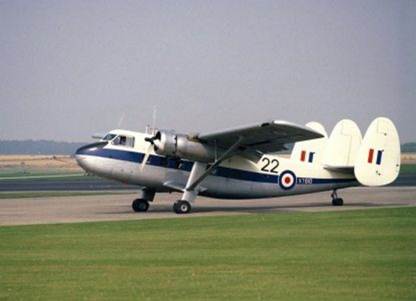 Aden is now on the tourist track for students of ancient history, as is
neighbouring Oman. Some villages in Oman are deserted, having been bombed
decades ago by the RAF, but I cannot find details of these actions.[157]
Aden is now on the tourist track for students of ancient history, as is
neighbouring Oman. Some villages in Oman are deserted, having been bombed
decades ago by the RAF, but I cannot find details of these actions.[157]
The aircraft depicted are De Havilland Venom and Hawker Hunter fighters and Armstrong Whitworth Argosy transports. On this page is the Twin Pioneer, excellent for short take-off and landing work in rugged areas. It was replaced from the 1960s by helicopters.
Appendix 5: Graduates of the ‘Air Control School of Training’
Slessor [158] says that Sheikh Mahmud in Kurdistan was known for years in the R.A.F. as ‘the Director of Training’ because he continually set new problems for the military to solve. Certainly, many prominent military people from World War II gained their military experience in the Middle East between the wars. These include
1. Almost all leaders of Bomber Command, RAF, 1936-45:
Air Marshal Sir Charles Portal KG, GCB, OM, DSO, MC
Air Chief Marshal Sir Edgar Ludlow-Hewitt GCB, GBE, CMG, DSO, MC
Air Marshal Sir Richard E C Peirse KCB, DSO, AFC
Air Chief Marshal Sir Arthur Harris GCB, OBE, AFC
Also: Air Chief Marshal Hugh Caswell Tremenheere Dowding, 1st Baron Dowding GCB GCVO CMG) leader of RAF Fighter Command during the Battle of Britain.
2. Other prominent airmen:
Air Chief Marshal Sir Norman Bottomley KCB, CB, CIE, DSO, AFC
Air Marshal John Breen CB, OBE
Air Chief Marshal Sir Robert Moore Brooke-Popham, GCVO, KCB, CMG, DSO, AFC
Air Marshal Sir Roddy Carr CB, DFC, AFC
Air Chief Marshal the Hon Sir Ralph A Cochrane GBE, KCB, AFC, FRAES
Air Vice-Marshal Richard Harrison, CB, CBE, DFC, AFC
Air Chief Marshal Sir Alan Lees KCB, CBE, DSO, AFC
Air Vice-Marshal Percy Maitland CB, CBE, MVO, AFC
Air Chief Marshal Sir William G. S. Mitchell, KCB, CBE, DSO, MC, AFC
Air Vice-Marshal Cuthbert MacLean CB, DSO, MC
Air Vice-Marshal Alan Ritchie CBE, AFC
Marshal of the RAF Sir John Slessor GCB, DSO, MC, DL
Air Vice-Marshal Henry Thorold CB, CBE, DSC, DFC, AFC
Air Marshal Sir John Whitley KBE, CB, DSO, AFC & Bar
Air Vice-Marshal Arthur Wright AFC
3. Many army leaders including
Field Marshal John Standish Surtees Prendergast Vereker, 6th Viscount Gort VC, GCB, CBE, DSO & Two Bars, ,MVO, MC
Field Marshal Sir Claude John Eyre Auchinleck, GCB, GCIE, CSI, DSO, OBE
Field Marshal Bernard Law Montgomery, 1st Viscount Montgomery of Alamein, KG, GCB, DSO, PC
Field Marshal William Riddell Birdwood, 1st Baron Birdwood, GCB, GCSI, GCMG, GCVO, GBE, CIE, DSO,
Field Marshal William Joseph Slim, 1st Viscount Slim, KG, GCB, GCMG, GCVO, GBE, DSO, MC
Please note, however, that many of these people may not have been involved in ‘Air Control!
Appendix 6: Relief of the Chitral Garrison, 1940
Upper: the chtral fort in 1985; below a modern picture of Chitral gives a good idea of the topography.
 As has been previously mentioned, the Chitral garrison was about
120 miles, 200 km, north of the railway at Peshawar. It was regarded as being
of strategic importance to the British in impeding the advance of Russia into Afghanistan
and Pakistan. In 1895, as described above, a small expeditionary force, with
about 400 troops, was besieged in Chitral fortress as described above. Happily
for the British, the relief force arrived in time and the tribesmen withdrew.
As has been previously mentioned, the Chitral garrison was about
120 miles, 200 km, north of the railway at Peshawar. It was regarded as being
of strategic importance to the British in impeding the advance of Russia into Afghanistan
and Pakistan. In 1895, as described above, a small expeditionary force, with
about 400 troops, was besieged in Chitral fortress as described above. Happily
for the British, the relief force arrived in time and the tribesmen withdrew.
From that time on, Chitral fortifications were permanently manned by British forces, actually Indian soldiers with a few British officers. This was a very isolated outpost: contact with the outside world only occurred every two years, when relieving forces arrived. The area between Peshawar and Chitral was largely hostile, and the resupply operation was a major effort, using the technique described on page ##. In 193#, the resupply column was escorted by aircraft, which considerably improved its efficiency. Forces remained in Chitral for two years before being relieved by means of a major overland supply operation..
 |
In 1940, it was decided to conduct the resupply operation by air, though a small land column was also needed to carry heavy goods that could not be carried by air.
The aircraft used were Vickers Valentias. These were the final versions of the 1922 Vickers Victorias, and many Valentias were indeed simply upgraded Victorias.
Ten aircraft were used.
The Chitral Relief 1940 was
carried out by air from 20th to 24th Sept. incl., apart from an escorting
ground party with all heavy kit which could not be carried by an aircraft owing
to size. An average of 9 aircraft were available twice a day in both directions
for the 5 days. Risalpur was used as the main operating base for the Relief
where all emplaning for, and deplaning from, Drosh (Chitral airfield) and
refuelling were carried out. All aircraft returned to Peshawar after each day
and flew to Risalpur early each following morning. An RAF Ground Liaison
Officer (changed daily) was stationed at Drosh, and also at Risalpur to prepare
loads and weight  sheets.
It was originally intended to carry a load of 4500 lbs in each aircraft which were denuded of X-country kit, spares, and surplus petrol. (T.A-U.W approx 18,500) but owing to the consequent poor climb and ceiling and difficulty of getting through the Lowari Pass (10,350'), this was reduced to 3,500 lbs.
The main problem was gaining enough altitude to clear the Lawarai pass, where the altitude was 3058 metres, 1030 feet. The Valentias cold not easily reach this altitude with a full load:
….it was rather higher than the more tired of our old Valentias could reach in still air, so to get through the Pass one had to circle in a convenient thermal up-current (circling vultures gave one an indication) and then, with some 2000 feet extra in hand, head for the Pass. If the height was dissipated before you got through, then it meant a steep turn away and a search for another thermal.[159]
Some statistics:
|
Carried to Chitral |
Carried from Chitral |
|
Men: 847 (Wt. 140,426 lbs) Baggage : 136,321 lbs |
Men : 821 (Wt. 145,040 lbs)
|
|
TOTAL 276,747 lbs |
TOTAL 145,040 lbs |
 The total Squadron flying time was 291 hours 35 minutes, averaging
less than six hours per aircraft per day.
The total Squadron flying time was 291 hours 35 minutes, averaging
less than six hours per aircraft per day.
It is interesting to note that the Douglas DC-2, which first flew in 1934, had a service ceiling of over 20000 feet, with a payload under any circumstances of at least 5000 pounds.
Above: Drosh airfield, Chitral, 1940; below – a Virginia being refuelled at a forward airfield, 100 four-gallon tins being required.
About this book
While cataloguing books at the Australian Aviation Museum, Bankstown, I came across a 1934 book entitled The Encyclopaedia of the Air, including an essay by one Flight-Lieutenant McLoughry, describing with pride, and in considerable detail, the manner in which the Royal Air Force was controlling the savage and rebellious tribesmen, mainly from the Middle East and the Indian North-West Frontier.
I had seen pictures, such as the cover of this book, of romantic-looking biplanes among the rugged mountains of the North West Frontier Province, but had no idea of the extent of the use of aircraft as a judicial weapon between the wars. So I began to research this matter, and to take notes which have been organised into this book.
Much of the information has come from the library of the Australian Aviation Museum at Bankstown, incorporating the recently acquired Aviation Historical Library (NSW branch) collection, the Bob Wills collection and the periodicals collection..
Chris Matts and Perc Lyell have been very helpful in finding material for these notes- thank you!
I have supplemented this from many sources, including internet sites. I believe that I have taken into account the political and other biases of many of these sites, and that the information quoted is factual. The interpretations of facts are mine, and are not infallible!
General material has been taken from Encyclopaedia Britannica, and general aviation books such as The Encyclopaedia of World Aircraft published in 1998 in London by Brown Books. In the figures describing aircraft characteristics etc I have sought only to give a general idea of performance etc and there will be minor inaccuracies and discrepancies.
Bibliography
Baker, A, et al: Wings over Kabul, Kimber, London, 1975. The Kabul Airlift of 1928-9 by people with personal recollection of the event.
Barton, Sir William, Britain’s North-West Frontier, Murray, London,1939
Bierman, J and Smith, C, Fire in the Night, Biography of Orde Wingate, Random House, New York, 1999,
Boyle, A: Trenchard, Man of Vision, Cassell, London, 1962
Carr, S J, You are not sparrows, Ian Allan, 1975. This book and that by Dudgeon (below) are excellent first-hand accounts from young, enthusiastic pilots.
Chomsky, N: Year 501: The Conquest Continues, Chapter 1, See http://tinyurl.com/3297ry)
Clayton, Anthony, The British Empire as a superpower, London, Macmillan, 1986
Corum , Dr. James S. The Myth of Air Control; Reassessing the History. Published Aerospace Power Journal – Winter 2000 http://www.airpower.au.af.mil/airchronicles/apj/apj00/win00/corum.htm
Douie, Sir James, MA, KCSI The Panjab, North-West Frontier Province and Kashmir. originally published 1911,Seema Publications C-3/19, R P Bagh, Delhi-First Indian Edition 1974, internet publication by the Gutenberg project.
Dudgeon A G, Luck of the Devil, Shrewsbury: Airlife, 1985.
Edwards, David B: Genealogies of the Afghan Jihad, University of California Press, 2002, www.escholarship.org/editions/view?docId=ft3p30056w&brand=ucpress – 897k –
Franks, N: First in the Indian Skies, the history of 31 Squadron RAF, published by the 31 squadron association, 1982
Grey, C G: Bombers, Faber, London
Janes All the Worlds Aircraft, Janes Publishing, various editions from the interwar period.
Hough, R and Richards, D, The Battle of Britain, Hodder and Stoughton, London, 1989: chapters 2-4 are a typical exposition of Trenchard’s work in organisation of the RAF.
Keith, C H, Flying Years, John Hamilton, London, 1931; memoirs of flying in Iraq and Perisa, with little emphasis on the military aspects.
Lunt, James, Imperial Sunset, Macdonald, London, 1981
McCloughry, Flight-Lieutenant E J, DSO, DFC Extracts from the Gordon-Sheppard Memorial Prize Essay, 1933, published in The RAF Quarterly. Reprinted in The Encyclopaedia of Aviation, Pitman, London, 1935
Moreman,T R: The Army in India and the Development of Frontier Warfare 1849-1947, (London, 1998) http://www.khyber.org/pashtohistory.shtml, an army-oriented study which does not give as much attention to the air force as its proponents would like. Therefore his positive comments should be given good attention
Omissi, David E: Air Power and Colonial Control: The Royal Air Force 1919-1939 (Manchester and New York: Manchester University Press, 1990), http://www.globalpolicy.org/security/issues/iraq/history/1990airpow.htm
Parkinson , Darryl R.J, Major, USAF. Air Control: Lessons From Iraq 1919-1939, Air Command and Staff College Air University, Maxwell Air Force Base, Alabama. April 2006 https://www.afresearch.org/skins/rims/q_mod_be0e99f3-fc56-4ccb-8dfe-670c0822a153/q_act.../q_obj.../display.aspx?rs
Parsons, Capt David Willard USAF, British Air Control:A Model for the Application of Air Power in Low-Intensity Conflict? http://www.airpower.maxwell.af.mil/airchronicles/apj/apj94/sum94/parsons.html
Portal, C F A British Air Control In Underdeveloped Areas, in Emme. E M, The Impact of Air Power, Van Nostrand, New York (Excerpts from ‘Air Force Co-Operation in Policing the Empire,’ a lecture at the Royal United Service Institution at London, by Air Commodore Portal, February 17, 1937, published in the R.U.S.I. Journal, May, 1937).
Probert, H Bomber Harris, His Life and Times, Greenhill books, London, 2001. A major biography of Harris, agreeing in many respects to Sayward’s book (below) but a little less adulatory. The difference is symbolised by treatment of his personal life: the earlier book completely ignored Harris’ first marriage, which ended in divorce after two children were born.
Sayward, D ‘Bomber’ Harris, Cassell, London. This was the ‘authorised’ biography of Harris, and in accordance with his instructions, was published in 1984 after his death.
Slessor, Sir John, The Central Blue, Cassell. London, 1956 (Slessor’s autobiography)
Slugget, P: The Royal Air Force in Iraq (an excerpt from Britain in Iraq: 1914-193)2 (London: Ithaca Press, 1976) in http://www.globalpolicy.org/security/issues/iraq/after/2003/0424postmodern.htm
Document collections and journals, including internet publications
8 Squadron: http://www.8squadron.co.uk
BBC website: http://www.bbc http://www.gwpda.org/1918p/hagair.html.co.uk
BRITISH IMPERIALISM AND BOMBING CIVILIANS, a collection of original documents including the writing of T E Lawrence and Gertrude Bell http://www.worldfuturefund.org/wffmaster/Reading/war.crimes/World.war.2/Air.Control.htm
Chemical Weapons: Tenth Session of the Conference of the States Parties to the CWC 7-11 November 2005, The Hague, The Netherlands). http://www.wsws.org/articles/2003/apr2003/1920-a01.shtml
Documents on disarmament: http://www.worldfuturefund.org; http://www.gwpda.org/1918p/hagair.html
East Africa: http://eastafricapi.com/index.php?option=com_content &task=view&id=102&Itemid=1
French aircraft: http://www.aviastar.org/air/france/potez-25.php
Guardian Website: http://www.guardian.co.uk
Handley Page website: http://www.geocities.com/roynagl/handleypage.htm
History of the Khyber pass area: Khyber.ORG website
Indian History: http://www.king-emperor.com
King-Crane Commission Report, August 28, 1919:Report of [the] American section of Inter-allied Commission of mandates in Turkey. An official United States government report by the Inter-allied Commission on Mandates in Turkey. http://www.globalpolicy.org/security/issues/iraq/after/2003/0424postmodern.htm
Maps etc: http://googlesightseeing.com
Military art website: http://www.military-art.com
Pathfinder, Air Power Development Centre Bulletin, Issue 60, February 2007, published by the RAAF, www.raaf.gov.au/airpower
RAF website: http://www.raf.mod.uk
Somali operation: – Danish website http://www.chakoten.dk/mad_mullah.html
Use of gas: http://www.greenleft.org.au/2006/661/7096; http://www.wsws.org/articles/2003/apr2003/1920-a01.shtml
Valentia aircraft: http://myweb.tiscali.co.uk/mikeskeetsww2website/valentiacol.html
Wapiti aircraft: http://www.bharat-rakshak.com/IAF/History/Aircraft/Wapiti.html
WORLD WAR I AND THE BRITISH MANDATE, Library of Congress Country Studies, Iraq; http://lcweb2.loc.gov/cgi-bin/query/r?frd/cstdy:@field(DOCID+iq0019
Airlife magazine; Flypast magazine; Aeroplane magazine, Airpower Journal, Air Enthusiast Historical Aviation Quarterly, Flight Magazine, Time Magazine
TV program: ‘Birds of Death’, Director George Case, a Wall to Wall television production for Channel 4, Broadcast in Britain by Channel 4, 21 April 1996