The 1919-20 flight of the Smith crew in their Vickers
Vimy was a sensational feat, from Hounslow, England, to Adelaide and made a
world-wide impact.
The Vimy itself became a prized exhibit of the
Australian War Museum in Canberra, but in 1955 it was cast out of the museum
because it had not actually fought in World War I and space was required for
more recent exhibits. This, and the death of Keith Smith, also in 1955, led to
a reawakening of interest in the 1919 flight.
Thanks to a pledge of £10,000 from Vickers and its
associated companies, and the proceeds of a public appeal, the Vimy was
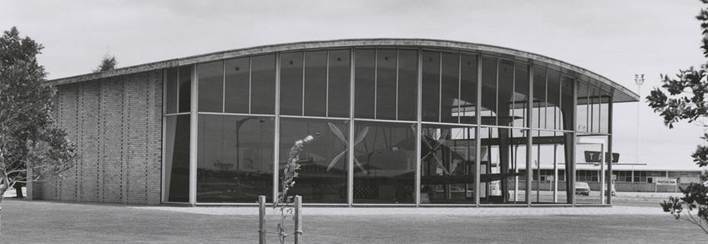
eventually displayed at the existing memorial hangar at Adelaide Airport,
finally dedicated in 1958. The Commonwealth Government owns the Vimy and
granted land on the airport for the memorial, and funds for its annual upkeep.
A memorial, financed by the Lions Club of Enfield and
erected on the spot where the Vimy landed at Adelaide on its final flight on March 23, 1920, was unveiled on
February 19, 1966.
Thus, as the fiftieth anniversary of the great flight
approached, momentum was building for a suitable form of commemoration, further
underlined by the death of the last crew member, Wally Shiers, on June 2, 1968.
Graham Alderman, manager of the South Australian Aero
Club, suggested a re-enactment of the 1919 air race. The idea was taken up by
Peter Lloyd, then president of the Royal Federation of Aero Clubs of Australia.
He suggested that 1970 was also the 200th anniversary of the explorations of
Captain Cook, and this would be a great opening to those celebrations. (Incidentally,
Peter Lloyd was the nephew of Reginald Lloyd, who led the team of motorcyclists
who initially surveyed the route across Australia that was followed by the
Smiths (see 102 days pages 27-8)
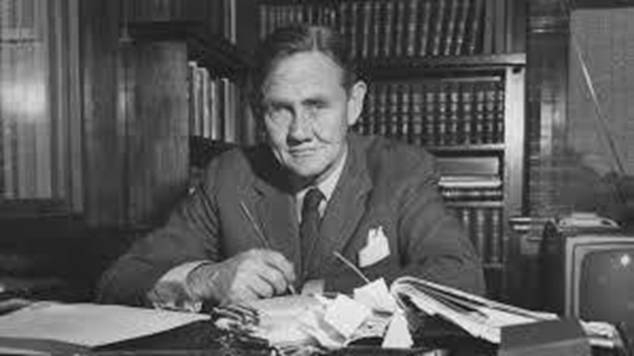
John Gorton (Courier Mail photo)
Prime Minister of the time was John Gorton. He gained
a pilot’s licence in England in 1932 and in 1941 enlisted in the RAF. He
trained in England and was sent to Singapore with 135 Squadron RAF, arriving
on 13 January 1942, when the island was only a month away from being captured
by the Japanese. On 20 January his aircraft crashed after combat with Japanese
fighters, and his face was smashed on the gun sight. He immediately evacuated
on the SS Derrymore, which was promptly torpedoed by a Japanese
submarine. He was again rescued by HMAS Ballarat and finally returned to
Australia on March 7. He was then posted to 77 Squadron RAAF and flew Kittyhawk
fighters at Darwin and Milne Bay. In November 1944 his face was surgically
repaired. He entered politics and was Prime Minister from January 9, 1968, to
March 22, 1971.
He remained interested in aircraft and strongly
supported the air race idea, as did Sir Donald Anderson the Director-General of
Civil Aviation, Sir Richard Casey who was Governor-General 1965-69 and Senator
Cotton, Minister for Civil Aviation 1969-72.
 Thanks to the
efforts of the managing director of BP Australia, Mr J Stafford Fox, the
company provided a sum of $50,000 towards the cost of conducting the race. The
Commonwealth then advanced $25,000, followed by $15,000 from the New South
Wales Government, and $10,000 from the South Australian Government.
Thanks to the
efforts of the managing director of BP Australia, Mr J Stafford Fox, the
company provided a sum of $50,000 towards the cost of conducting the race. The
Commonwealth then advanced $25,000, followed by $15,000 from the New South
Wales Government, and $10,000 from the South Australian Government.
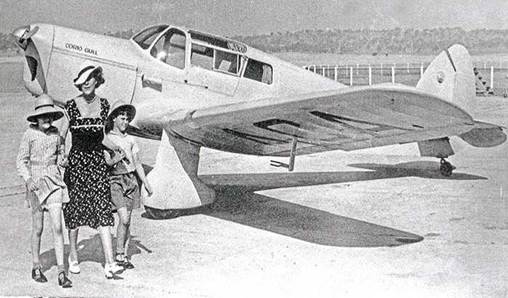
Governor-General Richard Casey,
and his wife Maie, were aviators: Maie Casey is with her children and the
family Percival Proctor in 1939.
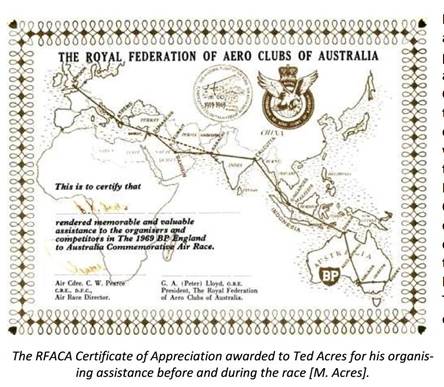
Air Commodore C.W Pearce CBE, DFC, a distinguished World
War II airman, was appointed race director.
Air races were in fashion. The Daily Mail had
sponsored ‘The Great Transatlantic Air Race of 1969’ to commemorate the 50th
anniversary of the flight across the Atlantic by John Alcock and Arthur Brown
in June, 1919. Between May 4 and May 11 360 competitors competed to set the
fastest time between the top of the Post Office Tower in London, and the 86th
floor of the Empire State Building in New York. The winner was Lt Commander
Peter Goddard, Royal Navy, flying Phantom 001 from 892 Squadron, in a time of 5
hours 11 minutes and 57 seconds.
This was different. It was proposed as a handicap air
race for light aircraft, point to point. Every effort was taken to make an even
playing field. It is not the function of this booklet to go into minutiae, but
this summary from the South Australian Aviation Museum newsletter of October
2018 (by Mike Milln) gives the basic information, announced by Peter Lloyd on
15 July.
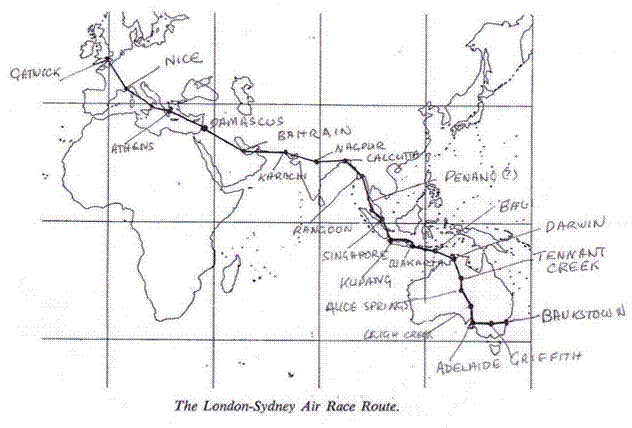
The route would follow the Vimy’s path as much as
possible, with compulsory stops at Athens, Karachi, Calcutta, Singapore,
Darwin, Alice Springs, Adelaide, Griffith and Sydney. The field would be split
into three classes: the first for single unsupercharged piston-engined aircraft
up to 5,000 lb all-up weight
(AUW); the second for light twin unsupercharged piston
engined aircraft up to 12,500 lb AUW; and the third for supercharged piston or
propeller turbine single- or twin engined aircraft up to 12,500 lb AUW. Entry
fees for the three 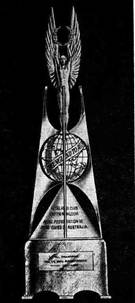 classes would
be $60, $100 and $150, respectively; and a total of $100,000 in prize money
would be awarded, including $25,000 for the best overall performance London–Sydney,
$10,000 for the best performance London– Adelaide plus the SA Government’s ‘Sir
Ross and Sir Keith Smith Prize’ Trophy, and $10,000 for the fastest time London–
Sydney plus the NSW Government’s ‘Captain Cook Bicentennial Trophy’. At the
last minute two jet aircraft were accepted in a separate speed race event: a
Qantas HS125 used for jet training and a Canadian armed forces Dassault Falcon.
(incidentally, the QANTAS aircraft beat the Falcon by two hours).
classes would
be $60, $100 and $150, respectively; and a total of $100,000 in prize money
would be awarded, including $25,000 for the best overall performance London–Sydney,
$10,000 for the best performance London– Adelaide plus the SA Government’s ‘Sir
Ross and Sir Keith Smith Prize’ Trophy, and $10,000 for the fastest time London–
Sydney plus the NSW Government’s ‘Captain Cook Bicentennial Trophy’. At the
last minute two jet aircraft were accepted in a separate speed race event: a
Qantas HS125 used for jet training and a Canadian armed forces Dassault Falcon.
(incidentally, the QANTAS aircraft beat the Falcon by two hours).
The handicapping was outlined five pages of the Supplementary
Regulations to Race Regulations First Issue and was involved calculations
of wing area and power, with allowances made for features such as fixed
undercarriages, superchargers and so on. There were six mandatory stops between
Gatwick and Adelaide, and contestants were allowed to make additional stops up
to a total of thirteen. Two hours were allowed at each of the mandatory stops
and half an hour at any verified intermediate stop. The estimated race time
(ERT) for each aircraft was calculated according to the formulae in the
Supplementary Regulations and its handicap time
was the difference between its ERT and the highest value ERT of any aircraft in
the race. A contestant’s race time was then based on its Gatwick start time and
Parafield finish time, less time allowance for mandatory and verified
intermediate stops, plus or minus the calculated handicap time. Not
surprisingly, participants read the regulations minutely so as to gain every
advantage.
BP (British Petroleum) sponsored many
pioneering flights and some later anniversary flights. These range from the
Melbourne to Sydney flight of Maurice Guillaux, 1914 to current sponsorship of
the Red Bull events. BP provided the main trophy, designed by Adelaide
artist, Mr Don Allnutt, and was valued at $1,500. It was made of Broken Hill
silver with a globe of the world which would rotate and was mounted on an
Australian Jarrah base. It was 22 ½ inches, about 55 cm, high. This trophy, and
the Commonwealth prize of $25,000 was awarded to the aircraft with the highest
handicap points scored in the two sections of the race
Entrants came from many countries – 31 from Australia;
26 from Great Britain; 15 from the USA; 2 each from New Zealand and Sweden, and
one each from Finland, Kenya, Ireland and Zambia. 114 numbers were allocated
but some numbers were not listed, and others were noted as withdrawn. Of the 80
aircraft listed in the official program, 66 were manufactured in the
USA, of which 31 were Pipers of various kinds, 16 were
Cessnas, 14 were Beechcrafts, 3 were Mooneys and 2 were Aero Commanders. Of the
remainder, 10 were built in the UK, and one each in France (Fournier RF5),
Italy (SIAI Marchetti SF260) and Australia (Victa Airtourer).
The ten British aircraft included the eventual winner one of two Britten-Norman
Islanders. Other British aircraft included three Austers and one Beagle (Auster
successor), a Rollason Condor, a Percival Prentice, a Walrus amphibian and
even a Dragon Rapide. (see page 21)
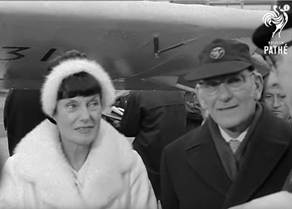 Jean Batten
and Francis Chichester were the distinguished guests at the start.
Jean Batten
and Francis Chichester were the distinguished guests at the start.
The start was spread over three days.
There was a delay on the first day (December 17) because
of weather and only eight aircraft got away. The next day
44 departed and the final 25 got away on 19 December.
The event was widely
publicised: the pictures are stills from the
newsreels.
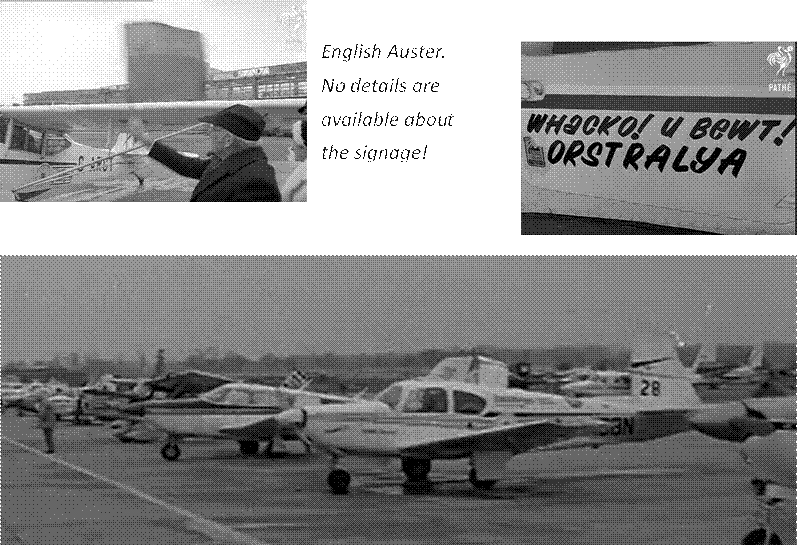
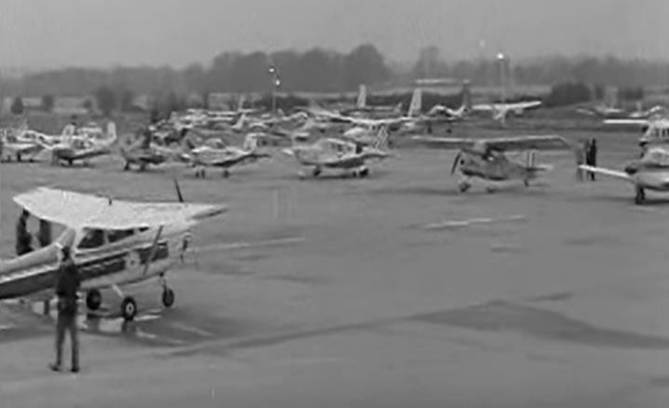 The scenes
at the start.
The scenes
at the start.
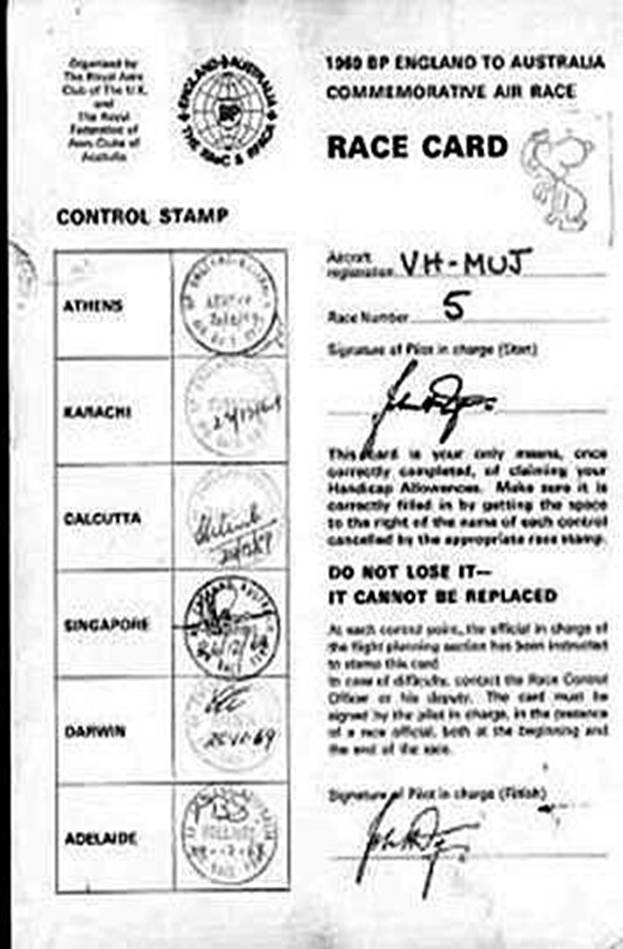
Seven stops were compulsory, but …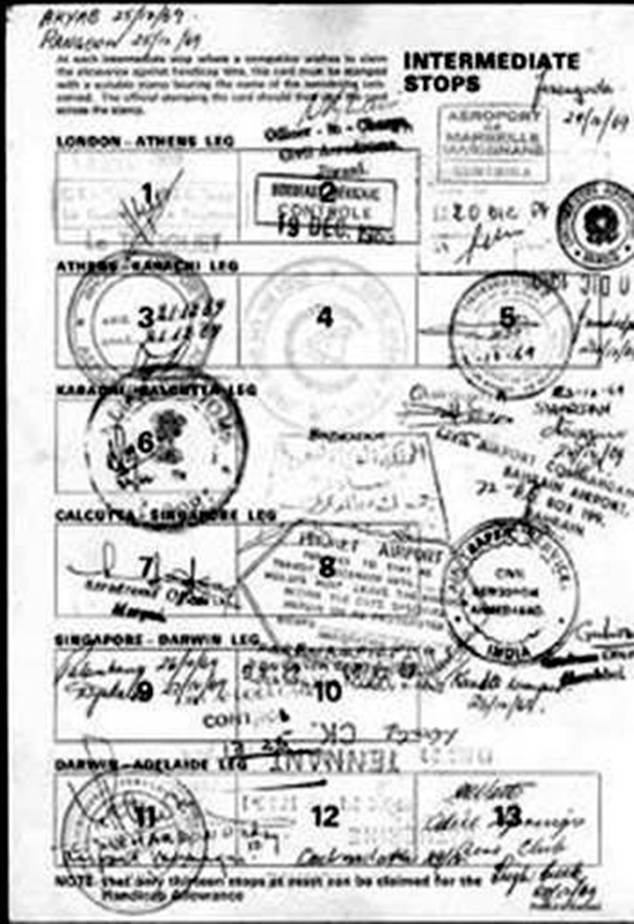
There is far too much material for a booklet this
size, so here we will just have some vignettes – the challenge for the future
is for the full story to be recorded. # indicates the race number of individual
aircraft.
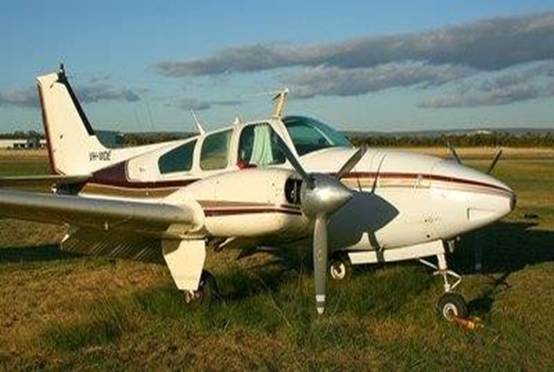 Laurence
Gruzman QC, had served in the army in World War II and leant to fly at the age
of 42. With his wife Zoe, also an experienced private pilot, he took delivery
of a brand new Beech 95 D55 Baron at the company's factory at Wichita, Kansas
and flew to London via Canada, Greenland, Iceland and Scotland. They then
carried out a proving flight over the proposed route of the air race to
Australia. This was itself an adventure: among other things, they were arrested
following an unplanned landing in Cambodia.
Laurence
Gruzman QC, had served in the army in World War II and leant to fly at the age
of 42. With his wife Zoe, also an experienced private pilot, he took delivery
of a brand new Beech 95 D55 Baron at the company's factory at Wichita, Kansas
and flew to London via Canada, Greenland, Iceland and Scotland. They then
carried out a proving flight over the proposed route of the air race to
Australia. This was itself an adventure: among other things, they were arrested
following an unplanned landing in Cambodia.
When he
returned to Australia, he again returned to his summer occupation, flying from
the Merimbula airfield on the far south coast of NSW. He would sail his ketch
from Sydney for the summer and spend
the summer months giving joy flights and
general commercial aviation. Laurence's Beech Baron was given the Australian
civil registration, VH-WDE and the picture shows it in dilapidated condition at
Jandakot, Western Australia in about 2014, prior to being scrapped,
(This story is included to give an idea of the total
course. It comes from the best such summary I have found – courtesy of John
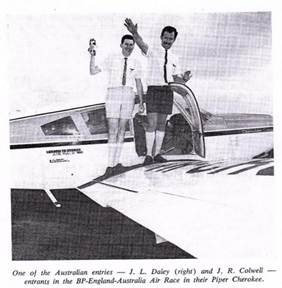
Scott, AHSA historian. John Colwell, co-pilot of #46, Piper Cherokee Arrow,
with John Daley, wrote an account of the flight in the December 1969 issue of
the journal of the Australian Institute of Navigation),
rom the start, they entered into rivalry with #100,
another Arrow, Ulster Pride, crewed by Irishmen and a RAF Squadron
Leader, Terry Nash. At Nice, the aircraft landed within minutes of each other,
and found that the French controllers had no idea that the race was in
progress.
 Another
competitor, Margaret and Peter Kentley in Mooney #21, (see page 14) who arrived
as they were leaving also became a rival. In the next leg, to Athens, the
Kentleys caught up: their Mooney was faster than the Arrow.
Another
competitor, Margaret and Peter Kentley in Mooney #21, (see page 14) who arrived
as they were leaving also became a rival. In the next leg, to Athens, the
Kentleys caught up: their Mooney was faster than the Arrow.
Athens was different: they were
received with television cameras and flashbulbs. The air controllers were
cautious, but eventually they were cleared for departure to Damascus. But en
route the Damascus approach controller informed them that they could go no
further than Damascus as the airway was closed to Australian and American
aircraft. We asked the controller to telephone the
Australian Embassy in Beirut to which he
agreed and then at his request we commenced to descend to 5,000 feet. At this
stage John remarked that the cloud in front of us had a remarkably solid
appearance. It was in fact an 8000 foot snow covered mountain. The controller
then called up in rather a panic and told us to climb to 11,000 feet. I replied
we were already dead but his sense of humour was rather limited.
They landed at dawn just three minutes after the
Kentleys, so after promising to avoid Iraqi territory, they were both allowed
to depart, agreeing to stick together. They were checked out by Syrian MiGs as
they came near to the oil pipeline to Bahrain during this very long stage.
At Bahrein they were allowed to jump the approach
queue and land quickly, ahead of waiting airliners, because fuel was short.
There was a big sign of welcome on the terminal building, and they were
refuelled and, within 20 minutes, on their way with a gift of goodies on behalf
of the ruler.
 On the next
leg, a long haul to Karachi, they heard Sheila Scott reporting that her long
range radio equipment had been wrecked. After this tale of woe an anonymous,
but very Australian voice said, ‘It must have been the Israelis!’
On the next
leg, a long haul to Karachi, they heard Sheila Scott reporting that her long
range radio equipment had been wrecked. After this tale of woe an anonymous,
but very Australian voice said, ‘It must have been the Israelis!’
They were told to climb to 13000 feet as Sheila Scott
wanted their altitude. They replied that they could not reach 13,000 feet so
the controller made them descend to 7,000 out of the strong tailwinds. They
were not impressed!
They were in about sixth place when they landed in
Karachi, where a great welcome greeted them. The Karachi Aero Club processed
them efficiently and they were quickly on their way to Nagpur. Here, for the
first time their bags were searched by a customs official – technically not
necessary, but it was wiser not to protest, and 45 minutes later they took off
to Calcutta. The Kentleys in #21 had flown direct to Calcutta from Karachi and
so were well ahead.
The next stop was Rangoon, and here bureaucracy was
slow.
To their delight, they found that the Kentleys had
problems: their spark plug leads had failed. Then, just as they were
approaching Phuket, their own engine began running roughly, so they landed at
Penang, where simple remedies (new spark plugs) failed. They ate and slept
while the locals worked for four hours to solve the problem (also spark plug
leads), flying on to reach Singapore in the morning, This upset their timing:
they needed to fly through the rough weather in daylight and they could not
arrive at Kupang. Their mood was not improved when they talked to Dennys Dalton
in the Beech Travelair, #1, who had turned back from Bali after his aircraft
had been hit twice by lightning and his compass wrecked. The Navy team arrived
in their Beech Baron, #18 and their old rival #100 was back on the scene.
Not very optimistic, they set off, but arrived at
Djakarta, then headed for Bali. They had to navigate around the thunderheads by
map reading and dead reckoning, and for a while it looked as though they might
be able to fly on the Darwin directly. Eventually they decided to return to
Bali where they spent an uncomfortable night in the terminal building.
Three hours before dawn, they set off to Kupang. At
last, all went well, with an efficient trip to Darwin. They were delayed by the
press, and no 100 was once again ahead. They cunningly took advantage of the
rules by making an unnecessary stop at Katherine, loading ten gallons of fuel
in a 15 minute stop and gaining a half hour time allowance.
They played tag with #100 across Australia, both
stopping at Leigh Creek for fuel and to make up time. As they approached
Adelaide, they tried to take advantage of local knowledge by getting a special
clearance on a frequency not known to all, but the Adelaide controller was too
sporting – he gave the opposition the same clearance.
#100 finished the race at 1645 GMT on December 22. Our
heroes were 14 minutes behind them but on handicap had beaten them by 1 hour
and 29 minutes. Total time from London was 102 hours 26 minutes. The two crews
had a few drinks before catching up on sleep.
Keith Meggs was pilot of #47, Beech S-35 Bonanza,
VH-CHX, the entry for the Victoria Police Club. He had a distinguished career
with the Commonwealth Aircraft Corporation, interrupted by service in the RAAF
1948-67, flying Mustangs and Meteors in the Korean War and Vampires in
Australia and Malta. Keith rejoined CAC in 1957 and the last 25 years of his
professional flying career was as a freelance charter pilot. He is arguably Australia’s
greatest aviation historian, his major work being the monumental two-volume
work Australian-built Aircraft and the Industry.
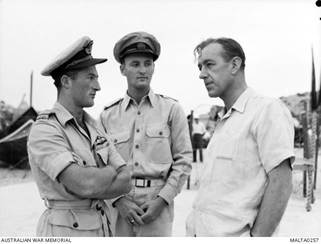 Photo:
Australian War Museum. The caption reads ‘Pilot Officer Keith Meggs DFM of
Preston, Vic (left), who was decorated for his service as a pilot in Korea,
discusses aerial warfare in Korea with LAC Merv Dunn of Newcastle, NSW and
leading British film actor Alec Guinness. The
Photo:
Australian War Museum. The caption reads ‘Pilot Officer Keith Meggs DFM of
Preston, Vic (left), who was decorated for his service as a pilot in Korea,
discusses aerial warfare in Korea with LAC Merv Dunn of Newcastle, NSW and
leading British film actor Alec Guinness. The 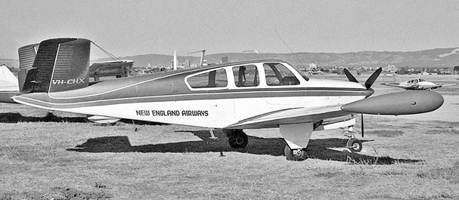 Australians
were members of 78 Fighter Wing RAAF, stationed in Malta for garrison duty.
Guinness was on the island to make the feature film The Malta Story, in which
he played an RAF reconnaissance pilot who was forced to land on Malta during
the blitz against Malta in
Australians
were members of 78 Fighter Wing RAAF, stationed in Malta for garrison duty.
Guinness was on the island to make the feature film The Malta Story, in which
he played an RAF reconnaissance pilot who was forced to land on Malta during
the blitz against Malta in
1941’. Above: #47, which finished 34th.
Margaret Kentley and son
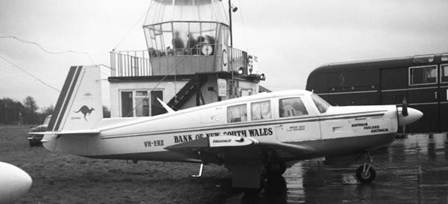 Margaret
Kentley entered the race with her 23 year old son Peter, an Ansett Airlines
of Australia pilot, flying #21, Margaret's Mooney M20F Executive, VH-ERX,
named ‘Skippy’. She was once the fiancé of Jimmy Melrose, a famous Australian
aviator of the 1930s. He was killed in a crash in 1936. Margaret and her son
reported being buzzed for five minutes by Russian MiG fighters over Syria.
Margaret
Kentley entered the race with her 23 year old son Peter, an Ansett Airlines
of Australia pilot, flying #21, Margaret's Mooney M20F Executive, VH-ERX,
named ‘Skippy’. She was once the fiancé of Jimmy Melrose, a famous Australian
aviator of the 1930s. He was killed in a crash in 1936. Margaret and her son
reported being buzzed for five minutes by Russian MiG fighters over Syria.
#55, a Shrike Commander 500S, N9093N, was flown by
Captain Bernard Ferner from Pennsylvania, USA, and his co-pilot was Captain
Kandar Dodd from 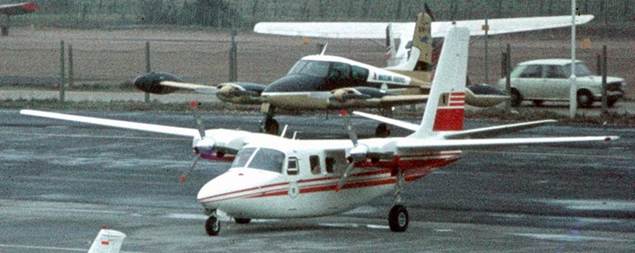 Melbourne. They
took off among the last group of aircraft on December 18, and Air Traffic
Control lost contact with them at 2.50 am on December 19. Searches were carried
out for the next few weeks, but no trace of them was found until 1970. They had
crashed on a mountain near Courchevel in the French Alps near Chambery. The
crew’s remains were still inside the aircraft. This was the only fatal accident
in the race. Photo from Swiss accident prevention site B3a.
Melbourne. They
took off among the last group of aircraft on December 18, and Air Traffic
Control lost contact with them at 2.50 am on December 19. Searches were carried
out for the next few weeks, but no trace of them was found until 1970. They had
crashed on a mountain near Courchevel in the French Alps near Chambery. The
crew’s remains were still inside the aircraft. This was the only fatal accident
in the race. Photo from Swiss accident prevention site B3a.
From his daughter, Vivian Heal: My
father was in the 1969 Air Race. He owned
Davey Air Services at Dubbo. He was
sponsored by Haddon Rig (the famous Merino stud, owned by the Falkiner family
at Warren). He flew with his Chief Pilot, Olaf Weyand. Dad is no longer alive.
I was at Uni in 1969 and the only
recollection I have is of Dad telling me of a fuel stop in the Middle East.
They had been warned to be careful because of the political tension so Dad got
Olaf to negotiate the refuelling because he was 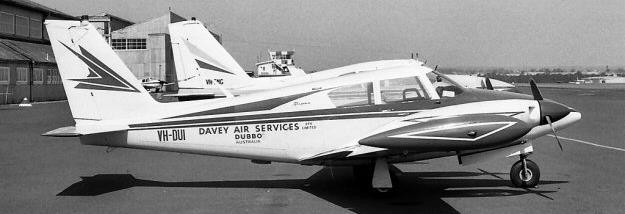 Dutch and
still had a strong accent. Speaking English may have got you into trouble.
Dutch and
still had a strong accent. Speaking English may have got you into trouble.
They flew their plane to London for the
start of the race and had no dramas either way.
Bill began charter flying in 1956. In 1967 Flying magazine
recognised his company with an award as the most efficient charter service in
Australia. He had bought Piper Comanche 250 Cherokee -VH-CDA the first modern retractable-undercarriage aircraft
to be used on charterwork in NSW. He was president of the Charter Operators
Association and was active in lobbying for a change in the ‘two airline’
system. In 1976 Nyngan, Cobar, Bourke and Brewarrina were served by flights to
Dubbo, linking Airlines of NSW flights to Sydney and later by direct flights.
He was also active in establishing the air ambulance organisation in 1965.
VH-DUI at Bankstown, 1970 (Ed Coates
Collection).
According to https://www.airhistory.net/ Davey Air Services owned at least 13 aircraft at different
times, including an Embraer EMB-110 and a Lycomingengined DH114 Heron. Davey
Air Services was absorbed into Avdev airlines in the early 1980s: this was
owned by Olaf Weyand. Avdev airlines itself was later acquired by Rex (Regional
Express Airlines). Olaf died last year, and his service to the cultural life of
Dubbo and its aviation industry is recognised by the naming of a new street in
his honour at Dubbo airport.
For the race Bill Davey and Olaf Weyand flew Piper Twin
Comanche VH-DUI,
#12, The Ed Coates collection records that VH-DUI was
in the news in September 2015 when its crew, two brothers, were arrested at
Maryborough, Queensland, and extradited back to Western Australia to face drug
charges. The Twin Comanche, which was painted all white and had its
registration obscured, was detained by authorities at Maryborough airport. The
aircraft survives – see page 17.
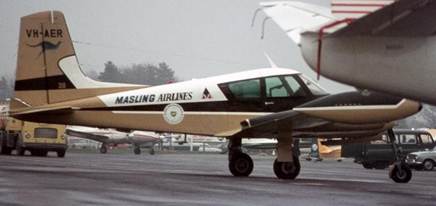 Jack Masling
was another pioneer of regional aviation and he competed in the 1969 air race
in VH-AER. It was built in 1953 and was imported into Australia in 1954 from
New Zealand and used by Utah Mining and then by CSIRO for rain-making
experiments. In 1960 it was re-registered as VHAER and was flown by Jack
Masling and George Williams in the 1964 R.M. Ansett Brisbane to Adelaide Air
Race. It was Masling's first twin engined aircraft. As mentioned on page 27 it
was first across the line at Bankstown at the end of the 1969 air race,
finishing tenth overall on handicap. Its elapsed time was considerably less
than the winning Islander. It was ‘written off’ after an accident on Kangaroo
Island on 27 May 1981 and was restored to display condition by the Moorabbin
Air Museum, its present owners.
Jack Masling
was another pioneer of regional aviation and he competed in the 1969 air race
in VH-AER. It was built in 1953 and was imported into Australia in 1954 from
New Zealand and used by Utah Mining and then by CSIRO for rain-making
experiments. In 1960 it was re-registered as VHAER and was flown by Jack
Masling and George Williams in the 1964 R.M. Ansett Brisbane to Adelaide Air
Race. It was Masling's first twin engined aircraft. As mentioned on page 27 it
was first across the line at Bankstown at the end of the 1969 air race,
finishing tenth overall on handicap. Its elapsed time was considerably less
than the winning Islander. It was ‘written off’ after an accident on Kangaroo
Island on 27 May 1981 and was restored to display condition by the Moorabbin
Air Museum, its present owners.
By the early 1970s, Masling Commuter Services was
Australia's fourth largest air carrier. The airline flew 215 Flights per week
carrying more than 40,000 passengers per year, serving Sydney, Goulburn,
Canberra, Cootamundra, Young, Nowra, Newcastle, Scone, Moruya and Tumut.
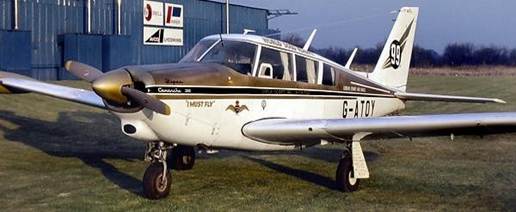 After a career
as actress, Sheila Scott learnt to fly in 1960 at the age of 33. She displayed
remarkable talent, and was sponsored by Cessna and Piper aircraft for long-distance
flights, for example around the world in 1966. Her entry in the 1969 air race
was a publicity coup for the organisers.
After a career
as actress, Sheila Scott learnt to fly in 1960 at the age of 33. She displayed
remarkable talent, and was sponsored by Cessna and Piper aircraft for long-distance
flights, for example around the world in 1966. Her entry in the 1969 air race
was a publicity coup for the organisers.
 Her
record-breaking success was largely due to her technique of flying the longest
possible stages, but in this race she had problems with her radio and
autopilot. While flying from Singapore to Darwin she was forced to land at
Macassar, south Sulawesi (Celebes). Aircraft were asked to divert to Macassar
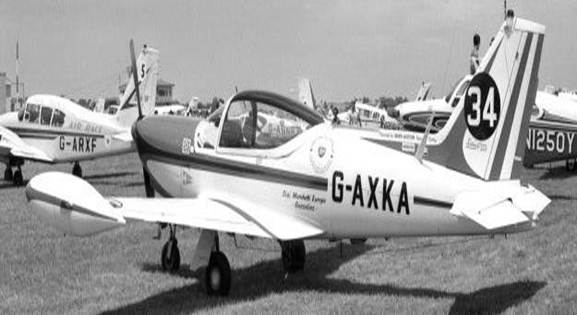
to escort her, and Flight Lieutenants Kingsley and Evans in the Italian -built
SF160 (#64, G-AXKA) volunteered, but when the joint flight got under way the
aircraft were separated by monsoon conditions.
Her
record-breaking success was largely due to her technique of flying the longest
possible stages, but in this race she had problems with her radio and
autopilot. While flying from Singapore to Darwin she was forced to land at
Macassar, south Sulawesi (Celebes). Aircraft were asked to divert to Macassar
to escort her, and Flight Lieutenants Kingsley and Evans in the Italian -built
SF160 (#64, G-AXKA) volunteered, but when the joint flight got under way the
aircraft were separated by monsoon conditions.
Miss Scott landed at Sumbawa in West Nussa Tengara.
The RAF crew made a forced landing on a beach on 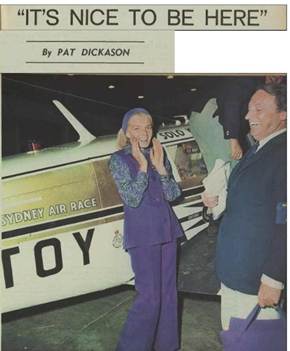 Flores Island.
After the beach had been reinforced with coconut branches, they were able to
take off, a situation reminiscent of the Smith flight’s take-off from Surabaya
fifty years before. Sheila Scott was delayed while petrol was sent to her, and
she was also able to fly on. The RAF plane reached Adelaide in 57th position,
and Sheila Scott was in 61st position, the last aircraft to reach Adelaide in
the allowed time.
Flores Island.
After the beach had been reinforced with coconut branches, they were able to
take off, a situation reminiscent of the Smith flight’s take-off from Surabaya
fifty years before. Sheila Scott was delayed while petrol was sent to her, and
she was also able to fly on. The RAF plane reached Adelaide in 57th position,
and Sheila Scott was in 61st position, the last aircraft to reach Adelaide in
the allowed time.
She was widely featured in Australian media,
particularly in the Australian Women's Weekly of Wednesday 14 January 1970,
when she was the leading story:
Visibly tired, she was dressed
immaculately in a purple sleeveless pantsuit and a floral-print blouse. The
three-piece outfit made up the major part of her capsule wardrobe, arranged for
her by the International Wool Secretariat in London. Accessories in her
matching bag included a beaded collar to dress up the sleeveless outfit at
night, scarves, purple slipper-shoes, and a big, floppy
beret ‘to hide untidy, wind-blown hair.’
‘I like women to be feminine,’ she said.
‘I can't stand women pilots all covered in grease.’ Then after a quick thought
she added, ‘But a woman pilot should only be her feminine self on the ground.
Once in control of the plane she hasn't time to think pretty thoughts.’
Smilingly she said, ‘I like women to be women, and I love men’.
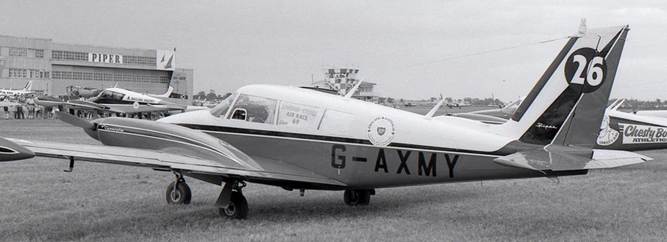
DM Parsons, as Managing Director of Anglo-Nordic
Burner Products Limited, wrote glowingly of the performance of his Piper in an
advertisement published in Flight magazine:
You may be interested in some facts and
figures regarding our entry In the London-Sydney Air Race with G-AXMY which had
98 hours on the clock prior to take-off from London.
On the flight out to Adelaide we cruised
for 63 hours 28 minutes with 5 hours 52 minutes total ground time at 6 stops.
Petrol consumption was 13.1 imperial gallons per hour at full throttle settings
and 2500 rpm at heights averaging between 7,000 and 9,000 feet. … over the
great circle route (less than we covered) an average ground speed of 157.5
knots was obtained … True air speed [was] consistently 155/160 knots when 10%
over all up weight … increasing … to 170 knots when tip tanks had been
used.
Full systems checks showed two very minor faults over
the return journey, despite a very wide temperature variation and all
climatic conditions.
All the modern communications worked
faultlessly and especially the Altimatic 38 auto pilot was a complete
godsend ... connected for 99.9% of the time in various modes.
These two pilots operated their charter company,
Transair, on flights as far afield as Indonesia. They entered Piper Twin
Comanche VH-DOL, one of Transair’s two aircraft. They left Adelaide on 12
November to fly to England.
In general, their tactics were to make the longest
possible stages, and to that end they installed an additional 50 gallon
aluminum fuel tank, giving them a total of 150 gallons. They made a total of
eleven landings and many similar aircraft made up to 13 landings. They finished
tenth overall, with a
prize of $2000 for being second in class A.
Other aircraft modifications included a specially
tuned new Lycoming engine, and the rear seats were removed to hold the fuel
tank, food lockers and a banana lounge to enable one pilot to rest. They had to
cut a hole in the rear panel so the sleeper’s feet could protrude into the
empennage. Rick admitted that the fuel tank had not been specifically approved
by the Australian Department of Civil Aviation, and was critical of the overall
degree of regulations, but seems to have largely ignored them anyway! Their
aircraft is now a museum object and a survivor of the event – see page 28.
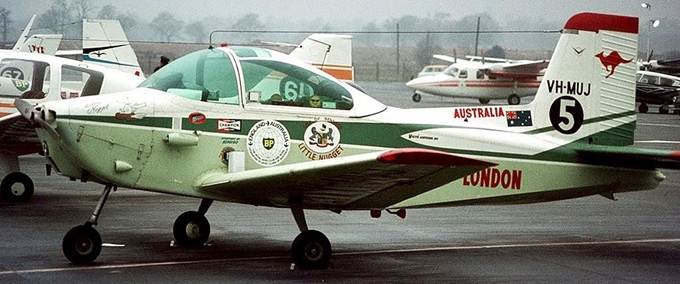
#5 was an Australian designed and built Victa
Airtourer 100, VH-MUJ, made for short-distance recreational flying and
elementary flight training, not for overseas travel. The pilots, John Wynn and
Keith Buttrey, both from Bendigo, were relatively inexperienced, though John
had already flown around Australia. Their first overseas flight had to reach
London in time for the start of the race.
The local press had given them lots of publicity, and
the local council, the
Lions Club and
even Qantas provided sponsorship. The Airtourer was named Little Nugget and
equipped with a tape recorder and film camera to send back regular reports to
their supporters.
Lions
International clubs along the route were primed to offer hospitality and
assistance: this was a mixed blessing as the hospitality was overwhelming! To
tell the full story of their amazing race requires a major book, but an
indication of the number of landings made can be seen on page 8.
They won the
Rolls Royce trophy for the best performance by an aircraft equipped with
Rolls-Royce engine, and also the BAC Vickers trophy, but to their
disappointment there was no cash prize attached! VH-MUJ survives – see page 29.
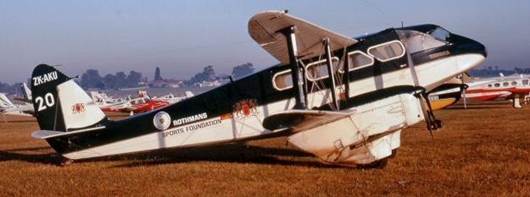 The Rapide was
part of the expansion of the RNZAF during World War II. Nine were sent from the
UK and all survived the war. After the war ZK-AKU was sold to the New Zealand
National Airways Corporation (NZNAC or just plain NAC) and used to ferry
passengers across Cook Strait between North Island and South Island. It was
named ‘Tawaka’. ZK-AKU was sold in 1963 to the Nelson Aero Club and then had
various private owners. It took part in the London to Sydney Air Race in 1969,
finishing fourth last, but still an incredible achievement. Crew members were
JE Moon, DW Gray and MA Cooney. Commentators pointed out that this was very
similar to ZK-ACO, a competitor on the 1934 Macrobertson air race that had also
done remarkably well against the Comets that were specially built for racing
and the modern all-metal airliners.
The Rapide was
part of the expansion of the RNZAF during World War II. Nine were sent from the
UK and all survived the war. After the war ZK-AKU was sold to the New Zealand
National Airways Corporation (NZNAC or just plain NAC) and used to ferry
passengers across Cook Strait between North Island and South Island. It was
named ‘Tawaka’. ZK-AKU was sold in 1963 to the Nelson Aero Club and then had
various private owners. It took part in the London to Sydney Air Race in 1969,
finishing fourth last, but still an incredible achievement. Crew members were
JE Moon, DW Gray and MA Cooney. Commentators pointed out that this was very
similar to ZK-ACO, a competitor on the 1934 Macrobertson air race that had also
done remarkably well against the Comets that were specially built for racing
and the modern all-metal airliners.
ZK-AKU has undergone a complete rebuild and is still
flying, restored to its wartime livery as NZ528. The photo was taken at
Bankstown in 1970 before it returned to New Zealand. It flew direct from
Hobart, assisted by favourable winds. 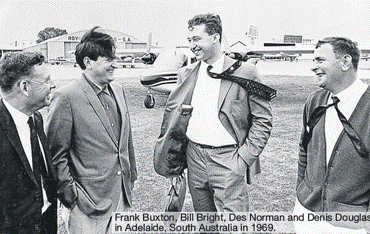
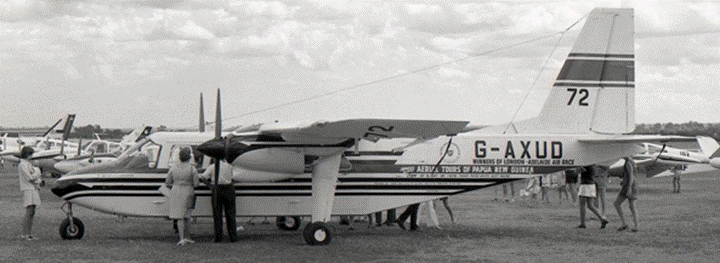 As is mentioned
on page 5, the overwhelming majority of entrants flew American aircraft, yet
the handicap winner was British.
As is mentioned
on page 5, the overwhelming majority of entrants flew American aircraft, yet
the handicap winner was British.
Two Islanders entered the race as part of their
delivery flight. The winner was flown by W J Bright of Ascot, England, with F
Buxton as copilot. We do not know much about them. The second Islander had a
very aristocratic crew – Sir William Dugdale and The Hon. Hugh Astor. They
finished 33rd.
The ‘Highlands and Islands’ of Scotland impose
particular needs on aircraft. They must be strong to handle the wild climate,
have good short take-off and landing capabilities, and be reliable. A capacious
cabin is also desirable. To meet these needs, thr first Britten-Norman Islander
flew om June 1965. Certification was achieved in 1967 and shortly thereafter
the Islander came to the attention of Dennis Douglas, owner of Aerial Tours
of New Guinea, who ordered ten aircraft.
Britten-Norman’s factory on the Isle of Wight built
the earlier aircraft by artisan effort rather than mass-production. The
existing factory was unable to handle the demand, and the aircraft was produced
in Romania. BrittenNorman itself went into receivership in October 1972 and was
taken over by Fairey Aviation, and the Islander was then produced in Belgium.
The comparison between the Islander and the second-place
Piper is interesting. The Islander carried eight to ten passengers, the Piper
four or six. The Islander was heavier – 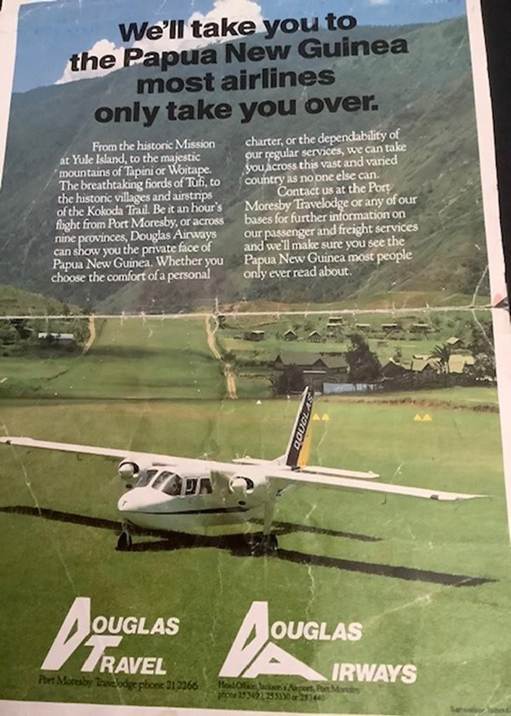 maximum
take-off weight 3000 kg, the Piper 1700 kg. Cruising speed was 140 knots, the
Piper cruised at 155 knots. The Islander, in race form, had longer range. The
Islander’s landing speed was about 45 mph, the Piper’s about 70 mph.
maximum
take-off weight 3000 kg, the Piper 1700 kg. Cruising speed was 140 knots, the
Piper cruised at 155 knots. The Islander, in race form, had longer range. The
Islander’s landing speed was about 45 mph, the Piper’s about 70 mph.
Basically the Islander won because the other aircraft
such as the Pipers had retractable undercarriage and this detrimentally
affected their handicap. But the Islander has a proud place in British aviation
history – over 5000 have been made and they were in wide demand in rugged,
isolated areas.
The ten aircraft ordered by Dennis Douglas served in
New Guinea for his company Aerial Tours Ltd. When New Guinea became
independent, Aerial Tours was renamed Douglas Airways. G-AXUD had been given
the Australian registration VH-ATZ and in 1974 the New Guinean registration
PZ-ATZ.
For many years the airline had a great safety
record, but unfortunately PZ-ATZ crashed at Kwainj along the Kokoda trail on
August 8, 1988, killing one passenger and injuring two others, a huge blow to
Dennis. He died in 2000.
His wife Janetta wrote in an article
published in October 2019: Dennis was devastated. He was immensely proud of
his pilots and engineers and the safely record that they had established.
She also described an effort to retrieve
the crashed aircraft: A rescue mission was mounted by PNG Aviation
enthusiasts. A helicopter was engaged: ropes were attached; she was lifted out
of her mud bath; she was free again; she was up in the air again and in her
excitement she proudly tried to fly off by herself; the helicopter was in
danger; the ropes had to be cut and off she went flying straight and level on
her next big adventure. Where did she go? Where did she land? A prize is now
being offered by her admirers for information and photographs leading to the
recovery of all or part of this Britton Norman Islander registered ATZ painted
in her distinctive blue, black and white livery.
This year marks the centenary
anniversary of the Keith and Ross Smith flight.
There is no better time to
begin the search.
(Most of the material above has come from
David Caughey, a former employee of Aerial Tours / Douglas Airlines who
travelled to Darwin to be present at the hundredth anniversary of the Smith
flight arrival, December 10)
Australia:
Arrival at Adelaide
Aircraft arrived at Adelaide beginning on 22
December. Because the start had been spread over three days, it was difficult
to say who was leading, and this is even before the application of the complex
handicapping scheme. Also, the time limit for arrivals was extended, and
probably not coincidentally the last aircraft to qualify under the extension
was Miss Sheila Scott (page 17). The Victa Airtourer (page 17) also just made
the extended deadline.
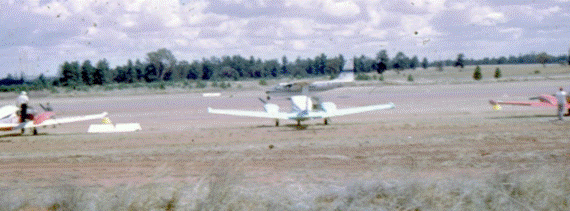 The aircraft
staged at Griffith en route to Bankstown.
The aircraft
staged at Griffith en route to Bankstown.
The newly elected Federal MP, Al Grassby, organised
a huge welcome. Local residents who were former citizens of the USA, New
Zealand, Britain, Sweden, Switzerland, Ireland, Zambia, Kenya, Norway, Finland
and Germany welcomed their compatriot pilots as they landed, and Australia was
represented by an Aboriginal elder from the local region. The flamboyant local
member was a strong supporter of multiculturalism and 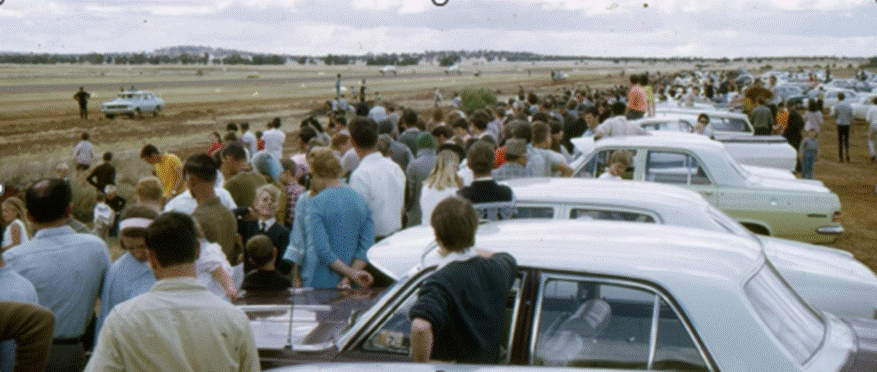 internationalism!
Griffith airport, December 2 1969.
The news was reported in the New York Times!
SYDNEY, Australia, Jan. 4 — An
adventure‐filled air race from London to Sydney came to a spectacular
close today as 59 planes dived out of a brilliant Australian summer sky to
streak across the finish line before 4,000 spectators.
The finishers, mostly light aircraft,
landed only seconds apart at the Bankstown Airport, in a Sydney suburb some
12,000 miles from where they had started on Dec. 17.
The first to land in the $112, 000
competition, at 12:27 P.M., were two Australians — Jack Masling and his
co‐pilot, George Williams — in a Cessna 310. Forty more planes roared
across the field in the next 10 minutes, with the rest arriving within an hour.
The provisional winner of the $28,000
first prize—announced after the judges had spent hours on a complicated
handicap and points calculation — was
Capt. W. J. Bright of Ascot, England,
who had been the first pilot to reach Australian soil. His elapsed time was
approximately 76 hours in a British‐made Britten‐Norman Islander.
‘A marvellous thing for British aviation,’ he said.
An odd event was the reported action of #64, Tom
Lampitt in his Beech 99. He did not land at Adelaide, but flew on, direct to
Sydney. He recorded the amazing time of 49 hours 46 minutes for the total trip.
In one source, he is shown as not finishing the race, and in another he is
recorded as receiving New South Wales Government / Sir Ross and Sir Keith Smith
/ Captain Cook Bi-Centenary / Dunlop Prize with ‘$10000 in cash’. It is hard to
find information on this race that can be guaranteed 100% accurate, and any
more detailed coverage of this race must make this a high priority,
On 14 January Flying Officer AD Willis, in another
British aircraft, #31, an Auster 9, arrived at Adelaide. He was copilot to
Yorkshire businessman M Clarke, who became ill at Athens and was unable to
continue, and flew the aircraft solo for the remainder of the journey, a
tribute to the aged aircraft and the pilot’s determination. Whatever the errors
in the source material, it is clear that this race was an amazing achievement
of a type that can never be repeated.
It is easier to get information on surviving aircraft
than surviving human participants!
#19, VH-DOL. From the website of the South
Australian Aviation Museum:
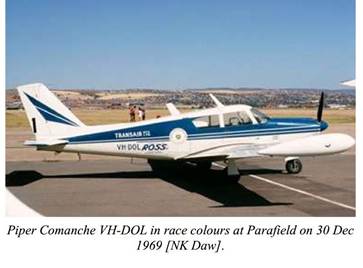 Piper Twin
Comanche VH-DOL was manufactured by Piper Aircraft Corporation in the United
States in
Piper Twin
Comanche VH-DOL was manufactured by Piper Aircraft Corporation in the United
States in
1959 where it was registered as N6230P.
It was first registered in Australia in 1962 in South Australia and remained
there throughout its operational life.
VH-DOL competed in the 1969 London –
Adelaide – Sydney BP Commemorative Air race flown by its owner, Rick Buchanan
and Ian BrittenJones, and placed second in class. The race commemorated the
first flight from England to Australia in 1919 and the bicentenary of James
Cook’s discovery of Australia’s east coast.
It was withdrawn from service in 1992
and was stored in a hangar for twentytwo years until it was donated to SAAM by
Mr Buchanan’s son and daughter, arriving at the museum in December 2014. It is
now on display in the main hangar.
#40 VH-AER Cessna 310 belonging to Jack
Masling, see page 17
#46 VH-ALB Vickers-Supermarine Walrus
Because the race was commemorating a Vickers built
aircraft and its crew, (Sir Keith Smith had also been the Australian
representative for Vickers for more than 30 years), there was much excitement
when a Vickers Supermarine Walrus Mk 1, VH-ALB was entered as #48. It
originally was delivered to the RAAF in 1935 as a Seagull Mark V, and given the
identification A2-4. It was sold off in 1946 and restored to flying condition
in 1960. Although one source lists it as taking off from England in the 1969
race, the evidence is that it was prepared, given the race number 46 and set
out for England but crashed at Dili on 17 December, due to fuel problems. It
was repaired and flew back to Sydney, arriving on 8 January. A crew of 4 is
listed: AE Parks, BA Watson, LA Ashenden and JL Nichols.
In 1973 it was returned to the UK and restored to
wartime RAAF markings, and is on display at Hendon.
Current registration lists provide the following
information
•
#14 VH-TYZ: Beech Aircraft 36 was entered by Des Aviation and
flown by TK Brougham and D Ryan. It came third in the final results and is now
registered to Aircraft Service and Maintenance of Bundaberg, Queensland.
•
#9 Piper PA-24-760 VH-MDD was flown by RP Bennett and GW Howe and
is now owned by Robert Douglas of Allingham, Queensland.
•
#7, Piper PA-30 VH-POM was flown by G Cavill and JC Holcombe
advertising Chesty Bond athletics. It is now owned by Evan Slayter of Red Hill,
ACT
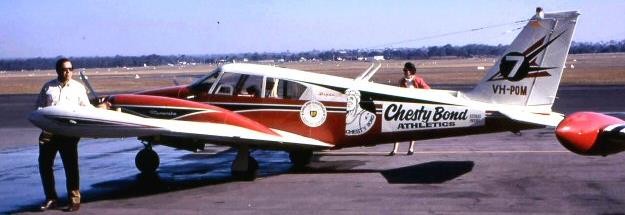
•
#21 Mooney M20F VH-ERX was flown by the Kentleys (page14) and is
now owned by Stuart Byrne of Peak Hill, NSW
•
#8, Beech E33 VH-PWT, flown by TMM Long and Peter Johnson (later
a Boeing 727 pilot) is now owned by Arthur Princehorn of Belmont, NSW
•
#5, Victa Airtourer VH-MUJ (page 17) is owned by Lorraine
MacGillivray, of Sale, Victoria, and a post states that it was modernised in 1974
with a Lycoming 140 hp engine, technically being known as a Millicer M10-140.
It is later reported as being under major
refurbishment.
•
#41 Cessna 182K VH-KRE belonged to Canberra Aero Club and was
flown by GN Goddard, JJ Stewart and BJ Denny, now owned by Alastair
Greenshields of Glenaroua, Victoria
•
#49 PA-30 VH-WJD: now owned by Jetstream Electrical, Parap NT,
was flown by WJ Campbell and NCT Blakhouse
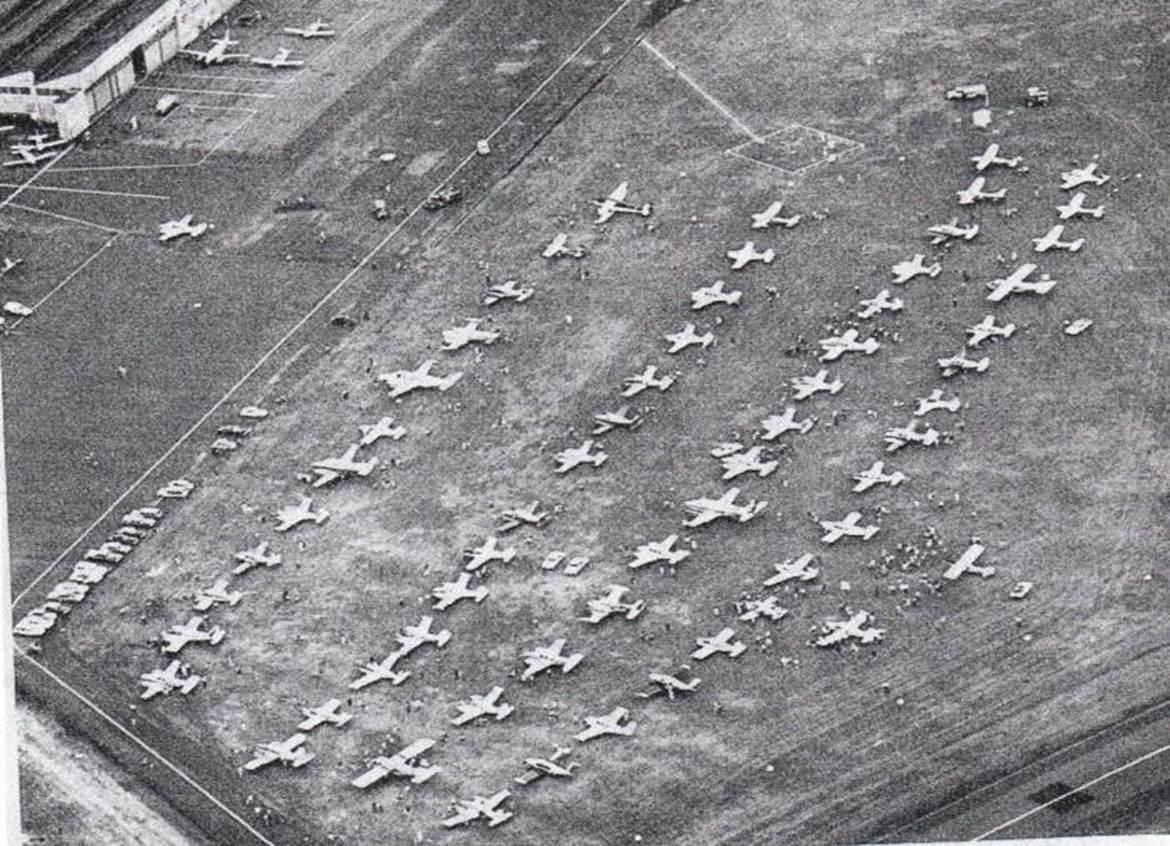
 A chat board
post from the UK listed six aircraft, possibly seven, still existing.
A chat board
post from the UK listed six aircraft, possibly seven, still existing.
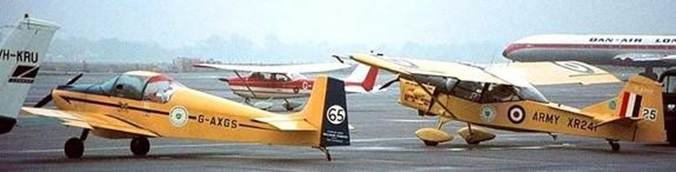
Three were light aircraft similar in specifications to
the Victa Airtourer. They were #25 Auster AOP.9 G-AXRR/XR241 Mike
Somerton-Raynor, #65 Rollason Condor G-AXGS special long-range version with
ventral tank, entered by owner NH Jones (retired at Le Touquet, 18.12.69) and
#61, Beagle Pup 150 GAXMX, A, WB Jones
The picture location is unknown. Note
the DH Comet jet airliner in the background.
•
#100 Piper PA.28 Cherokee Arrow G-AWBC JD Murray, TJ Nash MP
Mahon
•
#49 Piper PA.24 Comanche G-ATNV, flown by GJ Dunster, IF Peradon,
Mrs Dunster, M Glinski
•
#53 Prentice G-APPL (GP Layton) retired in the south of France.
The post also listed Cessna 180 G-ASIT but no other details are known
 ZK-DAA is
probably #6, flown by P Pellow and GCW Biel. See also Dragon-Rapide #29,
ZK-AKU.
ZK-DAA is
probably #6, flown by P Pellow and GCW Biel. See also Dragon-Rapide #29,
ZK-AKU.
Though not a part of the race, an amazing return flight
from Adelaide to Singapore was organised by group of philatelists, officially
known as the Australian Air Mail Society. Leading members were Ernest Crome and
Nelson Eustis: Nelson Eustis was more than a philatelist: his histories of
early aviators are unique and indispensable records. They chartered a TAA DC-3,
VH-AEQ for the purpose, and flew from Adelaide to Singapore and return,
arriving in Darwin on 10 December 1969. They were met by Hudson Fysh, who had
also welcomed the Smiths in 1919.
 This aircraft
had recently completed service with TAA and was about to be condemned because
of ’excessive corrosion’. The captain was Desmond Gillespie. The navigator was
listed as D George. The second pilot was ‘Nobby’ Buckley, from a prominent
Adelaide family, and his wife Jessie was hostess. The pilots were very
experienced indeed, which was probably highly desirable, given the aircraft’s
condition.
This aircraft
had recently completed service with TAA and was about to be condemned because
of ’excessive corrosion’. The captain was Desmond Gillespie. The navigator was
listed as D George. The second pilot was ‘Nobby’ Buckley, from a prominent
Adelaide family, and his wife Jessie was hostess. The pilots were very
experienced indeed, which was probably highly desirable, given the aircraft’s
condition.
There were fifteen passengers, mainly philatelists, but
a very special passenger was
 Reg Williams,
(picture) aged 73 and not in good health. He was the only person still alive of
the 16 people who started in the 1919 London-to-Sydney air race. He was a
member of the crew of a Blackburn Kangaroo, a long range twin engined bomber
equivalent in performance to the Vimy. The captain was Hubert Wilkins, a war
hero later to become famous as an
Reg Williams,
(picture) aged 73 and not in good health. He was the only person still alive of
the 16 people who started in the 1919 London-to-Sydney air race. He was a
member of the crew of a Blackburn Kangaroo, a long range twin engined bomber
equivalent in performance to the Vimy. The captain was Hubert Wilkins, a war
hero later to become famous as an
Antarctic explorer. The aircraft crashed in Crete on
8 December, and as the Smith crew had nearly reached Darwin their flight was
abandoned.
VH-AEQ in
‘storage’ near Bendigo, 2013
The airmail flight carried a wide
range of material. Even though VH=AEQ only made a return trip from Melbourne to
Singapore, some covers were actually sent from further afield, eg Calcutta.


 January 2020,
Centenary Commemoration Committee
January 2020,
Centenary Commemoration Committee 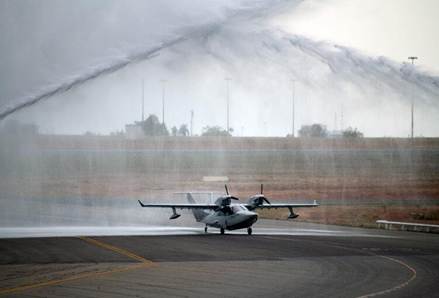 The Northern
Territory Major Events organisation tried valiantly to organise another air
race, this time for high-tech and ‘electric’ aircraft, but were forced to
abandon the project, mainly because of the international situation in the
Middle East and
The Northern
Territory Major Events organisation tried valiantly to organise another air
race, this time for high-tech and ‘electric’ aircraft, but were forced to
abandon the project, mainly because of the international situation in the
Middle East and